Pre AP Biology -CELLS 2.3 Specialized Cells- MCQ Exam Style Questions -New Syllabus 2025-2026
Pre AP Biology -CELLS 2.3 Specialized Cells- MCQ Exam Style Questions – New Syllabus 2025-2026
Pre AP Biology -CELLS 2.3 Specialized Cells- MCQ Exam Style Questions – Pre AP Biology – per latest Pre AP Biology Syllabus.
Question
b. vascular bundle
c. spongy mesophyll
d. palisade mesophyll
▶️ Answer/Explanation
The correct answer is a. pericycle.
In eudicot leaves, the ground tissue is differentiated into palisade and spongy mesophyll.
Vascular bundles (veins) are present to transport water and nutrients throughout the lamina.
The pericycle is a specific layer of cells found in roots and stems, not in leaves.
In roots, the pericycle is responsible for the initiation of lateral roots.
In leaves, the vascular bundles are typically surrounded by a bundle sheath rather than a pericycle.
Therefore, the pericycle is the structure absent in the internal anatomy of a leaf.
Question
▶️ Answer/Explanation
The term dendritic is derived from the Greek word dendron, meaning “tree.”
In biology, this refers to a branching structure similar to the limbs of a tree or the roots below.
Unlike animals, plants expand their surface area by repeated bifurcation or branching.
This allows them to maximize sunlight absorption above ground and nutrient uptake below ground.
Therefore, the definition centers on the highly branched nature of the plant organs.
The correct option is c.
Question
▶️ Answer/Explanation
c. Each will develop into a starfish.
– Starfish embryos undergo regulative development in early stages.
– Cells at the blastula stage are totipotent, meaning they can form a complete organism.
– Isolating one cell allows it to divide and differentiate independently into a full starfish.
– The original embryo can compensate for the lost cell through cell rearrangement and proliferation.
– This phenomenon is observed in echinoderms like starfish and sea urchins.
– Thus, both the isolated cell and the remaining embryo develop into complete starfish.
Question
b. a fungus
c. an animal
d. a plant
▶️ Answer/Explanation
The correct answer is c. an animal.
Organisms in Kingdom Animalia are characterized by being multicellular heterotrophs.
Unlike plants, fungi, and most bacteria, animal cells lack a cell wall.
Most animals exhibit motility (the ability to move spontaneously) at some stage in their life cycle.
Bacteria typically possess cell walls made of peptidoglycan.
Fungi have cell walls composed of chitin and are generally non-motile.
Plants are autotrophs with cell walls made of cellulose.
Question
b. parabasalids
c. euglenoids
d. diplomonads
▶️ Answer/Explanation
The correct answer is b. parabasalids.
Parabasalids are anaerobic flagellated protists that lack conventional mitochondria.
They possess a unique structure called an undulating membrane.
This membrane consists of a flagellum buried in a fold of the cytoplasmic membrane.
This adaptation allows them to move effectively through viscous fluids like vaginal mucus.
A well-known species, Trichomonas vaginalis, causes a common sexually transmitted disease.
Other options like diplomonads have flagella but lack the specific undulating membrane described.
Question
▶️ Answer/Explanation
Question
b. ribosome
c. cell wall
d. plasma membrane
▶️ Answer/Explanation
The correct answer is d. plasma membrane.
In bacteria, the electron transport chain and $\text{ATP}$ synthase are located in the plasma membrane.
Unlike eukaryotes, bacteria lack mitochondria to perform cellular respiration.
They create a proton gradient across the cell membrane to drive the synthesis of $\text{ATP}$.
The flagellum is used for locomotion, not energy conversion.
Ribosomes are the sites of protein synthesis, and the cell wall provides structural support.
Therefore, the metabolic machinery for energy conversion is embedded directly in the plasma membrane.
Question
▶️ Answer/Explanation
The correct answer is (C).
A control group must be identical to the experimental group except for the independent variable (the antibiotic).
Both groups must have the bacterial infection to measure if the treatment actually works.
The control group receives a placebo to account for the “placebo effect” and natural recovery rates.
Option (A) is incorrect because healthy individuals do not show the effect of an antibacterial drug.
Option (B) represents the experimental group, not the control group.
Option (D) is incorrect as it tests the drug’s effect on healthy subjects, which is not the goal of the study.
Question
▶️ Answer/Explanation
The correct option is (A) T cells.
Helper T cells ($CD4^+$) act as the “generals” of the immune system.
They recognize antigens presented by MHC II molecules on APCs.
Upon activation, they secrete signaling proteins called cytokines.
These cytokines coordinate the activities of $B$ cells and cytotoxic $T$ cells.
They bridge the gap between innate and adaptive immunity.
Without these signals, the overall immune response would be severely impaired.
Question

▶️ Answer/Explanation
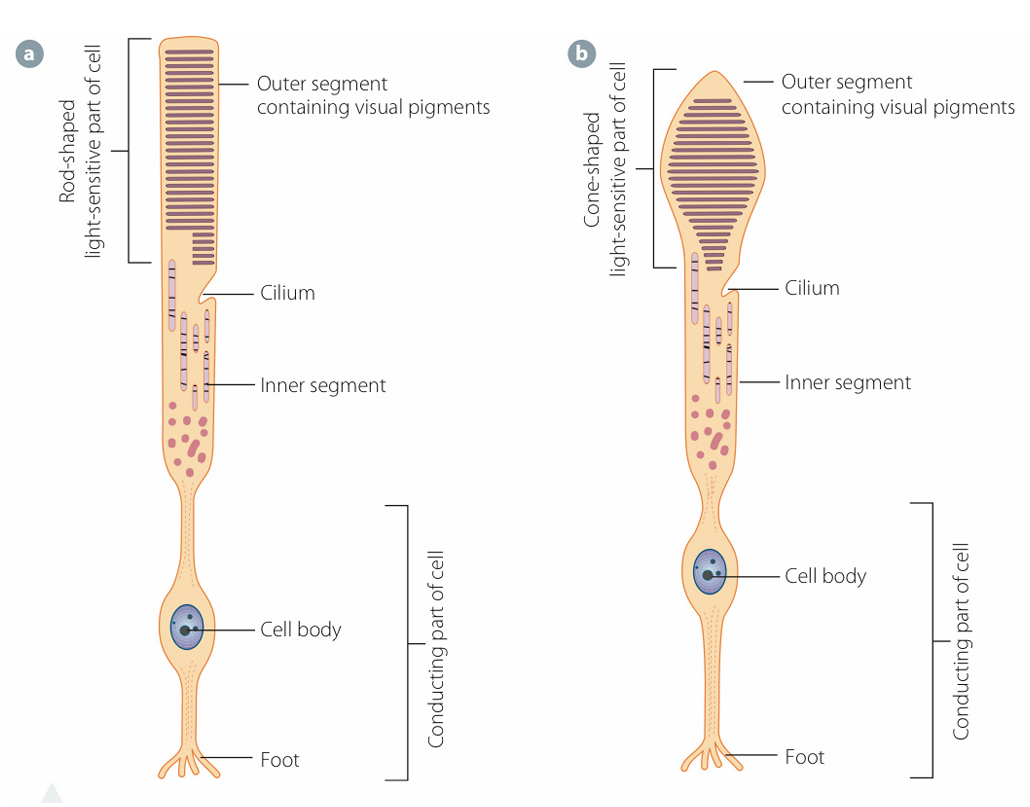
The diagram illustrates rod and cone cells, which are types of photoreceptors.
These cells contain visual pigments in their outer segments to detect light stimuli.
The fovea is the specific region of the retina with the highest concentration of these receptors.
Option (B) is incorrect because the choroid is a vascular layer, not the neural layer containing receptors.
Mechanoreceptors (Options A and C) respond to physical pressure or sound, not light.
Therefore, the correct identification is a photoreceptor in the fovea.
The correct answer is (D).
Question
B. Insulin
C. Oestrogen
D. Inhibin
▶️ Answer/Explanation
The correct answer is D. Inhibin.
Progesterone is the primary hormone that maintains the uterine lining and prevents contractions.
Oestrogen supports the growth of the uterine lining and the mammary glands during pregnancy.
Insulin is vital for regulating maternal blood glucose levels to ensure fetal nourishment.
Inhibin primarily functions to inhibit $FSH$ secretion during the menstrual cycle.
While present, Inhibin does not play a direct, critical role in preventing the loss of the fetus.
Therefore, it is considered the least necessary hormone among the choices for preventing miscarriage.
Question
B. Antibodies
C. Yeast
D. Fever
▶️ Answer/Explanation
The correct answers are A (Mucus) and D (Fever).
Innate immunity refers to non-specific defense mechanisms that come into play immediately or within hours of an antigen’s appearance in the body.
Mucus acts as a physical barrier that traps pathogens before they can enter cells.
Fever is a systemic inflammatory response that slows the growth of certain microbes.
Antibodies are part of the adaptive (acquired) immune system, as they are specific to certain pathogens.
Yeast is a type of fungus and is a potential pathogen, not a part of the immune response.
Note: If this is a single-choice question, A is often categorized as a primary physical barrier of the innate system.
Question

(B) waxy cuticle.
(C) leaf receptors.
(D) external layer of small hairs.
▶️ Answer/Explanation
Correct Option: (A) stomata.
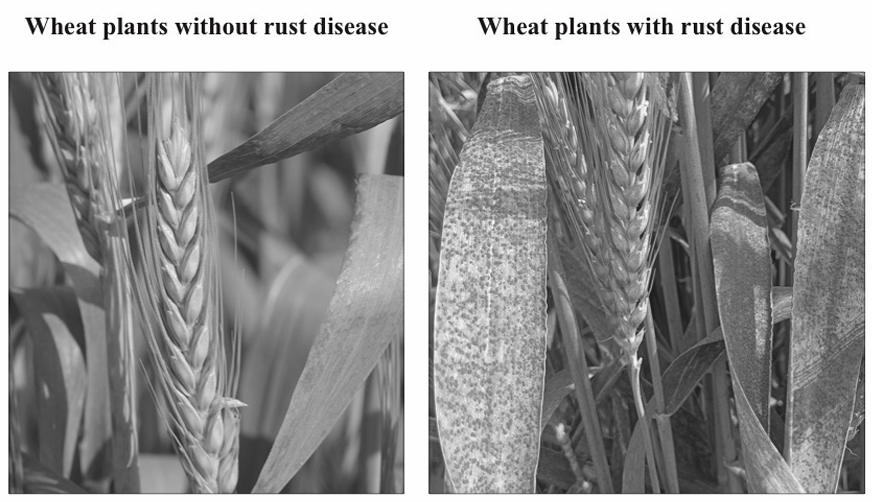
Fungal pathogens like wheat rust ($\textit{Puccinia graminis}$) primarily enter through natural openings.
The stomata are microscopic pores on the leaf surface used for gas exchange.
Fungal spores germinate on the leaf surface and produce specialized hyphae called germ tubes.
These tubes locate the stomata and develop an appressorium to force entry into the internal tissues.
The waxy cuticle and small hairs act as physical barriers designed to prevent such entry.
Leaf receptors are involved in pathogen recognition and signaling, not as a physical portal for entry.
Therefore, the stomata represent the path of least resistance for the fungal invasion.
Question

(B) $B$ only
(C) $A$ and $B$
(D) $A$, $B$ and $C$
▶️ Answer/Explanation
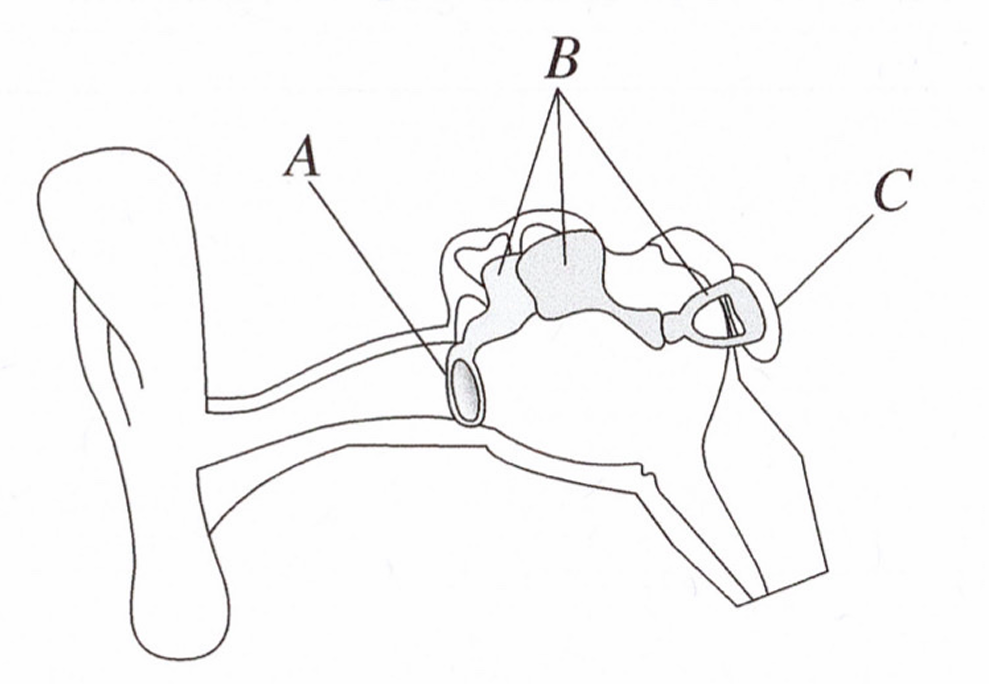
The correct option is (C) $A$ and $B$.
Part $A$ represents the eardrum (tympanic membrane), which marks the beginning of the middle ear.
Part $B$ represents the ossicles (malleus, incus, and stapes), the tiny bones located within the middle ear cavity.
Part $C$ represents the cochlea, which is a major component of the inner ear, not the middle ear.
The middle ear functions to transmit sound vibrations from the air to the fluid-filled cochlea.
Therefore, the structures belonging to the middle ear in this diagram are limited to $A$ and $B$.
Question

(B) B
(C) C
(D) D
▶️ Answer/Explanation
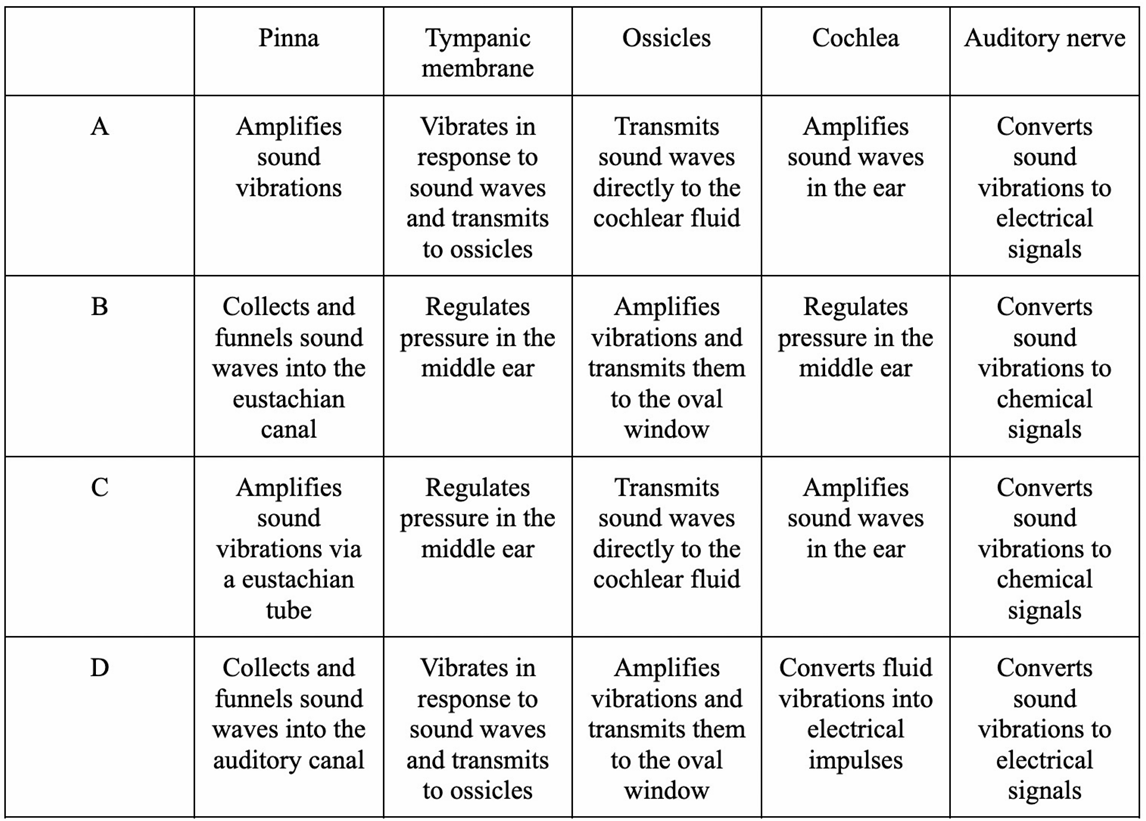
The correct option is (D).
The Pinna collects and funnels sound waves into the auditory canal.
The Tympanic membrane vibrates in response to sound and transmits them to the ossicles.
The Ossicles amplify these vibrations and transmit them to the oval window.
The Cochlea contains hair cells that convert fluid vibrations into electrical impulses.
The Auditory nerve transmits these electrical signals to the brain for processing.
Question
(B) Cones detect light in dim conditions, and their dysfunction leads to reduced colour vision in low light.
(C) Rods detect light in low-light conditions, and cones are responsible for colour vision; dysfunction in both leads to difficulty seeing in dim light and distinguishing colours.
(D) Cones are responsible for detecting light in bright conditions, and dysfunction leads to difficulty seeing at night and loss of peripheral vision.
▶️ Answer/Explanation
The correct option is (C).
Rods are photoreceptors specialized for vision in low-light (scotopic) conditions.
Cones are responsible for photopic vision, providing high acuity and colour perception.
Dysfunction of rods specifically results in nyctalopia, or difficulty seeing in dim light.
Dysfunction of cones leads to impaired colour discrimination and loss of central visual clarity.
Since this patient has both symptoms, it confirms the combined dysfunction of both photoreceptor types.
Options (A), (B), and (D) incorrectly assign the physiological roles or lighting requirements of these cells.
Question
B. While all cells have the same DNA, specialized cells express certain traits that produce feathers or scales.
C. Skin cells that have feathers are diploid, while skin cells that make scales are haploid.
D. Some skin cells have different DNA to build structures like feathers and scales.
▶️ Answer/Explanation
The correct answer is B.
Every somatic cell in an organism contains the exact same DNA sequence.
The difference in cell types arises through a process called cell differentiation.
In this process, specific genes are switched “on” or “off” based on chemical signals.
Therefore, feather cells and scale cells express different sets of proteins despite having the same genome.
Options C and D are biologically incorrect as somatic cells remain diploid and share the same DNA.
Question
| Cell | Cell Wall | Chloroplast | Mitochondria | Ribosome |
|---|---|---|---|---|
| $1$ | ✓ | ✓ | ||
| $2$ | ✓ | ✓ | ✓ | ✓ |
| $3$ | ✓ | ✓ | ||
| $4$ | ✓ | ✓ | ✓ |
▶️ Answer/Explanation
Prokaryotic cells are characterized by the absence of membrane-bound organelles.
Mitochondria and chloroplasts are membrane-bound, so they are only found in eukaryotes.
Cell $3$ lacks both mitochondria and chloroplasts, fitting the prokaryotic profile.
Unlike eukaryotic organelles, ribosomes are found in both cell types for protein synthesis.
Many prokaryotes (like bacteria) possess a cell wall, which Cell $3$ has.
Cells $1$, $2$, and $4$ all contain mitochondria, identifying them as eukaryotic.
Therefore, Cell $3$ is the only candidate for a prokaryotic cell.
