
▶️ Answer/Explanation
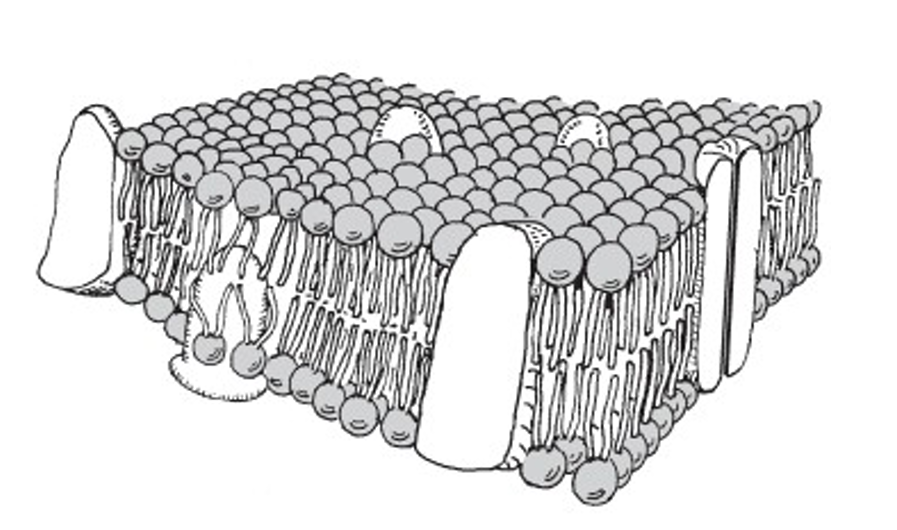
(a) Structure of the Cell Membrane
The cell membrane is primarily a phospholipid bilayer[cite: 653]. It is made up of polar heads (hydrophilic) and nonpolar tails (hydrophobic)[cite: 653].
The arrangement is specific due to interactions with water:
- The heads are hydrophilic and face the external and internal aqueous environments[cite: 653].
- The tails are hydrophobic and face inward, away from water[cite: 653].
(b) Function of the Cell Membrane
The cell membrane acts as a selectively permeable barrier that separates the cell from its environment and maintains dynamic homeostasis[cite: 653].
(c) Hypertonic Solution Effect
When placed in a hypertonic solution (higher solute concentration outside), the cell will shrivel.
Reason: Water moves out of the cell along the concentration gradient via osmosis to balance the environment[cite: 653].
(d) Passive Transport
Definition: Movement of solutes across the membrane along the concentration gradient without the use of additional energy [cite: 653].
Example: Facilitated diffusion through transport proteins[cite: 653].
(e) Active Transport
Definition: Movement of solutes against their concentration gradients with the use of additional energy [cite: 653].
Example: Endocytosis, a form of bulk transport where the membrane encloses particles to bring them into the cell[cite: 653].