Pre AP Biology -CELLS 3.1 Cell Membrane Structure- MCQ Exam Style Questions -New Syllabus 2025-2026
Pre AP Biology -CELLS 3.1 Cell Membrane Structure- MCQ Exam Style Questions – New Syllabus 2025-2026
Pre AP Biology -CELLS 3.1 Cell Membrane Structure- MCQ Exam Style Questions – Pre AP Biology – per latest Pre AP Biology Syllabus.
Question
▶️ Answer/Explanation
The symptoms of fatigue, nausea, and right-sided abdominal pain suggest acute viral hepatitis.
Clay-coloured stools indicate a lack of bile pigment, typically caused by liver inflammation or bile duct obstruction.
Hepatitis A is commonly associated with travel to regions with poor sanitation via the fecal-oral route.
The Hepatitis A virus ($HAV$) is a member of the $Picornaviridae$ family.
Hepatitis B belongs to the $Hepadnaviridae$ family, not $Papovaviridae$ or $Picornaviridae$.
Therefore, the most likely diagnosis is Hepatitis A caused by a $Picornaviridae$ virus.
The correct option is c.
Question
b. It is composed only of hydrophobic amino acids.
c. It contains both hydrophobic and hydrophilic domains.
d. It contains one long stretch of hydrophobic amino acids.
▶️ Answer/Explanation
The correct option is c.
Rhodopsin is an integral membrane protein that must interact with both the oily interior and watery exterior of the cell.
To span the membrane $7$ times, it requires hydrophobic domains (alpha-helices) to sit within the lipid bilayer.
It also requires hydrophilic domains for the loops and ends that face the aqueous cytoplasm and extracellular space.
Option a is incorrect because each of the $7$ spans requires many amino acids, not just one.
Option b is incorrect because a purely hydrophobic protein would be unstable in aqueous environments.
Option d is incorrect as the protein weaves in and out, creating multiple distinct hydrophobic segments.
Question
b. scanning microscopy
c. the freeze-fracture technique
d. the Frye–Edidin experiment
▶️ Answer/Explanation
The correct answer is c. the freeze-fracture technique.
This method involves freezing a specimen and hitting it with a sharp blade.
The fracture line often travels through the hydrophobic interior of the lipid bilayer.
This splits the membrane into two separate leaves: the P-face and the E-face.
Researchers can then observe the distribution of proteins on each interior face.
This directly reveals the asymmetric arrangement of proteins within the bilayer.
In contrast, the Frye–Edidin experiment measures lateral mobility, not structural symmetry.
Question
▶️ Answer/Explanation
The correct option is b.
Unsaturated fatty acids contain double bonds that create “kinks” or bends in the hydrocarbon tails.
These kinks prevent the phospholipid molecules from packing closely together.
By increasing the space between molecules, the intermolecular forces are weakened.
This structural disruption directly results in increased membrane fluidity.
Saturated fats, conversely, lack double bonds and pack tightly, making membranes more rigid.
Question
▶️ Answer/Explanation
The correct option is c.
The term “fluid” refers to the lateral movement of phospholipids.
The “mosaic” refers to the diverse pattern of proteins scattered throughout the bilayer.
These proteins can be peripheral or integral (embedded).
Options a and b describe the basic structure of the bilayer itself, not the mosaic pattern.
Option d is incorrect because membrane components are generally asymmetrical.
Question
▶️ Answer/Explanation
The “fluid” portion of the model describes the physical state of the membrane lipids.
Individual phospholipid molecules are not fixed in a static position.
They can move laterally within their specific layer of the bilayer.
This lateral diffusion occurs at a rate of approximately $2 \text{ \mu m}$ per second.
The “mosaic” part, by contrast, refers to the pattern of proteins embedded in the membrane.
Therefore, fluidity is a direct result of the kinetic movement of these lipid molecules.
Option (a) correctly identifies this constant movement as the source of fluidity.
Question
B. two points on the opposite ends of the DNA molecule.
C. dozens to hundreds of points along the molecule.
D. opposite ends of the molecule.
▶️ Answer/Explanation
The correct answer is A.
Prokaryotes typically possess a single, circular DNA molecule.
Replication starts at a specific sequence called the origin of replication ($oriC$).
Unlike eukaryotes, prokaryotes have only one such point per chromosome.
From this single point, replication proceeds bidirectionally around the circle.
This process continues until the two replication forks meet at the termination site.
Eukaryotic cells, by contrast, require hundreds of origins due to their larger, linear genomes.
Question
B. A second messenger molecule is synthesized by a kinase.
C. A ligand binds to a receptor, activating it and changing its shape.
D. Specific proteins are synthesized and phosphorylated.
▶️ Answer/Explanation
The correct answer is C.
Cell signaling begins when a ligand (chemical messenger) recognizes and binds to a specific receptor.
This binding event causes a conformational change (shape change) in the receptor protein.
This structural shift is the initial trigger that initiates the signal transduction pathway.
Options A, B, and D describe downstream events that occur after the initial reception.
Reception must occur at the cell surface or cytosol before transduction or response can begin.
Question
B. $\text{ATP}$
C. $\text{NADPH}$
D. Sugars such as glucose
▶️ Answer/Explanation
The correct answer is D. Sugars such as glucose.
Light-dependent reactions occur in the thylakoid membranes of the chloroplast.
Chlorophyll absorbs solar energy to split water molecules, releasing $\text{O}_2$ as a byproduct.
This process generates chemical energy in the form of $\text{ATP}$ via photophosphorylation.
It also produces reducing power in the form of $\text{NADPH}$ for later use.
Sugars are synthesized during the light-independent reactions (Calvin Cycle).
The Calvin Cycle uses the $\text{ATP}$ and $\text{NADPH}$ produced earlier to fix $\text{CO}_2$.
Question
B. 2, because $Ca^{2+}$ ions will covalently binds to a surface protein to be transported into the cell.
C. 3, because $Ca^{2+}$ ions must flow through a protein channel across the membrane because they are charged.
D. 4, because $Ca^{2+}$ ions are taken into the cell by endocytosis after binding to a glycoprotein.
▶️ Answer/Explanation
Correct Option: C
$Ca^{2+}$ ions are hydrophilic and highly charged, preventing them from passing through the hydrophobic lipid bilayer.
These ions require facilitated diffusion via specific transmembrane protein channels (represented by point 3).
Simple diffusion (Option A) is impossible because ions are polar/charged, not nonpolar.
Covalent bonding to surface proteins (Option B) is not a standard mechanism for ion transport.
The protein channel provides a hydrophilic pathway that bypasses the fatty acid tails of the phospholipids.
This allows the cell to regulate the internal concentration of $Ca^{2+}$ effectively.
Question

B. The cell placed in the $0.9\%$ saline solution.
C. The cell placed in the $1.5\%$ saline solution.
D. This cannot be determined from the information provided.
▶️ Answer/Explanation
Correct Option: A
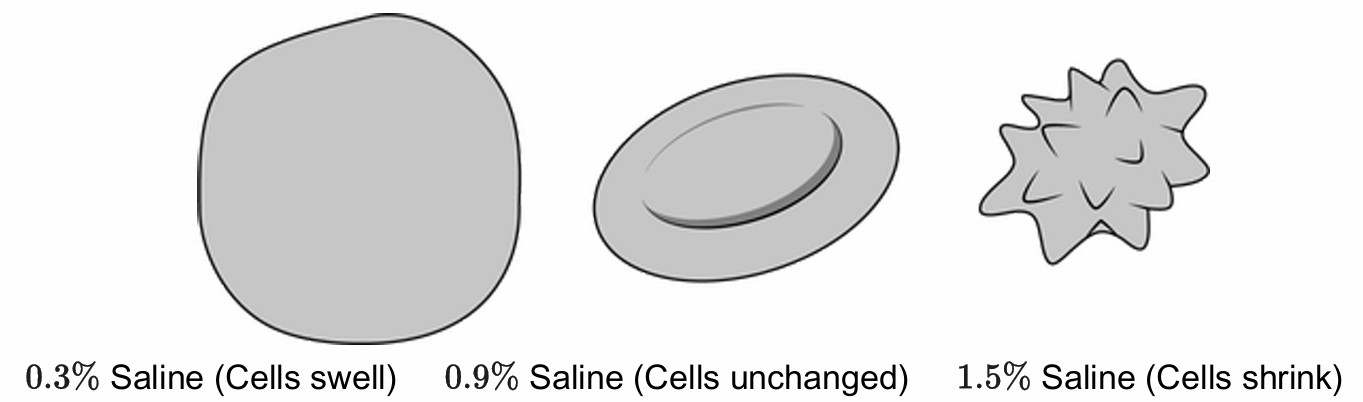
A hypotonic solution has a lower solute concentration than the inside of the cell.
This causes water to enter the cell via osmosis to reach equilibrium.
The net movement of water into the cell causes it to swell or potentially burst.
The diagram shows the cells swell in the $0.3\%$ saline solution.
In contrast, the $0.9\%$ solution is isotonic (no change) and $1.5\%$ is hypertonic (shrinkage).
Therefore, the $0.3\%$ saline solution represents the hypotonic condition.
Question

▶️ Answer/Explanation
The correct answer is A.
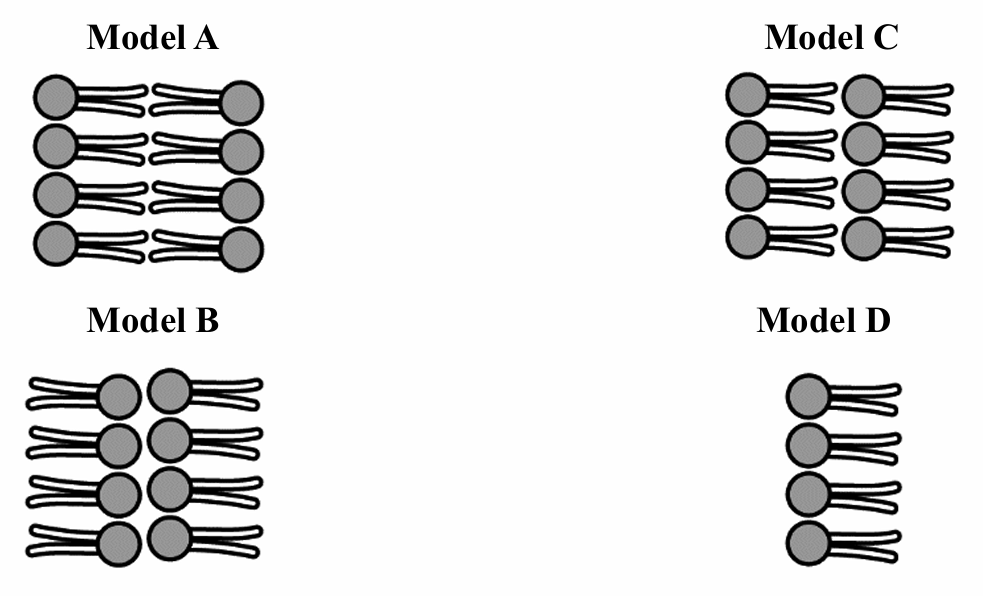
Phospholipids are amphipathic molecules containing a phosphate head and fatty acid tails.
The hydrophilic heads are polar and orient toward the aqueous environments inside and outside the cell.
The hydrophobic non-polar tails orient inward, away from water, to face each other.
Model A correctly depicts this “tail-to-tail” arrangement forming a stable bilayer.
Other models fail because they expose hydrophobic regions to water or lack the bilayer structure.
This orientation creates a semi-permeable barrier essential for cellular homeostasis.
Question

B. It is a saturated fatty acid, because it contains no double bonds.
C. It is a saturated nucleic acid, because it has a bent shape.
D. It is an unsaturated nucleic acid, because it has a linear shape.
▶️ Answer/Explanation
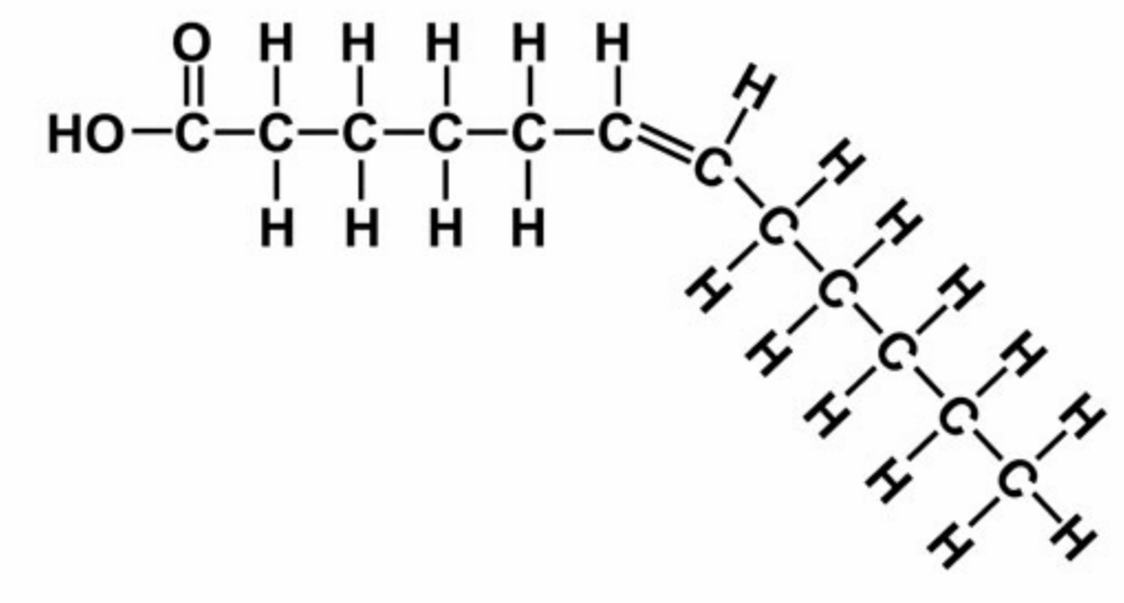
The molecule consists of a carboxyl group ($-\text{COOH}$) attached to a long hydrocarbon chain.
The presence of a $C=C$ double bond classifies it as unsaturated.
This double bond creates a “kink” or bend in the physical structure of the chain.
Because it is a carboxylic acid with a long lipid tail, it is a fatty acid, not a nucleic acid.
Saturated fats only contain single $C-C$ bonds and typically have straight chains.
Therefore, statement A is the only correct description of the molecule’s chemistry and structure.
Question
The Brackish Life
Finger mullets are small fish that play a critical role in North Carolina’s estuary ecosystems. Estuaries are ecosystems of change, and life is not always easy for finger mullets there.
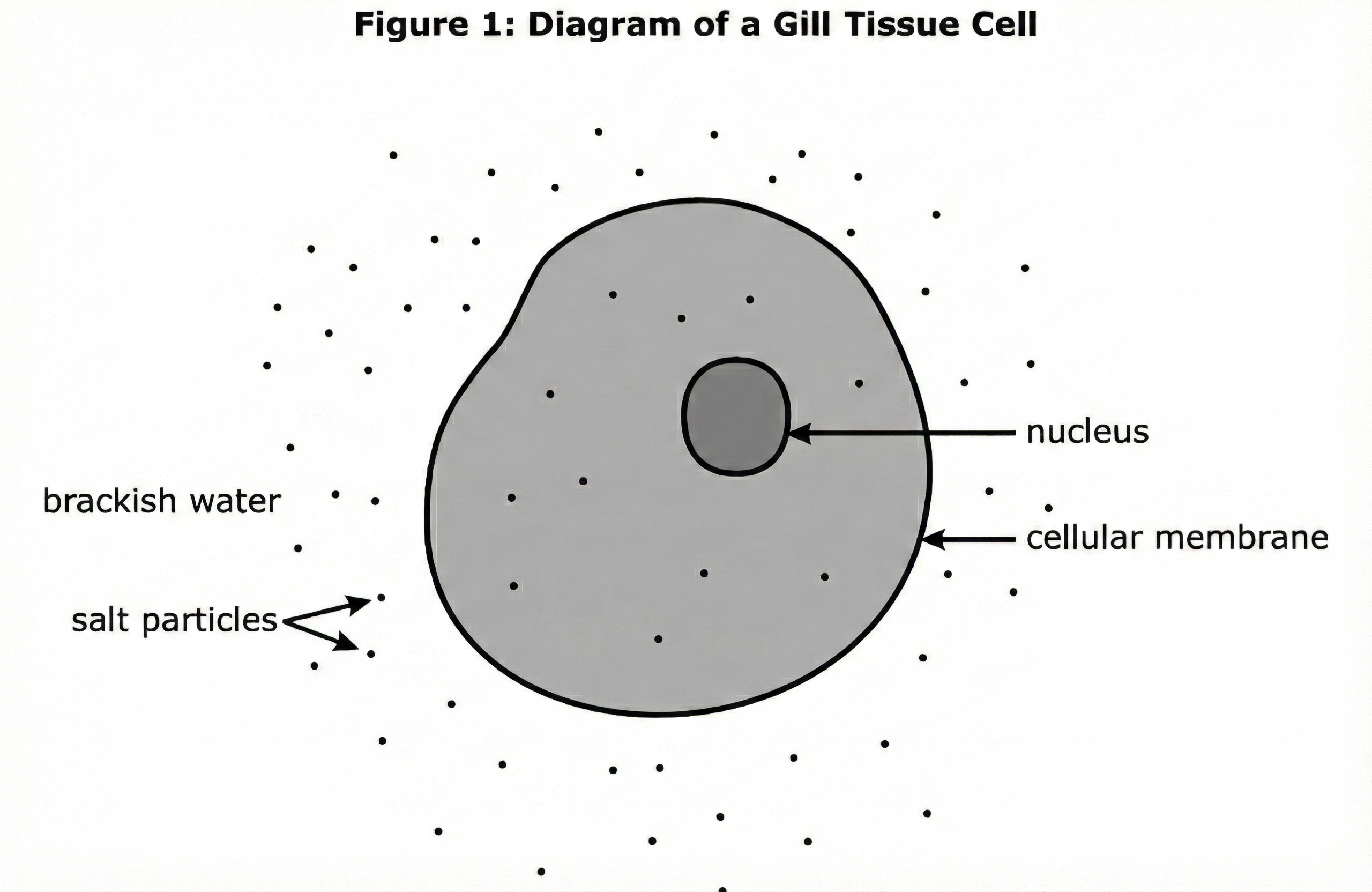
An estuary is a brackish water environment. Salinity changes in response to tidal changes. At high tide, the estuary is filled with more ocean water, and the salinity increases. The salinity decreases at low tide, when the ocean waters recede and fresh water from the mouth of the river is allowed in. Organisms that live in this environment are specially adapted for constantly changing salinity levels. When the salinity of the water changes, the cells of the organisms that live there must adjust by either taking in water or releasing it. Figure 1 represents a cell from the gill tissue of a finger mullet in a high-salinity environment.

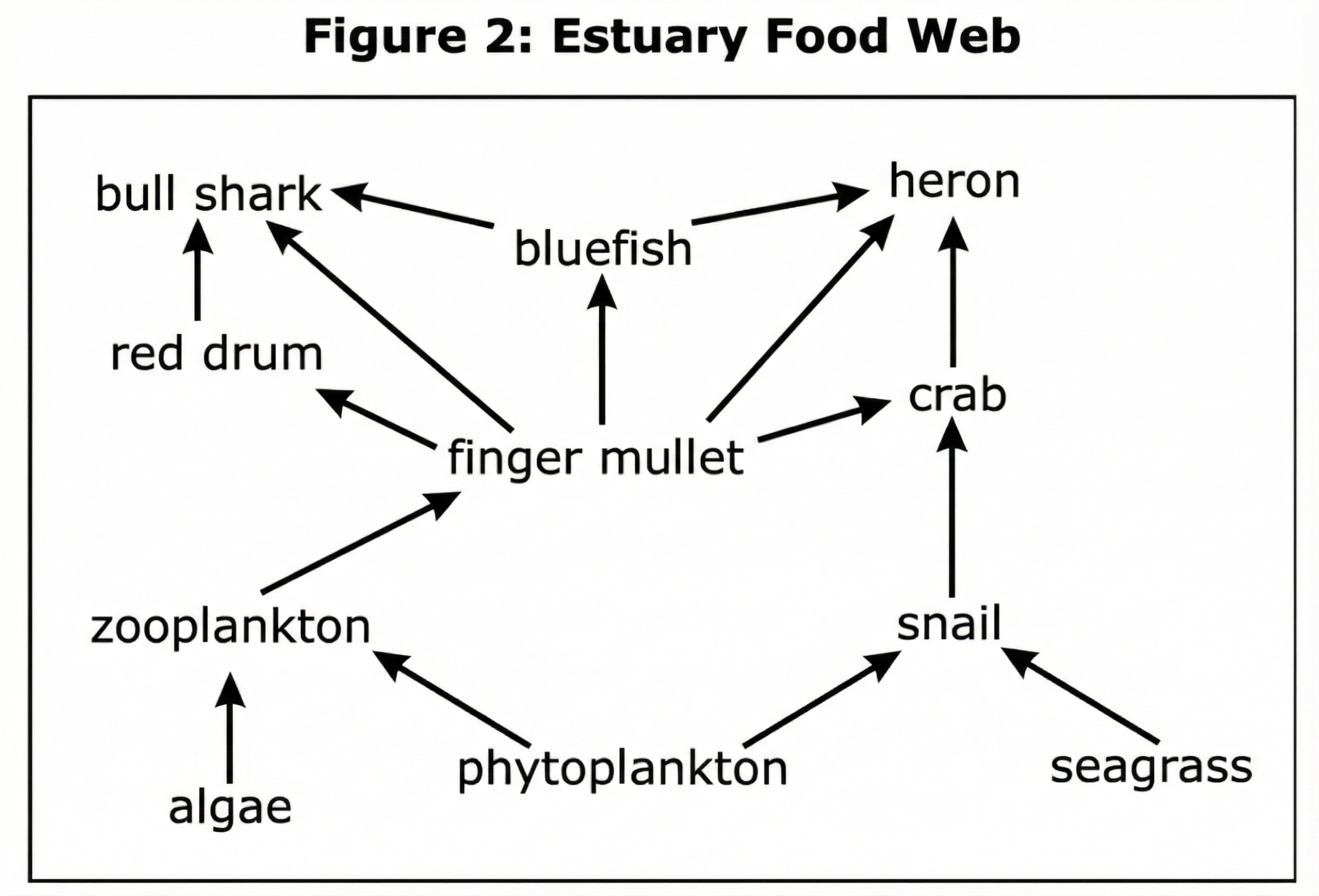
Along with salt and other nutrients, the tides also sweep organisms into and out of the estuaries. Small invertebrates and fish are carried with the currents, and predators often enter estuary areas as they follow the food. This food web represents some of the complicated relationships among estuary organisms, with the finger mullet at its center.

Q. How does the cellular membrane of the finger mullet’s cell contribute to homeostasis within the cell?
- (A) It serves as a solid membrane, allowing no materials to pass into and out of the cell.
- (B) It serves as an impermeable membrane, allowing only water to move into and out of the cell.
- (C) It serves as a selectively permeable membrane, allowing water and other materials to move into and out of the cell as needed.
- (D) It serves as a permeable membrane, allowing any material to easily pass into and out of the cell, whether needed or not.
Q. Place the phrases to correctly complete the statement, so that it explains how the cellular membrane shown in Figure 1 helps support the finger mullet in a high-salinity environment.
“The cell membrane ____ by allowing water ____.”
- (A) maintains homeostasis; to enter the cell.
- (B) maintains homeostasis; to exit the cell.
- (C) disrupts homeostasis; to enter the cell.
- (D) disrupts homeostasis; to exit the cell.
Q. A researcher hypothesizes that water will move out of the cell more quickly when the concentration of salt in the water outside the cell is greater. Which experiment would best test this hypothesis?
- (A) A researcher places three cells of the same type in varying concentrations of salt water. Then the researcher measures the size of each cell every minute during a 5-minute period of time.
- (B) A researcher places three cells of the same type in the same concentration of salt water. Then the researcher measures the size of each cell every minute during a 5-minute period of time.
- (C) A researcher places cells from three different fish in varying concentrations of salt water. Then the researcher measures the size of each cell at the end of a 5-minute period of time.
- (D) A researcher places cells from three different fish in the same concentration of salt water. Then the researcher measures the size of each cell at the end of a 5-minute period of time.
Q. Based on the food web (Figure 2), what effect will a decrease in the algae population have on the finger mullet population in the estuary?
- (A) The finger mullet population will increase because the zooplankton population will decrease.
- (B) The finger mullet population will decrease because the zooplankton population will increase.
- (C) The finger mullet population will decrease because the zooplankton population will decrease.
- (D) The finger mullet population will stay the same because algae is not a direct food source for the mullets.
Q. Based on the food web (Figure 2), which statements are true? Select (click) three true statements.
- (1) The red drum only receives energy by consuming finger mullets.
- (2) The seagrass obtains its energy from the phytoplankton and algae.
- (3) The phytoplankton produce oxygen and glucose the heron needs to survive.
- (4) The phytoplankton produce carbon dioxide and glucose the algae need to survive.
- (5) The bull shark and heron populations have the most energy available because they are at the top of the food chain.
- (6) The phytoplankton population has the most energy available because it is at the bottom of the food chain.
▶️ Answer/Explanation
A. Answer: C
The cell membrane contributes to homeostasis by acting as a selectively permeable barrier.
This means it regulates the passage of substances, allowing essential materials like water and nutrients to enter while keeping harmful substances out.
Option A is incorrect because a completely solid membrane would prevent necessary exchanges.
Option B is incorrect because cells need to transport ions and nutrients, not just water.
Option D is incorrect because unregulated transport would disrupt the internal balance.
A. Answer: B
The correct statement is: “The cell membrane maintains homeostasis by allowing water to exit the cell.”
In a high-salinity environment (hypertonic solution), the salt concentration outside the cell is higher than inside.
Water naturally moves from an area of high water concentration (inside) to low concentration (outside) via osmosis.
By allowing water to exit, the cell balances its internal concentration with the environment, preventing damage.
A. Answer: A
To test the hypothesis, the experiment must vary the salt concentration (the independent variable) while keeping the cell type constant.
Option A correctly uses the same cell type across different concentrations and measures size frequently to determine the speed of water movement.
Option B is incorrect because it uses only one concentration, so no comparison can be made.
Options C and D introduce a confounding variable (different fish species) and fail to measure the rate of change over time.
A. Answer: C
The food web shows a direct energy flow: Algae → Zooplankton → Finger Mullet.
If the algae population decreases, the zooplankton will have less food available, causing their population to decline.
With fewer zooplankton to eat, the finger mullet population will also decrease due to a lack of food resources.
This illustrates the “bottom-up” effect where changes at the producer level impact all higher consumer levels.
A. Answer: Statements 1, 3, and 6
Statement 1: The food web diagram shows only one arrow pointing to the red drum, coming from the finger mullet, meaning it is its sole energy source.
Statement 3: Phytoplankton are producers that create glucose and oxygen through photosynthesis; these products support the entire ecosystem, including the heron.
Statement 6: Energy is highest at the producer level (phytoplankton) and decreases by approximately 90% at each trophic level as heat.
Statements 2, 4, and 5 are false because seagrass is a producer (not consumer), algae produce their own glucose, and top predators have the least available energy.