Pre AP Biology -CELLS 3.2 Cell Transport- MCQ Exam Style Questions -New Syllabus 2025-2026
Pre AP Biology -CELLS 3.2 Cell Transport- MCQ Exam Style Questions – New Syllabus 2025-2026
Pre AP Biology -CELLS 3.2 Cell Transport- MCQ Exam Style Questions – Pre AP Biology – per latest Pre AP Biology Syllabus.
Question
▶️ Answer/Explanation
The correct option is b.
Water potential ($\Psi$) is defined by the equation $\Psi = \Psi_s + \Psi_p$.
It quantifies the tendency of water to move from one area to another.
$\Psi_s$ represents the solute potential, which lowers water potential as solutes are added.
$\Psi_p$ represents the pressure potential, which is the physical pressure on a solution.
Together, these two components dictate the overall free energy of water in a system.
Therefore, it is best described as the combined effect of these two physical properties.
Question
b. The pressure of the movement of water into a cell by osmosis
c. The driving force for osmotic movement of water
d. The pressure exerted by fluid inside a plant cell against the cell wall
▶️ Answer/Explanation
Turgor pressure is the hydrostatic pressure generated within a cell.
It occurs as the central vacuole fills with water via osmosis.
The expanding protoplast pushes outward against the rigid cell wall.
This internal pressure provides structural rigidity to non-woody plants.
In the water potential equation, it is represented as pressure potential ($\psi_p$).
Option d accurately identifies this physical interaction between fluid and the wall.
Question
b. symport transport
c. exchange diffusion
d. facilitated diffusion
▶️ Answer/Explanation
The correct answer is a. cotransport (specifically antiport).
This process is a form of secondary active transport.
One ion moves down its electrochemical gradient, releasing free energy.
This energy is used to pump a second substance up its gradient.
Since the substances move in opposite directions, it is called antiport.
Both symport and antiport are sub-categories of cotransport.
Facilitated diffusion is ruled out as it does not require an energy input.
Question
| Selectively Permeable Membrane | |||
|---|---|---|---|
| Inside a Cell | Extracellular Fluid | ||
| Solvent | \(\square \square \square\) | Solvent | \(\square \square \square\) |
| Solute | \(\square \square\) | Solute | \(\square \square\) |
b. The net flow of solvent is into the cell.
c. The cell is in a hypertonic environment.
d. The relation of the cell to its environment is isotonic.
▶️ Answer/Explanation
The table shows that the amount of solvent is equal on both sides (\(3\) units each).
The table shows that the amount of solute is equal on both sides (\(2\) units each).
Since the concentrations of solute and solvent are identical, there is no osmotic gradient.
Water molecules will move across the membrane in both directions at an equal rate.
This state of dynamic equilibrium indicates that the environment is isotonic relative to the cell.
Therefore, there will be no net change in the volume or shape of the cell.
The correct statement is (d).
Question
b. phagocytosis
c. bulk-phase endocytosis
d. receptor-mediated endocytosis
▶️ Answer/Explanation
The correct answer is c. bulk-phase endocytosis.
Bulk-phase endocytosis, also known as pinocytosis, is the non-specific uptake of extracellular fluid.
During this process, the plasma membrane folds inward to form a vesicle containing droplets of liquid.
Unlike phagocytosis, which engulfs large solid particles, pinocytosis focuses on solutes and liquids.
Exocytosis is the process of exporting materials out of the cell, not engulfing them.
Receptor-mediated endocytosis is highly selective and targets specific molecules rather than bulk liquid.
Question
b. $\text{K}^+$ because it is charged
c. glucose because it is large
d. $\text{CO}_2$ because it contains three atoms
▶️ Answer/Explanation
The correct answer is b. $\text{K}^+$ because it is charged.
Simple diffusion across the phospholipid bilayer favors small, non-polar molecules like $\text{CO}_2$.
While glucose is large, it is uncharged and can occasionally cross much faster than a full ion.
Ions like $\text{Na}^+$ and $\text{K}^+$ are highly hydrophilic and carry a net charge.
The hydrophobic core of the membrane creates an extremely high energy barrier for charged particles.
Therefore, ions have the lowest permeability and the slowest rate of simple diffusion.
Between the options, the charge is the primary factor that prevents crossing the lipid tails.
Question
▶️ Answer/Explanation
The correct answer is a. non-gated channel protein.
Aquaporins are integral membrane proteins that form pores in the membrane.
They specifically facilitate the transport of $H_{2}O$ molecules across the bilayer.
Unlike gated channels, most aquaporins are constitutively open, making them non-gated.
They allow water to flow rapidly following an osmotic gradient via facilitated diffusion.
They do not require a conformational change like a carrier protein to move molecules.
They do not require a stimulus (voltage or ligand) to open, unlike gated channels.
Question
b. $\text{ATP}$ actually contains very little free energy.
c. The hydrolysis of $\text{GTP}$ is more common than $\text{ATP}$ in cellular reactions.
d. Water does not enter the active site of enzymes linked to $\text{ATP}$ breakdown.
▶️ Answer/Explanation
The correct option is d.
In most cellular reactions, $\text{ATP}$ is not simply broken down by water in a vacuum.
Enzymes typically exclude water from the active site to prevent “wasting” energy as heat.
Instead of simple hydrolysis, the terminal phosphate is transferred directly to a substrate.
This process, known as phosphorylation, creates a high-energy intermediate.
Energy is coupled to the reaction through this group transfer rather than aqueous hydrolysis.
Therefore, saying “hydrolysis” provides the energy is chemically misleading in a cellular context.
Question
b. It is translated on ribosomes that are already within the nucleus.
c. It is recognized by the nuclear pore complex, as it contains a nuclear localization signal.
d. It diffuses into the nucleus as a set of small polypeptides prior to their assembly.
▶️ Answer/Explanation
The correct answer is c.
Large proteins cannot pass through the nuclear envelope by simple diffusion.
These proteins contain a specific amino acid sequence called a Nuclear Localization Signal (NLS).
The Nuclear Pore Complex (NPC) acts as a gatekeeper for the nucleus.
Importin proteins recognize the $NLS$ and escort the protein through the $NPC$.
This process is active and requires energy, often involving the $GTPase$ named $Ran$.
Transcription factors are synthesized in the cytoplasm and must be imported this way.
Question

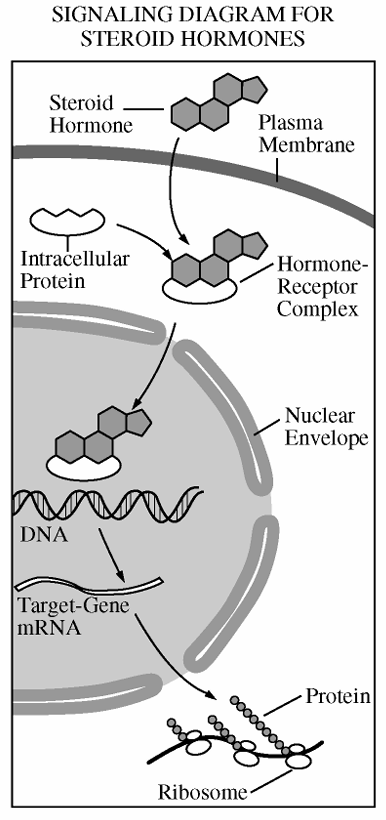
\(Q\). Based on the information presented, which of the following accurately describes the mode of transport for testosterone and other steroid hormones?
(B) Steroid hormones are exocytosed from a presynaptic neuron and diffuse across the synapse to a post synaptic neuron via local signaling.
(C) Steroid hormones are secreted from endocrine cells into the bloodstream, where they travel throughout the body to target cells.
(D) Steroid hormones pass through plasmodesmata, which are channels found between adjacent cells, allowing cells to share both cytosol and signals.
\(Q\). Based on the information presented, which of the following accurately explains the properties that allow steroid hormones to cross the plasma membrane via simple diffusion and bind to intracellular receptors?
(B) Steroid hormones are relatively small in size and are charged/polar.
(C) Steroid hormones are relatively large in size and are charged/polar.
(D) Steroid hormones are relatively small in size and are nonpolar.
\(Q\). Based on the information presented, which of the following will also occur as a cellular response to testosterone signaling in this cell?
(B) Ribosome production will increase because ribosomes are specific for the \(\text{mRNA}\) with which they bind during translation.
(C) \(\text{DNA}\) replication will increase as a result of the binding of the hormone-receptor complex to the \(\text{DNA}\).
(D) Production of a specific \(\text{mRNA}\) will increase as a result of the binding of the hormone-receptor complex to the \(\text{DNA}\).
▶️ Answer/Explanation
\(A\). Answer: (C)
Testosterone is a steroid hormone, which acts via the endocrine system. These hormones are secreted into the bloodstream to travel long distances to target cells. Options (A) and (B) describe paracrine and synaptic signaling, respectively, while (D) describes plant structures.
\(A\). Answer: (D)
The plasma membrane is a phospholipid bilayer with a hydrophobic core. To diffuse across it, molecules must be nonpolar (hydrophobic). Steroid hormones are lipids (nonpolar) and are considered relatively small, allowing them to pass freely without transport proteins.
\(A\). Answer: (D)
The diagram shows the hormone-receptor complex binding to \(\text{DNA}\) to initiate transcription, producing “Target-Gene \(\text{mRNA}\)”. Thus, the direct response is the synthesis of specific \(\text{mRNA}\), which will subsequently be translated into protein.
Question

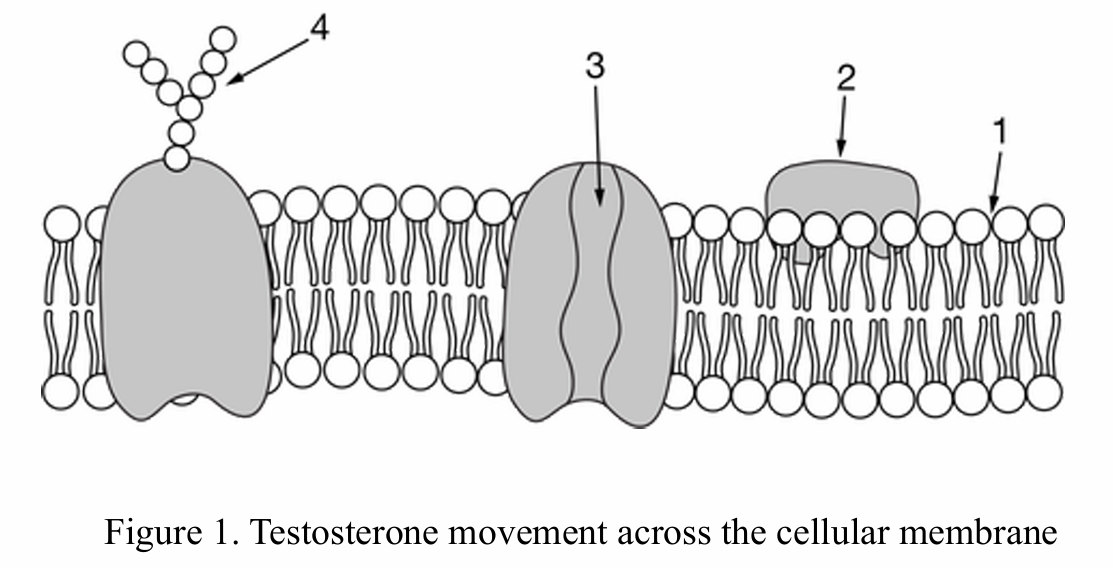
B. $2$, because oxygen covalently binds to a surface protein and transports into the cell.
C. $3$, because oxygen must dissolve in water to flow through a protein channel across the membrane.
D. $4$, because oxygen is taken into the cell by endocytosis after binding to a glycoprotein.
▶️ Answer/Explanation
The correct answer is A.
Label $1$ represents the phospholipid bilayer.
Oxygen ($O_2$) is a small, nonpolar molecule.
Nonpolar molecules can dissolve in the hydrophobic lipid core.
This allows $O_2$ to cross the membrane via simple diffusion.
It does not require transport proteins ($2$ or $3$) or carbohydrates ($4$).
Movement occurs down the concentration gradient without energy input.
Question
The Brackish Life
Finger mullets are small fish that play a critical role in North Carolina’s estuary ecosystems. Estuaries are ecosystems of change, and life is not always easy for finger mullets there.
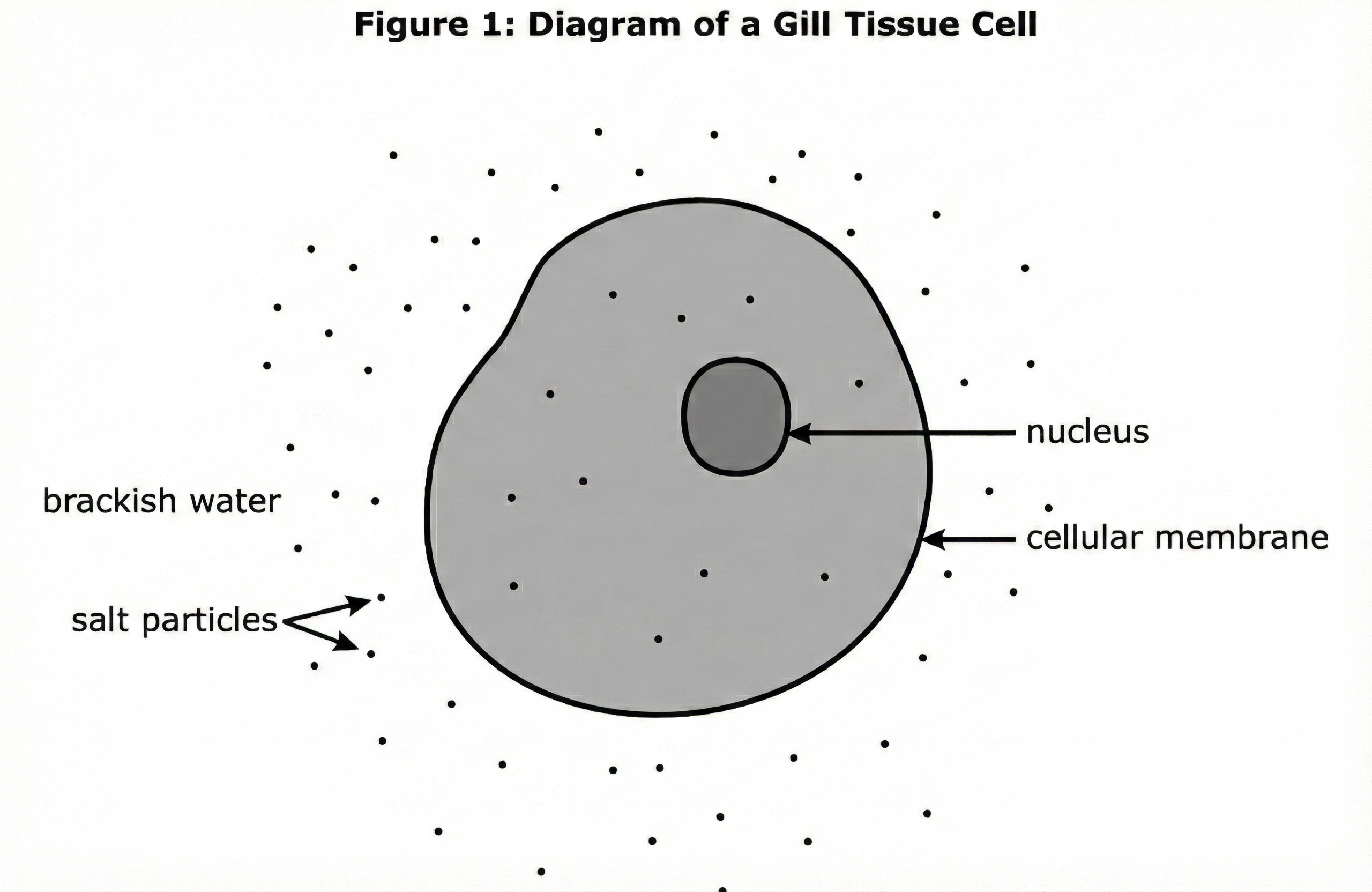
An estuary is a brackish water environment. Salinity changes in response to tidal changes. At high tide, the estuary is filled with more ocean water, and the salinity increases. The salinity decreases at low tide, when the ocean waters recede and fresh water from the mouth of the river is allowed in. Organisms that live in this environment are specially adapted for constantly changing salinity levels. When the salinity of the water changes, the cells of the organisms that live there must adjust by either taking in water or releasing it. Figure 1 represents a cell from the gill tissue of a finger mullet in a high-salinity environment.

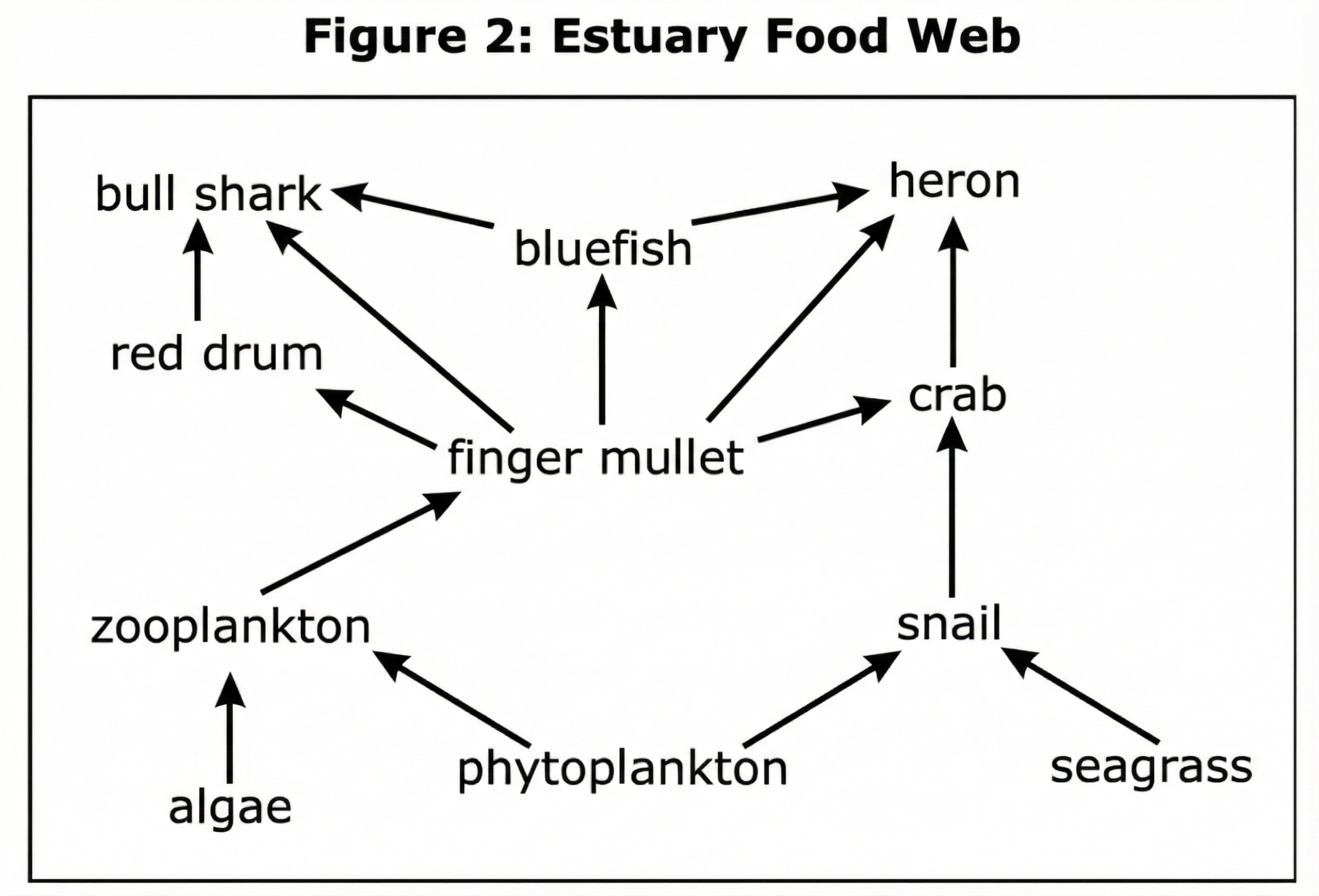
Along with salt and other nutrients, the tides also sweep organisms into and out of the estuaries. Small invertebrates and fish are carried with the currents, and predators often enter estuary areas as they follow the food. This food web represents some of the complicated relationships among estuary organisms, with the finger mullet at its center.

Q. How does the cellular membrane of the finger mullet’s cell contribute to homeostasis within the cell?
- (A) It serves as a solid membrane, allowing no materials to pass into and out of the cell.
- (B) It serves as an impermeable membrane, allowing only water to move into and out of the cell.
- (C) It serves as a selectively permeable membrane, allowing water and other materials to move into and out of the cell as needed.
- (D) It serves as a permeable membrane, allowing any material to easily pass into and out of the cell, whether needed or not.
Q. Place the phrases to correctly complete the statement, so that it explains how the cellular membrane shown in Figure 1 helps support the finger mullet in a high-salinity environment.
“The cell membrane ____ by allowing water ____.”
- (A) maintains homeostasis; to enter the cell.
- (B) maintains homeostasis; to exit the cell.
- (C) disrupts homeostasis; to enter the cell.
- (D) disrupts homeostasis; to exit the cell.
Q. A researcher hypothesizes that water will move out of the cell more quickly when the concentration of salt in the water outside the cell is greater. Which experiment would best test this hypothesis?
- (A) A researcher places three cells of the same type in varying concentrations of salt water. Then the researcher measures the size of each cell every minute during a 5-minute period of time.
- (B) A researcher places three cells of the same type in the same concentration of salt water. Then the researcher measures the size of each cell every minute during a 5-minute period of time.
- (C) A researcher places cells from three different fish in varying concentrations of salt water. Then the researcher measures the size of each cell at the end of a 5-minute period of time.
- (D) A researcher places cells from three different fish in the same concentration of salt water. Then the researcher measures the size of each cell at the end of a 5-minute period of time.
Q. Based on the food web (Figure 2), what effect will a decrease in the algae population have on the finger mullet population in the estuary?
- (A) The finger mullet population will increase because the zooplankton population will decrease.
- (B) The finger mullet population will decrease because the zooplankton population will increase.
- (C) The finger mullet population will decrease because the zooplankton population will decrease.
- (D) The finger mullet population will stay the same because algae is not a direct food source for the mullets.
Q. Based on the food web (Figure 2), which statements are true? Select (click) three true statements.
- (1) The red drum only receives energy by consuming finger mullets.
- (2) The seagrass obtains its energy from the phytoplankton and algae.
- (3) The phytoplankton produce oxygen and glucose the heron needs to survive.
- (4) The phytoplankton produce carbon dioxide and glucose the algae need to survive.
- (5) The bull shark and heron populations have the most energy available because they are at the top of the food chain.
- (6) The phytoplankton population has the most energy available because it is at the bottom of the food chain.
▶️ Answer/Explanation
A. Answer: C
The cell membrane contributes to homeostasis by acting as a selectively permeable barrier.
This means it regulates the passage of substances, allowing essential materials like water and nutrients to enter while keeping harmful substances out.
Option A is incorrect because a completely solid membrane would prevent necessary exchanges.
Option B is incorrect because cells need to transport ions and nutrients, not just water.
Option D is incorrect because unregulated transport would disrupt the internal balance.
A. Answer: B
The correct statement is: “The cell membrane maintains homeostasis by allowing water to exit the cell.”
In a high-salinity environment (hypertonic solution), the salt concentration outside the cell is higher than inside.
Water naturally moves from an area of high water concentration (inside) to low concentration (outside) via osmosis.
By allowing water to exit, the cell balances its internal concentration with the environment, preventing damage.
A. Answer: A
To test the hypothesis, the experiment must vary the salt concentration (the independent variable) while keeping the cell type constant.
Option A correctly uses the same cell type across different concentrations and measures size frequently to determine the speed of water movement.
Option B is incorrect because it uses only one concentration, so no comparison can be made.
Options C and D introduce a confounding variable (different fish species) and fail to measure the rate of change over time.
A. Answer: C
The food web shows a direct energy flow: Algae → Zooplankton → Finger Mullet.
If the algae population decreases, the zooplankton will have less food available, causing their population to decline.
With fewer zooplankton to eat, the finger mullet population will also decrease due to a lack of food resources.
This illustrates the “bottom-up” effect where changes at the producer level impact all higher consumer levels.
A. Answer: Statements 1, 3, and 6
Statement 1: The food web diagram shows only one arrow pointing to the red drum, coming from the finger mullet, meaning it is its sole energy source.
Statement 3: Phytoplankton are producers that create glucose and oxygen through photosynthesis; these products support the entire ecosystem, including the heron.
Statement 6: Energy is highest at the producer level (phytoplankton) and decreases by approximately 90% at each trophic level as heat.
Statements 2, 4, and 5 are false because seagrass is a producer (not consumer), algae produce their own glucose, and top predators have the least available energy.