
Pre AP Biology -CELLS 4.1 Organ/Tissue Systems- MCQ Exam Style Questions -New Syllabus 2025-2026
Pre AP Biology -CELLS 4.1 Organ/Tissue Systems- MCQ Exam Style Questions – New Syllabus 2025-2026
Pre AP Biology -CELLS 4.1 Organ/Tissue Systems- MCQ Exam Style Questions – Pre AP Biology – per latest Pre AP Biology Syllabus.
Question
▶️ Answer/Explanation
Correct Option: a
1. Sucrose is actively loaded into companion cells and then into sieve tube members at the source.
2. High sucrose concentration lowers the water potential ($\psi_s$) inside the sieve tube.
3. Water enters the sieve tube from the xylem by osmosis, following the water potential gradient.
4. The influx of water increases the turgor pressure (hydrostatic pressure) at the source end.
5. This pressure gradient drives the bulk flow of phloem sap toward the sink (lower pressure).
6. Finally, the sink takes up sucrose, causing water to exit and completing the cycle.
Question
▶️ Answer/Explanation
The correct option is c. Turgor pressure in the guard cells increases.
Stomata open when guard cells take up water via osmosis, increasing their turgor pressure.
This uptake is driven by the active transport of $K^+$ ions into the guard cells, not out.
Higher internal $CO_2$ concentrations typically signal the plant to close stomata to conserve water.
The $H^+$-ATPase pumps must be active to create the electrochemical gradient needed for $K^+$ entry.
As guard cells become turgid, their unique wall structure causes them to bow outward, opening the pore.
Conversely, a loss of turgor pressure leads to stomatal closure.
Question
▶️ Answer/Explanation
The correct option is c.
The Casparian strip is a band of waterproof suberin located in the endodermis.
It blocks the apoplast pathway, forcing water to enter the living protoplast.
This selective barrier ensures that minerals are actively filtered by the cell membrane.
Once water enters the vascular cylinder, the strip acts as a seal to prevent backflow.
This maintains root pressure, allowing water to move upwards toward the leaves.
Therefore, it blocks the apoplastic route and prevents the leakage of water out of the stele.
Question
▶️ Answer/Explanation
The correct option is d.
In the apoplastic pathway, water moves exclusively through the non-living parts of the plant.
This includes the interconnected cell walls and intercellular spaces without crossing any membranes.
In contrast, the symplastic pathway involves water movement through the living cytoplasm via plasmodesmata.
Options a, b, and c are incorrect because they misidentify these distinct physiological routes.
The apoplastic route is faster as it does not face the resistance of the selectively permeable plasma membrane.
Question
▶️ Answer/Explanation
The correct answer is a. parallel leaf veins.
A flower with $6$ petals is a multiple of $3$, which identifies it as a monocot.
Monocots typically possess leaves with parallel venation.
They have only $1$ cotyledon, whereas option b suggests $2$.
Their vascular bundles are scattered, not arranged in a ring.
They usually have a fibrous root system rather than a taproot.
Therefore, parallel leaf veins is the only consistent feature listed.
Question
▶️ Answer/Explanation
The correct answer is b. $1$ ring.
The vascular cambium is a lateral meristem responsible for secondary growth.
Unlike annual growth rings (xylem), there is only one continuous cylinder of vascular cambium.
This single layer of cells remains active throughout the life of the tree.
It divides to produce secondary xylem toward the inside and secondary phloem toward the outside.
While the tree adds $1$ new xylem ring per year, the cambium itself does not multiply.
Therefore, whether a tree is $1$ year old or $100$ years old, it possesses only $1$ ring of vascular cambium.
Question
b. lateral roots on a taproot
c. root hairs on a lateral root
d. root hairs on a fibrous root
▶️ Answer/Explanation
The correct answer is b. lateral roots on a taproot.
A carrot is biologically classified as a taproot system.
The main orange body of the carrot is the primary root.
The “long, slender, white outgrowths” appearing on the surface are lateral roots.
These lateral roots emerge from the pericycle layer of the primary taproot.
They are multicellular structures, unlike root hairs which are single-cell extensions.
In a moist refrigerator environment, the dormant carrot may begin to produce these roots to seek nutrients.
Question
▶️ Answer/Explanation
The correct answer is b. all vascular plants.
Tracheids are elongated, lignified cells in the xylem that serve in water transport and structural support.
They are a defining characteristic of tracheophytes, which include all vascular plants.
Non-vascular land plants (bryophytes) lack these specialized conducting tissues.
While seed plants and angiosperms have tracheids, they are not the only groups to possess them.
Pteridophytes (ferns) also rely on tracheids for water conduction.
Therefore, tracheids are found across the entire diversity of the vascular plant lineage.
Question
b. parenchyma and sclereids
c. epidermis and companion cells
d. phloem and sieve tube members
▶️ Answer/Explanation
The correct option is d.
Phloem is a complex permanent tissue responsible for the transport of organic nutrients.
Its primary conducting components are sieve tube members (or sieve tube elements).
Tracheids are components of xylem, not sclerenchyma tissue.
Sclereids are a specialized type of sclerenchyma cell, not parenchyma.
Companion cells are part of the phloem complex, not the dermal epidermis.
Therefore, only phloem and sieve tube members represent a matching tissue-component pair.
Question
b. well-defined pseudocoelom
c. incomplete digestive system
d. lack of sensory cells in the skin
▶️ Answer/Explanation
The correct option is a. lack of excretory and respiratory systems.
Echinoderms are unique because they lack specialized, complex internal organs for excretion and respiration.
Instead, they rely on their water vascular system and coelomic fluid for transport.
Nitrogenous waste (mostly ammonia) diffuses out through the tube feet or papulae.
Gas exchange also occurs primarily through these thin-walled projections via simple diffusion.
Unlike many other complex animals, they do not possess a centralized kidney or lung-like system.
Options b, c, and d are incorrect as echinoderms are true coelomates with complete digestive systems and sensory capabilities.
Question
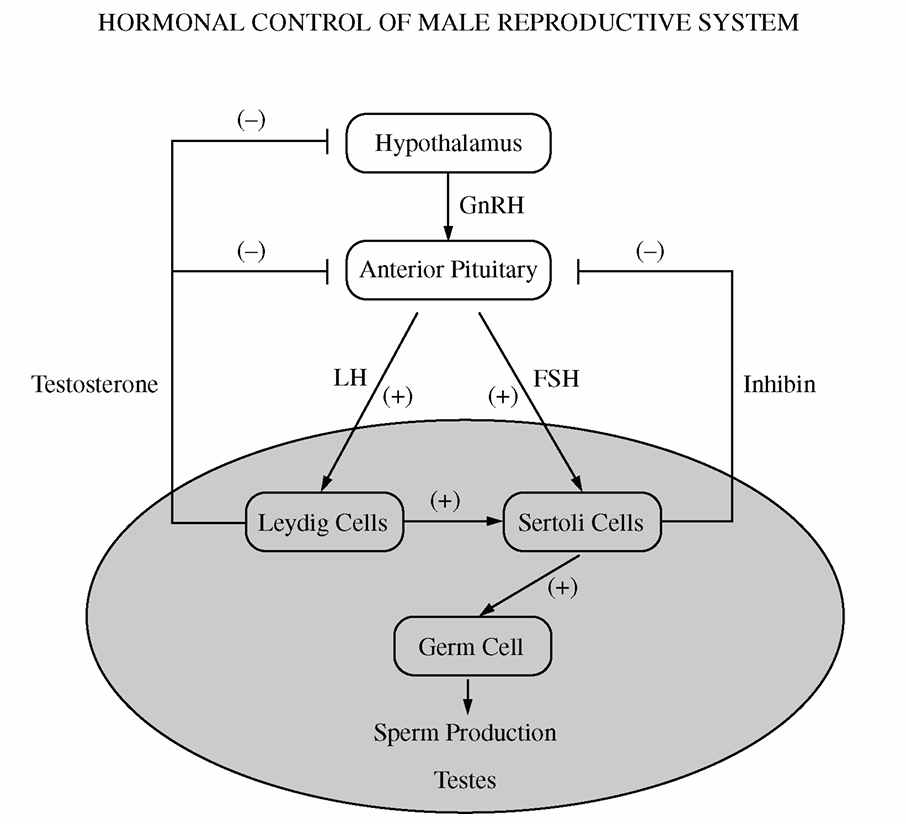
Q. Based on the passage and figure provided, which of the following best describes the mechanism by which the hormones testosterone, LH, and FSH maintain relatively constant levels in individuals that do not take AAS?
B. When homeostatic levels of testosterone are reached they inhibit activity of the hypothalamus and anterior pituitary, which will lead to less LH and FSH production.
C. Sperm cells are inhibitory to the hypothalamus.
D. GnRH stimulates the anterior pituitary to produce testosterone directly when levels drop below normal.
Q. Assuming that AAS function in the same way as naturally occurring testosterone, it is most likely that long-term abuse of AAS would
B. stimulate testosterone production
C. stimulate LH secretion
D. reduce sperm production
Q. Grave’s Disease is an autoimmune disorder that causes antibodies to bind onto thyroid-stimulating hormone (TSH) receptors on the thyroid. This causes the thyroid to constantly release \(T_3\) and \(T_4\). What effect would this have on TSH levels?
B. TSH levels would be decreased
C. TSH levels would increase, and then decrease
D. TSH levels would be increased
▶️ Answer/Explanation
A: Answer B
The diagram illustrates a negative feedback loop controlling reproduction. When testosterone levels rise, they exert an inhibitory effect \((-)\) on the hypothalamus and anterior pituitary. This inhibition reduces the secretion of \(GnRH\), \(LH\), and \(FSH\). Lower levels of \(LH\) reduce stimulation of Leydig cells, lowering testosterone production back to homeostasis. Option A is incorrect because the mechanism is negative, not positive feedback. Option D is incorrect because the pituitary releases \(LH\), not testosterone directly.
A: Answer D
AAS mimics the effects of testosterone in the body. High levels of AAS trigger the negative feedback loop, inhibiting the anterior pituitary. This inhibition causes a significant drop in the secretion of \(FSH\) and \(LH\). \(FSH\) is directly required to stimulate Sertoli cells for spermatogenesis (sperm production). Without sufficient \(FSH\) and natural intratesticular testosterone, sperm production decreases significantly.
A: Answer B
In Grave’s disease, antibodies mimic \(TSH\), constantly stimulating the thyroid. This leads to excessively high levels of \(T_3\) and \(T_4\) in the blood. The body’s normal negative feedback system detects these high levels. Consequently, the pituitary gland is inhibited and reduces or stops \(TSH\) production. Therefore, clinical tests would show very low (decreased) levels of \(TSH\) despite high thyroid activity.
Question
A. During labor, the fetus exerts pressure on the uterine wall, inducing the production of oxytocin, which stimulates uterine wall contraction. The contractions cause the fetus to further push on the wall, increasing the production of oxytocin.
B. After a meal, blood glucose levels become elevated, stimulating beta cells of the pancreas to release insulin into the blood. Excess glucose is then converted to glycogen in the liver, reducing blood glucose levels.
C. At high elevation, atmospheric oxygen is more scarce. In response to signals that oxygen is low, the brain decreases an individual’s rate of respiration to compensate for the difference.
D. A transcription factor binds to the regulatory region of a gene, blocking the binding of another transcription factor required for expression.
▶️ Answer/Explanation
Correct Option: B
Negative feedback occurs when a system responds to a stimulus by initiating actions that counteract or reverse the initial change.
In option B, the stimulus is an increase in blood glucose levels following a meal.
The endocrine response is the release of insulin from the pancreas.
Insulin promotes the conversion of glucose into glycogen, effectively reducing blood glucose back toward the set point.
Option A describes positive feedback, as the response (oxytocin) amplifies the initial stimulus (pressure).
Option C is biologically incorrect, as low oxygen usually triggers an increase in respiration, not a decrease.
Option D describes gene regulation via competitive inhibition rather than a systemic endocrine feedback loop.
Question
B. There is no advantage to injecting insulin versus consuming an insulin pill; insulin is injected simply because that is how it is manufactured
C. Injecting insulin allows for it to be dispensed in a slow-release fashion, while consuming an insulin pill releases the hormone rapidly
D. Injecting insulin delivers it directly to the brain, while consuming a pill would require it to travel through the gastrointestinal tract first
E. Injecting insulin delivers it directly into the bloodstream, while consuming a pill would require it to travel through the gastrointestinal tract before being utilized
▶️ Answer/Explanation
Correct Option: E
Insulin is a peptide hormone, meaning it is composed of amino acids linked by peptide bonds.
If taken orally, insulin would enter the gastrointestinal (GI) tract.
In the stomach and small intestine, protease enzymes would digest the protein into individual amino acids.
This digestion would denature and destroy the hormone’s biological activity before it could reach the blood.
Injection bypasses the digestive system, delivering the hormone directly into the bloodstream or subcutaneous tissue.
This ensures the insulin remains intact and functional to regulate blood glucose levels.
Question
B. Positive feedback
C. Negative feedback
D. Neutral feedback
▶️ Answer/Explanation
The correct answer is B. Positive feedback.
In this scenario, the presence of oxytocin leads to the release of even more oxytocin.
Unlike negative feedback, which seeks to return a system to a set point, positive feedback amplifies a stimulus.
During childbirth, oxytocin triggers uterine contractions which further stimulate the pituitary gland.
This creates a self-augmenting cycle that increases the intensity of the process until the “climactic event” (delivery) occurs.
Most homeostatic markers use negative feedback, but oxytocin is a classic biological exception.
Question
The body attempts to closely regulate the free hormone concentration in the blood through a variety of factors, including binding of free hormones in the blood by albumin. This causes inhibition of additional hormone release and increased degradation of existing hormone when levels are too high. For example, triiodothyronine ($T3$) is able to prevent additional release of $T3$ from the thyroid when its levels are too high.
What kind of feedback mechanism does $T3$ employ?
B. Positive feedback
C. Negative feedback
D. $T3$ does not employ a feedback mechanism
▶️ Answer/Explanation
The correct answer is C. Negative feedback.
When $T3$ levels in the blood rise above the set point, they signal the thyroid gland to inhibit further release.
This mechanism works to reverse the initial stimulus (high hormone levels) to maintain homeostasis.
By reducing production and increasing degradation, the body brings $T3$ concentrations back to normal range.
In contrast, positive feedback would encourage further release, leading to an even higher concentration.
Most endocrine pathways, including the hypothalamic-pituitary-thyroid axis, rely on this regulatory inhibition.
Question
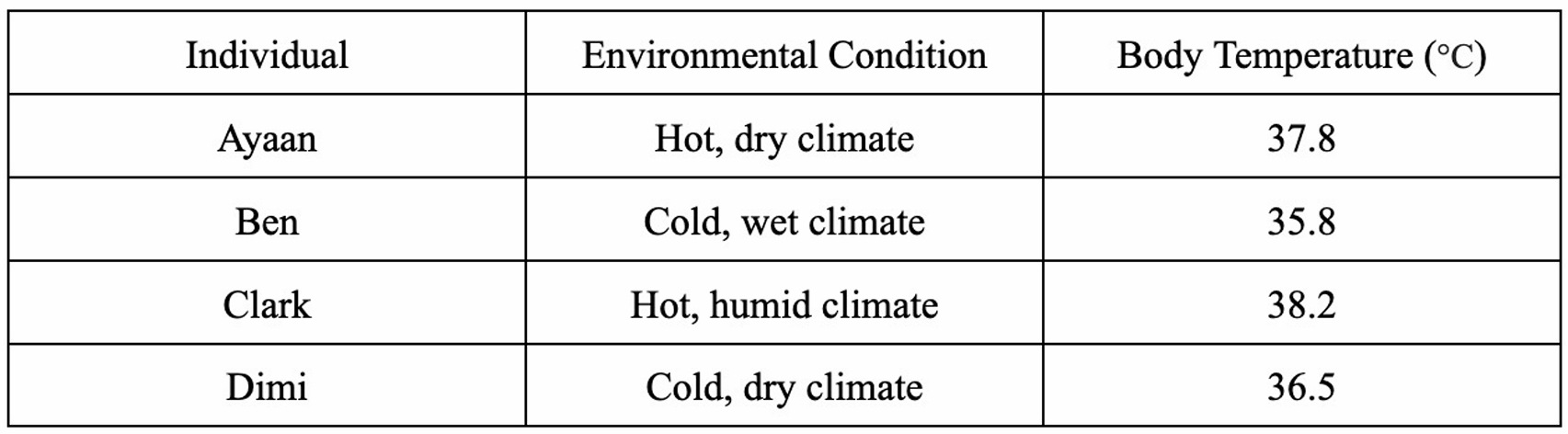
(B) Ben
(C) Clark
(D) Dimi
▶️ Answer/Explanation
The correct answer is (C) Clark.
Metabolic rate is often adjusted to help regulate internal body temperature.
Clark is in a hot, humid climate and has the highest body temperature of $38.2^\circ\text{C}$.
High humidity prevents heat loss through evaporation of sweat, causing the body to overheat.
To reduce further internal heat production, the body slows down its metabolic rate.
In contrast, individuals in cold climates (Ben and Dimi) would likely increase metabolism to generate heat.
Ayaan’s temperature is closer to the norm ($37^\circ\text{C}$) due to the efficiency of cooling in dry heat.