Home / AP® Exam / Pre AP Biology / Exam Style Questions

Pre AP Biology -CELLS 4.2 Response to Stimuli - MCQ Exam Style Questions -New Syllabus 2025-2026

Pre AP Biology -CELLS 4.2 Response to Stimuli – MCQ Exam Style Questions – New Syllabus 2025-2026

Pre AP Biology -CELLS 4.2 Response to Stimuli – MCQ Exam Style Questions – Pre AP Biology – per latest Pre AP Biology Syllabus.

Pre AP Biology – MCQ Exam Style Questions- All Topics

Question

Suppose that you expose a tardigrade to an extreme dehydration. Which of the following will most likely happen to the tardigrade?
a. It will die right away.
b. It will become more active and will search for water.
c. It will dry out and turn into a dust in about a few hours.
d. It will dry out, but will revive if placed in water.
▶️ Answer/Explanation
Detailed solution

The correct option is d.
Tardigrades are famous for a survival strategy called anhydrobiosis.
When facing extreme dehydration, they lose over $95\%$ of their body water.
They retract their legs and head to form a dormant, shriveled state called a tun.
In this state, their metabolism slows to less than $0.01\%$ of normal levels.
This allows them to survive for years in extreme environments.
Once re-exposed to water, they rehydrate and return to an active state within hours.

Question

You are reading this text while breathing in oxygen and breathing out carbon dioxide. Which two processes are the sources of the carbon dioxide?
a. glycolysis and pyruvate oxidation
b. glycolysis and oxidative phosphorylation
c. pyruvate oxidation and the citric acid cycle
d. the citric acid cycle and oxidative phosphorylation
▶️ Answer/Explanation
Detailed solution

The correct option is c. pyruvate oxidation and the citric acid cycle.

Glycolysis occurs in the cytosol and does not release any $CO_2$.
During pyruvate oxidation, each pyruvate ($3C$) is converted to acetyl-CoA ($2C$), releasing $1$ molecule of $CO_2$.
The citric acid cycle (Krebs cycle) further breaks down the acetyl group, releasing $2$ more molecules of $CO_2$ per turn.
Oxidative phosphorylation uses oxygen as a final electron acceptor to form $H_2O$ but does not produce $CO_2$.
Therefore, all respiratory $CO_2$ is generated within the mitochondrial matrix during these two specific stages.

Question

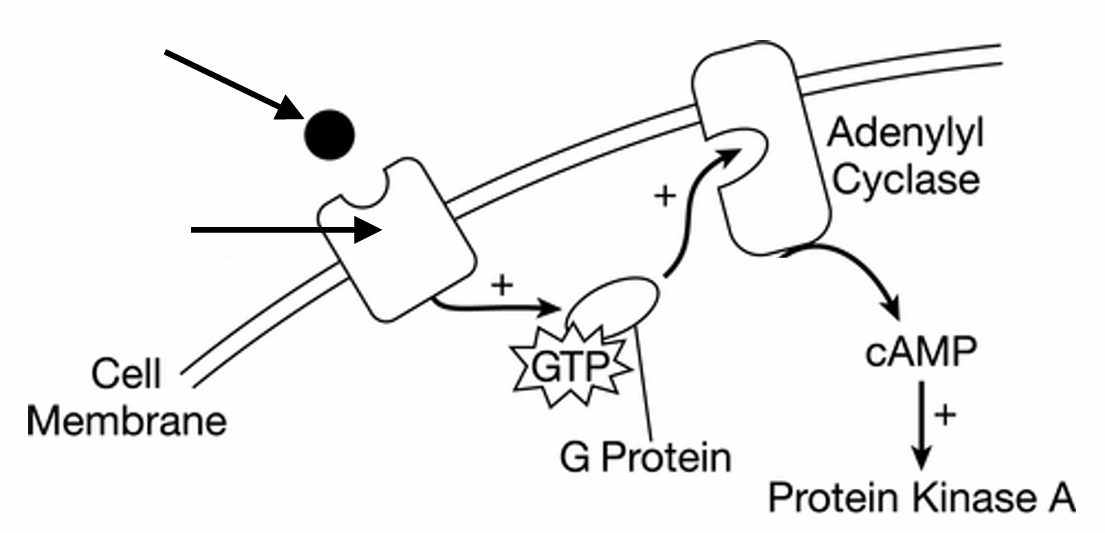
Q. Which of the following correct identifies Molecule X and Protein B in the figure above?

(A) Molecule X is a steroid hormone and Protein B is a tyrosine kinase receptor.
(B) Molecule X is a peptide hormone and Protein B is a G protein-coupled receptor.
(C) Molecule X is a secondary messenger and Protein B is a ligand-gated ion channel receptor.
(D) Molecule X is a steroid hormone and Protein B is a G protein.

Q. Based on the figure above and what you have learned in class, which of the following statements best describes the action of G proteins in the signaling pathway when GTP is bound to them?

(A) The G protein is active, and goes on to activate adenylyl cyclase.
(B) The G protein is inactive, which no longer inhibits adenylyl cyclase.
(C) The G protein is active, which goes on to activate Protein B.
(D) The G protein is inactive, which allows cAMP to activate Protein Kinase A.

Q. Which of the following statements best describes the role of cyclic AMP in the signal transduction pathway?

(A) It acts as a signaling molecule that passes the signal from the cell to other cells.
(B) It acts as a receptor that carries the signal from outside the cell to inside the cell.
(C) It acts as a second messenger that helps relay and amplify the signal within the cell.
(D) It acts as a channel protein that transmits the signal across the cell’s nuclear membrane.

Q. Which of the following statements best describes the result of Molecule X becoming permanently bound to Protein B?

(A) The G protein will always be bound to GDP.
(B) Adenylyl cyclase will not be able to produce cAMP.
(C) cAMP levels within the cell will be very low.
(D) Protein Kinase A will be highly active and constantly phosphorylate other proteins in the signaling pathway.
▶️ Answer/Explanation
Detailed solution

A. Answer: (B) — The diagram shows a G protein-coupled receptor (GPCR) pathway, typical for peptide hormones which are hydrophilic and bind to cell surface receptors (Protein B), unlike steroid hormones which cross the membrane.

A. Answer: (A) — When the G protein binds \(GTP\), it undergoes a conformational change to become active. As shown in the diagram, this active G protein moves to stimulate the enzyme adenylyl cyclase.

A. Answer: (C) — Cyclic AMP (\(cAMP\)) is synthesized intracellularly by adenylyl cyclase. It acts as a secondary messenger, diffusing through the cytoplasm to activate Protein Kinase A, thereby relaying and amplifying the signal.

A. Answer: (D) — If Molecule X is permanently bound, the receptor remains constantly active. This leads to continuous activation of G proteins and adenylyl cyclase, causing sustained high levels of \(cAMP\) and constitutive activity of Protein Kinase A.
Question

In the light-dependent reactions, when light strikes Photosystem II, what is the immediate result?
A. Electrons are excited and passed to the ETC.
B. Electrons are fused together with $ADP$ to form $ATP$.
C. Glucose is produced by $ATP$ synthase.
D. Carbon dioxide is produced via dehydration synthesis.
▶️ Answer/Explanation
Detailed solution

The correct option is A.
When photons of light strike the antenna pigments of Photosystem II ($PSII$), the energy is funneled to the reaction center ($P680$).
This energy boosts electrons to a higher energy level, causing them to be captured by a primary electron acceptor.
These excited electrons are then passed into the electron transport chain ($ETC$) to create a proton gradient.
The “hole” left in $PSII$ is filled by electrons obtained from the photolysis of $H_2O$.
Options B and C are incorrect as $ATP$ and glucose are products of later stages or the Calvin cycle.
Option D is incorrect because $CO_2$ is consumed in photosynthesis, not produced via dehydration synthesis.

Question

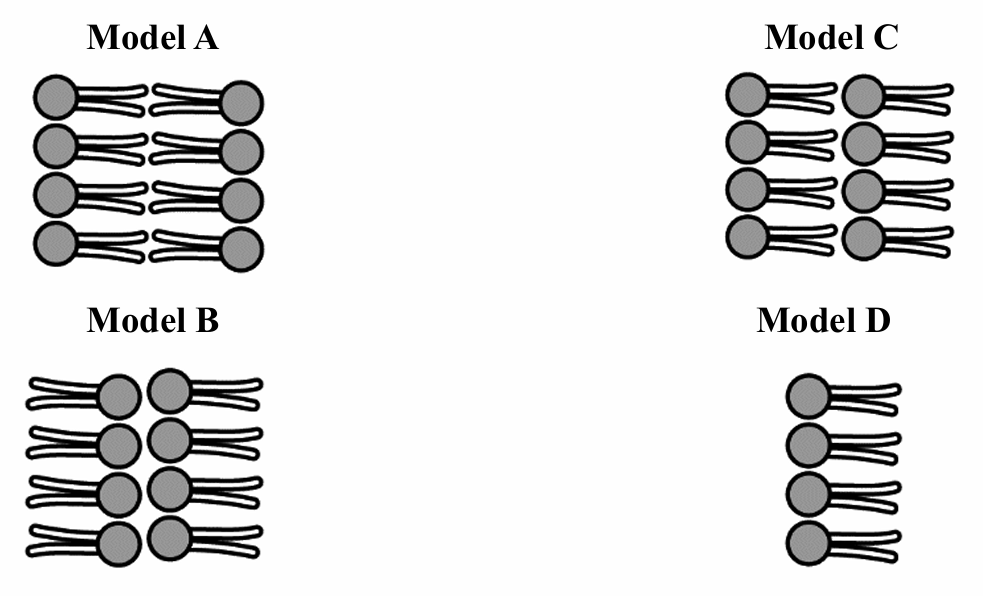
Which of the following models and descriptions best explains how phospholipids orient in a nonpolar liquid such as oil with no water present?
A. Model A – Having the hydrophilic heads face outward to interact with oil while having the hydrophobic tails face each other.
B. Model B – Having the hydrophobic tails face outwards to interact with oil and fat molecules while having the hydrophilic heads face each other.
C. Model C – Having two identically oriented phospholipids that can interact with oil and fat molecules on either side.
D. Model D – Having a single layers of phospholipids is sufficient to create a barrier for both water and lipids.
▶️ Answer/Explanation
Detailed solution

Phospholipids are amphipathic, meaning they have a hydrophilic (polar) head and hydrophobic (nonpolar) tails.
In a nonpolar environment like oil, the hydrophobic tails will seek to maximize contact with the solvent.
Conversely, the hydrophilic heads are sequestered away from the nonpolar oil to minimize unfavorable interactions.
Model B correctly shows an “inverted” bilayer where tails face the outside and heads are tucked inside.
This orientation allows the nonpolar tails to interact with the oil via van der Waals forces.
The central core of the structure becomes a sequestered polar environment for the heads.
Therefore, the correct description and model match is Option B.

Scroll to Top