Pre AP Biology -CELLS 4.2 Response to Stimuli - MCQ Exam Style Questions -New Syllabus
Pre AP Biology -CELLS 4.2 Response to Stimuli – MCQ Exam Style Questions – New Syllabus 2025-2026
Pre AP Biology -CELLS 4.2 Response to Stimuli – MCQ Exam Style Questions – Pre AP Biology – per latest Pre AP Biology Syllabus.
Question
b. It will become more active and will search for water.
c. It will dry out and turn into a dust in about a few hours.
d. It will dry out, but will revive if placed in water.
▶️ Answer/Explanation
The correct option is d.
Tardigrades are famous for a survival strategy called anhydrobiosis.
When facing extreme dehydration, they lose over $95\%$ of their body water.
They retract their legs and head to form a dormant, shriveled state called a tun.
In this state, their metabolism slows to less than $0.01\%$ of normal levels.
This allows them to survive for years in extreme environments.
Once re-exposed to water, they rehydrate and return to an active state within hours.
Question
▶️ Answer/Explanation
The correct option is c. pyruvate oxidation and the citric acid cycle.
Glycolysis occurs in the cytosol and does not release any $CO_2$.
During pyruvate oxidation, each pyruvate ($3C$) is converted to acetyl-CoA ($2C$), releasing $1$ molecule of $CO_2$.
The citric acid cycle (Krebs cycle) further breaks down the acetyl group, releasing $2$ more molecules of $CO_2$ per turn.
Oxidative phosphorylation uses oxygen as a final electron acceptor to form $H_2O$ but does not produce $CO_2$.
Therefore, all respiratory $CO_2$ is generated within the mitochondrial matrix during these two specific stages.
Question

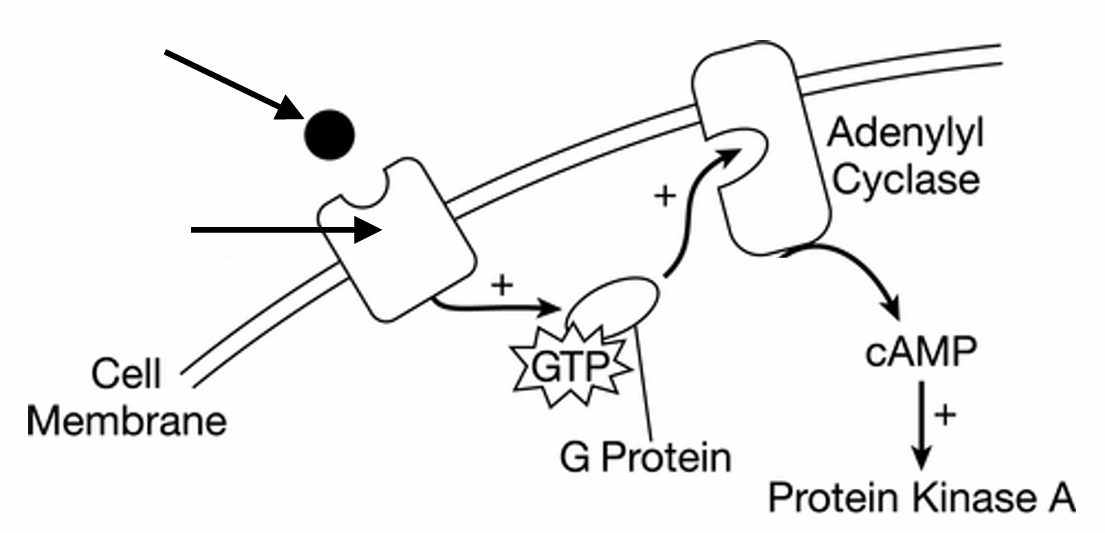
Q. Which of the following correct identifies Molecule X and Protein B in the figure above?
(B) Molecule X is a peptide hormone and Protein B is a G protein-coupled receptor.
(C) Molecule X is a secondary messenger and Protein B is a ligand-gated ion channel receptor.
(D) Molecule X is a steroid hormone and Protein B is a G protein.
Q. Based on the figure above and what you have learned in class, which of the following statements best describes the action of G proteins in the signaling pathway when GTP is bound to them?
(B) The G protein is inactive, which no longer inhibits adenylyl cyclase.
(C) The G protein is active, which goes on to activate Protein B.
(D) The G protein is inactive, which allows cAMP to activate Protein Kinase A.
Q. Which of the following statements best describes the role of cyclic AMP in the signal transduction pathway?
(B) It acts as a receptor that carries the signal from outside the cell to inside the cell.
(C) It acts as a second messenger that helps relay and amplify the signal within the cell.
(D) It acts as a channel protein that transmits the signal across the cell’s nuclear membrane.
Q. Which of the following statements best describes the result of Molecule X becoming permanently bound to Protein B?
(B) Adenylyl cyclase will not be able to produce cAMP.
(C) cAMP levels within the cell will be very low.
(D) Protein Kinase A will be highly active and constantly phosphorylate other proteins in the signaling pathway.
▶️ Answer/Explanation
A. Answer: (B) — The diagram shows a G protein-coupled receptor (GPCR) pathway, typical for peptide hormones which are hydrophilic and bind to cell surface receptors (Protein B), unlike steroid hormones which cross the membrane.
A. Answer: (A) — When the G protein binds \(GTP\), it undergoes a conformational change to become active. As shown in the diagram, this active G protein moves to stimulate the enzyme adenylyl cyclase.
A. Answer: (C) — Cyclic AMP (\(cAMP\)) is synthesized intracellularly by adenylyl cyclase. It acts as a secondary messenger, diffusing through the cytoplasm to activate Protein Kinase A, thereby relaying and amplifying the signal.
A. Answer: (D) — If Molecule X is permanently bound, the receptor remains constantly active. This leads to continuous activation of G proteins and adenylyl cyclase, causing sustained high levels of \(cAMP\) and constitutive activity of Protein Kinase A.
