
Pre AP Biology -CELLS 5.1 Cell Cycle: Interphase- MCQ Exam Style Questions -New Syllabus 2025-2026
Pre AP Biology -CELLS 5.1 Cell Cycle: Interphase- MCQ Exam Style Questions – New Syllabus 2025-2026
Pre AP Biology -CELLS 5.1 Cell Cycle: Interphase- MCQ Exam Style Questions – Pre AP Biology – per latest Pre AP Biology Syllabus.
Question
b. Primary growth, but not secondary growth, occurs at meristems.
c. Primary growth, but not secondary growth, occurs in all seed plants.
d. Trees and other woody plants have secondary growth but not primary growth.
▶️ Answer/Explanation
Primary growth occurs in $100\%$ of seed plants to increase length.
Secondary growth (thickness) is absent in many herbaceous plants.
Both types of growth actually occur at specialized tissues called meristems.
Woody plants like trees must undergo primary growth before secondary growth.
Secondary growth can occur in both stems and roots of woody species.
Therefore, only primary growth is a universal characteristic of all seed plants.
Question
▶️ Answer/Explanation
The correct answer is c. elongation of the cells behind the root apical meristem.
While the apical meristem produces new cells, it is the Zone of Elongation that provides the physical thrust.
In this zone, cells take up water and expand significantly in length.
This expansion creates a powerful mechanical force that pushes the root tip deeper into the soil.
The root cap (option a) primarily serves to protect the meristem and lubricate the path.
Cell division (option b) increases the number of cells but does not significantly increase length.
Maturation (option d) involves cell specialization and anchoring, not the forward driving force.
Question
▶️ Answer/Explanation
The correct option is a.
Telomerase is an enzyme that adds repetitive nucleotide sequences to the ends of chromosomes.
In most normal adult somatic cells, telomerase activity is low or absent, leading to progressive shortening.
However, approximately $90\%$ of cancer cells upregulate telomerase to achieve replicative immortality.
Option b is incorrect because telomerase is naturally more active in embryonic and stem cells.
Option c is incorrect because telomeres are made of DNA; telomerase itself contains an RNA template.
Option d is incorrect because telomerase extends telomeres rather than shortening them.
Question
b. during $G_2$; both $n$ and $C$ equal $4$
c. during metaphase of meiosis II; both $n$ and $C$ equal $1$
d. during metaphase of mitosis; both $n$ and $C$ equal $2$
▶️ Answer/Explanation
The correct answer is a. during $G_1$; both $n$ and $C$ equal $2$.
A gamete is haploid ($1n$) and has unreplicated DNA ($1C$).
In the $G_1$ phase, a somatic cell is diploid, so the chromosome number is $2n$.
Since DNA replication has not yet occurred in $G_1$, each chromosome consists of a single chromatid, making the DNA content $2C$.
In this stage, both coefficients are $2$, satisfying the condition of equality.
In $G_2$ or Mitosis, DNA is replicated, leading to a $4C$ content while remaining $2n$.
In Metaphase II, the cell is $1n$ but contains sister chromatids, resulting in $2C$ DNA content.
Question
▶️ Answer/Explanation
The value $C = 64 \text{ Mb}$ represents the DNA content of a haploid genome ($1n$).
A diploid cell ($2n$) in the $G_1$ phase contains $2C$ amount of DNA.
During the S phase, DNA replication occurs, doubling the DNA content.
In the $G_2$ phase, the cell has completed replication but has not yet divided.
Therefore, the DNA content in $G_2$ is $2 \times 2C = 4C$.
Calculation: $4 \times 64 \text{ Mb} = 256 \text{ Mb}$.
The correct option is d.
Question
▶️ Answer/Explanation
The correct answer is b.
Cyclins are regulatory proteins whose concentrations fluctuate during the cell cycle.
When a cyclin binds to a Cyclin-Dependent Kinase (CDK), it activates the complex.
The active CDK then phosphorylates specific target proteins to trigger downstream effects.
While CDKs primarily phosphorylate targets, this process leads to the eventual degradation of inhibitors or the cyclin itself to progress the cycle.
Option a is incorrect because caspases are involved in apoptosis (cell death), not primary cycle regulation via cyclins.
Option c is incorrect as telomere shortening typically leads to cell senescence or arrest, not promotion of cycling.
Option d describes a characteristic of stem cells but is not a mechanism of cell cycle regulation itself.
Question
b. $S$ phase does not increase ploidy from $2n$ to $4n$.
c. $G_2$ does not follow $S$ phase.
d. Cytokinesis is not part of mitotic cell division.
▶️ Answer/Explanation
The correct answer is b.
During the $S$ phase, DNA replication doubles the amount of DNA (from $2c$ to $4c$).
However, the number of chromosomes (ploidy) remains constant at $2n$.
Replicated chromosomes consist of two sister chromatids joined at a single centromere.
They are still counted as a single chromosome until they separate during anaphase.
Therefore, the cell does not become tetraploid ($4n$) during the $S$ phase.
The passage incorrectly confuses DNA content with the chromosomal count.
Question
b. chromatids
c. chromosomes
d. $\text{CDK2}$ molecules
▶️ Answer/Explanation
The correct answer is b. chromatids.
The $S$ phase (Synthesis phase) is the period of the cell cycle where $\text{DNA}$ replication occurs.
At the start of $S$ phase, each chromosome consists of a single strand of $\text{DNA}$.
During $S$ phase, the amount of $\text{DNA}$ doubles as each chromosome is copied.
By the end of $S$ phase, each chromosome is composed of two identical sister chromatids.
The number of chromosomes remains the same (e.g., $2n$) throughout this process.
The nucleus does not divide until the $M$ phase (Mitosis), so its count remains $1$.
Therefore, the number of chromatids is twice as high at the end of $S$ phase than at the start.
Question
▶️ Answer/Explanation
The correct option is d. S phase.
The S phase, or Synthesis phase, is the specific period during interphase.
During this stage, DNA replication occurs within the nucleus.
The cell duplicates its genetic material, effectively doubling the mass of DNA.
This ensures that each daughter cell receives a complete set of chromosomes.
In contrast, $G_1$ and $G_2$ are growth phases where the DNA amount remains constant.
The M phase involves the physical division of the already duplicated DNA.
Question
B. three diploid gamete cells that are each genetically different from each other.
C. four diploid gamete cells that are each genetically identical to each other.
D. four haploid gamete cells that are each genetically different from each other.
▶️ Answer/Explanation
The correct option is D.
Meiosis involves two successive nuclear divisions ($Meiosis\ I$ and $Meiosis\ II$).
This process results in the production of $4$ daughter cells from a single diploid cell.
Each daughter cell is haploid ($n$), containing half the number of chromosomes of the parent.
Crossing over and independent assortment occur during the process.
These mechanisms ensure that all $4$ cells are genetically different from each other.
In contrast, Mitosis produces $2$ genetically identical diploid ($2n$) somatic cells.
Question
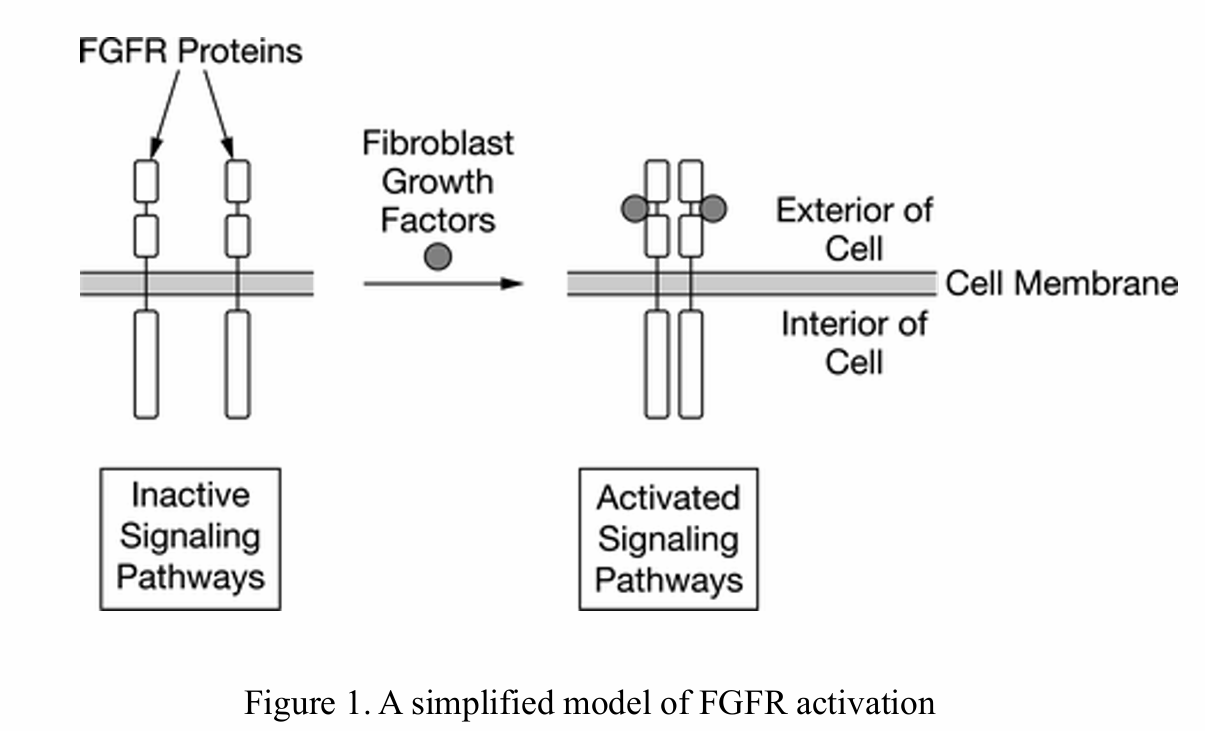
(B) FGF is a peptide hormone and FGFR is a ligand-gated ion channel.
(C) FGF is a steroid hormone and FGFR is a tyrosine kinase receptor.
(D) FGF is a peptide hormone and FGFR is a tyrosine kinase receptor.
(B) The FGFR proteins will dimerize (come together) and activate kinases in the interior (intracellular) portion of the receptor.
(C) The FGFR proteins, a ligand-gated ion channel, will open and allow secondary messengers to enter the cell.
(D) The FGFR proteins will activate, producing the secondary messenger molecule cAMP within the cell.
\(Q\). Which of the following changes in the FGFR signaling pathway is most likely to result in constant, uncontrolled cell division?
(B) The loss of the intracellular FGFR protein kinase function.
(C) A decrease in the intracellular concentration of \(ATP\).
(D) A decrease in the intracellular concentration of \(GTP\).
▶️ Answer/Explanation
A: (D)
The passage states that the intracellular domains function as kinases transferring phosphate to tyrosine substrates, defining FGFR as a tyrosine kinase receptor.
Ligands that bind to cell surface receptors (like FGFR) are typically hydrophilic, such as peptide hormones.
Steroid hormones are hydrophobic and usually cross the membrane to bind intracellular receptors, so options A and C are incorrect.
Therefore, FGF is a peptide hormone and FGFR is a tyrosine kinase receptor.
A: (B)
The provided diagram illustrates two separate FGFR proteins coming together upon ligand binding.
This process of coming together is known as dimerization.
The text confirms that the intracellular domain functions as a kinase to transfer phosphate groups.
Thus, the proteins dimerize and activate the intracellular kinases.
A: (A)
The normal pathway leads to cell division when activated by FGF.
Irreversible dimerization would lock the receptor proteins in their “active” conformation permanently.
This would cause the kinases to constantly signal for cell division, even without the FGF ligand present.
Options B, C, and D would all hinder or stop the signaling process, not increase it.