Home / AP® Exam / Pre AP Biology / Exam Style Questions

Pre AP Biology -CELLS 5.2 Cell Cycle: Cell Division- FRQ Exam Style Questions -New Syllabus

Pre AP Biology -CELLS 5.2 Cell Cycle: Cell Division- FRQ Exam Style Questions – New Syllabus 2025-2026

Pre AP Biology -CELLS 5.2 Cell Cycle: Cell Division- FRQ Exam Style Questions – Pre AP Biology – per latest Pre AP Biology Syllabus.

Pre AP Biology – FRQ Exam Style Questions- All Topics

Question

Australia has one of the highest rates of skin cancer in the world. Many factors can increase your risk, including unprotected exposure to UV radiation. Many human skin tumours contain mutated $p53$ genes (tumour suppressor genes). In a study, $94\%$ of patients contained $CC$ to $TT$ mutations in codon numbers $245$ and $247$. Healthy individuals had the normal codons $CCT$ and $TTC$ respectively on the non-coding DNA strand.
Australia has one of the highest rates of skin cancer in the world. About 2 out of 3 Australians will be diagnosed with some form of skin cancer before the age of 70.
Many factors can increase your risk of skin cancer, including having:
  • pale or freckled skin, especially if it burns easily and doesn’t tan
  • red or fair hair and light-coloured eyes (blue or green)
  • unprotected exposure to UV radiation, particularly a pattern of short, intense periods of sun exposure and sunburn, such as on weekends and holidays
  • actively having tanned, sunbaked or used solariums
  • worked outdoors or spent a lot of time outside (e.g. gardening or golfing)
Many human skin tumours contain mutated p53 genes (tumour suppressor genes) that result from UV exposure. After investigating the p53 gene mutation in skin cancer patients, 94% contained CC to TT mutations (not vice versa) in codon number 245 and 247. Healthy individuals did not have this mutation and had the normal codon 245 and 247 which were CCT and TTC respectively on the non-coding DNA strand.
(a) Identify the type of mutagen causing skin cancer.
(b) Justify whether the mutation is somatic or germ-line.
Tumour suppressor genes normally code for proteins that slow down or stop mitosis if a mutation occurs during DNA replication.
(c) Using polypeptide synthesis, explain how a mutation in the $p53$ gene will cause uncontrollable cell growth.
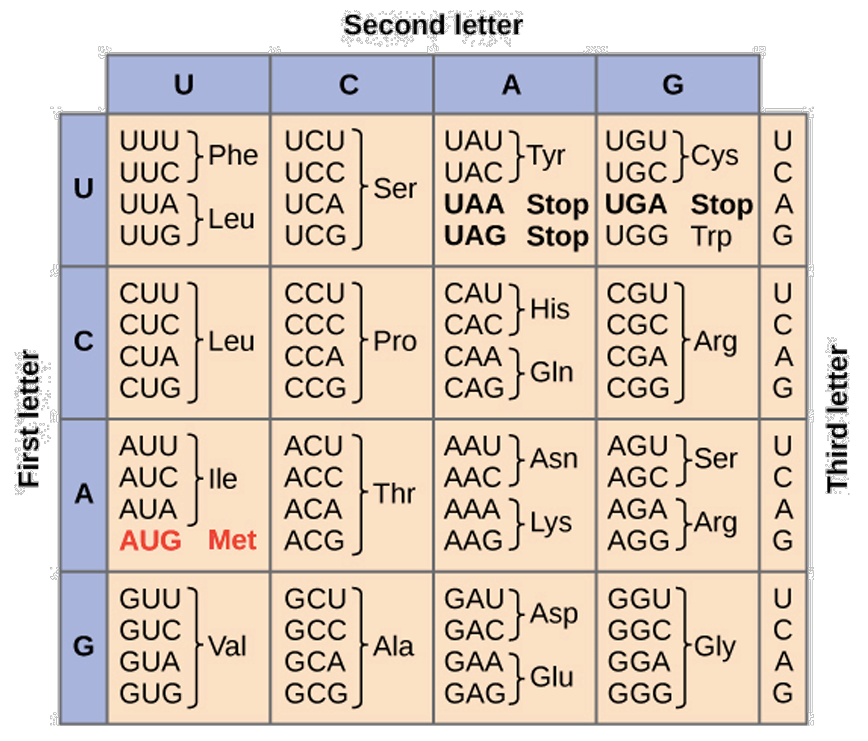
This is a codon table. Note: These codons are corresponding to the mRNA codons in polypeptide synthesis.
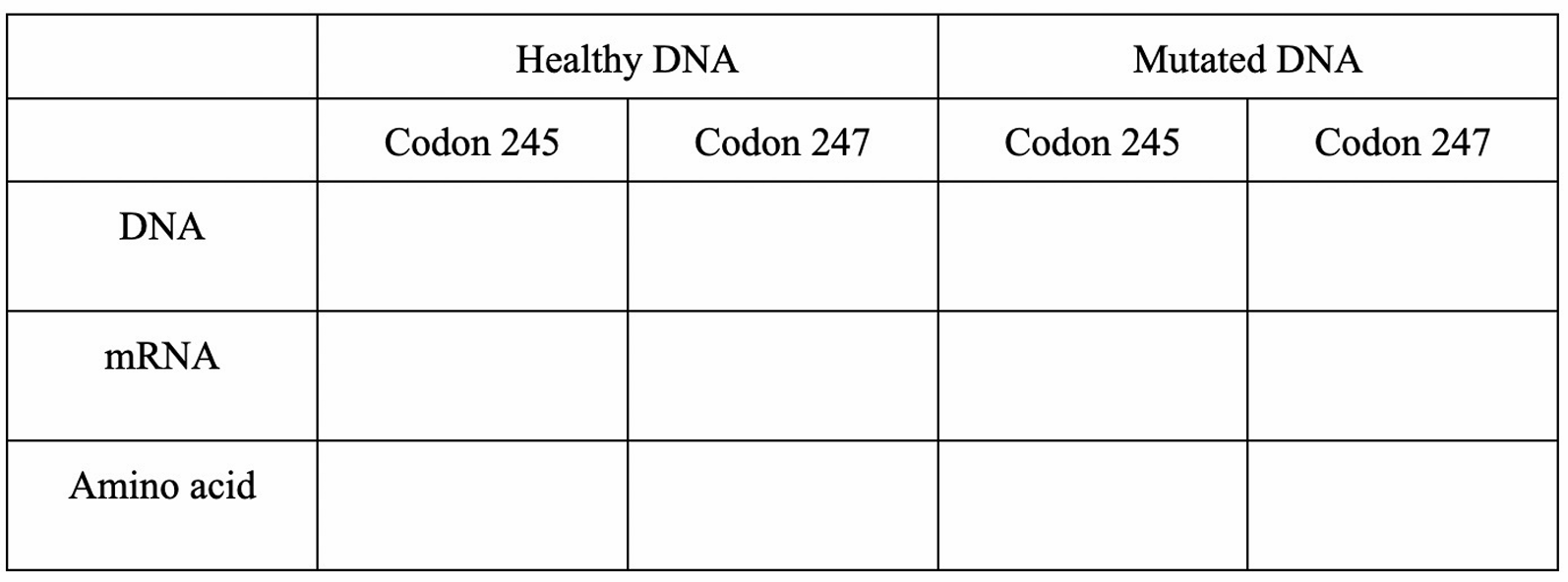
(d) Fill in the table below to show how a change in DNA nucleotides will cause a change in the protein.

Most-appropriate topic codes (Pre-AP Biology):

TOPIC: GEN 3.4 – Mutations: Environmental mutagens (e.g., UV light) and changes to DNA sequences — parts (a), (d)
TOPIC: CELLS 5.2 – Cell Cycle: Cell Division: Cancer cells form when cell division continues without regulation — parts (b), (c)
TOPIC: GEN 3.3 – Translation: Gene expression including the process of protein synthesis — parts (c), (d)
▶️ Answer/Explanation
Detailed solution

(a)
The mutagen is ultraviolet (UV) radiation, which is a physical mutagen.

(b)
The mutation is somatic. It occurs in skin cells (body cells) as a result of environmental exposure (UV radiation) rather than being inherited through gametes. Somatic mutations are not passed on to offspring but can lead to localized diseases such as cancer in the affected individual.

(c)
During polypeptide synthesis, a mutation in the DNA sequence of the $p53$ gene results in a different mRNA codon during transcription. During translation, this may lead to the incorporation of a different amino acid or a premature stop codon. Since $p53$ is a tumour suppressor gene that normally produces proteins to slow down or stop mitosis (cell division), a non-functional or altered $p53$ protein fails to regulate the cell cycle. Consequently, cells with DNA damage continue to divide, leading to uncontrollable cell growth and tumour formation.

(d)
Based on the prompt, the “non-coding” (template) strand is provided. mRNA is complementary to the template strand.

 Healthy DNAMutated DNA
DNA (Template)$CCT$$TTC$$TTT$$TTT$
mRNA$GGA$$AAG$$AAA$$AAA$
Amino acidGlycine (Gly)Lysine (Lys)Lysine (Lys)Lysine (Lys)

Note: Mutation logic assumes $CC \rightarrow TT$ change on the DNA template provided in text.

Scroll to Top