Pre AP Biology -CELLS 5.2 Cell Cycle: Cell Division- MCQ Exam Style Questions -New Syllabus
Pre AP Biology -CELLS 5.2 Cell Cycle: Cell Division- MCQ Exam Style Questions – New Syllabus 2025-2026
Pre AP Biology -CELLS 5.2 Cell Cycle: Cell Division- MCQ Exam Style Questions – Pre AP Biology – per latest Pre AP Biology Syllabus.
Question
b. cork
c. periderm
d. heartwood
▶️ Answer/Explanation
Primary growth occurs at apical meristems and increases the length of the plant.
The pith is a central ground tissue formed from the ground meristem during primary growth.
In contrast, cork and periderm are products of the cork cambium during secondary growth.
Heartwood is older, non-functional secondary xylem formed as the plant increases in girth.
Therefore, only the pith is a primary tissue present from the initial development stage.
The correct option is (a).
Question
b. Oncogenes are near repressor genes.
c. They have a balance of oncogenes and tumour suppressor genes.
d. $TP53$ mutations are one of several likely changes in DNA.
▶️ Answer/Explanation
The correct answer is d.
Cancer cells arise from the accumulation of multiple mutations in DNA.
The $TP53$ gene codes for the $p53$ protein, which regulates the cell cycle and apoptosis.
Mutations in $TP53$ are found in approximately $50\%$ of all human cancers.
Typical cancer cells convert proto-oncogenes into oncogenes, not the reverse.
They exhibit an imbalance where oncogenes are overactive and tumor suppressors are inactivated.
These genetic changes lead to uncontrolled cell division and survival.
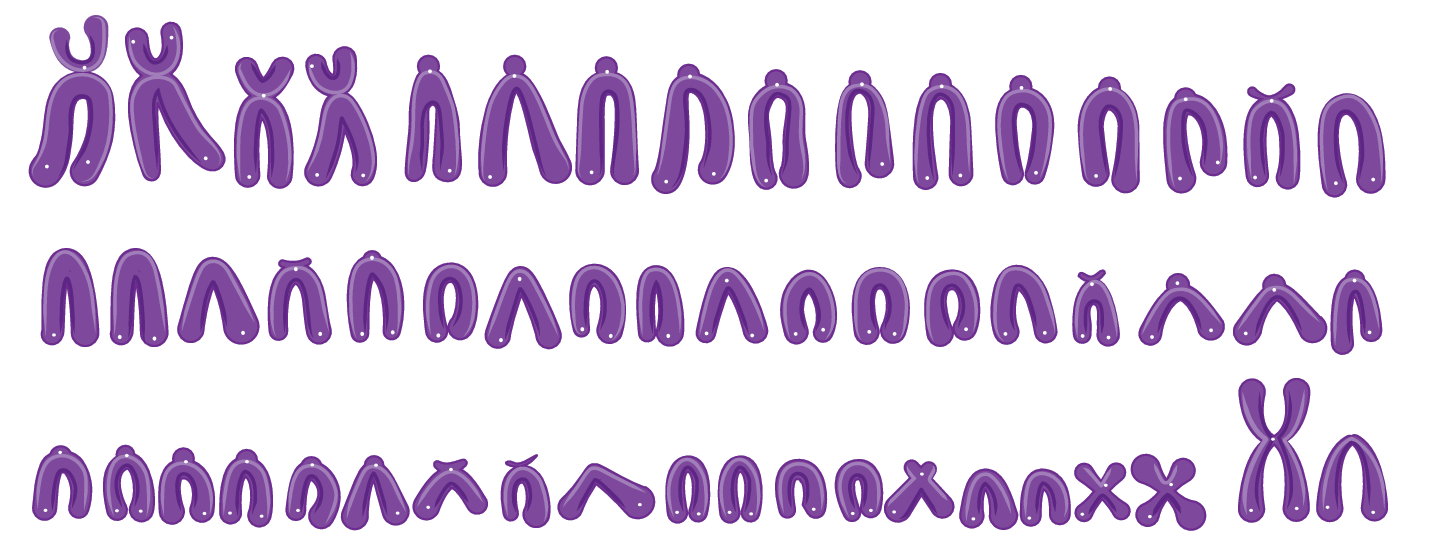
Question

b. $2$
c. $3$
d. $4$
▶️ Answer/Explanation
The correct answer is d. $4$.
The image displays chromosomes in metaphase, meaning DNA replication has already occurred.
A standard somatic cell of a diploid organism like a vole contains $2$ sets of chromosomes ($2n$).
During metaphase, each chromosome consists of two identical sister chromatids.
Each sister chromatid represents one full copy of the genetic information (the genome).
Since there are $2$ homologous chromosomes, each with $2$ chromatids, there are $2 \times 2 = 4$ copies.
Therefore, there are $4$ total copies of the pine vole genome present in the cell at this stage.
