
Pre AP Biology -ECO 1.1 Hydrologic Cycle- MCQ Exam Style Questions -New Syllabus 2025-2026
Pre AP Biology -ECO 1.1 Hydrologic Cycle- MCQ Exam Style Questions – New Syllabus 2025-2026
Pre AP Biology -ECO 1.1 Hydrologic Cycle- MCQ Exam Style Questions – Pre AP Biology – per latest Pre AP Biology Syllabus.
Question
b. an epicotyl
c. a hypocotyl
d. a coleoptile
▶️ Answer/Explanation
The correct answer is a. a radicle.
During seed germination, the radicle is the first part of the embryo to emerge.
It grows downward into the soil to become the primary root of the plant.
The epicotyl eventually develops into the upper stem and leaves.
The hypocotyl is the transition zone between the radicle and the cotyledons.
The coleoptile is a protective sheath covering the emerging shoot in monocots.
Therefore, the root system originates specifically from the embryonic radicle.
Question
▶️ Answer/Explanation
The correct option is b.
The IUCN has assessed only a small fraction of the estimated $8.7$ million eukaryotic species on Earth.
Monitoring efforts are heavily biased toward vertebrates and conspicuous plants, leaving many invertebrates and fungi unexamined.
Many “Data Deficient” species are likely at risk but cannot be formally listed as threatened without more evidence.
Cryptozoic or deep-sea species often face habitat loss before they are even discovered or assessed.
Therefore, the current count of threatened species is a significant underestimation of the true global total.
Question
b. $10\%$
c. $50\%$
d. $100\%$
▶️ Answer/Explanation
The correct answer is b. $10\%$.
This concept is known as the Tens Rule in invasion biology.
It suggests that only $10\%$ of imported species actually escape into the wild.
Of those that escape, only $10\%$ (which is $1\%$ of the original) become established.
Furthermore, only $10\%$ of established species eventually become pests or invasive.
Most introduced species fail to survive due to lack of resources or unsuitable climate.
Therefore, the estimated establishment rate is approximately $10\%$.
Question
▶️ Answer/Explanation
The correct answer is a. This will reflect mainly primary productivity.
Primary productivity is the rate at which solar energy is converted into organic compounds via photosynthesis.
In this process, autotrophs fix inorganic carbon ($\text{CO}_2$) into organic biomass.
Declining levels of carbon in an ecosystem suggest a decrease in the rate of carbon fixation.
Since producers are the entry point for carbon into the food web, this shift directly impacts primary productivity.
Higher trophic levels (secondary or tertiary) depend entirely on the carbon fixed at this initial stage.
Therefore, a fundamental decline in carbon levels is most primarily reflected in the productivity of the producers.
Question
▶️ Answer/Explanation
The correct answer is a.
Biological magnification refers to the increasing concentration of toxic substances in organisms at higher trophic levels.
Toxicants like $DDT$ or heavy metals are often fat-soluble and cannot be easily excreted or metabolized.
As energy moves up the food chain, biomass decreases while the total amount of toxin remains constant or accumulates.
Consequently, the concentration of the substance increases significantly at each successive level.
This results in top predators having the highest concentrations of these harmful materials.
Therefore, it describes the trend where concentration increases as we move from producers to top carnivores.
Question
▶️ Answer/Explanation
The correct option is d.
Energy availability begins with the Net Primary Productivity (NPP), which is the energy stored by producers.
As energy moves upward, only about $10\%$ is typically transferred to the next level.
This transfer rate is defined by the ecological efficiency of each level.
Energy at the highest level is the cumulative result of $NPP$ multiplied by efficiencies at every step.
Therefore, all lower trophic levels directly constrain the energy reaching the top.
Options a and b are incorrect as primary productivity occurs only at the first level.
Question
b. $\sim 30\%$
c. $\sim 50\%$
d. $\sim 90\%$
▶️ Answer/Explanation
The correct answer is d. $\sim 90\%$.
In an ecosystem, only about $10\%$ of the energy is transferred to the next trophic level.
The remaining $\sim 90\%$ of the energy is used by the organisms at the current level.
This energy is consumed through metabolic processes such as cellular respiration.
A significant portion is also lost to the environment as heat.
Some energy remains in unconsumed body parts or waste products (detritus).
This inefficient transfer explains why food chains rarely exceed four or five levels.
Question
▶️ Answer/Explanation
The correct answer is c. tropical rainforest.
Net primary productivity (NPP) is defined by the equation $NPP = GPP – R$.
Tropical rainforests have ideal conditions of high temperature and abundant rainfall year-round.
These conditions allow for a high rate of photosynthesis and dense vegetation growth.
While the open ocean covers more area, its NPP per unit area is very low due to nutrient limits.
Temperate forests and agricultural lands have lower NPP due to seasonal changes or less biomass.
On a per-square-meter basis, tropical rainforests consistently exhibit the highest carbon fixation rates.
Question
b. a measure of the forest’s net primary productivity
c. a measure of the forest’s standing crop biomass
d. a measure of the forest’s ecological efficiency
▶️ Answer/Explanation
The correct answer is c. a measure of the forest’s standing crop biomass.
Standing crop biomass refers to the total dry mass of all living organisms at a specific time.
Gross primary productivity ($GPP$) is the total rate of energy capture by photosynthesis.
Net primary productivity ($NPP$) is the energy remaining after plant respiration ($R$), calculated as $NPP = GPP – R$.
Biomass represents the accumulated organic matter available in the ecosystem.
Ecological efficiency describes the percentage of energy transferred between trophic levels.
Therefore, “standing crop” specifically identifies the physical mass of the plant material present.
Question
b. a robin catching and eating an earthworm
c. a crow eating a dead robin
d. a bacterium decomposing the feces of an earthworm
▶️ Answer/Explanation
The correct option is b.
A detrital food web begins with dead organic matter (detritus) and decomposers.
An earthworm is a primary consumer in the detrital food web as it eats dead leaves.
A robin is part of the grazing food web which typically involves living primary producers or their consumers.
When the robin eats the earthworm, energy and nutrients move from the detrital system back into the grazing system.
Option a describes movement within the detrital web.
Options c and d describe movement from the grazing web back into the detrital/decomposer web.
Question
b. Jane Lubchenco
c. Joseph Connell
d. Robert Whittaker
▶️ Answer/Explanation
The correct answer is c. Joseph Connell.
The intermediate disturbance hypothesis ($IDH$) suggests that local species diversity is maximized when ecological disturbance is neither too rare nor too frequent.
Joseph Connell famously formalized this hypothesis in $1978$ through his studies on tropical rain forests and coral reefs.
He proposed that at high levels of disturbance, only “pioneer” species survive.
At low levels of disturbance, competitive dominant species exclude others, reducing diversity.
Therefore, intermediate levels of disturbance maintain a balance that allows for the highest species richness.
Question
▶️ Answer/Explanation
The correct option is b. $0.072/\text{individual}/\text{year}$.
The value of $r$ represents the per capita rate of increase, calculated as $r = b – d$.
First, calculate the birth rate ($b$): $452 / 1000 = 0.452$.
Next, calculate the death rate ($d$): $380 / 1000 = 0.380$.
Subtract the death rate from the birth rate: $0.452 – 0.380 = 0.072$.
This gives the intrinsic rate of increase per individual per year.
Question
b. $r$ gets larger as a population gets larger.
c. $r$ gets smaller as a population gets larger.
d. $r$ is always at its maximum level ($r_{\text{max}}$).
▶️ Answer/Explanation
The correct answer is a.
In the exponential growth model, the rate of population increase is given by $\frac{dN}{dt} = rN$.
The term $r$ represents the per capita growth rate, which is assumed to be a constant.
Unlike logistic growth, exponential growth assumes unlimited resources and no competition.
Because resources do not become scarce, the value of $r$ does not decrease as $N$ increases.
Therefore, $r$ remains independent of the population size ($N$).
While $r$ is often constant, it is not strictly required to be at $r_{\text{max}}$ unless conditions are ideal.
Question
b. They use resources that are patchily distributed.
c. They may experience intraspecific competition for vital resources.
d. They have no ecological interactions with each other.
▶️ Answer/Explanation
The correct answer is c.
Uniform dispersion often results from direct interactions between individuals in the population.
It frequently arises due to intraspecific competition for limited resources like food or water.
Individuals maintain a specific distance from one another to ensure access to these vital resources.
Territoriality is a common behavioral mechanism that leads to this evenly spaced pattern.
In contrast, option a suggests clumped, b suggests clumped, and d suggests random dispersion.
Question
▶️ Answer/Explanation
The correct option is b.
In population ecology, the variable $K$ represents the carrying capacity.
Carrying capacity is the maximum population size an environment can sustain.
The variable $r$ represents the intrinsic rate of increase or growth rate.
The variable $N$ is typically used to represent the actual population size.
Therefore, the pair “$K$ and carrying capacity” is the only accurate match.
Question
b. They turn their host cell into a prophage.
c. They integrate their DNA into the host cell’s chromosomes.
d. They break down the host cell’s chromosomes when their DNA enters the cell.
▶️ Answer/Explanation
The correct option is c.
Temperate phages are capable of entering the lysogenic cycle.
In this cycle, the viral DNA integrates into the bacterial host chromosome.
Once integrated, the viral genome is referred to as a prophage.
The prophage is replicated along with the host $\text{DNA}$ during cell division.
Unlike virulent phages, they do not immediately lyse the host cell upon entry.
Environmental stressors can later trigger the prophage to exit and enter the lytic cycle.
Question
b. flatworms
c. arrow worms
d. tapeworms
▶️ Answer/Explanation
The correct answer includes both b. flatworms and d. tapeworms (as tapeworms are a type of flatworm).
Flame cells are specialized excretory cells found in the simplest freshwater invertebrates.
They function like a kidney, helping the animal to remove waste materials.
The “flame” aspect comes from a bundle of cilia that flickers like a flame to move liquid.
These cells are the primary structural unit of the protonephridial system in Phylum Platyhelminthes.
Flatworms (Planaria) and Tapeworms (Cestodes) both belong to this phylum.
In many standardized tests, b. flatworms is the most generalized correct category.
Question
b. lack of vascular tissues
c. lack of true roots
d. lack of bark
▶️ Answer/Explanation
The correct answer is b. lack of vascular tissues.
Mosses are non-vascular plants, meaning they lack specialized conducting tissues like xylem and phloem.
Without these tissues, they cannot transport water and nutrients efficiently over long distances against gravity.
They rely on simple diffusion and osmosis, which only work effectively over very short distances.
Additionally, vascular tissue provides structural support through lignin, which mosses lack.
This structural limitation prevents them from growing tall like tracheophytes (vascular plants).
Therefore, their height is restricted to just a few centimeters to ensure all cells receive necessary resources.
Question
b. the nutrient-absorbing region of an ascomycete
c. the nutrient-absorbing region of a basidiomycete
d. a reproductive structure formed only by basidiomycetes
▶️ Answer/Explanation
The correct answer is d.
A mushroom is the fruiting body (basidiocarp) used for sexual reproduction.
It is specifically produced by fungi in the phylum Basidiomycota.
Options a and b refer to Ascomycetes, which produce $asci$ rather than mushrooms.
Option c is incorrect because the nutrient-absorbing region is the mycelium, not the mushroom.
The mushroom’s primary biological role is to disperse basidiospores into the environment.
Therefore, it is defined as a reproductive structure unique to this fungal group.
Question
b. In deserts, because of the drought
c. In tropical rainforests, because soils are too damp
d. In tropical rainforests, because soils are poor in mineral ions
▶️ Answer/Explanation
The correct answer is d.
In tropical rainforests, heavy rainfall causes rapid leaching of nutrients from the ground.
This results in oxisols that are significantly poor in mineral ions like phosphorus.
Mycorrhizal fungi extend their hyphae to increase the surface area for nutrient absorption.
They efficiently capture minerals from decaying organic matter before they wash away.
In exchange, the host plant provides the fungi with carbon/sugars from photosynthesis.
This mutualistic relationship is essential for supporting the massive biomass of the rainforest.
Question
▶️ Answer/Explanation
The correct option is d. Zygomycota, Ascomycota, and Basidiomycota.
Mushrooms (typical field mushrooms) belong to the phylum Basidiomycota.
Truffles and the fungi used to ripen Camembert cheese (Penicillium camemberti) belong to Ascomycota.
The common mould on bread (such as Rhizopus stolonifer) belongs to the phylum Zygomycota.
Glomeromycota are arbuscular mycorrhizal fungi associated with plant roots and are not typically found in these food items.
Therefore, the meal represents the three groups: Zygomycota, Ascomycota, and Basidiomycota.
Question
b. zygosporangium
c. basidiocarp
d. gametangium
▶️ Answer/Explanation
The correct answer is b. zygosporangium.
In the life cycle of fungi like Zygomycota, the zygosporangium is formed by the fusion of two haploid (\(n\)) hyphae.
Initially, it is heterokaryotic, but it becomes diploid (\(2n\)) following the process of karyogamy (nuclear fusion).
An ascospore is a haploid (\(n\)) sexual spore produced within an ascus.
A basidiocarp is the fruiting body (like a mushroom), which is primarily dikaryotic (\(n+n\)) rather than diploid.
A gametangium is a haploid (\(n\)) structure in which gametes are produced.
Therefore, the zygosporangium is the stage that contains the diploid zygote before meiosis occurs.
Question
▶️ Answer/Explanation
The correct option is d.
An autotroph is defined by its ability to fix inorganic carbon (such as $\text{CO}_2$) into organic compounds.
While many autotrophs use light (photoautotrophs), some use chemical energy (chemoautotrophs), making d the most inclusive definition.
Option a is incomplete as it excludes chemoautotrophs that do not use light.
Option b is broad; many organisms synthesize carbohydrates from organic precursors, but autotrophs start from inorganic sources.
Option c describes a heterotroph, which must ingest or absorb organic matter from others.
Therefore, the primary characteristic of an autotroph is the synthesis of organic molecules from $\text{C}_1$ inorganic sources.
Question
b. Its breakdown is exergonic ($-\Delta G$).
c. It has a high activation energy ($E_a$).
d. It contains an abundance of oxygen and little hydrogen.
▶️ Answer/Explanation
The correct option is c.
Thermodynamic instability means the reaction to break down propane is spontaneous ($-\Delta G$).
Kinetic stability refers to the rate at which a reaction occurs.
Propane molecules require a significant input of energy to reach the transition state.
This high activation energy ($E_a$) acts as a barrier that prevents the reaction from proceeding at room temperature.
Without this energy (like a spark), the bonds remain intact despite the potential for a lower energy state.
Therefore, propane remains stable over long periods unless ignited.
Question
b. a saucepan of water with a lid heating on a stove
c. an ocean
d. a dead organism
▶️ Answer/Explanation
The correct answer is b. a saucepan of water with a lid heating on a stove.
In thermodynamics, a closed system allows energy transfer but not mass transfer.
The lid prevents steam (matter) from escaping the saucepan.
However, heat (energy) from the stove enters the system through the metal base.
The universe is generally considered an isolated system ($E = \text{constant}$, $m = \text{constant}$).
Oceans and organisms are open systems that exchange both matter and energy.
Therefore, the lidded saucepan best fits the definition where $\Delta m = 0$ and $Q \neq 0$.
Question
b. The entropy of water increases as it freezes.
c. The entropy of ice decreases as it melts.
d. The entropy of water increases as it vaporizes.
▶️ Answer/Explanation
The correct option is d.
Entropy is a measure of the molecular disorder or randomness in a system.
In a liquid state, molecules are relatively close together with limited movement.
As water vaporizes into a gas, the molecules gain kinetic energy and spread out significantly.
This transition results in a much higher degree of randomness and disorder.
Therefore, the change in entropy $\Delta S$ is positive during vaporization.
Conversely, processes like freezing or liquefying involve a decrease in molecular disorder.
Question
▶️ Answer/Explanation
The correct option is c.
Energy is a fundamental quantity that cannot be created or destroyed, only transformed.
It exists in many forms such as kinetic, potential, thermal, chemical, and electrical energy.
While food contains chemical potential energy, they are not the exact same thing.
Energy is defined as the capacity to do work, but it is not identical to work itself.
Work ($W$) is the process of energy transfer, often expressed as $W = F \cdot d$.
Therefore, the statement that it exists in different forms is the most accurate description.
Question
B. equilibrium
C. competition
D. decomposition
▶️ Answer/Explanation
The correct option is C. competition.
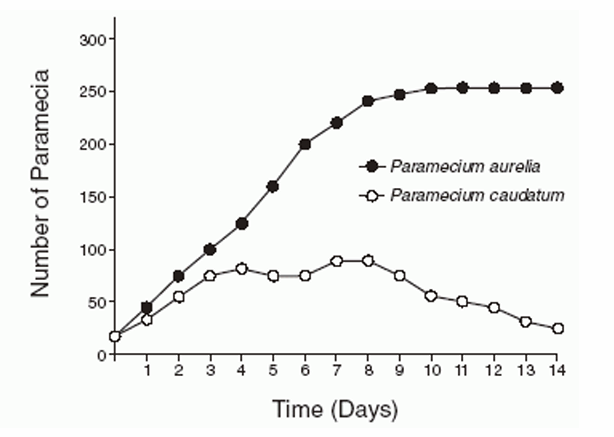
The graph illustrates Gause’s Principle of competitive exclusion.
Both species start with similar growth, but P. aurelia outcompetes P. caudatum.
The population of P. aurelia reaches a stable carrying capacity of $\approx 250$ individuals.
The population of P. caudatum declines toward $0$ after day $8$ due to limited resources.
This shows that two species competing for the same niche cannot coexist indefinitely.
The superior competitor eventually eliminates the other from the shared environment.
Question
B. produce carbon dioxide and water as metabolic wastes
C. are able to obtain complex organic materials from the environment
D. are able to synthesize organic molecules from inorganic raw materials
▶️ Answer/Explanation
Correct Option: D
Autotrophs are “self-feeders” that do not rely on other organisms for food.
They use energy (usually light) to convert inorganic $CO_2$ and $H_2O$ into organic $C_6H_{12}O_6$.
Maple trees and tulips perform photosynthesis to create these complex carbon compounds.
Option A is incorrect because gametes are typically produced via meiosis in these plants.
Option B describes a byproduct of cellular respiration, which heterotrophs also perform.
Option C actually describes the behavior of heterotrophs, not autotrophs.
Question
Q. Which organisms are correctly paired with their feeding roles?
B. mouse—autotroph; flower seed—heterotroph
C. mountain lion—predator; bark beetle—herbivore
D. grasshopper—carnivore; grass—autotroph
Q. Which of the following would likely result if the Mountain Lion population decreased drastically due to human hunting?
B. The deer population would increase, leading to a decrease in tree biomass.
C. The hawk population would decrease, leading to an increase in rabbits.
D. The seed-eating bird population would increase, leading to an increase in hawks.
Q. Changes in abiotic factors that could affect the stability of this ecosystem food web could include
B. blizzards, heat waves, and swarms of grasshoppers
C. droughts, floods, and heat waves
D. species of fish, number of decomposers, and supply of algae
Q. Which of the following correctly describes the roles of mushrooms and bacteria?
B. They are strictly secondary consumers
C. They are both heterotrophic decomposers
D. They are both mutualistically symbiotic with each other
▶️ Answer/Explanation
A. Answer: C
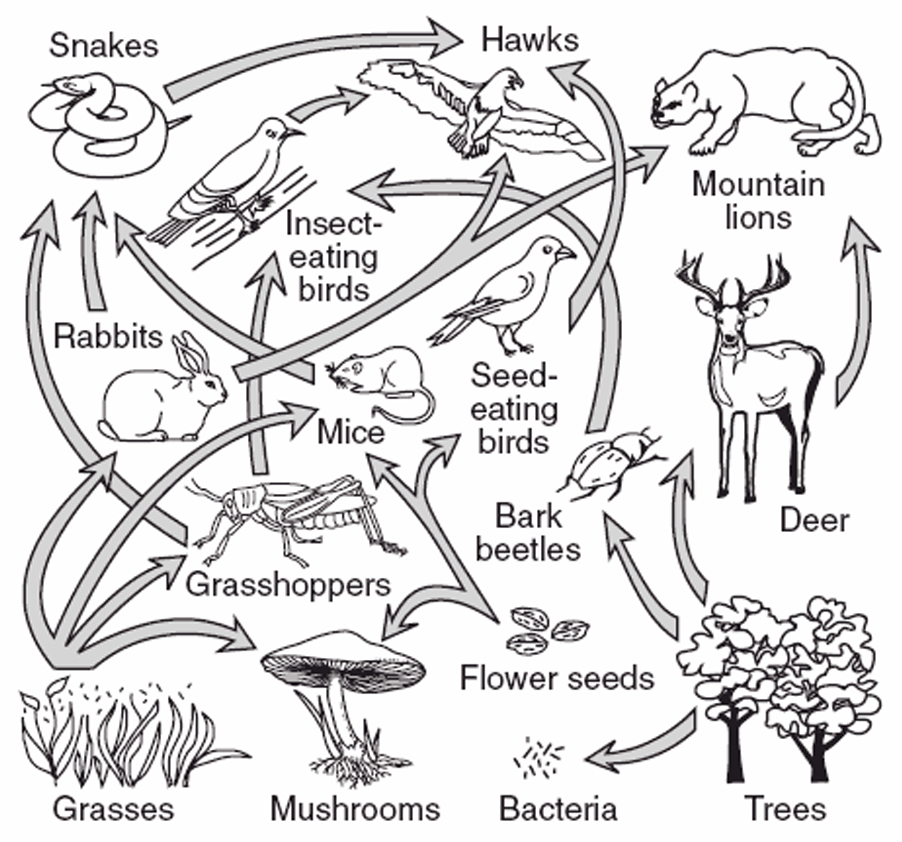
Mountain lions hunt and consume deer, which correctly classifies them as predators.
Bark beetles feed on tree bark (plant material), which correctly classifies them as herbivores.
Other options are incorrect (e.g., hawks are carnivores, not decomposers; mice are heterotrophs, not autotrophs).
A. Answer: B
The food web shows that mountain lions prey on deer.
A drastic decrease in the mountain lion population removes a primary predator.
This lack of predation would likely cause the deer population to increase.
A larger deer population would consume more trees, leading to a decrease in tree biomass.
A. Answer: C
Abiotic factors are the non-living chemical and physical parts of the environment.
Droughts, floods, and heat waves are all non-living, weather-related events.
The other options contain biotic (living) factors such as wolves, grasshoppers, fish, decomposers, or algae.
A. Answer: C
In the diagram, mushrooms and bacteria receive energy from dead organic matter originating from various plants and animals.
They break down this organic material, fulfilling the role of decomposers.
Since they rely on organic substances for nutrition (cannot make their own food), they are heterotrophic.
Question
▶️ Answer/Explanation
Correct Option: A
Prokaryotes typically have a single, circular chromosome with a single origin of replication ($oriC$).
Eukaryotes possess much larger, linear chromosomes that require multiple $ori$ sites to ensure timely replication.
Having multiple origins allows eukaryotes to replicate their massive genomes simultaneously in sections.
Option B is incorrect as it reverses the biological reality of genome complexity.
Option C incorrectly applies modes of replication (dispersive/conservative) to the definition of the $ori$.
Option D is false because the $ori$ is strictly a feature of DNA replication, not transcription.
Question
What part of the nucleotide is labelled $3$?
B. Amino group
C. Nitrogenous base
D. Carboxyl group
▶️ Answer/Explanation
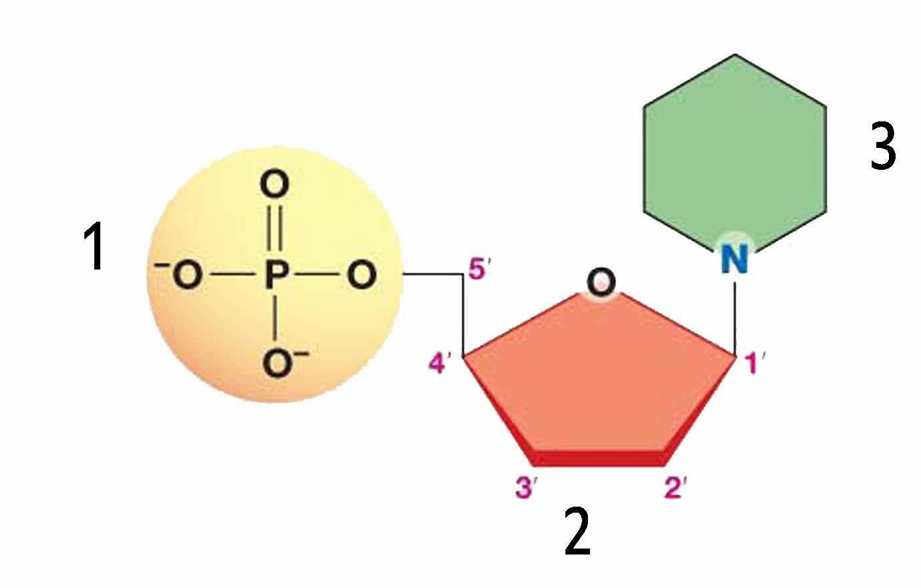
The correct answer is C. Nitrogenous base.
Label $1$ represents the phosphate group, which is attached to the $5’$ carbon of the sugar.
Label $2$ represents the pentose sugar (deoxyribose or ribose) forming the central structure.
Label $3$ represents the nitrogenous base, which is attached to the $1’$ carbon of the sugar.
These three components together form the basic monomeric unit of $DNA$ and $RNA$ called a nucleotide.
The nitrogenous base is the part that carries the genetic information through specific pairing.
Question
▶️ Answer/Explanation
The correct answer is B.
Water molecules stay together due to cohesion, caused by hydrogen bonding.
This internal attraction creates surface tension at the liquid-air interface.
Surface tension behaves like an elastic “skin” that supports light weights.
The weight of the water strider is distributed across its long, hydrophobic legs.
Because the force of the insect is less than the surface tension, it does not sink.
Adhesion (attraction to other surfaces) would actually cause the insect to get “wet” or stuck.
Therefore, cohesion and surface tension are the primary properties involved.
Question
B. It forms a suspension, in which the polar water molecules repel the nonpolar lipid molecules.
C. It forms a suspension, in which the nonpolar water molecules attract the polar lipid molecules.
D. It forms solvent, in which the polar lipid molecules dissolve the nonpolar water molecules.
▶️ Answer/Explanation
The correct option is B.
Water is a polar molecule, whereas lipids (oils) are nonpolar.
Polar and nonpolar substances do not mix, leading to the formation of a suspension.
Water molecules are more attracted to each other than to the lipids.
This results in the repulsion of the nonpolar lipid molecules from the water network.
Option C is incorrect because water is polar, not nonpolar.
Options A and D are incorrect as oil and water do not form a true solution or solute/solvent pair.
Question
B. Open-minded
C. Skeptical
D. Bias
▶️ Answer/Explanation
The correct answer is D. Bias.
Scientific attitudes are mental habits that help scientists reach objective conclusions.
Curiosity drives a scientist to ask questions and seek new knowledge.
Open-mindedness allows a scientist to accept different ideas and change their view based on evidence.
Skepticism ensures that a scientist questions existing ideas and requires proof before accepting claims.
Bias is a personal prejudice that prevents objective analysis and is therefore undesirable in science.
Question
B. makes the acceptance of new ideas more likely.
C. means a new idea will only be accepted if it is backed by evidence.
D. proves that some ideas are unimportant.
▶️ Answer/Explanation
Scientific skepticism involves questioning claims rather than accepting them on faith.
It ensures that any new hypothesis is subjected to rigorous testing and scrutiny.
This process filters out subjective bias and prevents the spread of misinformation.
By requiring evidence, skepticism maintains the integrity and reliability of scientific knowledge.
Therefore, an idea is only integrated into the scientific body of work if it is supported by empirical data.
The correct option is C.
Question
▶️ Answer/Explanation
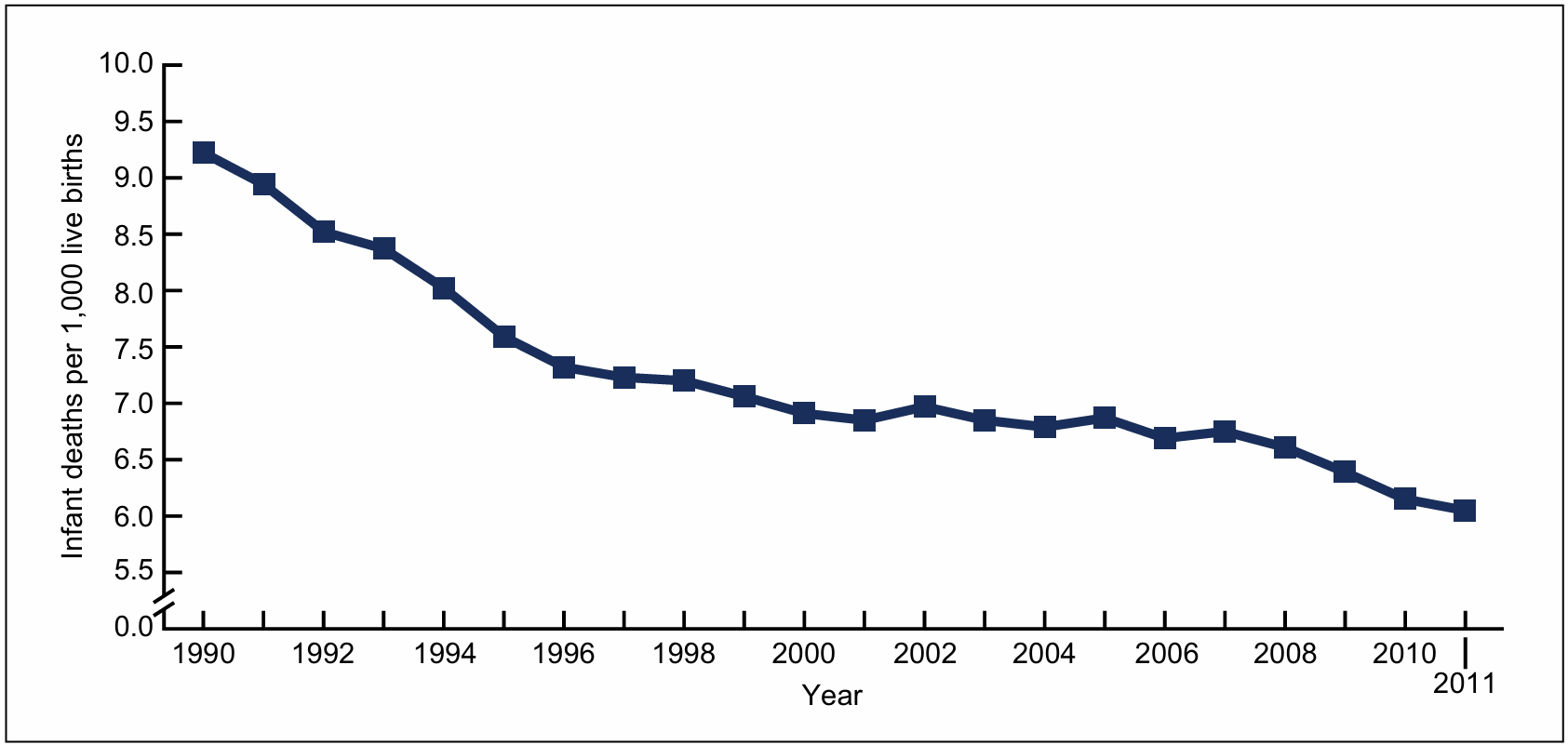
Identify the value for the year $1990$ on the y-axis, which is approximately $9.2$.
Identify the value for the year $2011$ on the y-axis, which is approximately $6.1$.
Calculate the difference: $9.2 – 6.1 = 3.1$.
This represents a total decrease of approximately $3$ infant deaths per $1,000$ live births.
Comparing this result to the given options, Option B is the closest match.
Therefore, the correct answer is B.
Question
B. The infant death rate in $2003$ is half that of $2005$.
C. The infant death rate in $2003$ is $75\%$ of that of $2005$.
D. The infant death rate in $2003$ is approximately the same as in $2005$.
▶️ Answer/Explanation
Locate the year $2003$ on the horizontal axis and find the corresponding data point.
The infant death rate for $2003$ is approximately $6.9$ deaths per $1,000$ live births.
Locate the year $2005$ on the horizontal axis and find the corresponding data point.
The infant death rate for $2005$ is approximately $6.8$ deaths per $1,000$ live births.
Comparing $6.9$ and $6.8$, the values are extremely close to one another.
Therefore, the rate in $2003$ is approximately the same as in $2005$.
Correct Option: D
Question
B. Time in years.
C. The number of infant deaths per $1,000$ live births.
D. The total number of infant deaths.
▶️ Answer/Explanation
The dependent variable is the factor being measured or observed, typically plotted on the vertical $y$-axis.
In Figure 5, the $y$-axis is explicitly labeled “Infant deaths per $1,000$ live births.”
The horizontal $x$-axis represents the independent variable, which in this case is the “Year.”
Option C accurately reflects the specific metric being tracked over time.
Option D is incorrect because the graph shows a rate (per $1,000$), not the absolute total count of deaths.
Therefore, the correct choice is C.
Question
B. observable.
C. testable.
D. correct.
▶️ Answer/Explanation
The correct option is C.
A scientific hypothesis is a proposed explanation that can be tested through experimentation or observation.
To be useful, it must be possible to prove the hypothesis false if it is indeed incorrect (falsifiability).
While being measurable or observable is helpful, testability is the fundamental requirement for the scientific method.
A hypothesis does not have to be correct initially; its purpose is to be evaluated to find the truth.
If a statement cannot be tested, it falls outside the realm of empirical science.
Question
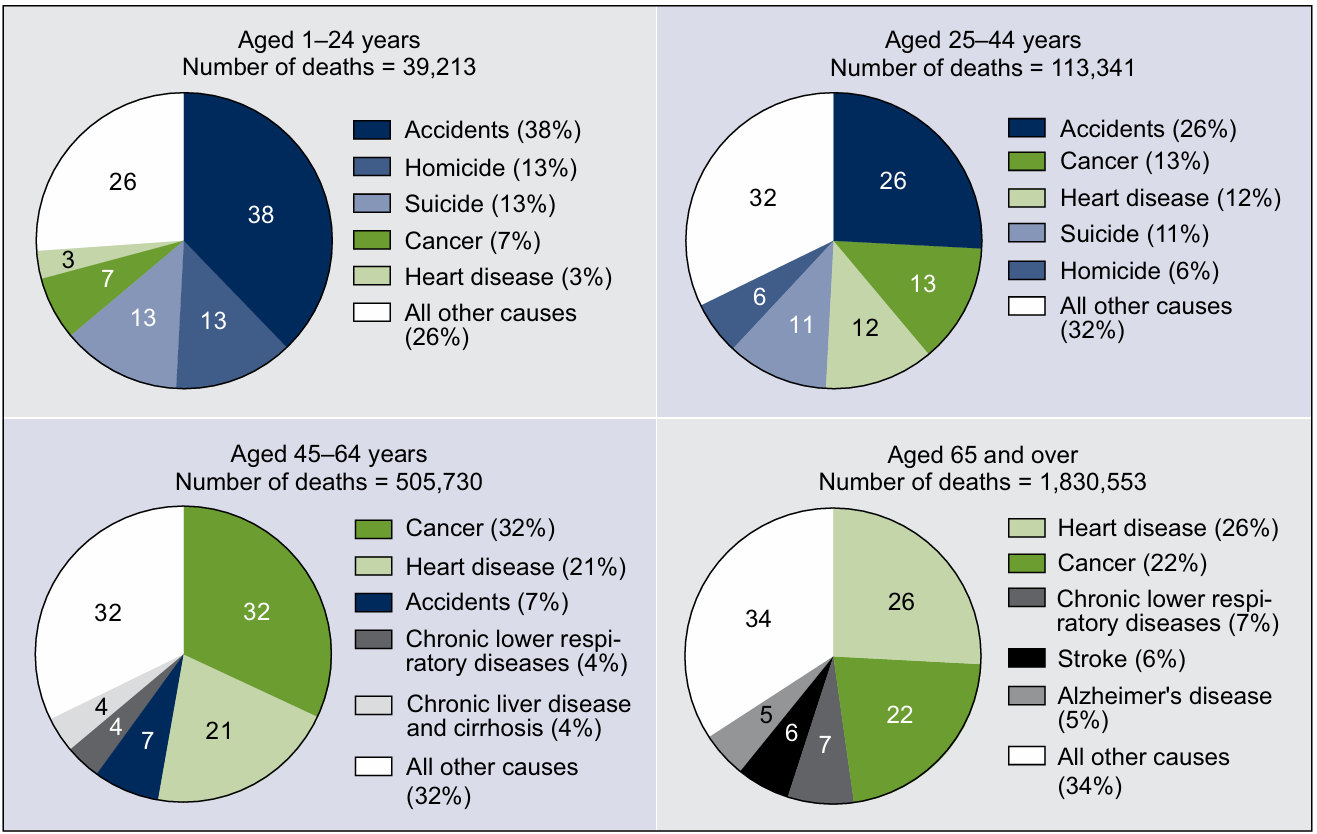
B. \(13\%\)
C. \(26\%\)
D. \(38\%\)
▶️ Answer/Explanation
The correct answer is D.
Locate the pie chart titled “Aged \(1-24\) years” in the top-left quadrant of the figure.
Identify the legend entry for “Accidents” which is represented by the darkest blue color.
The legend explicitly lists “Accidents” as \(38\%\).
The corresponding section in the pie chart also displays the number \(38\).
Therefore, accidents account for \(38\%\) of deaths in this age group.
Other causes like Homicide and Suicide follow at \(13\%\) each.