
Question
According to the World Health Organisation, approximately (250) million people are affected by vitamin A deficiency, including (40%) of children under five in developing countries. This deficiency is the leading cause of preventable childhood blindness, and tragically, half of the affected children die within a year of becoming blind.
Vitamin A deficiency can lead to blindness by causing extreme dryness in the cornea, a condition known as xerophthalmia. This dryness can damage the cornea and retina, potentially resulting in permanent vision loss.
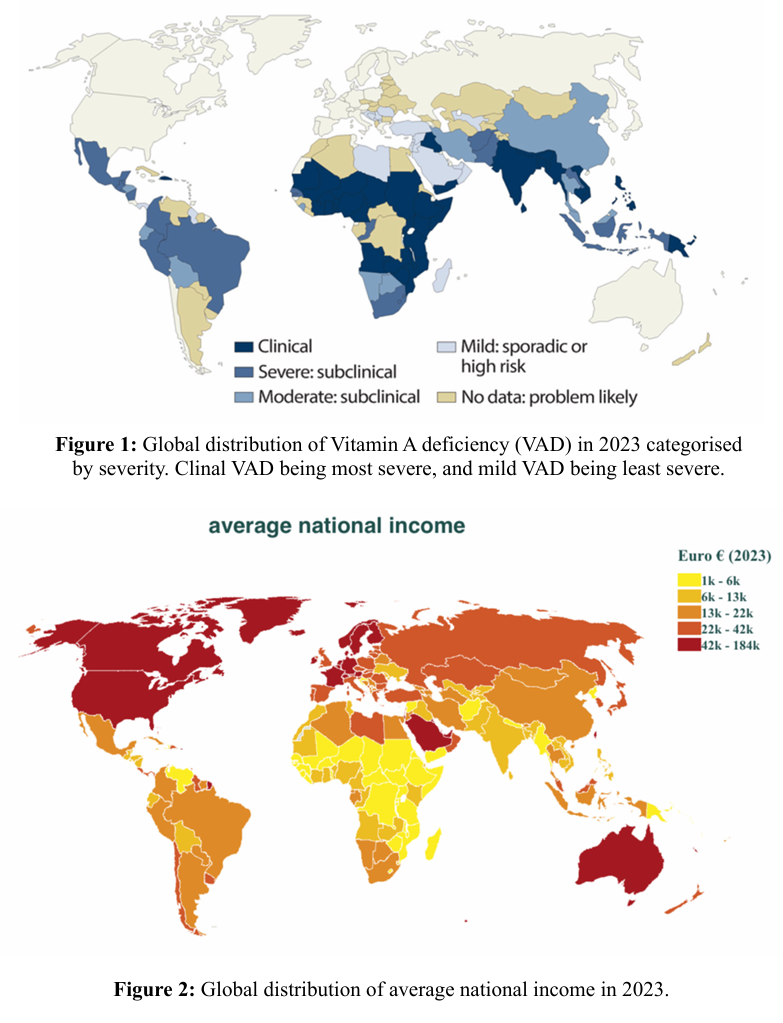
(a) Analyse the global distribution of vitamin A deficiency and average national income globally.
Golden rice is a transgenic rice that contains a beta-carotene gene. The beta-carotene is used by the body to produce vitamin A. This transgenic rice is produced using the techniques outlined below:
- The genes that enable Golden Rice to produce beta-carotene in its endosperm are derived from daffodils and the bacterium Erwinia uredovora.
- These genes, along with promoters, are inserted into plasmids found in the bacterium Agrobacterium tumefaciens.
- The Agrobacterium containing these plasmids is then introduced to rice embryos, transferring the beta-carotene-producing genes.
- The resulting transgenic rice plants are crossed with local rice varieties.
- The transgenic rice, known as Golden Rice, is enriched with vitamin A.
(b) Evaluate potential impacts golden rice has on the biodiversity of the ecosystem in the short term and long term.
Most-appropriate topic codes (Pre-AP Biology):
• TOPIC: ECO 2.1 — Population Structure: Explain the role abiotic and/or biotic resources play in defining the niche of a species — part (a)
• TOPIC: ECO 5.2 — Human-Induced Changes in Biodiversity: Predict potential biological consequences for an ecosystem’s biodiversity — part (b)
• TOPIC: GEN 6.1 — Biotechnology: Describe techniques used to manipulate DNA and explain potential benefits and/or consequences — context and part (b)
• Science Area of Focus — Strategic Use of Mathematics: Analyze and interpret data collected while investigating the natural world — part (a)
• Science Area of Focus — Emphasis on Analytical Reading and Writing: Extract, synthesize, and compare complex information from multiple representations — part (a)
• TOPIC: ECO 5.2 — Human-Induced Changes in Biodiversity: Predict potential biological consequences for an ecosystem’s biodiversity — part (b)
• TOPIC: GEN 6.1 — Biotechnology: Describe techniques used to manipulate DNA and explain potential benefits and/or consequences — context and part (b)
• Science Area of Focus — Strategic Use of Mathematics: Analyze and interpret data collected while investigating the natural world — part (a)
• Science Area of Focus — Emphasis on Analytical Reading and Writing: Extract, synthesize, and compare complex information from multiple representations — part (a)
▶️ Answer/Explanation
Detailed solution
(a)
There is a distinct negative correlation (inverse relationship) between average national income and the severity of Vitamin A deficiency (VAD) globally .
- Developing Regions (Low Income): As shown in Figure 2, regions with low average national incomes, such as Sub-Saharan Africa and parts of South/Southeast Asia, correspond to the areas in Figure 1 with the most severe and clinical levels of VAD. This indicates that economic barriers serve as a density-independent factor limiting access to essential biotic resources (nutrients) required for health .
- Developed Regions (High Income): Conversely, regions with high average national incomes, such as North America and Western Europe, show minimal to no clinical data for VAD. Higher national wealth correlates with increased availability of nutrient-dense resources, effectively eliminating this specific environmental pressure .
(b)
The introduction of Golden Rice, a product of biotechnology , impacts ecosystem biodiversity as follows:
Short Term:
- Gene Flow: There is a risk of horizontal gene transfer where the beta-carotene transgene may move to local rice landraces or wild relatives through cross-pollination .
- Agricultural Monoculture: Human activity in favoring a single transgenic variety can reduce the cultivation of diverse local varieties, leading to a decrease in agricultural biodiversity .
Long Term:
- Reduction of Genetic Pool: If Golden Rice outcompetes wild varieties or leads to their abandonment, essential natural resistance genes within the genetic pool may be lost forever .
- Ecosystem Resilience: Significant reductions in local biodiversity can alter the stability of ecosystem processes and services, potentially making the agricultural system less resilient to major environmental disturbances.