
▶️ Answer/Explanation
A: B. the Sun.
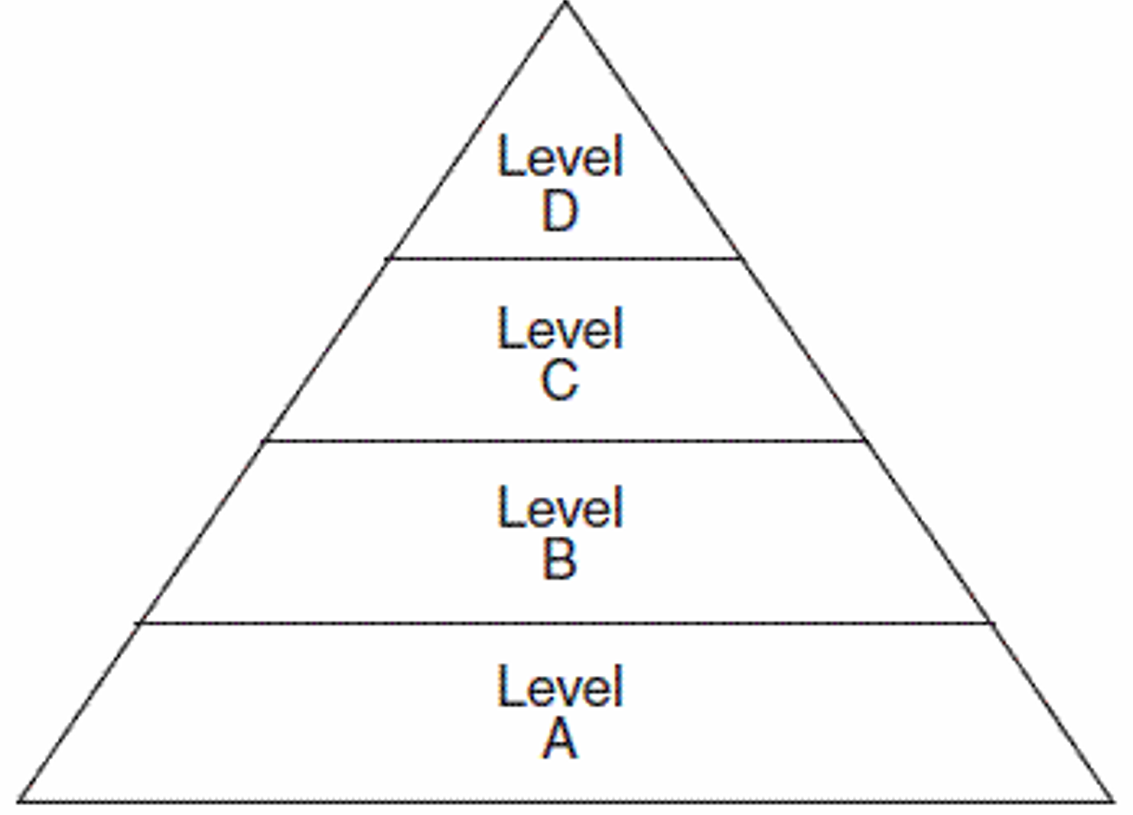
Level A is at the bottom of the pyramid, representing the producers.
Producers are autotrophs that synthesize their own food.
They utilize light energy to power photosynthesis.
Thus, the original source of energy is the Sun.
A: B. \(20,000\) ; \(180,000\)
According to the \(10\%\) rule, only \(10\%\) of energy transfers to the next level.
Energy transferred to Level D \(= 200,000 \times 0.10 = 20,000 \text{ J}\).
The remaining \(90\%\) is lost as heat or waste.
Energy lost \(= 200,000 – 20,000 = 180,000 \text{ J}\).
▶️ Answer/Explanation
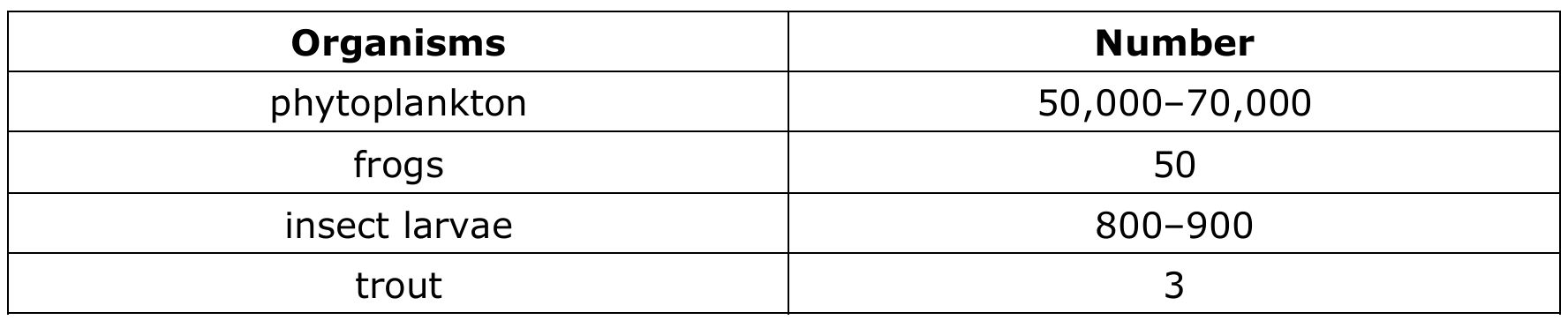
Phytoplankton are producers that convert solar energy into chemical energy via photosynthesis.
In an ecological pyramid, producers must have the largest biomass and population to support higher levels.
As energy moves up the food chain (from larvae to frogs to trout), approximately $90\%$ of energy is lost as heat.
Because only $10\%$ of energy is transferred to each succeeding level, fewer organisms can be supported at the top.
Therefore, a massive base of phytoplankton is required to sustain a very small number of apex predators like trout.