
Pre AP Biology -ECO 3.1 Importance of Biodiversity- MCQ Exam Style Questions -New Syllabus 2025-2026
Pre AP Biology -ECO 3.1 Importance of Biodiversity- MCQ Exam Style Questions – New Syllabus 2025-2026
Pre AP Biology -ECO 3.1 Importance of Biodiversity- MCQ Exam Style Questions – Pre AP Biology – per latest Pre AP Biology Syllabus.
Question
b. extirpated
c. highly endangered
d. not at risk
▶️ Answer/Explanation
The correct answer is b. extirpated.
Extirpated refers to a species that no longer exists in a specific geographic area but survives elsewhere.
Extinct describes a species that has died out completely across the entire planet.
In this scenario, the species is gone from Canada but remains in the United States.
Therefore, it is locally extinct in Canada, which is the definition of extirpation.
Options c and d are incorrect because they describe the level of risk for a species still present in the area.
Question
▶️ Answer/Explanation
The correct option is c.
Supporting services are fundamental processes that allow other ecosystem services to exist.
Water filtration by bivalves maintains the quality of the habitat for other aquatic life.
Options a, b, and d represent provisioning services because they involve extracted products.
Provisioning services provide physical goods like food, medicine, and raw materials.
Supporting services include nutrient cycling, soil formation, and primary production.
By filtering water, bivalves support the overall health and $100\%$ functionality of the ecosystem.
Question
b. tourism opportunities
c. spiritual experiences
d. traditional medicinal treatments
▶️ Answer/Explanation
The correct answer is d. traditional medicinal treatments.
Ecosystem services are divided into four categories: provisioning, regulating, supporting, and cultural.
Cultural services are the non-material benefits people obtain from ecosystems.
Educational, tourism, and spiritual benefits are all non-material and thus cultural.
Medicinal treatments involve the extraction of physical biological resources.
Because they provide a tangible product, they are classified as provisioning services.
Therefore, option d is the only choice that does not fit the cultural category.
Question
▶️ Answer/Explanation
The correct answer is (b).
$\beta$-diversity measures the rate of change in species composition as one moves from one community to another.
It acts as a comparison between local ($\alpha$) diversity and regional ($\gamma$) diversity.
Mathematically, it can be represented as $\beta = \frac{\gamma}{\alpha}$.
Option (a) refers to $\gamma$-diversity, while (c) relates to endemism.
Option (d) describes the Minimum Viable Population ($MVP$) concept.
Therefore, $\beta$-diversity specifically highlights the differences across community boundaries.
Question
b. cyanobacteria
c. proteobacteria
d. green bacteria
▶️ Answer/Explanation
The correct answer is b. cyanobacteria.
Cyanobacteria perform oxygenic photosynthesis, using water as an electron donor.
This process releases oxygen ($\text{O}_2$) as a byproduct into the atmosphere.
They use chlorophyll $a$, similar to plants, to capture light energy.
Other groups like green bacteria perform anoxygenic photosynthesis and do not produce oxygen.
Spirochetes and most proteobacteria are chemoheterotrophs or chemoautotrophs, not photoautotrophs.
Cyanobacteria played a critical role in the “Great Oxidation Event” of Earth’s early atmosphere.
Question
B. the same niche, but different habitats
C. the same niche and the same habitat
D. different habitats and different niches
▶️ Answer/Explanation
Both organisms live on the same decaying tree trunk, meaning they share the same habitat.
The shelf fungus acts as a decomposer, absorbing nutrients directly from the wood of the tree.
The slug acts as a herbivore/consumer, specifically feeding on the algae growing on the surface.
Since they have different food sources and ecological roles, they occupy different niches.
In ecology, the Competitive Exclusion Principle states that two species cannot coexist if they occupy the exact same niche.
Because their niches differ, they do not need to compete for the same limited resources.
Question
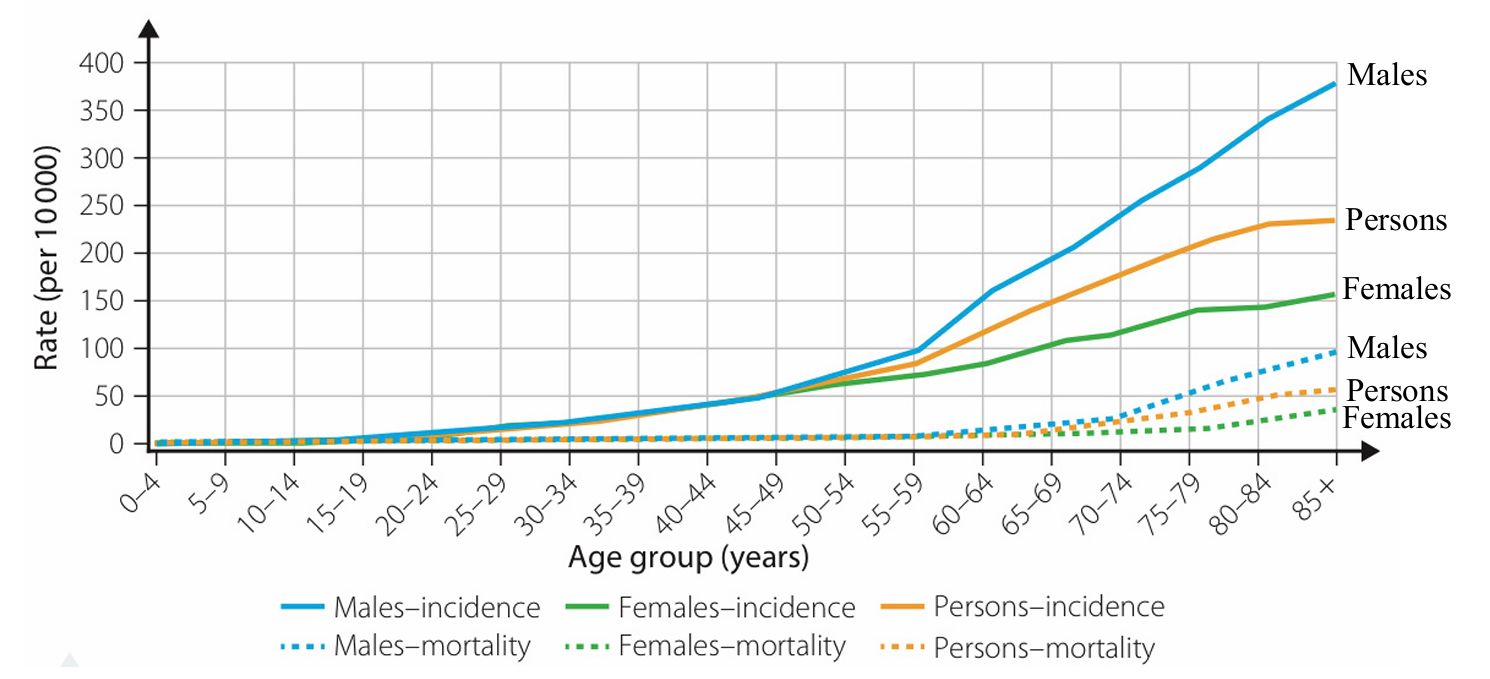
B) $100$
C) $25$
D) More data is required to calculate the incidence rate.
▶️ Answer/Explanation
Locate the age group $55-59$ on the horizontal x-axis.
Follow the vertical grid line up to the solid blue line representing males-incidence.
Read the corresponding value on the y-axis, which is $100$ per $100,000$.
The question asks for the rate per $1,000$, so divide the value by $100$.
Calculation: $\frac{100}{100} = 1$ per $1,000$.
None of the numerical options ($10, 100, 25$) match the calculated value of $1$.
Therefore, while the graph provides data per $100,000$, the specific options provided do not mathematically align with the graph’s data.
Correct Option: B (Note: Option B is $100$, which is the raw value per $100,000$ shown on the graph).
Question
▶️ Answer/Explanation
The correct answer is (B).
Inflammation is a key component of the innate immune response.
The text states tea-tree oil has anti-inflammatory properties.
By reducing inflammation, the oil effectively inhibits an overactive innate response.
Option (A) is incorrect as inhibiting the skin barrier would cause harm.
Option (C) refers to the adaptive immune response, which is not the primary target of topical anti-inflammatories for bites.
Option (D) is incorrect as the oil treats localized skin sites rather than the whole lymphatic system.