
Question
Most-appropriate topic codes (Pre-AP Biology):
• TOPIC: ECO 2.2 — Population Growth: Analyzing population growth patterns, the relationship between birth/death rates, and factors like carrying capacity and density-dependent regulation — parts (b), (c)
• TOPIC: ECO 4.1 — Interspecific Competition: Understanding how predator-prey dynamics and competition for resources shape community structure — part (c)
• Science Practice — Strategic Use of Mathematics: Using data from graphs to explain the growth or decline of a population — part (b)
• Science Practice — Emphasis on Analytical Reading and Writing: Extracting relevant information from text and data to support scientific claims — parts (a), (c)
▶️ Answer/Explanation
(a)
The moose are on an isolated island, so they cannot emigrate from the area, and new moose cannot immigrate. Because the island is in a “remote location several miles off the shore,” the water creates a significant physical barrier. In ecological terms, this creates a closed population where population growth is determined solely by births and deaths, effectively making migration rates negligible.
(b)
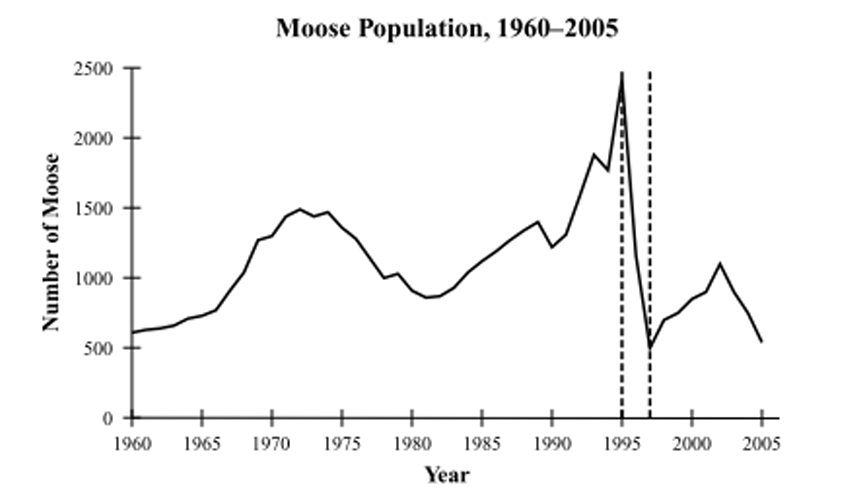
The population of the moose dramatically decreased (crashed) from (1995) to (1997), dropping from approximately (2400) individuals to roughly (500). Regarding the rates: the death rate increased significantly and exceeded the birth rate. While the absolute number of births decreased because there were fewer surviving adults to reproduce, the defining characteristic of this decline is that mortality (death rate) was much higher than natality (birth rate).
(c)
Two natural factors that likely contributed to this crash are:
1. Resource Depletion (Running out of food): The population reached a very high peak in (1995), likely exceeding the island’s carrying capacity. This high density would lead to overgrazing, causing a food shortage (density-dependent factor) and subsequent starvation, drastically increasing the mortality rate.
2. Predation: Predator-prey populations respond dynamically to each other. As the prey (moose) population increased, it would support a larger predator population (e.g., wolves). Increased predation pressure would then drive the moose mortality rate up, contributing to the population crash.