Home / AP® Exam / Pre AP Biology / Exam Style Questions

Pre AP Biology -ECO 4.2 Symbiosis- MCQ Exam Style Questions -New Syllabus

Pre AP Biology -ECO 4.2 Symbiosis- FRQ Exam Style Questions – New Syllabus 2025-2026

Pre AP Biology -ECO 4.2 Symbiosis- FRQ Exam Style Questions – Pre AP Biology – per latest Pre AP Biology Syllabus.

Pre AP Biology – FRQ Exam Style Questions- All Topics

Question

Read these passages from the text and answer the questions that follow.

Ecology of Flatworms

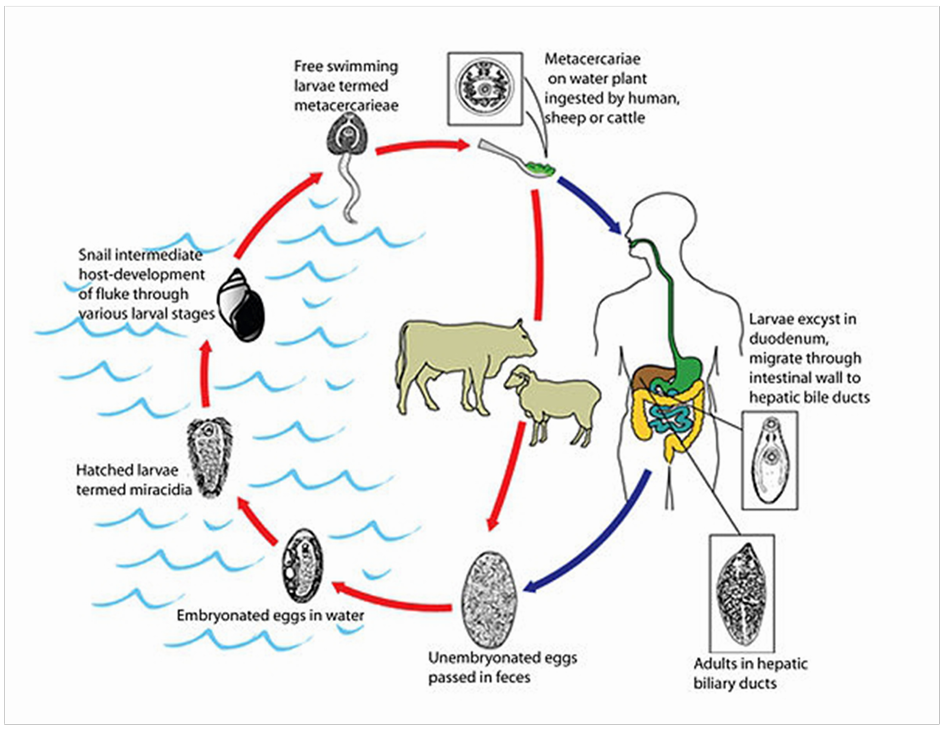
Both flukes and tapeworms are parasites with vertebrate hosts, including human hosts. Flukes live in the host’s circulatory system or liver. Tapeworms live in the host’s digestive system. Usually, more than one type of host is required to complete the parasite’s life cycle. Look at the life cycle of the liver fluke in the diagram below. As an adult, the fluke has a vertebrate host. As a larva, it has an invertebrate host. If you follow the life cycle, you can see how each host becomes infected so the fluke can continue its life cycle.

Life Cycle of the Sheep Liver Fluke. The sheep liver fluke has a complicated life cycle with two hosts.
 
Questions:
(1) What are some major characteristics shared by tapeworms and flukes?
(2) Where does the fluke described in the reading above live in humans?
(3) What is another host of the liver fluke?
(4) When does the fluke live in this host?
(5) How does it get from the human host to this host?

Most-appropriate topic codes (Pre-AP Biology):

TOPIC: ECO 4.2 — Symbiosis: Describing symbiotic relationships (parasitism) where two or more species live closely together — part (1)
TOPIC: CELLS 4.1 — Organ/Tissue Systems: Understanding how organ systems (digestive, circulatory, liver) function in multicellular organisms — part (2)
TOPIC: ECO 2.1 — Population Structure: Identifying the niche and biotic/abiotic resources required for species survival — parts (3), (4)
TOPIC: ECO 1.1 — Hydrologic Cycle: Understanding how water serves as a transport medium for biological life cycles — part (5)
Science Practice — Attention to Modeling: Using a diagrammatic model of a life cycle to explain interactions and relationships in biological systems — context and parts (3), (4), (5)
▶️ Answer/Explanation
Detailed solution

(1)
Answer: Both tapeworms and flukes are flatworms. Both can have a human host at least during some part of their life cycle.
Explanation: The introductory text explicitly states that both organisms are parasites that utilize vertebrate hosts, which includes humans. In biology, this is classified as a parasitic symbiotic relationship where the parasite (symbiont) benefits while harming the host.

(2)
Answer: The liver fluke lives in the liver and circulatory system of humans.
Explanation: According to the passage, flukes specifically target the host’s “circulatory system or liver.” In multicellular organisms like humans, the circulatory system is responsible for transporting oxygen and nutrients to cells.

(3)
Answer: The snail is another host of the liver fluke.
Explanation: The text mentions that as a larva, the fluke has an invertebrate host. By analyzing the provided diagram, we can clearly see the snail labeled as the “intermediate host,” which defines part of its biological niche.

(4)
Answer: The fluke parasitizes the snail during some, but not all, of its larval stages.
Explanation: The passage indicates that the fluke utilizes its invertebrate host specifically “As a larva.” The diagram further supports this by noting that the snail is used for the “development of fluke through various larval stages.”

(5)
Answer: The fluke gets from humans to snails by its eggs being expelled from human feces. After fertilization, the eggs develop into embryos and hatch into larvae in the water. One of the early larval stages finds the snail host, where larval development continues.
Explanation: Following the directional arrows in the diagram reveals the transmission pathway. The cycle shows “Unembryonated eggs passed in feces,” which then become “Embryonated eggs in water.” These hatch into free-swimming larvae (“miracidia”) that subsequently infect the snail to continue their development, highlighting the role of water in the hydrologic cycle for transporting biological material.

Scroll to Top