Home / AP® Exam / Pre AP Biology / Exam Style Questions

Pre AP Biology -ECO 5.2 Human-Induced Changes in Biodiversity- MCQ Exam Style Questions -New Syllabus

Pre AP Biology -ECO 5.2 Human-Induced Changes in Biodiversity- MCQ Exam Style Questions – New Syllabus 2025-2026

Pre AP Biology -ECO 5.2 Human-Induced Changes in Biodiversity- MCQ Exam Style Questions – Pre AP Biology – per latest Pre AP Biology Syllabus.

Pre AP Biology – MCQ Exam Style Questions- All Topics

Question

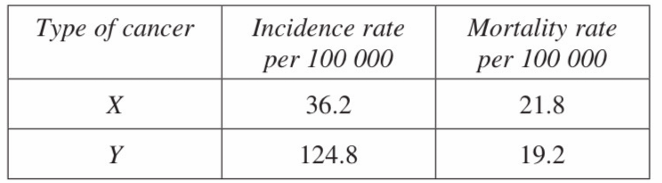
The table shows the incidence rate and mortality rate for two types of cancer ($X$, $Y$) with the highest mortality rate for females in Australia in $2017$.
Which statement best explains why cancer $Y$ has a lower mortality rate than cancer $X$?
(A) Government funding has increased for research into treatment options for cancer $Y$.
(B) Health services have been reoriented so that cancer $Y$ is detected and treated earlier.
(C) Individuals have enhanced their personal skills to effectively address the modifiable risk factors for cancer $Y$.
(D) An increased number of out-patient health services for cancer $Y$ has improved access for the priority population group.
▶️ Answer/Explanation
Detailed solution

Correct Option: (B)
Cancer $Y$ has a significantly higher incidence ($124.8$) but a lower mortality ($19.2$) compared to Cancer $X$.
This suggests a much higher survival rate for those diagnosed with cancer $Y$.
Reorienting health services toward early detection (like screening) is the most effective way to lower mortality despite high incidence.
Early detection allows for medical intervention before the disease progresses to a terminal stage.
Option (A) focuses on treatment research, which may not yet reflect in current population mortality rates.
Option (C) addresses incidence (prevention) rather than mortality (survival after diagnosis).
Option (D) improves access but does not inherently guarantee the clinical outcome of reduced mortality as effectively as early diagnosis.

Question

A remote community is experiencing an outbreak of cholera, a bacterial disease transmitted through contaminated water. Several prevention strategies are considered to control the outbreak. Which of the following strategies would be the most effective at both preventing the spread of the disease and reducing future outbreaks?
(A) Administer antibiotics to all infected individuals to kill the bacteria and stop the outbreak.
(B) Provide vaccines to the population to develop long-term immunity against the cholera bacteria.
(C) Implement strict water sanitation and hygiene practices, including chlorination of water and education on proper sanitation.
(D) Quarantine all infected individuals to prevent them from spreading the bacteria through person-to-person contact.
▶️ Answer/Explanation
Detailed solution

The correct option is (C).
Cholera is primarily a waterborne disease caused by the bacterium Vibrio cholerae.
Sanitation and chlorination directly eliminate the source of infection in the environment.
Improving infrastructure provides a permanent solution that prevents future bacterial contamination.
Antibiotics and quarantine address current cases but do not fix the contaminated water supply.
Vaccines provide immunity but are often less effective than source-water protection for total eradication.
Therefore, hygiene and water treatment are the most effective dual-purpose strategies.

Question

Kudzu was brought into the southeastern United States in the late 1800s and was encouraged for use in controlling erosion. However, in 1972 the USDA declared kudzu to be a weed. Which statement best explains this change in thought?
A. Kudzu grew faster than native species and reduced biodiversity in the area in which it lived.
B. Kudzu formed a mutualistic relationship with native plants and increased biodiversity in the area in which it thrived.
C. Kudzu emitted an odd odor and people disliked how it looked on their property.
D. Kudzu brought diseases from Japan that infected native plants.
▶️ Answer/Explanation
Detailed solution

The correct answer is A.
Kudzu is an invasive species that lacks natural predators in the U.S.
It grows aggressively, often outcompeting and smothering native plants for sunlight.
By displacing native vegetation, it significantly reduces local biodiversity.
A “weed” is typically defined as a plant growing aggressively where it is not wanted.
While it controlled erosion, its ecological damage eventually outweighed its benefits.
This rapid spread and negative impact led to its reclassification by the USDA.

Scroll to Top