Home / AP® Exam / Pre AP Biology / Exam Style Questions

Pre AP Biology -EVO 1.2 Classifying Evolutionary Relationships - MCQ Exam Style Questions -New Syllabus 2025-2026

Pre AP Biology -EVO 1.2 Classifying Evolutionary Relationships – MCQ Exam Style Questions – New Syllabus 2025-2026

Pre AP Biology -EVO 1.2 Classifying Evolutionary Relationships – MCQ Exam Style Questions – Pre AP Biology – per latest Pre AP Biology Syllabus.

Pre AP Biology – MCQ Exam Style Questions- All Topics

Question

Suppose that your friend found a medusa and you want to impress her. Which of these phyla can you correctly tell her that it belongs to?
a. Cnidaria
b. Arthropoda
c. Echinodermata
d. Porifera
▶️ Answer/Explanation
Detailed solution

The correct answer is a. Cnidaria.
A medusa is one of the two primary body forms found in the phylum Cnidaria.
It is characterized by a bell-shaped, free-swimming body with tentacles hanging downward.
Common examples of the medusa form include jellyfish.
The other primary body form in this phylum is the sessile polyp, such as sea anemones.
Phyla like Arthropoda, Echinodermata, and Porifera do not exhibit the medusa body plan.

Question

How many basal phyla do scientists identify?
a. $1$
b. $2$
c. $3$
d. $4$
▶️ Answer/Explanation
Detailed solution

The correct answer is d. $4$.
Basal phyla are those that diverged early from the main animal lineage.
Scientists generally identify $4$ distinct basal animal phyla.
These include Porifera (sponges) and Cnidaria (jellyfish and corals).
They also include Ctenophora (comb jellies) and Placozoa.
These groups lack the complex bilateral symmetry found in Bilateria.
They represent the most primitive branches of the animal phylogenetic tree.

Question

Which of the following are considered to be key innovations in animal evolution?
a. patterns of body symmetry, heterotrophy
b. patterns of body symmetry, presence of different tissues
c. multicellularity, presence of different tissues
d. multicellularity, heterotrophy
▶️ Answer/Explanation
Detailed solution

The correct option is b.
Key innovations refer to traits that evolved within the animal lineage to drive diversification.

Heterotrophy and multicellularity are ancestral traits shared with fungi or protist ancestors.
The evolution of symmetry (radial and bilateral) allowed for directed movement and cephalization.
The development of specialized tissues enabled complex organ systems and physiological division of labor.
These two features distinguishes Parazoa (sponges) from Eumetazoa (true animals).
Therefore, symmetry and tissue differentiation are the primary evolutionary “milestones” listed.

Question

Within which supergroup are animals thought to have evolved?
a. Opisthokonts
b. Rhizaria
c. Stramenopiles
d. Alveolates
▶️ Answer/Explanation
Detailed solution

The correct answer is a. Opisthokonts.
Opisthokonta is a broad group of eukaryotes that includes both the Animal and Fungus kingdoms.
This supergroup is characterized by cells that possess a single posterior flagellum at some point in their life cycle.
Animals are specifically closely related to choanoflagellates, which are protists within this supergroup.
Other groups like Rhizaria or Stramenopiles belong to different eukaryotic lineages (such as the SAR clade).
Molecular evidence and structural similarities confirm that animals share a common ancestor within the Opisthokont lineage.

Question

Suppose you want to convert a phylogenetic tree into a classification. What would you need to identify in order to achieve this?
a. both monophyletic and paraphyletic taxa or lineages
b. paraphyletic taxa or lineages only
c. polyphyletic taxa or lineages only
d. monophyletic taxa or lineages only
▶️ Answer/Explanation
Detailed solution

The correct answer is d. monophyletic taxa or lineages only.
In modern cladistics, a valid biological classification must reflect evolutionary history.
To achieve this, scientists identify monophyletic groups, also known as clades.
A monophyletic group includes a common ancestor and all of its descendants.
Paraphyletic and polyphyletic groups are avoided as they do not represent complete evolutionary lineages.
By naming only monophyletic groups, the classification becomes a direct map of the phylogenetic tree.

Question

If one was to construct a cladogram by applying the parsimony assumption to molecular sequence data, which of these steps would they use?
a. group organisms sharing the least number of ancestral sequences
b. group organisms sharing the largest number of ancestral sequences
c. group organisms that share derived sequences, matching the groups to those defined by morphological characters
d. group organisms sharing derived sequences, minimizing the number of hypothesized evolutionary changes
▶️ Answer/Explanation
Detailed solution

The correct option is d.
Maximum parsimony is a character-based method that seeks the simplest explanation for observed data.
It involves grouping organisms based on shared derived characters (synapomorphies) rather than ancestral ones.
The “parsimony assumption” specifically dictates choosing the tree topology that requires the minimum total number of character state transitions.
In molecular terms, this means selecting the tree that minimizes the number of base substitutions or mutations.
By reducing the number of hypothesized evolutionary changes, researchers avoid unnecessary complexity in the phylogenetic model.
This approach assumes that the most likely evolutionary path is the one involving the fewest independent genetic events.

Question

In a cladistic analysis, a systematist groups together organisms that share which of these types of traits?
a. derived homologous
b. derived homoplasious
c. ancestral homologous
d. ancestral homoplasious
▶️ Answer/Explanation
Detailed solution

The correct answer is a. derived homologous.
Cladistics relies on synapomorphies, which are shared derived characters.
Homologous traits indicate a shared evolutionary ancestry between groups.
Derived traits are those that evolved in the lineage leading to a specific clade.
Ancestral traits (plesiomorphies) are rejected because they do not distinguish sub-groups.
Homoplasious traits are ignored as they result from convergent evolution, not ancestry.
Systematists use these shared derived traits to define monophyletic groups.

Question

Which of these conditions can serve as a molecular clock?
a. sudden differences in mutations accumulated in proteins
b. constant rate of differences in mutations accumulated in proteins
c. differences in mutations accumulated in coding regions of DNA at a reasonably constant rate
d. differences in mutations accumulated in noncoding regions of DNA at a reasonably constant rate
▶️ Answer/Explanation
Detailed solution

The correct option is d.

Molecular clocks rely on the accumulation of mutations over time to estimate evolutionary divergence.
A reliable clock requires a reasonably constant rate of mutation to act as a consistent “ticking” mechanism.
Noncoding regions of DNA are often preferred because they are not subject to intense natural selection.
In these regions, neutral mutations can accumulate without affecting the organism’s fitness.
This allows the number of genetic differences to be proportional to the time since two species shared a common ancestor.
Coding regions and proteins are less ideal as selection pressures can cause sudden changes in mutation rates.

Question

Which of the following portrays a phylogenetic tree of a group of organisms?
a. its classification
b. its evolutionary history
c. its domain
d. its distribution
▶️ Answer/Explanation
Detailed solution

The correct option is b. its evolutionary history.
A phylogenetic tree is a diagram that represents evolutionary relationships among organisms.
It reflects how different species evolved from common ancestors over time.
While classification (a) is related, it is the naming system based on these relationships.
The domain (c) is merely the broadest category of biological classification.
Distribution (d) refers to geographic location, not ancestral lineage.
Therefore, the tree specifically maps out the phylogeny or historical descent of the group.

Question

Which of the following allowed scientists to determine whether or not the $\text{HIV-1}$ and $\text{HIV-2}$ strands of the virus evolved within human hosts?
a. genetic analysis
b. phylogenetic tree analyses
c. molecular phylogenetic analyses
d. molecular genetic analyses
▶️ Answer/Explanation
Detailed solution

The correct answer is c. molecular phylogenetic analyses.
Scientists compared the nucleotide sequences of $\text{HIV-1}$ and $\text{HIV-2}$ with Simian Immunodeficiency Viruses ($\text{SIV}$).
By constructing evolutionary trees, they found $\text{HIV-1}$ is more closely related to $\text{SIV}_{\text{cpz}}$ from chimpanzees.
$\text{HIV-2}$ was found to be more closely related to $\text{SIV}_{\text{sm}}$ from sooty mangabeys.
These trees showed the viruses entered humans multiple times from non-human primates.
Therefore, the analysis proved the virus did not evolve its distinct strands within human hosts.
This specific method of using molecular data to determine evolutionary history is known as molecular phylogenetics.

Question

The historic eradication of malaria (transmitted by some mosquitoes) in Europe owed a debt to which of the following?
b. systematics
c. ecology
d. artificial selection
e. natural life cycle of mosquitoes
▶️ Answer/Explanation
Detailed solution

The correct answer is b. systematics.
Systematics allowed researchers to distinguish between identical-looking mosquito species.
It was discovered that only specific members of the Anopheles maculipennis complex transmitted malaria.
Some species lived in brackish water, while others lived in fresh water or fed on livestock instead of humans.
By identifying these specific vectors, control efforts were accurately targeted rather than wasted.
This precise biological classification was essential for the successful eradication of the disease in Europe.

Question

Which of these statements best describes genome size?
(a) Bacteria have genomes that vary widely in size.
(b) The human genome is the largest among eukaryotes.
(c) Organisms with large genomes tend to be more complex than organisms with small genomes.
(d) As genome size increases in a lineage, the number of genes also always increases.
▶️ Answer/Explanation
Detailed solution

The correct option is (a).
Bacteria exhibit a vast diversity in genome size, ranging from approximately $1.6 \times 10^5$ to over $1.0 \times 10^7$ base pairs.
Option (b) is incorrect as many plants and amphibians have genomes much larger than the $3.2 \times 10^9$ base pairs found in humans.
Option (c) is false due to the C-value paradox, where genome size does not correlate with biological complexity.
Option (d) is incorrect because large eukaryotic genomes often consist of non-coding repetitive DNA rather than a higher count of functional genes.
Therefore, the wide variation in bacterial genome sizes is the most accurate biological description among the choices.

Questions

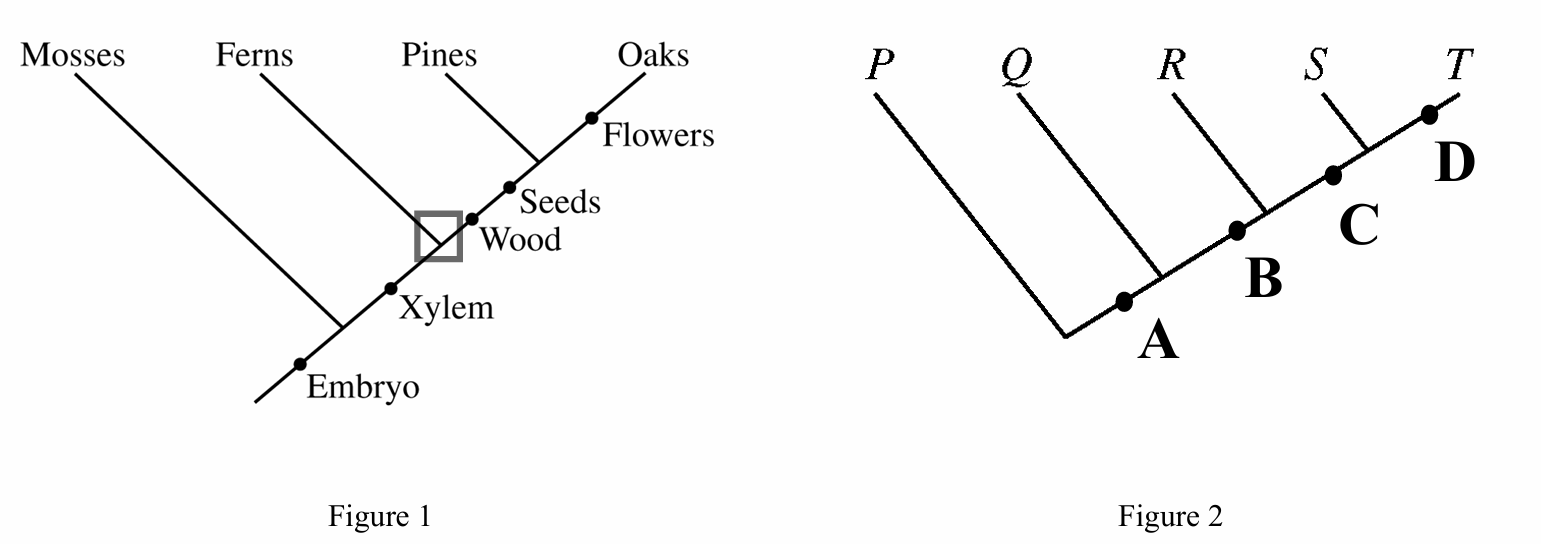
Q. Based on the cladogram in Figure 1, which of the following trait(s) is/are shared between ferns and pines, but not mosses?
A. Xylem only
B. Seeds and wood only
C. Embryo and xylem only
D. Embryo, xylem, wood, and seeds
 
Q. For the cladogram in Figure 1, which of the following species is the outgroup?
A. Mosses
B. Ferns
C. Pines
D. Oaks
 
Q. If the node in the box shown in Figure 1 represents a common ancestor, which of the following two species does the box represent the most recent common ancestor of?
A. Mosses and Ferns
B. Ferns and Pines
C. Pines and Oaks
D. Oaks and Mosses
 
Q. Which of the following conclusions is best supported by the cladogram in Figure 2?
A. Species \(P\) and \(Q\) are equally related to species \(T\).
B. Species \(P\) and \(T\) do not share a common ancestor.
C. Species \(S\) evolved from species \(R\).
D. Species \(S\) is more closely related to species \(T\) than to species \(R\).
 
Q. Which of the following is true regarding the cladogram in Figure 2?
A. Characteristic A is the newest, most derived trait.
B. Characteristic B is found in species \(Q\), \(R\), \(S\), and \(T\), but not in species \(P\).
C. Characteristic D is the most ancestral trait.
D. Characteristic C is more derived than characteristic B.
▶️ Answer/Explanation
Detailed solution
A. Answer: A
The cladogram shows the evolutionary order of traits relative to the branching of species.
The trait Xylem appears on the main line after the Mosses branch off but before the Ferns branch off.
This means Mosses do not possess Xylem (ancestral state), while Ferns and all subsequent lineages (Pines, Oaks) do possess Xylem.
Traits like Wood and Seeds appear later, after Ferns have branched off, so Ferns do not share them with Pines.
Therefore, Xylem is the only trait listed that is shared by Ferns and Pines but excluded from Mosses.
A. Answer: A
An outgroup is a group that branches off from the evolutionary lineage before the other groups (the ingroup).
In Figure 1, the lineage leading to Mosses is the first to diverge from the main stem (bottom left).
This position indicates that Mosses are the outgroup relative to the clade containing Ferns, Pines, and Oaks.
A. Answer: B
The boxed node represents a branching point (speciation event).
This specific node is the point where the lineage leading to Ferns diverges from the lineage leading to Pines and Oaks.
Therefore, this node represents the most recent common ancestor of the two groups that emerge from it: Ferns and Pines.
(Note: While it is also the ancestor of Oaks, “Ferns and Pines” is the correct pair representing the immediate split at that node).
A. Answer: D
Cladograms depict relatedness based on common ancestry.
Species \(S\) and species \(T\) share a common ancestor at the node located after trait \(B\) evolved.
Species \(S\) and species \(R\) share a more distant common ancestor at the node before trait \(B\) evolved.
Since \(S\) and \(T\) share a more recent node than \(S\) and \(R\), Species \(S\) is more closely related to species \(T\).
A. Answer: D
“Derived” in cladistics refers to a trait that evolved later (more recently) relative to ancestral traits.
Looking at the timeline of the cladogram from left (ancestral) to right (recent):
Trait \(B\) appears on the main line before the divergence of species \(S\).
Trait \(C\) appears on the line leading to species \(T\), after the divergence of species \(S\).
Since \(C\) appears later in the evolutionary sequence than \(B\), Characteristic \(C\) is more derived than characteristic \(B\).
Question

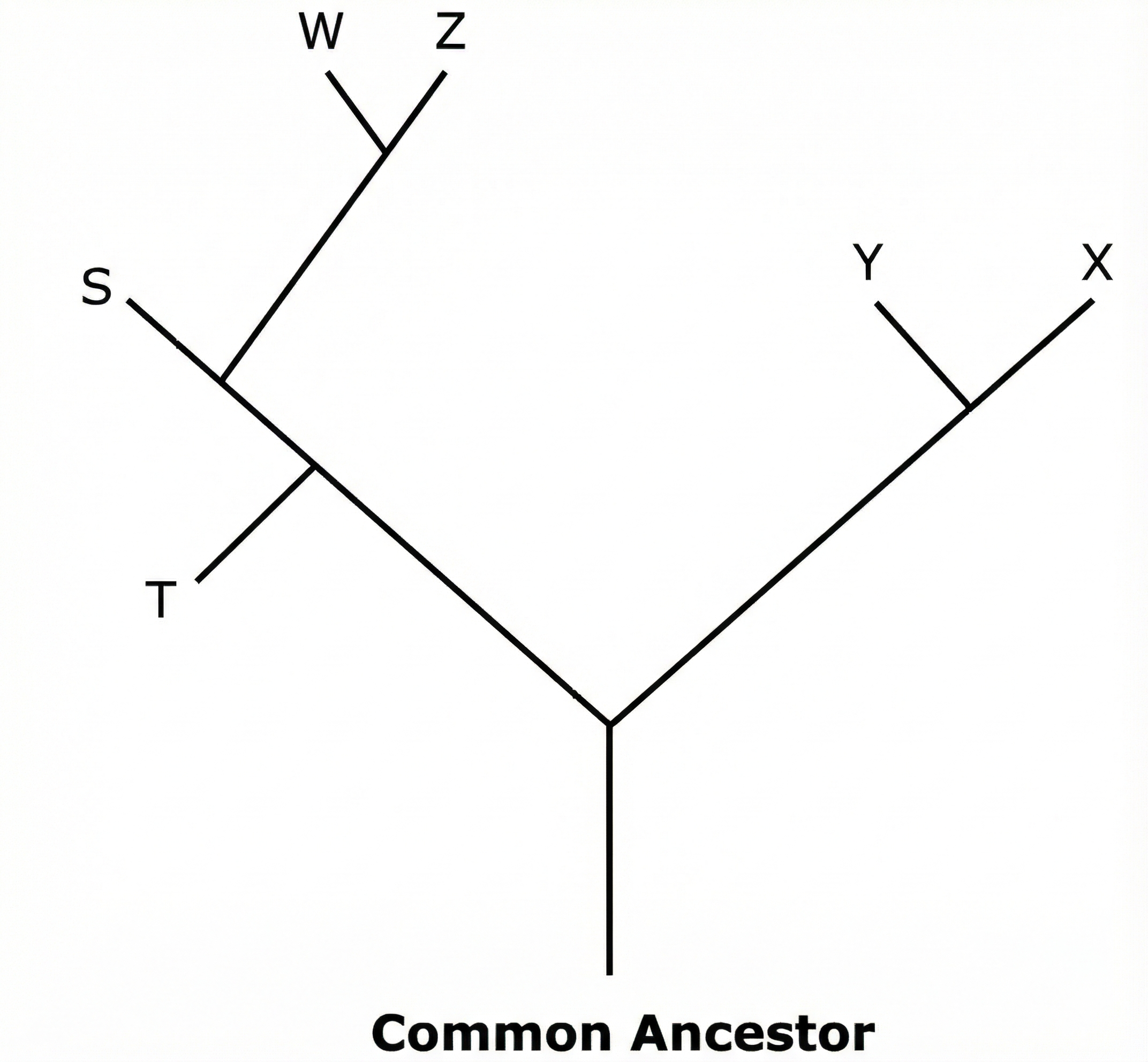
Fossils were discovered by scientists for each of the organisms in this phylogenetic tree.
Which organism is most likely the oldest?
A. organism $S$
B. organism $T$
C. organism $W$
D. organism $Y$
▶️ Answer/Explanation
Correct Answer: B (organism $T$)
Detailed solution

In a phylogenetic tree, the vertical or diagonal axis typically represents time.
The base of the tree represents the common ancestor, which is the furthest point in the past.
Organisms that branch off closer to the root (the bottom) appeared earlier in evolutionary history.
Looking at the diagram, the branch for organism $T$ is the first to diverge from the main lineage.
Because it splits off at the lowest point relative to the others, its fossil would be the oldest.
Organisms like $W$, $Z$, $X$, and $Y$ appear at higher nodes, indicating they evolved more recently.
Question

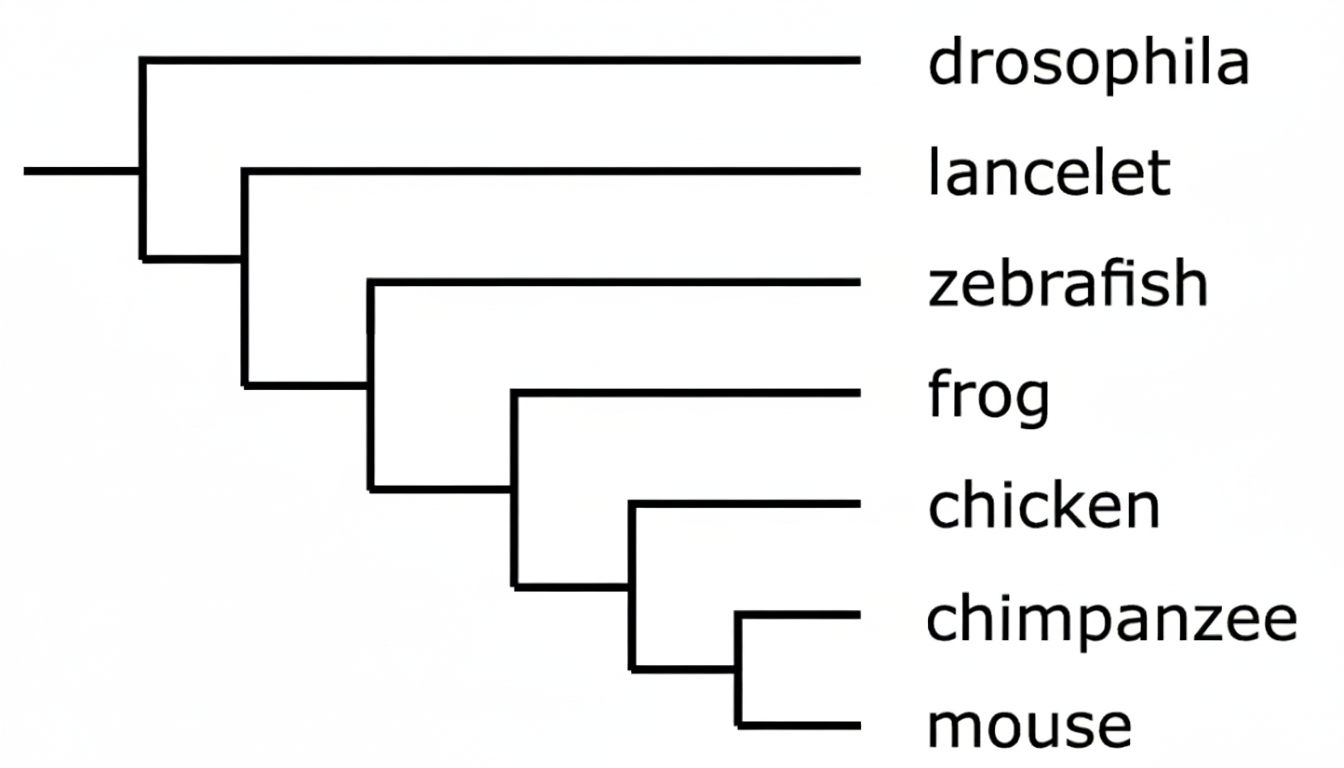
This is a phylogenetic tree.
Based on the phylogenetic tree, which two organisms share the most recent common ancestor?
A. drosophila and lancelet
B. frog and chicken
C. chicken and mouse
D. chimpanzee and frog
▶️ Answer/Explanation
Detailed solution

The correct answer is C.
In a phylogenetic tree, the most recent common ancestor is represented by the node (branching point) closest to the tips.
The node connecting the chicken and the mouse is further to the right than the nodes for other pairs listed.
Specifically, the chimpanzee and mouse share the most recent ancestor overall.
Among the given choices, the chicken and mouse share a more recent ancestor than frogs/chickens or drosophila/lancelets.
This indicates a more recent evolutionary divergence and closer genetic relationship.
Therefore, option C is the most accurate choice based on the branching structure provided.

Scroll to Top