
Pre AP Biology -EVO 2.1 Natural Selection Theory- MCQ Exam Style Questions -New Syllabus 2025-2026
Pre AP Biology -EVO 2.1 Natural Selection Theory- MCQ Exam Style Questions – New Syllabus 2025-2026
Pre AP Biology -EVO 2.1 Natural Selection Theory- MCQ Exam Style Questions – Pre AP Biology – per latest Pre AP Biology Syllabus.
Question
b. conifers
c. liverworts
d. seedless vascular plants
▶️ Answer/Explanation
The correct option is d. seedless vascular plants.
True roots contain vascular tissue ($xylem$ and $phloem$) for transport.
Mosses and liverworts are non-vascular and possess $rhizoids$ instead of true roots.
Seedless vascular plants (like ferns) were the first to evolve these specialized structures.
Conifers evolved much later in the evolutionary timeline than seedless vascular plants.
Therefore, the transition to a dominant $sporophyte$ led to the first appearance of true roots in this group.
Question
▶️ Answer/Explanation
The correct answer is b.
Antheridia are male gametangia that produce sperm in bryophytes and seedless vascular plants.
In seed plants ($gymnosperms$ and $angiosperms$), the male gametophyte is highly reduced.
Seed plants produce pollen grains rather than distinct, multicellular antheridia.
Therefore, antheridia are present in all land plant lineages except for the seed-bearing ones.
This makes statement b the most accurate description of their distribution.
Question
▶️ Answer/Explanation
The correct option is c.
Archegonia are multicellular structures that produce and contain the female gamete (egg).
They are present in bryophytes (nonvascular plants) and pteridophytes (ferns).
In seed plants, they are found in gymnosperms, though they are highly reduced.
Angiosperms (flowering plants) have lost the archegonia entirely during evolution.
In angiosperms, the female gametophyte is the embryo sac, which lacks archegonia.
Therefore, they are found in all land plants except for the angiosperms.
Question
▶️ Answer/Explanation
The correct option is c.
Early land plants required water for fertilization as they had motile (swimming) sperm.
Evolution led to nonmotile gametes (like pollen) to facilitate reproduction without surface water.
Option a is incorrect because plants evolved toward having seeds, not away from them.
Option b is incorrect as many advanced plants are heterosporous, producing two types of spores.
Option d is incorrect because the diploid (\(2n\)) sporophyte became the dominant generation.
This transition allowed plants to colonize diverse terrestrial environments successfully.
Question
▶️ Answer/Explanation
The correct answer is c.
This phenomenon is a classic example of the founder effect, a type of genetic drift.
The Amish population was established by a small number of German settlers in the $18^{th}$ century.
By chance, at least one “founder” carried the recessive allele for Ellis–van Creveld syndrome.
Because the community is genetically isolated, the allele frequency remains high.
Inbreeding within the small group increases the probability of offspring inheriting two recessive alleles.
Options a, b, and d describe gene flow, natural selection, and sexual selection, which do not apply here.
Question
▶️ Answer/Explanation
The correct option is c.
The neutral theory of molecular evolution suggests that most evolutionary changes occur at the molecular level.
It proposes that the vast majority of genetic variation within and between species is neutral.
This means these mutations do not provide a selective advantage or disadvantage to the organism.
Consequently, these mutations do not significantly alter the organismal fitness ($w$).
Evolutionary change in these instances is driven by genetic drift rather than natural selection.
While harmful mutations occur, they are quickly removed and do not contribute to long-term polymorphism.
Question
▶️ Answer/Explanation
The correct answer is b. genetic drift.
Genetic drift refers to random fluctuations in allele frequencies within a population.
It is driven by chance events rather than natural selection or environmental fit.
This process is particularly impactful in small populations where random deaths or births significantly shift the gene pool.
Unlike gene flow, which involves migration, drift occurs purely due to sampling error over generations.
Two common examples of this phenomenon include the bottleneck effect and the founder effect.
Question
b. founder effect
c. heterozygote advantage
d. adaptation
▶️ Answer/Explanation
The correct option is d. adaptation.
An adaptation is a heritable trait that maintained and evolved by means of natural selection.
It enhances the survival and reproductive success (fitness) of an organism in its environment.
While a mutation (a) provides the raw genetic variation, it is not always beneficial.
The founder effect (b) refers to a loss of genetic variation when a new population is established.
Heterozygote advantage (c) describes a specific case where the fitness of a heterozygote is higher than homozygotes.
Therefore, the general term for a fitness-increasing characteristic is an adaptation.
Question
b. Changes that an organism acquires during its lifetime are passed to its offspring.
c. All species change with time.
d. Changes are passed from one generation to the next.
▶️ Answer/Explanation
The correct answer is b.
Lamarck proposed the inheritance of acquired characteristics, suggesting physical changes gained during life are inherited.
Darwin’s theory of natural selection rejected this, focusing instead on variations present at birth.
Darwin emphasized that only heritable traits already existing in the population contribute to evolution.
Both scientists agreed that species change over time and respond to their environments.
However, the mechanism of passing on acquired traits is unique to Lamarckism and excluded by Darwin.
Modern genetics later confirmed that somatic changes (acquired traits) do not alter the germline DNA.
Question
▶️ Answer/Explanation
The correct option is d.
Jean-Baptiste Lamarck proposed the theory of inheritance of acquired characteristics.
He suggested that an organism can pass on traits acquired through use and disuse during its lifetime to its offspring.
This implies that physical changes driven by environmental needs are directly inheritable.
Options a, b, and c represent ideas largely rejected by Lamarck’s evolutionary framework.
While his mechanism was later proven incorrect by modern genetics, he was a pioneer in suggesting that species change over time.
Question
▶️ Answer/Explanation
The correct answer is c. individuals; populations.
Natural selection acts directly on individuals based on their specific phenotypes.
Individual organisms either survive and reproduce or fail to do so.
However, an individual does not evolve during its own lifetime.
The consequences (evolutionary changes) are seen in the population over time.
This is measured by changes in allele frequencies across generations.
Therefore, while individuals are selected, it is the population that evolves.
Question
B. Homologous Structure
C. Vestigial Structure
D. Analogous Structure
▶️ Answer/Explanation
The correct answer is A. Adaptation.
An adaptation is a genetically controlled trait that increases an individual’s fitness.
Fitness is defined as the ability to survive and reproduce in a specific environment.
These traits are passed to offspring, allowing the population to evolve over time.
Homologous, vestigial, and analogous structures are evidences of evolution, not the trait itself.
Natural selection acts on these variations to favor those that provide a functional advantage.
Question
B. Penguins did not use their wings for long periods of time. The disuse caused today’s penguins to have only tiny, nonfunctional wings.
C. Ancestral penguins without large wings were better able to swim and feed in the water; therefore they passed their genes for shorter wing structure on to their offspring.
D. A penguin’s wing is a vestigial structure, which means that penguins still have the ability to fly today, but choose not to anymore because it isn’t evolutionarily beneficial.
▶️ Answer/Explanation
The correct explanation relies on the principles of natural selection.
Options A and B incorrectly describe Lamarckian evolution, where acquired traits or disuse are inherited.
Option C correctly identifies that individuals with shorter wings had a survival advantage in aquatic environments.
These individuals were more successful at feeding, leading to higher differential reproduction.
Over generations, the frequency of alleles for shorter, paddle-like wings increased in the population.
Option D is incorrect because “vestigial” does not mean an organism “chooses” not to use a functional ability.
Evolution acts on heritable genetic variation rather than individual effort or choice.
Question
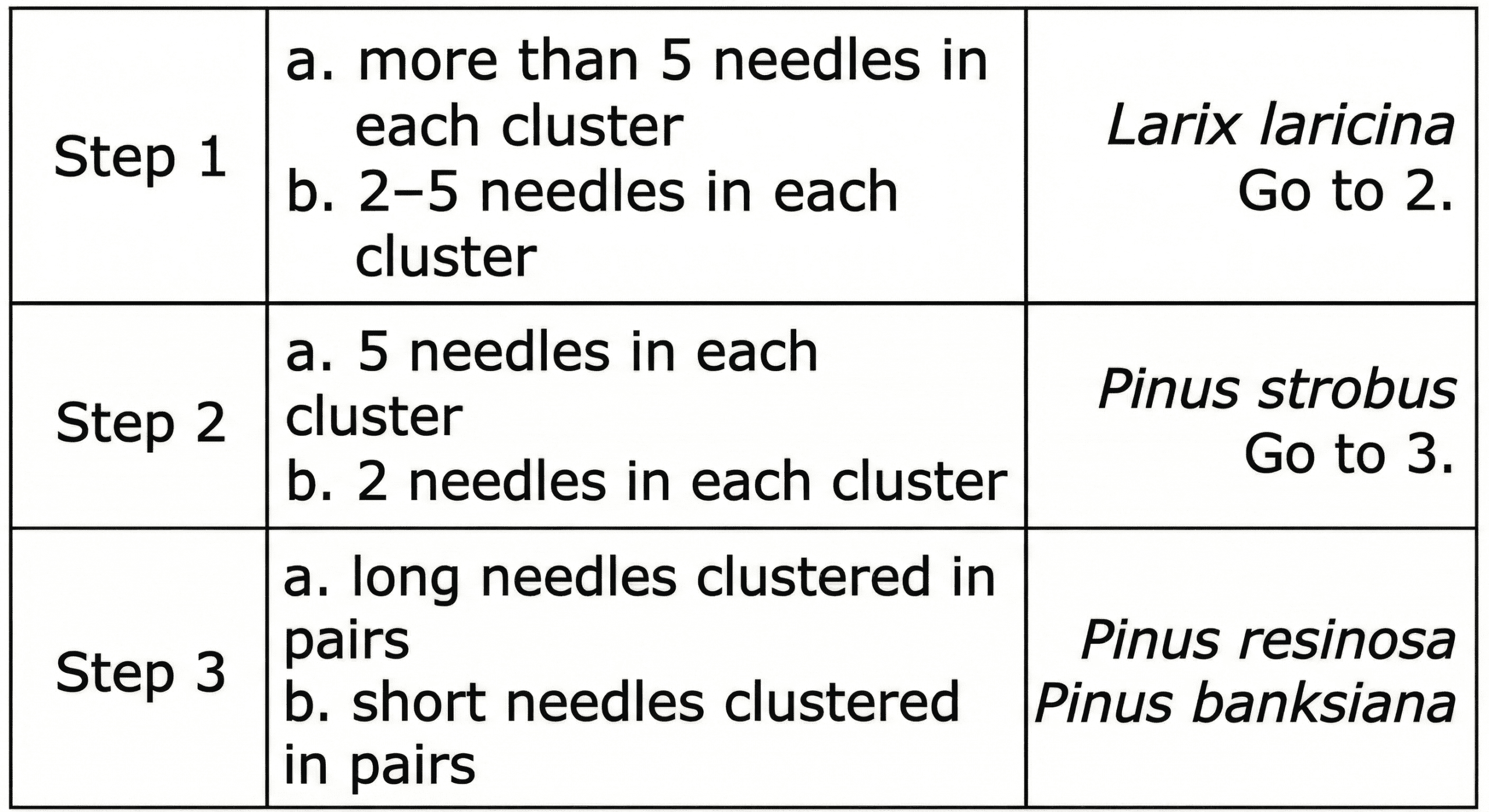
This is a dichotomous key used to identify coniferous tree species.
The diagrams below show four different species of coniferous tree: 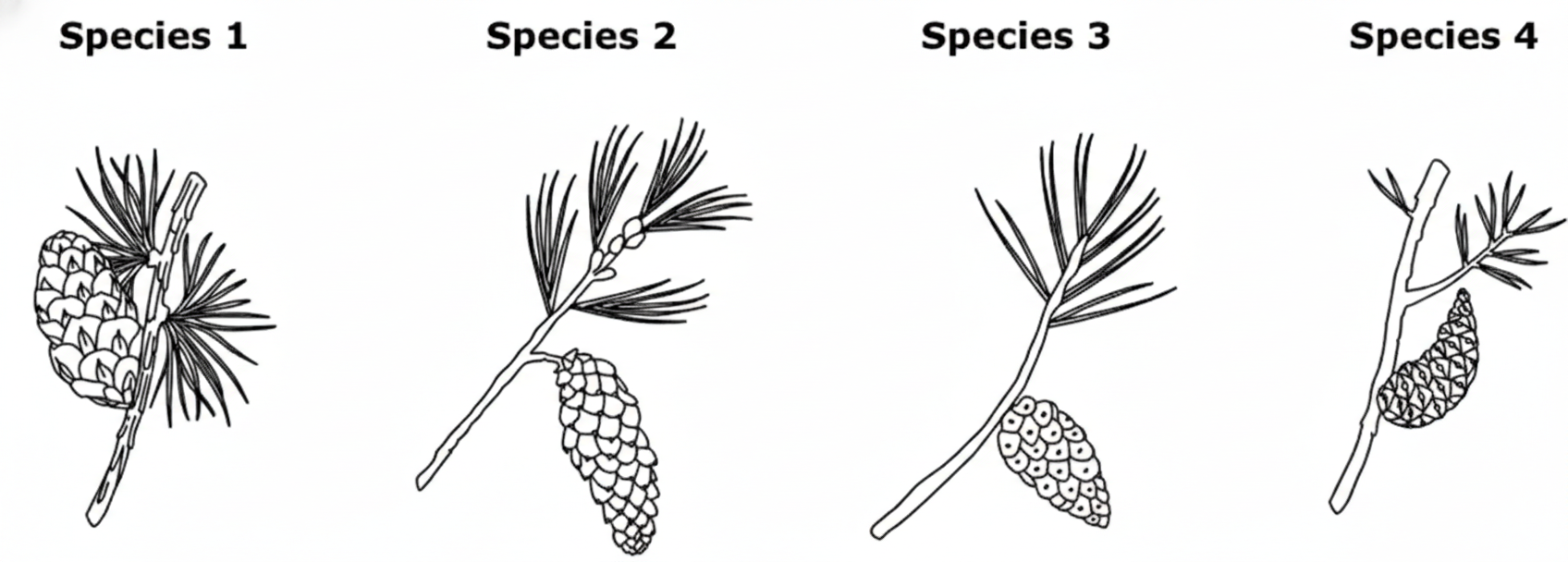
Using the dichotomous key and the tree descriptions, identify the correct scientific names for Species \(1\), \(2\), \(3\), and \(4\).
B. Species \(1\): Pinus strobus; Species \(2\): Larix laricina; Species \(3\): Pinus resinosa; Species \(4\): Pinus banksiana
C. Species \(1\): Pinus banksiana; Species \(2\): Pinus strobus; Species \(3\): Larix laricina; Species \(4\): Pinus resinosa
D. Species \(1\): Larix laricina; Species \(2\): Pinus strobus; Species \(3\): Pinus banksiana; Species \(4\): Pinus resinosa
▶️ Answer/Explanation
The correct option is (B).
Species \(1\) has \(5\) needles per cluster. Following the key: Step \(1b\) (\(2-5\) needles) \(\rightarrow\) Go to \(2\) \(\rightarrow\) Step \(2a\) (\(5\) needles) identifies it as Pinus strobus.
Species \(2\) has clusters with more than \(5\) needles. Following the key: Step \(1a\) (more than \(5\) needles) identifies it as Larix laricina.
Species \(3\) has long needles in pairs (\(2\)). Following the key: Step \(1b\) \(\rightarrow\) Step \(2b\) (\(2\) needles) \(\rightarrow\) Go to \(3\) \(\rightarrow\) Step \(3a\) (long needles) identifies it as Pinus resinosa.
Species \(4\) has short needles in pairs (\(2\)). Following the key: Step \(1b\) \(\rightarrow\) Step \(2b\) \(\rightarrow\) Step \(3b\) (short needles) identifies it as Pinus banksiana.