
Pre AP Biology -EVO 2.2 Selective Mechanisms- MCQ Exam Style Questions -New Syllabus 2025-2026
Pre AP Biology -EVO 2.2 Selective Mechanisms- MCQ Exam Style Questions – New Syllabus 2025-2026
Pre AP Biology -EVO 2.2 Selective Mechanisms- MCQ Exam Style Questions – Pre AP Biology – per latest Pre AP Biology Syllabus.
Question
b. $3$
c. at least $5$
d. at least $8$
▶️ Answer/Explanation
The correct answer is c. at least $5$.
Scientists widely recognize the “Big Five” mass extinction events in the Phanerozoic Eon.
The first was the Ordovician-Silurian extinction approximately $444$ million years ago.
The second was the Late Devonian extinction around $365$ million years ago.
The third was the Permian-Triassic extinction, the largest, roughly $252$ million years ago.
The fourth was the Triassic-Jurassic extinction about $201$ million years ago.
The fifth was the Cretaceous-Paleogene extinction that wiped out the dinosaurs $66$ million years ago.
The Anthropocene is often suggested as the period of the “Sixth Mass Extinction” caused by human activity.
Question
▶️ Answer/Explanation
The correct option is d.
Henry Bates is famous for identifying Batesian mimicry.
In this biological phenomenon, a harmless species evolves to imitate a harmful species.
The yellow jacket serves as the “model” because it is venomous and avoided by predators.
The fly acts as the “mimic,” gaining protection by looking like the dangerous yellow jacket.
Predators mistake the fly for a stinging insect and choose not to eat it.
Therefore, Bates would conclude the harmless fly resembles the venomous yellow jacket.
Question
b. Malpighian tubules
c. wings
d. metamorphosis
▶️ Answer/Explanation
Insects and plants have undergone extensive coevolution, particularly regarding pollination and herbivory.
Mouthparts are highly specialized structures that have evolved to match specific plant morphologies.
For instance, long proboscises in moths or bees correspond to the depth of specific floral tubes.
This specialization ensures that the insect receives nectar while effectively transferring pollen.
Other options like Malpighian tubules relate to excretion and do not directly drive plant coevolution.
Therefore, modifications in mouthparts represent a primary mechanism for mutualistic adaptation between the two groups.
Question
b. dependence on moist environments
c. dependence on shade
d. decreased photosynthesis
▶️ Answer/Explanation
The correct answer is b. dependence on moist environments.
Seedless vascular plants, such as ferns, possess vascular tissue which allows them to grow taller than bryophytes.
However, they still rely on flagellated sperm for reproduction.
These sperm must swim through a film of water to reach the egg for fertilization.
Because of this requirement, these plants are restricted to moist or damp habitats.
Unlike seed plants, they cannot reproduce effectively in very arid conditions.
Therefore, water availability remains a primary environmental constraint.
Question
▶️ Answer/Explanation
The correct answer is b. sexual reproductive structures.
Traditional fungal taxonomy is based primarily on the morphology of the spore-producing structures formed during sexual reproduction.
For example, Zygomycota are characterized by the formation of a thick-walled $zygospore$.
Ascomycota (sac fungi) are defined by the production of sexual spores within a microscopic sac called an $ascus$.
Basidiomycota (club fungi) produce sexual spores externally on a club-shaped structure known as a $basidium$.
While cell walls contain chitin in nearly all fungi, this feature does not vary enough to distinguish between major phyla.
Nutritional methods and water adaptations are also generally consistent across the kingdom and are not primary taxonomic markers.
Question
b. heterozygote advantage
c. neutral selection
d. stabilizing selection
▶️ Answer/Explanation
The correct answer is b. heterozygote advantage.
Individuals with the heterozygous genotype ($Hb^A Hb^S$) show greater fitness than both homozygotes.
Homozygous normal individuals ($Hb^A Hb^A$) are highly susceptible to severe malaria.
Homozygous recessive individuals ($Hb^S Hb^S$) suffer from debilitating sickle cell anemia.
Heterozygotes possess enough normal hemoglobin to function while gaining resistance to malaria.
Natural selection preserves the $Hb^S$ allele in the population because of this survival benefit.
This specific type of selection leads to a state known as balanced polymorphism.
Question
▶️ Answer/Explanation
The correct answer is a. natural selection.
This scenario describes heterozygote advantage, a specific mechanism of natural selection.
While the $HbS/HbS$ genotype is lethal, $HbS/HbA$ individuals have a higher survival rate in malaria-prone regions.
These heterozygotes are more resistant to malaria than homozygous $HbA/HbA$ individuals.
Because they survive and reproduce more effectively, the $HbS$ allele is maintained in the population.
Therefore, the high frequency of a “harmful” allele is driven by selective environmental pressures.
This process ensures the “fittest” genotypes for that specific environment are preserved.
Question
▶️ Answer/Explanation
The correct answer is c.
Directional selection occurs when environmental changes favor individuals at one extreme of a phenotypic range.
Sexual selection often functions similarly by favoring specific extreme traits (like long tails or bright colors) that increase mating success.
Both processes result in a shift of the population’s observed traits (phenotypes) in a specific direction over time.
Unlike stabilizing selection, these do not favor the average or mean individuals.
Selection acts directly on the phenotype (the physical expression) rather than the genotype itself.
Therefore, both modes of selection effectively push phenotypes toward one extreme of the distribution.
Question
b. stabilizing
c. disruptive
d. artificial
▶️ Answer/Explanation
The correct answer is a. directional.
In this scenario, the storm acts as a selective pressure against one extreme phenotype (small size).
Because small sparrows are killed at a higher rate, the survival of medium and large sparrows is favored.
This causes the allele frequency to shift toward the larger end of the size spectrum.
Unlike stabilizing selection, which favors the average, this process moves the population mean in one specific direction.
Therefore, the population undergoes directional selection toward a larger body size.
Question
▶️ Answer/Explanation
The correct option is d.
Spontaneous mutation rates are extremely low, typically occurring at a rate of $10^{-5}$ to $10^{-8}$ per gene per generation.
In a large population, a single new mutation represents a negligible fraction of the total gene pool.
Because the frequency of the existing nonmutated alleles is so high, one new allele does not significantly shift the overall ratio.
While mutation is the ultimate source of genetic variation, it is a very weak force for changing allele frequencies on its own.
Other evolutionary forces like natural selection or genetic drift are required to spread a mutation through a population.
Question
B. The barking prairie dog chooses to warn other prairie dogs, leading to more prairie dogs living above ground.
C. The barking prairie dog is alerting unrelated prairie dogs to the predator, so it is not giving any advantage to its own relatives.
D. The failure of the individual to bark when surrounded by unrelated prairie dogs ensures survival of the individual.
▶️ Answer/Explanation
The correct option is A.
This behavior is an example of kin selection, where an individual’s altruistic act benefits relatives.
By barking, the individual increases the inclusive fitness of its genetic lineage.
The survival of relatives ensures that shared genes are passed to the next generation.
The probability of barking increases when the coefficient of relatedness ($r$) is higher.
Natural selection favors traits that improve the reproductive success of the family unit.
Option D describes a result of the behavior but does not provide the primary evolutionary explanation for the bark itself.
Question
▶️ Answer/Explanation
Correct Option: C
Prezygotic isolation prevents the formation of a zygote entirely.
Option C describes temporal isolation, where species mate at different times.
Since they do not mate simultaneously, no fertilization or zygote formation occurs.
Option A is postzygotic because it involves hybrid inviability (embryonic mortality).
Option B is postzygotic because it involves hybrid sterility (non-functional pollen).
Option D is postzygotic because it involves hybrid sterility (sterile offspring like mules).
Question
B. The founder effect and allopatric speciation.
C. Gametic isolation and allopatric speciation.
D. Sexual selection, mutation, and sympatric speciation.
▶️ Answer/Explanation
The correct answer is B.
The “raft of ants” represents a small group starting a new population, known as the founder effect.
This is a specific type of genetic drift occurring when a few individuals colonize a new area.
The physical distance preventing the groups from meeting creates geographic isolation.
Evolution occurring due to geographic separation is termed allopatric speciation.
Sympatric speciation is incorrect because it occurs without physical barriers.
The “bottleneck effect” usually refers to a population crash rather than colonization of a new area.
Question
B. Mechanical isolation
C. Behavioral isolation
D. Temporal isolation
▶️ Answer/Explanation
The correct answer is C. Behavioral isolation.
Behavioral isolation is a prezygotic barrier based on unique courtship rituals.
Gentoo penguins use the specific action of presenting a pebble to attract mates.
Emperor penguins rely on distinct vocal calls and physical movements.
These unique signals ensure that individuals only mate with members of their own species.
Other options like temporal (timing) or mechanical (physical compatibility) do not apply here.
This mechanism prevents interbreeding by ensuring mate recognition through specific behaviors.
Question
B. The recessive alleles will be selected against.
C. The recessive alleles will be maintained at the same frequency.
D. The recessive alleles will become dominant.
▶️ Answer/Explanation
Hardy-Weinberg equilibrium describes a non-evolving population where allele frequencies remain constant over generations.
The model assumes no mutation, no gene flow, no natural selection, random mating, and a large population size.
In this state, the frequency of the dominant allele $p$ and the recessive allele $q$ must satisfy $p + q = 1$.
Because there is no selective pressure (Natural Selection), the recessive alleles are not “lost” or “selected against.”
Inheritance alone, through the reshuffling of alleles in sexual reproduction, does not change the gene pool frequencies.
Therefore, the frequency of the recessive allele $q$ will remain identical from one generation to the next.
Options A, B, and D all imply evolutionary change, which contradicts the fundamental definition of equilibrium.
Question
B. $0.01$
C. $0.9$
D. $0.09$
▶️ Answer/Explanation
The frequency of the homozygous recessive phenotype ($ww$) is $q^2 = \frac{9}{900} = 0.01$.
To find the frequency of the recessive allele $w$, take the square root: $q = \sqrt{0.01} = 0.1$.
In Hardy-Weinberg equilibrium, the sum of allele frequencies is $p + q = 1$.
Therefore, the frequency of the dominant allele $W$ is $p = 1 – q$.
Calculation: $p = 1 – 0.1 = 0.9$.
The frequency of the $W$ allele is $0.9$.
The correct option is C.
Question
B. $0.69$
C. $0.52$
D. $0.12$
▶️ Answer/Explanation
The frequency of the dominant allele is $p = 0.19$.
The frequency of the recessive allele is $q = 0.81$.
The Hardy-Weinberg formula for genotypes is $p^2 + 2pq + q^2 = 1$.
Heterozygous individuals are represented by the term $2pq$.
Calculation: $2 \times 0.19 \times 0.81 = 0.3078$.
Rounding to two decimal places, the frequency is $0.31$.
To find the percentage: $0.31 \times 100 = 31\%$.
Therefore, the correct option is A.
Question
B. Large population size
C. No migration of individuals into or out of the population (gene flow)
D. Natural selection must occur
▶️ Answer/Explanation
The correct answer is D.
Hardy-Weinberg equilibrium describes a theoretical state where allele frequencies remain constant over generations.
For this equilibrium to hold, no natural selection can occur, as selection favors certain alleles over others.
Condition A (Random mating) ensures that gametes mix without preference.
Condition B (Large population) prevents chance fluctuations in allele frequencies, known as genetic drift.
Condition C (No migration) ensures that no new alleles are introduced or lost via gene flow.
In contrast, if natural selection occurs, the population will evolve, breaking the equilibrium $p + q = 1$ and $p^2 + 2pq + q^2 = 1$.
Question
▶️ Answer/Explanation
The correct option is C. Genetic equilibrium.
Genetic equilibrium occurs when the allele frequencies in a gene pool remain constant over generations.
This state is described by the Hardy-Weinberg principle, represented by $p + q = 1$.
Even if genotype frequencies ($p^2, 2pq, q^2$) shift temporarily, the total frequency of alleles remains stable.
A bottleneck effect or founder effect would cause a drastic change in these frequencies.
Gene flow involves the transfer of alleles into or out of a population, which disrupts the steady state.
Therefore, a population with no change in allele frequency is in genetic equilibrium.
Question
B. Natural selection
C. Stabilizing selection
D. Artificial selection
▶️ Answer/Explanation
The correct answer is D. Artificial selection.
Artificial selection occurs when humans intervene in breeding to select specific phenotypic traits.
Unlike natural selection, the “fitness” of an individual is determined by human preference rather than environmental survival.
This process is commonly used in agriculture to increase crop yields and in animal husbandry for specific breeds.
In this context, the selective pressure is anthropogenic (human-derived) rather than ecological.
Options A, B, and C refer to mechanisms driven by environmental factors in the wild.
Question
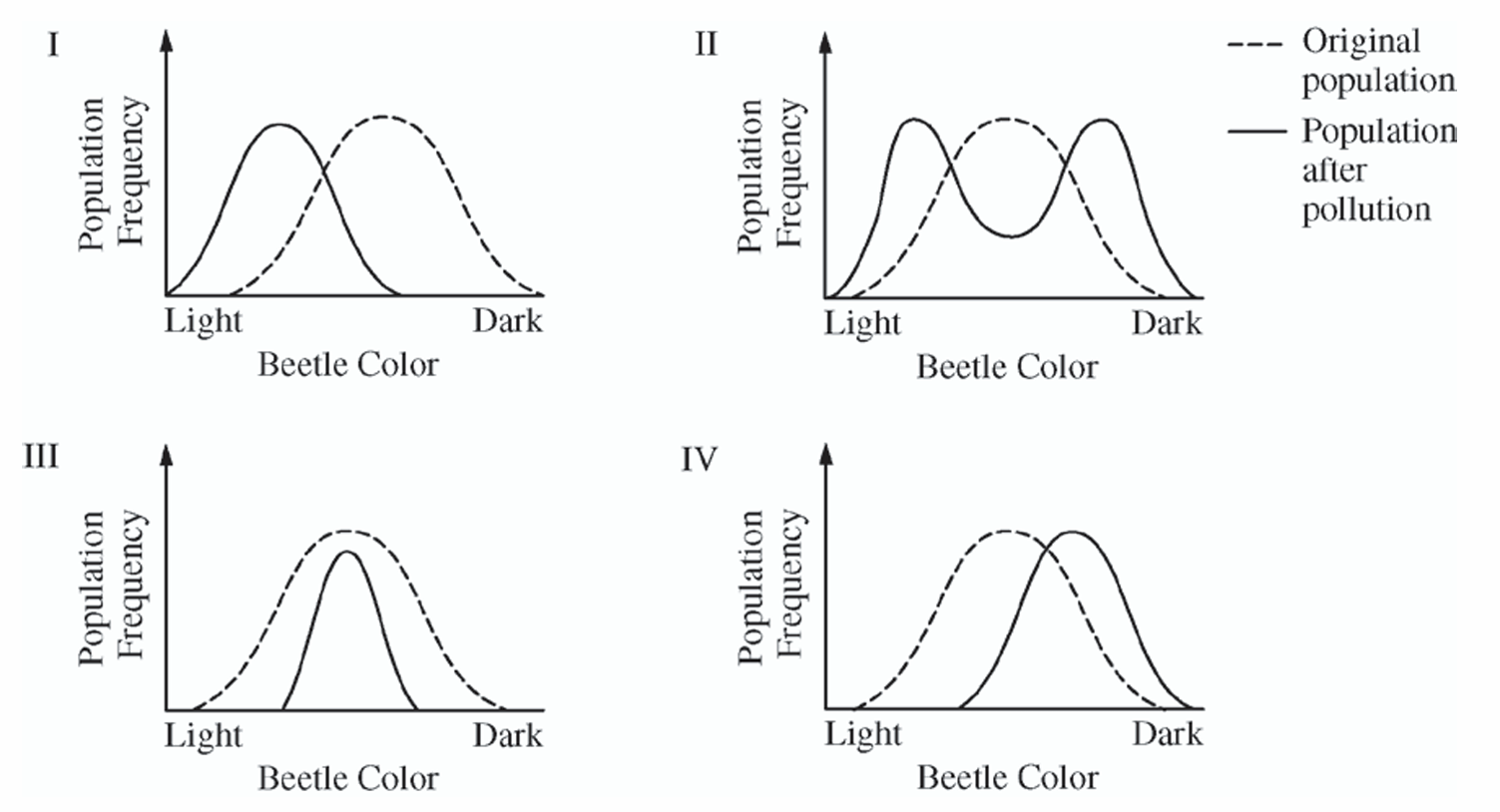
\(Q\). If most tree trunks suddenly became light colored, resulting in light colored beetles having higher fitness, which graph would best represent the change in the beetle population?
B. Graph II
C. Graph III
D. Graph IV
\(Q\). Which graph above represents disruptive selection?
B. Graph II
C. Graph III
D. Graph IV
▶️ Answer/Explanation
A:
The environment changes to favor light-colored tree trunks, giving light-colored beetles a survival advantage.
This creates a directional selection pressure that shifts the population distribution toward the “Light” end of the spectrum.
Graph I shows the peak of the population curve shifting to the left (Light), which matches this description.
Therefore, Option A is correct.
A:
Disruptive selection is a type of natural selection where extreme values for a trait are favored over intermediate values.
This process causes the population to split into two distinct groups, creating a bimodal distribution.
Graph II illustrates this by showing the original single peak dividing into two peaks at the “Light” and “Dark” extremes.
Therefore, Option B is correct.
Question
B. Directional selection for brown rabbits.
C. Stabilizing selection for grey rabbits.
D. Disruptive selection for both white and brown rabbits.
▶️ Answer/Explanation
Correct Option: A
The environmental change involves a shift from green grass to white snow.
White rabbits ($bb$) gain a selective advantage due to better camouflage in the snow.
Brown ($BB$) and grey ($Bb$) rabbits become more visible to predators and are selected against.
Natural selection favors one extreme phenotype (white) over the others.
This causes the allele frequency of $b$ to increase while $B$ decreases.
As the population mean shifts toward one extreme, it is classified as directional selection.
Question
B. A change in the environment that provides a survival advantage to individuals with certain traits more than other traits.
C. A change in the genotype frequencies in a population that does not change the allele frequencies.
D. Female guppy fish prefer males with brightly colored orange stripes over males without brightly colored stripes.
▶️ Answer/Explanation
The correct answer is C.
Evolution is defined biologically as a change in allele frequencies within a population’s gene pool over time.
Option A describes gene flow, which introduces or removes alleles, changing their frequencies.
Option B describes natural selection, where environmental pressures favor specific alleles.
Option D describes sexual selection, a form of non-random mating that alters allele distribution.
Option C mentions changing genotype frequencies without changing allele frequencies (e.g., via neutral non-random mating like selfing).
Since the ratio of alleles remains constant in Option C, no evolutionary change has occurred by definition.
Question
B. Genetically isolate genes for high milk production and separate the genes using gel electrophoresis.
C. High milk production is an acquired characteristic, so it cannot evolve.
D. Use artificial selection and selective breeding to only breed cows that produce more milk.
▶️ Answer/Explanation
>
The correct option is D.
Animal breeders use artificial selection to enhance desirable traits in livestock.
In this process, humans choose specific individuals with the highest milk yield to parent the next generation.
By repeating this over several generations, the frequency of “high-yield” alleles increases in the population.
Option A refers to natural selection, which focuses on survival rather than human utility.
Option B describes laboratory techniques that do not inherently involve a breeding program.
Option C is incorrect because milk production has a significant genetic basis and is not merely an acquired trait.
Question
B. An individual with low survival, but has some offspring.
C. An individual with low survival, and has very few offspring.
D. An individual with high survival, and has many offspring.
▶️ Answer/Explanation
The correct option is D.
Evolutionary fitness is defined by an organism’s ability to pass its genes to the next generation.
High survival increases the duration of the reproductive window for an individual.
Producing many offspring directly maximizes the numerical representation of an individual’s alleles in the gene pool.
Therefore, the combination of a long lifespan and high reproductive output results in the highest relative fitness.
In contrast, high survival without reproduction (Option A) results in an evolutionary fitness of $0$.
Option D represents the most successful strategy for genetic persistence over time.
Question
B. Genotype frequency
C. Gene pool
D. Population
▶️ Answer/Explanation
The correct answer is C. Gene pool.
A gene pool consists of all the genes, including all the different alleles, that are present in a population.
In genetics, this represents the total genetic diversity found within a social or biological group.
The allele frequency refers to how often a specific allele appears compared to the total number of alleles for that gene.
The genotype frequency is the proportion of a particular genotype among the individuals in the population.
A large gene pool indicates high genetic diversity, which increases the chances of biological fitness and survival.
Evolution involves changes in the composition of the gene pool over successive generations.
Question
B. Genotype frequency
C. Gene pool
D. Population
▶️ Answer/Explanation
Correct Option: B. Genotype frequency
$AA$, $Aa$, and $aa$ represent specific genotypes (combinations of alleles) in an individual.
Genotype frequency is the proportion of a specific genotype among all individuals in a population.
In Hardy-Weinberg terms, these frequencies are represented by $p^2$, $2pq$, and $q^2$.
Allele frequency (Option A) refers only to the proportion of individual alleles ($A$ or $a$) in the gene pool.
The gene pool (Option C) is the total collection of all genes in a population at any one time.
Therefore, measuring the specific distribution of $AA$, $Aa$, and $aa$ defines the genotype frequency.
Question
B. Inheritance of traits/characteristics.
C. Competition among individuals of a population for survival and reproduction.
D. The environment must remain stable (not change).
▶️ Answer/Explanation
The correct answer is D.
Natural selection requires variation so that some individuals have advantages over others.
These advantageous traits must be heritable to be passed to the next generation.
Competition (differential reproductive success) ensures only the fittest survive to breed.
A stable environment is not required; in fact, environmental change often drives selection.
If the environment never changed, many species would reach a static equilibrium.
Therefore, environmental stability is not a prerequisite for the process of evolution.
Question
B. The null hypothesis that predators successfully hunted and killed white rabbits and brown rabbits equally is not rejected.
C. The alternative hypothesis that predators successfully hunted and killed more white rabbits than brown rabbits is rejected.
D. The alternative hypothesis that predators successfully hunted and killed fewer white rabbits than brown rabbits is rejected.
▶️ Answer/Explanation
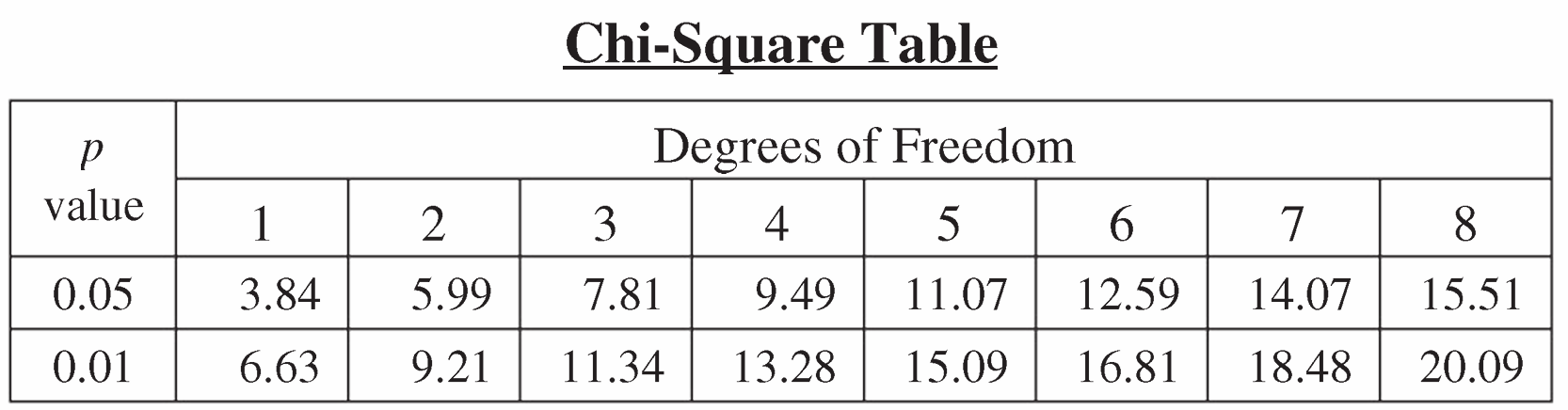
The experiment compares two groups (white vs. brown rabbits), so the degrees of freedom is $df = n – 1 = 2 – 1 = 1$.
At the standard significance level of $p = 0.05$ and $df = 1$, the table provides a critical value of $3.84$.
The calculated Chi-square value is $(\chi^2) = 5$.
Since the calculated value $5$ is greater than the critical value $3.84$, we reject the null hypothesis.
A rejected null hypothesis indicates there is a statistically significant difference in hunting success between the two rabbit types.
Therefore, statement A is the correct conclusion.
Question
▶️ Answer/Explanation
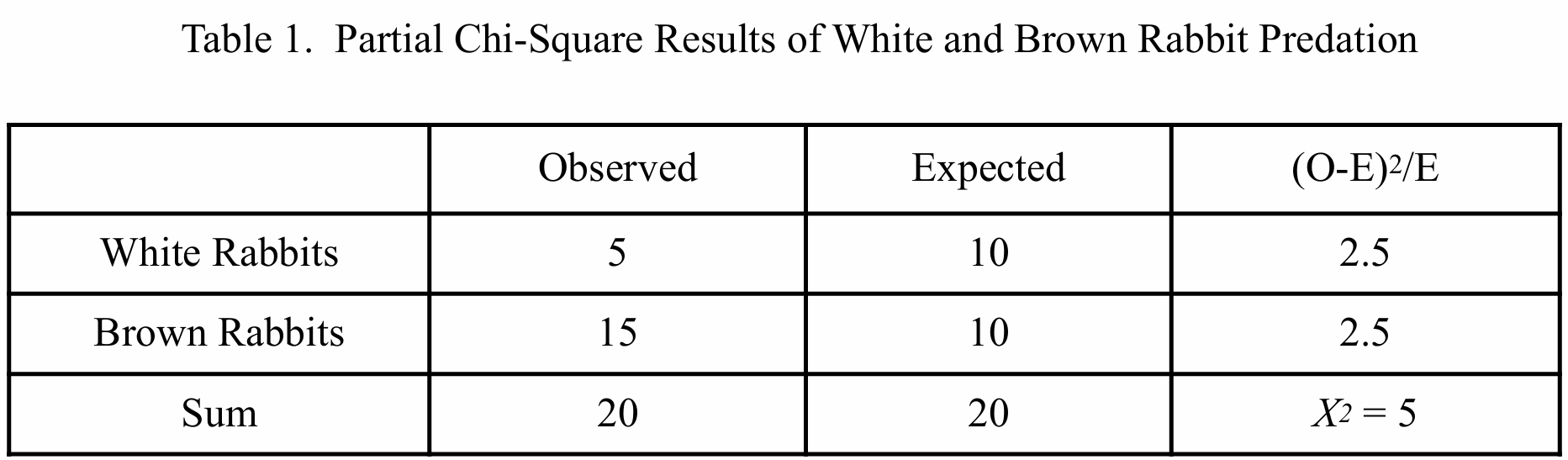
The experiment involves $n = 2$ categories: White Rabbits and Brown Rabbits.
Degrees of freedom ($df$) is calculated using the formula $df = n – 1$.
By substituting the values, we find $df = 2 – 1 = 1$.
For a significance level of $p = 0.05$ and $df = 1$, find the intersection in the table.
The standard critical value for these parameters is $3.84$.
Comparing the calculated $\chi^2 = 5$ to $3.84$ confirms the null hypothesis is rejected.
Therefore, the correct option is A.
Question
B. The degrees of freedom is $2$.
C. The degrees of freedom is $3$.
D. The degrees of freedom is $4$.
▶️ Answer/Explanation
The number of categories or possibilities in this experiment is $n = 2$ (White Rabbits and Brown Rabbits).
According to the provided formula, the degrees of freedom ($df$) is calculated as $n – 1$.
Substituting the value, we get $df = 2 – 1$.
Therefore, the degrees of freedom is $1$.
This value is used to determine the critical value from a Chi-square distribution table.
The correct option is A.
Question
B. If brown rabbits eat more grass, then white rabbits are the predators.
C. If the degrees of freedom are $7$, then brown rabbits are the preferred prey of predators in this habitat.
D. Predators in this habitat prefer white rabbits and brown rabbits equally, and there is no difference in predation rates.
▶️ Answer/Explanation
A null hypothesis ($H_0$) states there is no significant difference or effect between variables.
The prompt explicitly mentions the scientist is testing if rabbits are killed equally.
The expected values in the table ($10$ vs $10$) reflect an assumption of zero preference.
Option A describes an alternative hypothesis suggesting a specific direction of bias.
Options B and C introduce irrelevant variables like grass consumption or incorrect degrees of freedom.
Therefore, Option D correctly defines the “no-difference” baseline required for a Chi-Square test.
The calculated $\chi^2 = 5$ is then used to determine if this “equal” assumption should be rejected.
Question
B. They result when organisms observe traits of other successful populations.
C. They occur in somatic cells and can be passed to offspring.
D. They add variations to the gene pool of a population.
▶️ Answer/Explanation
The correct option is D.
Mutations are the primary source of genetic variation within a population.
They create new alleles, which changes the composition of the gene pool.
Natural selection requires this variation to “choose” traits that improve fitness.
Without mutations, populations would lack the diversity needed to adapt to environmental changes.
Somatic mutations (Option C) are not inherited; only germline mutations contribute to evolution.
Mutations are random and do not occur in response to observation or specific disasters.
Question
B. All bacteria adapted by developing resistance to the antibiotic, preventing them from surviving and reproducing.
C. The antibiotic prevented mutations in the DNA of some bacteria, allowing them to survive and reproduce.
D. The antibiotic caused a mutation in the DNA of all bacteria, preventing them from surviving and reproducing.
▶️ Answer/Explanation
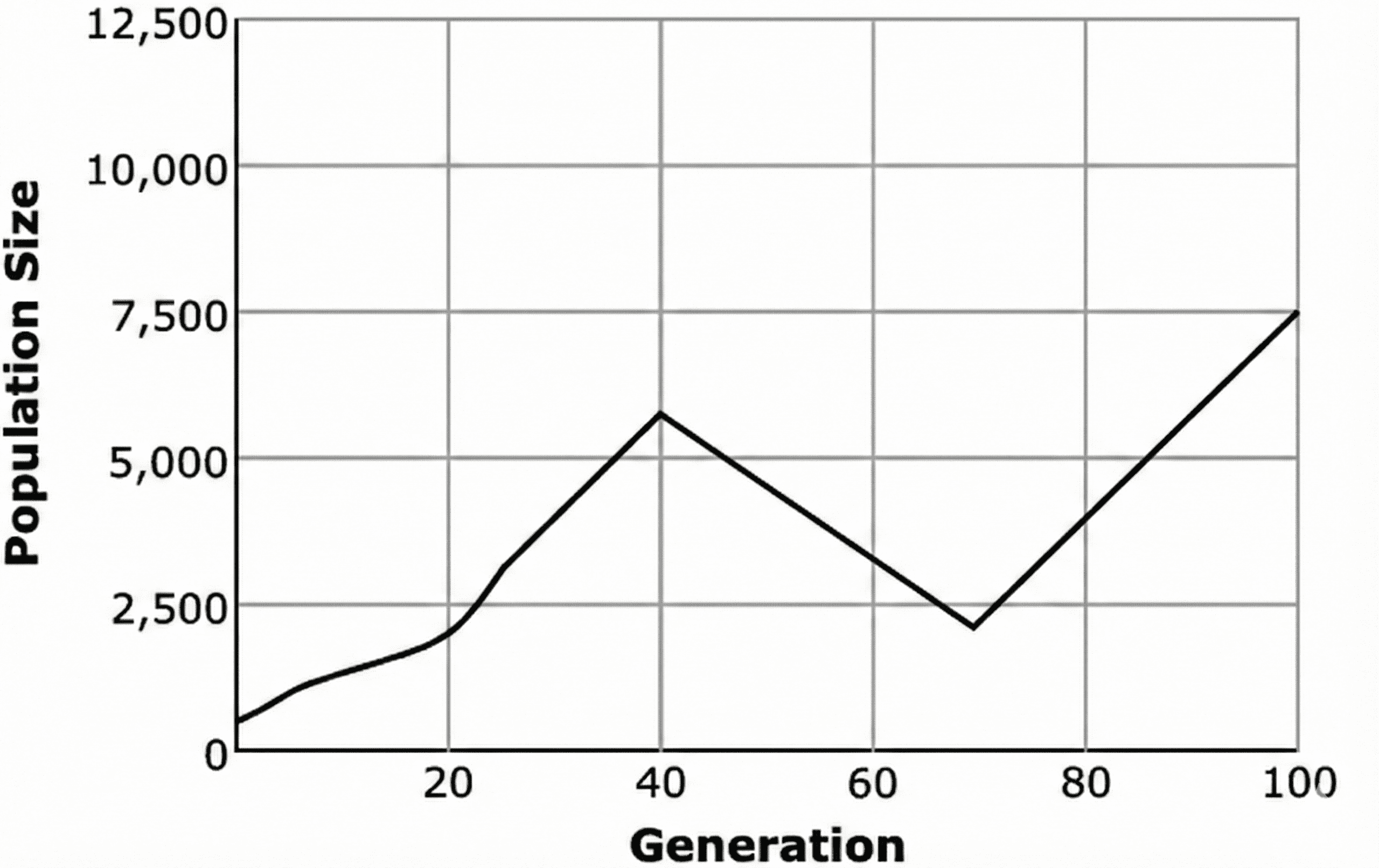
At Generation $40$, the antibiotic is introduced, causing a sharp decline in the population.
By Generation $70$, the population begins to increase again despite the presence of the antibiotic.
This recovery occurs because certain individuals possessed genetic variations or mutations conferring resistance.
These resistant bacteria survived the initial treatment while the non-resistant ones died off.
The survivors kemudian passed these resistant traits to their offspring through reproduction.
Over subsequent generations, the population of antibiotic-resistant bacteria grew, leading to the observed increase.
This process is a classic example of natural selection acting on a bacterial population.
Question
B. Dairy cows within the species have interbred, resulting in high genetic diversity among offspring.
C. Humans have used artificial selection to encourage transmission of traits associated with high-quality milk production from parent cows to offspring.
D. Humans have used natural selection to encourage transmission of traits associated with high-quality milk production from parent cows to offspring.
▶️ Answer/Explanation
Correct Option: C
The change in dairy cows is a result of selective breeding, also known as artificial selection.
Humans identify parent cows with desirable traits, such as high milk volume or fat content.
These specific individuals are then bred together to ensure those genes are passed to the next generation.
Unlike natural selection, which is driven by environmental fitness, this process is controlled by human preference.
Over many generations, this directed breeding leads to significant physiological changes in the population.
Options A and B focus on diversity levels rather than the mechanism of change, making C the most accurate explanation.
Question
▶️ Answer/Explanation
The correct answer is C.
Natural selection occurs when a specific trait provides a survival advantage in a given environment.
Individuals possessing the mutated receptor protein were resistant to Yersinia pestis.
These survivors had a higher fitness, meaning they lived long enough to reproduce.
As they passed the beneficial mutation to their offspring, the frequency of the allele increased.
This process is known as being “selected for” by environmental pressure.
Vaccines (Option A) were not available in the $1300\text{s}$ and do not cause genetic mutations.
Variation (Option B) must exist before selection; the outbreak itself did not create the mutation.
Question
B. White foxes would have a greater advantage, so their population size would increase, while the red fox population size would decrease.
C. White foxes would have a lesser advantage, so their population size would increase, while the red fox population size would remain the same.
D. Red foxes would have a lesser advantage, so their population size would increase, while the white fox population size would remain the same.
▶️ Answer/Explanation
Correct Option: B
A longer snow season provides a white background for a greater portion of the year.
White foxes possess camouflage in snow, making them less visible to predators and more effective hunters.
This selective advantage leads to higher survival and reproduction rates for white foxes.
Conversely, red foxes are easily spotted against white snow, increasing their risk of predation.
As a result, the white fox population is likely to increase while the red fox population decreases.
This is a classic example of natural selection driven by environmental changes.
Question
B. The number of rabbits with powerful legs will increase over time because they can better escape the wolves.
C. The total number of rabbits will decrease over time because all rabbits have an equal chance of getting eaten.
D. The total number of rabbits will decrease over time because most rabbits will have induced mutations that reduce their survival rate.
▶️ Answer/Explanation
The introduction of wolves creates a selective pressure on the rabbit population.
Rabbits with the mutation for extra-powerful hind legs have a survival advantage.
These individuals are more likely to escape predation and live long enough to reproduce.
They pass the beneficial mutation (alleles) to their offspring.
Over generations, the frequency of the mutation increases within the population.
This process is a classic example of natural selection driving evolution.
Options A, C, and D are incorrect as they ignore the adaptive advantage of the mutation.
Question
The sharks have been unable to adapt to changes in their environment.
Individuals are very similar to one another as a result of genetic continuity.
Individuals differ from one another as a result of genetic diversity.
The average number of births has been less than the average number of deaths in the population.
The average number of births has been greater than the average number of deaths in the population.
▶️ Answer/Explanation
1. The sharks have been able to adapt to changes in their environment.
Natural selection drives adaptation, allowing a population to survive shifting environmental pressures.
2. Individuals differ from one another as a result of genetic diversity.
Variation is the raw material for selection; without differences, “survival of the fittest” cannot occur.
3. The average number of births has been greater than the average number of deaths in the population.
A successful population must produce more offspring than are lost to maintain growth and spread favorable traits.
Genetic diversity ensures that some individuals possess traits that offer a competitive advantage.
These advantageous traits are passed to the next generation through successful reproduction (births > deaths).
Over time, this process results in a population that is better adapted to its specific ecological niche.
Question
B. The patient will require a vaccination to prevent the bacteria from reproducing.
C. The patient’s immune system will produce antibodies that prevent the bacteria’s reproduction.
D. The medication may serve as an energy source and cause rapid reproduction of the bacteria.
▶️ Answer/Explanation
The correct option is A.
Antibiotics exert selective pressure on bacterial populations.
While the medication kills susceptible bacteria, those with genetic mutations for resistance survive.
These resistant survivors then reproduce, passing the resistance traits to the next generation.
Vaccinations (Option B) are typically preventative, not a treatment for an active infection.
Antibodies (Option C) assist the immune response but do not define the medication’s impact on reproductive success.
Medications are designed to inhibit metabolic processes, not act as an energy source (Option D).
Thus, the ongoing reproduction of resistant strains is the most accurate description of long-term reproductive success.
Question
B. The hummingbirds will decrease their reproductive rate in order to decrease genetic diversity within the population.
C. The hummingbirds will immediately adapt to eat new food sources, increasing the overall survival rate of the population.
D. The hummingbirds will struggle to find food, and only those that can adapt to new food sources will survive.
▶️ Answer/Explanation
Correct Option: D
A drought reduces the availability of water and flowering plants, leading to a nectar shortage.
Hummingbirds will face intense competition and a struggle for survival due to this lack of food.
Individual organisms cannot “immediately” change their biology or diet by choice (eliminating C).
Increasing reproduction (A) is impossible without energy from food, and (B) is biologically illogical.
Natural selection occurs as only individuals with traits allowing them to use alternative sources survive.
Therefore, the population will likely decline, with survival limited to those that can adapt.