Home / AP® Exam / Pre AP Biology / Exam Style Questions

Pre AP Biology -GEN 1.1 Race to Discover DNA- FRQ Exam Style Questions -New Syllabus

Pre AP Biology -GEN 1.1 Race to Discover DNA- FRQ Exam Style Questions – New Syllabus 2025-2026

Pre AP Biology -GEN 1.1 Race to Discover DNA- FRQ Exam Style Questions – Pre AP Biology – per latest Pre AP Biology Syllabus.

Pre AP Biology – FRQ Exam Style Questions- All Topics

Question

Read these passages from the text and answer the questions that follow.
 
DNA
DNA is the genetic material in your cells. It was passed on to you from your parents and determines your characteristics. The discovery that DNA is the genetic material was another important milestone in molecular biology.
 
Griffith Searches for the Genetic Material
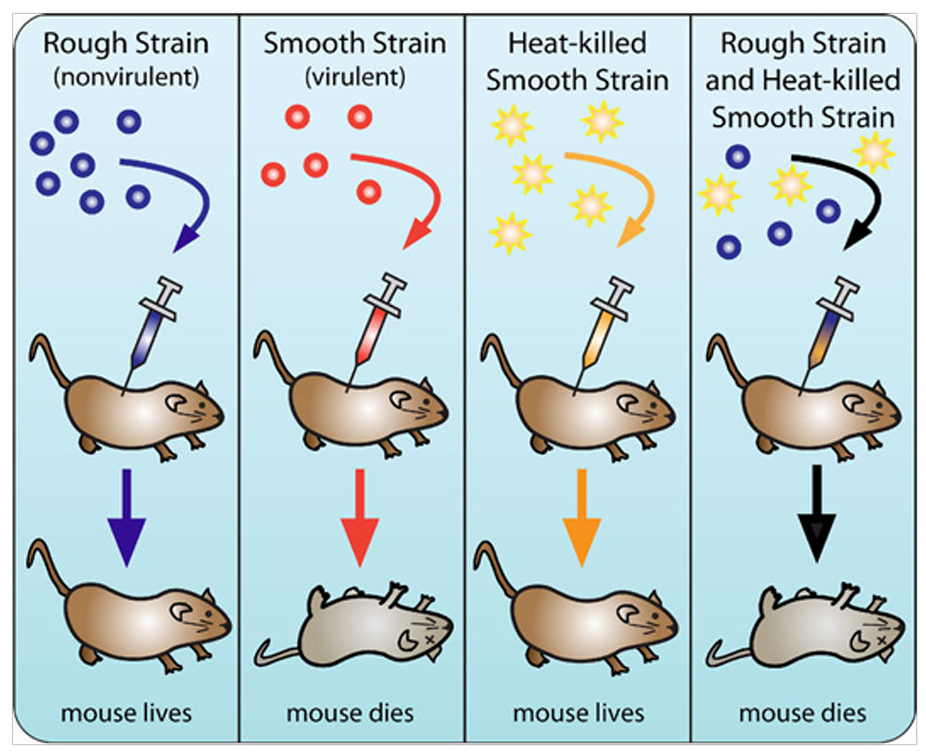
Many scientists contributed to the identification of DNA as the genetic material. In the 1920s, Frederick Griffith made an important discovery. He was studying two different strains of a bacterium, called R (rough) strain and S (smooth) strain. He injected the two strains into mice. The S strain (virulent) killed the mice, but the R strain (nonvirulent) did not (see the figure below). Griffith also injected mice with S-strain bacteria that had been killed by heat. As expected, the killed bacteria did not harm the mice. However, when the dead S-strain bacteria were mixed with live R-strain bacteria and injected, the mice died.
Griffith’s Experimental Results. Griffith showed that a substance could be transferred to harmless bacteria and make them deadly.
Based on his observations, Griffith deduced that something in the killed S-strain was transferred to the previously harmless R-strain, making the R-strain deadly. What was that something? What type of substance could change the characteristics of the organism that received it?
 
Hershey and Chase Seal the Deal
The conclusion that DNA is the genetic material was not widely accepted at first. It had to be confirmed by other research. In the 1950s, Alfred Hershey and Martha Chase did experiments with viruses and bacteria. Viruses are not cells. They are basically DNA inside a protein coat. To reproduce, a virus must insert its own genetic material into a cell (such as a bacterium). Then it uses the cell’s machinery to make more viruses. The researchers used different radioactive elements to label the DNA and proteins in viruses. This allowed them to identify which molecule the viruses inserted into bacteria. DNA was the molecule they identified. This confirmed that DNA is the genetic material.

Most-appropriate topic codes (Pre-AP Biology):

TOPIC: GEN 1.2 — Structure of DNA: DNA is the genetic material found in all living organisms.
TOPIC: CELLS 5.3 — Viruses: Viruses lack the ability to perform reactions that require energy and must utilize cellular machinery to replicate.
TOPIC: GEN 1.1 — Race to Discover DNA: Several scientists’ models and experiments contributed to the final consensus of DNA’s role and structure.
TOPIC: GEN 3.4 — Mutations: Mutations are heritable changes to DNA sequences that can produce variation or negative disruption.
▶️ Answer/Explanation
Detailed Solution

1. Answer: The mice were killed by the live S (smooth) strain bacteria and the mixture of live R (rough) strain with heat-killed S-strain bacteria.
Explanation: Griffith’s research identified the S-strain as virulent. While the heat-killed S-strain alone was harmless, mixing it with the live R-strain resulted in a lethal combination.

2. Answer: They killed the mice because a “substance” (later identified as DNA) was transferred from the dead S-strain to the live R-strain, transforming the R-strain into a deadly version.
Explanation: This demonstrates that DNA is the genetic material found in all living organisms. The R-strain acquired heritable genetic information that changed its phenotype to become virulent.

3. Answer: Viruses are not considered cells because they are basically DNA inside a protein coat and cannot reproduce without a host cell.
Explanation: Structurally, viruses lack the ability to perform reactions that require energy, such as replicating their own genetic material. They must hijack the cellular machinery of a host to produce viral proteins and genomes.

4. Answer: Hershey and Chase identifies DNA as the specific molecule that viruses insert into bacteria to reproduce.
Explanation: By using radioactive labels, they confirmed that DNA—not protein—is the genetic material passed into the cell to direct viral replication. This supports the enduring understanding that the molecular structure of DNA enables its function of storing life’s genetic information.

5. Answer: The term “transformation” is appropriate because the harmless R-strain bacteria were physically and genetically changed into a virulent form.
Explanation: In biology, this refers to a heritable change in the DNA sequence. The bacteria’s characteristics were transformed as they expressed new proteins from the acquired DNA.

Scroll to Top