
▶️ Answer/Explanation
Detailed solution
To acquire the full 4 marks, you must highlight the key differences between the artificial PCR process and natural DNA replication in human cells. Here is a line-by-line comparison:
- Strand Separation (Unwinding):
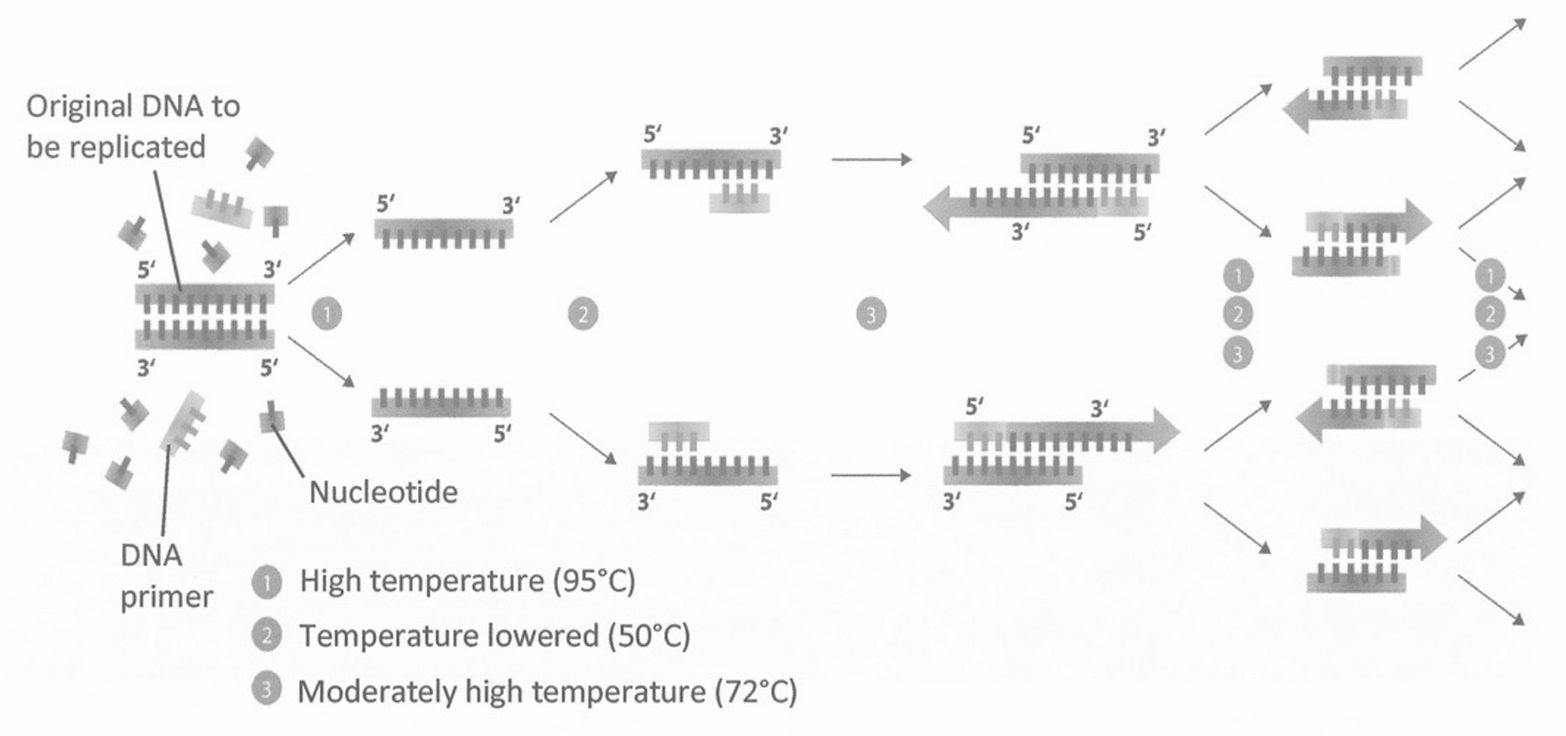
In PCR, high heat (approximately $95^\circ\text{C}$) is used to break the hydrogen bonds and separate the DNA strands. In contrast, human cells use the enzyme DNA helicase to unwind the double helix. - Primers:
PCR utilizes synthetic DNA primers that are added to the reaction mixture. In human cells, the primers used are made of RNA and are synthesized by the enzyme primase. - Polymerase Enzyme:
PCR uses Taq polymerase, a heat-stable enzyme derived from the bacterium Thermus aquaticus, allowing it to withstand high temperatures. Human cells use human DNA polymerase, which works at body temperature and would denature at PCR temperatures. - Temperature Conditions:
PCR involves a cycle of rapidly changing temperatures (heating to $95^\circ\text{C}$, cooling to $\approx 50^\circ\text{C}$, and heating to $72^\circ\text{C}$). Human DNA replication occurs at a constant, physiological body temperature of approximately $37^\circ\text{C}$. - Scope of Replication:
PCR typically amplifies only specific, short fragments of DNA. Human DNA replication involves the replication of the entire genome (all chromosomes).