
Pre AP Biology -GEN 3.1 RNA Structure- MCQ Exam Style Questions -New Syllabus 2025-2026
Pre AP Biology -GEN 3.1 RNA Structure- MCQ Exam Style Questions – New Syllabus 2025-2026
Pre AP Biology -GEN 3.1 RNA Structure- MCQ Exam Style Questions – Pre AP Biology – per latest Pre AP Biology Syllabus.
Question
b. poly(A) polymerase
c. DNA-binding protein
d. miRNA
▶️ Answer/Explanation
The correct option is c. DNA-binding protein.
Zinc fingers are structural motifs characterized by the coordination of one or more $Zn^{2+}$ ions.
These motifs are primarily found in transcription factors, which are a type of DNA-binding protein.
The $Zn^{2+}$ ion stabilizes the “finger” structure, allowing the protein to fit into the major groove of DNA.
If NOBA removes the $Zn^{2+}$ ions, the protein loses its specific 3D conformation.
Without this shape, the protein can no longer bind to its target DNA sequences effectively.
This directly inhibits the function of the DNA-binding protein in regulating gene expression.
Question
▶️ Answer/Explanation
The correct answer is b. in the operator.
Constitutive expression means the genes are transcribed continuously regardless of lactose levels.
Since functional repressor protein is present, the lacI gene is not the site of the mutation.
A mutation in the operator ($O^c$) prevents the repressor protein from recognizing or binding to the DNA site.
Without repressor binding, RNA polymerase has unimpeded access to the promoter.
This leads to “always on” transcription of the structural genes like lacZ.
Mutations in the promoter or CAP site would typically decrease or prevent transcription rather than increase it.
Question
▶️ Answer/Explanation
The correct option is a.
$\text{miRNA}$ (microRNA) molecules are transcribed from DNA but do not code for proteins.
They are functional RNA molecules that regulate gene expression post-transcriptionally.
The Dicer enzyme actually cleaves or cuts the precursor $\text{RNA}$, rather than elongating it.
$\text{miRNA}$ typically forms complementary base pairs with $\text{mRNA}$, not $\text{tRNA}$.
As non-coding $\text{RNA}$, $\text{miRNA}$ is never translated into a polypeptide chain.
Therefore, it is strictly classified as being encoded by non–protein-coding genes.
Question
▶️ Answer/Explanation
The correct answer is d. contains a stop codon.
The $lacZ$ and $lacY$ genes are structural genes within a single polycistronic operon.
Both genes are transcribed together from a single shared promoter, not individual ones.
Because they are part of one unit, they produce a single polycistronic mRNA rather than separate strands.
Neither $lacZ$ ($\beta$-galactosidase) nor $lacY$ (lactose permease) functions as a DNA-binding transcription factor.
However, each individual gene sequence must contain its own stop codon.
This ensures that the ribosome terminates translation correctly for each distinct protein product.
Without individual stop codons, the two proteins would be fused into a single non-functional polypeptide.
Question
b. DNA contains uracil, which is more stable than the thymine present in RNA.
c. Unlike RNA, DNA can exist in very complex three-dimensional shapes, which are very stable.
d. The presence of complementary strands in DNA means that single-base mutations can be easily repaired.
▶️ Answer/Explanation
The correct option is d.
DNA is a double-stranded molecule consisting of two complementary strands.
This double-stranded nature provides a template for repair mechanisms.
If a single-base mutation occurs on one strand, enzymes can detect the error.
The correct nucleotide is then replaced using the opposite strand as a guide.
In contrast, RNA is typically single-stranded and much more chemically unstable.
Option a is incorrect because DNA contains deoxyribose, not ribose.
Option b is incorrect because DNA contains thymine, while RNA contains uracil.
Question
▶️ Answer/Explanation
The correct option is a.
Ribozymes are ribonucleic acid ($\text{RNA}$) molecules that possess catalytic activity.
Unlike most biological catalysts, which are proteins, ribozymes are composed of nucleotides rather than amino acids.
They play critical roles in modern cells, such as in the ribosome during protein synthesis.
While they are highly efficient, they generally do not catalyze reactions faster than protein-based enzymes.
The discovery of ribozymes supports the $\text{RNA}$ world hypothesis, suggesting $\text{RNA}$ preceded $\text{DNA}$ and proteins.
Therefore, they are defined by their composition of $\text{RNA}$ rather than being amino acid polymers.
Question
▶️ Answer/Explanation
The correct answer is B. $50\%$.
The mother ($XX$) produces only eggs containing an $X$ chromosome.
The father ($XY$) produces two types of sperm: $50\%$ carry an $X$ and $50\%$ carry a $Y$.
A Punnett square cross results in $50\%$ $XX$ (daughters) and $50\%$ $XY$ (sons).
The ratio of female to male offspring is $1:1$.
Therefore, the probability of having a daughter is $\frac{1}{2}$, which is $50\%$.
Question
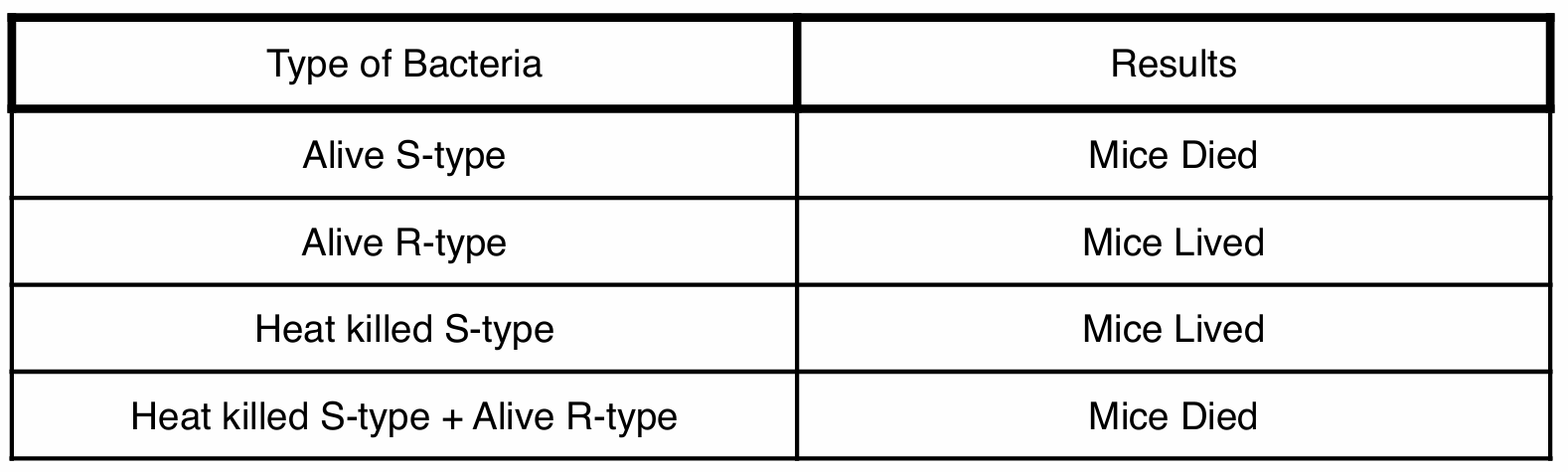
B. S-type is only virulent (deadly) when it is heat killed.
C. When heat killed S-type and alive R-type are mixed together, R-type bacteria brought S-type bacteria back to life.
D. When heat killed S-type and alive R-type are mixed together, R-type bacteria transformed into S-type bacteria by the transfer of genetic information.
▶️ Answer/Explanation
The experiment shows that alive R-type bacteria and heat-killed S-type bacteria are harmless individually.
However, when mixed, the mice die, and living S-type bacteria are recovered from the blood.
This suggests a “transforming principle” was transferred from the dead S-type to the living R-type.
The R-type bacteria acquired the genetic ability to produce a protective capsule (becoming S-type).
This process is known as bacterial transformation.
Option C is incorrect because “bringing back to life” is biologically impossible for heat-killed cells.
Options A and B contradict the specific data points shown in the table.
Therefore, the conclusion is the transfer of genetic information.
Question
Which of the following figures below correctly depicts the interactions at the lac operon when lactose is present and the operon is on? (Use the legend below) 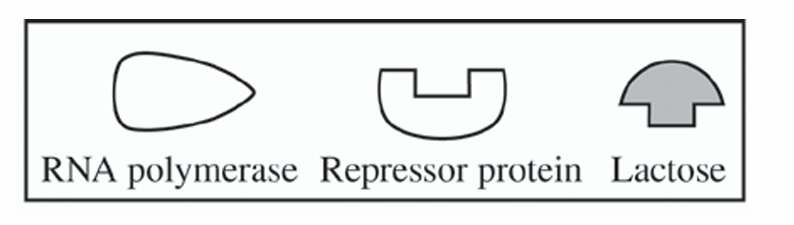
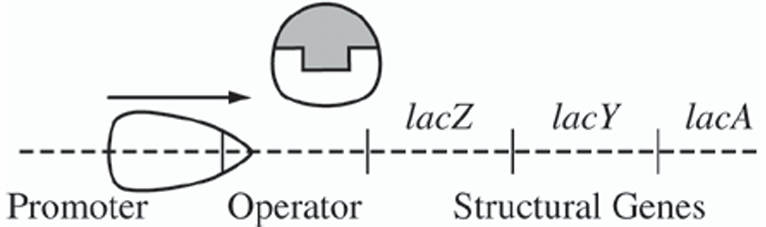
B.
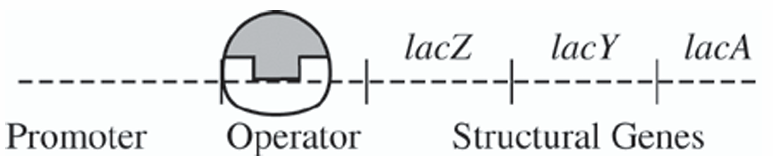
C.
D.

▶️ Answer/Explanation
Answer: (A)
The lac operon is turned “on” when lactose is available.
Lactose acts as an inducer and binds to the repressor protein.
This binding causes a conformational change in the repressor, preventing it from binding to the operator.
With the operator free, RNA polymerase can bind to the promoter and proceed with transcription.
Figure (A) correctly depicts the lactose-bound repressor detached from the DNA and RNA polymerase moving forward.
Question

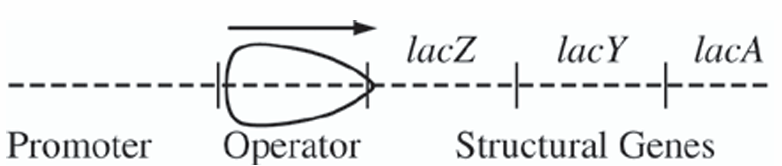
B. The \(P_{lac}\) promoter
C. The operator
D. The \(lacZ\) gene
B. The \(P_{lac}\) promoter
C. The operator
D. The \(lacZ\) gene
▶️ Answer/Explanation
A. Correct Answer: B
A. Correct Answer: C
A:
The initiation of transcription requires the enzyme RNA polymerase to attach to the DNA.
The specific DNA sequence designated for this attachment is called the promoter.
Therefore, RNA polymerase binds to the \(P_{lac}\) promoter to start transcribing the structural genes (\(lacZ\), \(lacY\), \(lacA\)).
A:
The repressor protein acts as a “brake” for gene expression when lactose is absent.
To function, the active repressor binds specifically to the operator region.
This binding physically blocks RNA polymerase from moving forward, thereby turning off the expression of the operon.
Question
B. Eukaryotes have a singular, circular chromosome; prokaryotes have several, linear chromosomes.
C. Eukaryotes have multiple genes in their genomes; Prokaryotes only have one gene in their genome.
D. Prokaryotic DNA has introns and exons; eukaryotic DNA does not have any introns.
▶️ Answer/Explanation
The correct option is A.
Prokaryotic DNA is typically organized into a single ($1$) circular chromosome located in the nucleoid region.
In contrast, eukaryotic DNA is organized into multiple ($n > 1$) linear chromosomes contained within a nucleus.
Option B is incorrect because it swaps the structural characteristics of the two cell types.
Option C is incorrect as prokaryotes contain hundreds to thousands of genes, not just one.
Option D is incorrect because introns (non-coding sequences) are a hallmark of eukaryotic DNA and are rare in prokaryotes.
Question
B. Radioactive $\text{S}$ in the DNA was found in the bacteria, while radioactive $\text{P}$ in proteins stayed in the bacteriophage.
C. Radioactive $\text{P}$ in the DNA and radioactive $\text{S}$ in proteins both stayed in the bacteriophage.
D. Radioactive $\text{S}$ in the DNA and radioactive $\text{P}$ in proteins were both transferred to the bacteria.
▶️ Answer/Explanation
• Hershey and Chase used $^{32}\text{P}$ to label DNA and $^{35}\text{S}$ to label protein coats.
• DNA contains phosphorus but no sulfur, while proteins contain sulfur but no phosphorus.
• After infection and agitation, the radioactive $^{32}\text{P}$ was detected inside the E. coli cells.
• The radioactive $^{35}\text{S}$ remained outside the cells in the phage ghosts (supernatant).
• This proved that DNA, not protein, enters the bacteria to direct new viral synthesis.
• Therefore, the correct observation matches option A.
Question
B. By facilitated diffusion
C. By active transport
D. By endocytosis
▶️ Answer/Explanation
The plasma membrane consists of a hydrophobic phospholipid bilayer.
Aldosterone is described as a small, nonpolar, and hydrophobic molecule.
Hydrophobic molecules can dissolve in and pass directly through the lipid bilayer.
The movement occurs down a concentration gradient, indicating passive transport.
Since no protein channel or carrier is mentioned for this specific passage, it is simple diffusion.
Facilitated diffusion and active transport are ruled out as they require specialized proteins.
Endocytosis is unnecessary for small, membrane-permeable molecules like steroid hormones.
Question
B. Rough endoplasmic reticulum
C. Mitochondria
D. Vacuoles
▶️ Answer/Explanation
The correct answer is B. Rough endoplasmic reticulum.
Pancreas cells specialize in the synthesis and secretion of digestive enzymes.
Since enzymes are proteins, they are synthesized by ribosomes.
The Rough Endoplasmic Reticulum (RER) is studded with ribosomes and is the primary site for protein synthesis.
Cells active in secretion require an extensive $RER$ network to process these proteins.
In contrast, the Smooth ER is primarily involved in lipid synthesis and detoxification.
Mitochondria provide energy ($ATP$), and Vacuoles are used for storage, making them less central to the specific task of enzyme production.
Question
B. It has pores that allow for molecules to move in and out of the nucleus.
C. It has a nucleolus region for the production of RNA.
D. The membrane is composed of tRNA.
▶️ Answer/Explanation
The correct answer is D.
The nuclear envelope is a double-membrane structure made of a phospholipid bilayer, not $\text{tRNA}$.
$\text{tRNA}$ (transfer RNA) is a molecule involved in protein synthesis, not a structural component of membranes.
The nucleus contains nuclear pores that regulate the trafficking of proteins and $\text{RNA}$.
The nucleolus is a dense region within the nucleus responsible for synthesizing ribosomal $\text{RNA}$ ($\text{rRNA}$).
Options A, B, and C all accurately describe anatomical features of the eukaryotic nucleus.
Question
B. The presence of $5’$ to $3’$ antiparallel directionality.
C. The presence of a $5$ carbon pentose sugar in the backbone of the polymer.
D. The presence of uracil nitrogenous bases.
▶️ Answer/Explanation
Correct Option: D
RNA contains the nitrogenous base uracil, whereas DNA contains thymine.
Both DNA and RNA utilize $5$ carbon pentose sugars, but RNA uses ribose and DNA uses deoxyribose.
Double-helix structures and antiparallel directionality are primary characteristics of DNA.
While some RNA can fold into complex shapes, the unique presence of uracil is a definitive chemical marker for RNA.
Options A and B describe traits typically associated with double-stranded DNA.
Option C is incorrect because both types of nucleic acids contain a $5$ carbon pentose sugar.
Question
B. DNA is typically single stranded, while RNA is typically double stranded.
C. RNA is antiparallel, while DNA is a parallel helix.
D. DNA contains deoxyribose sugar, while RNA contains ribose sugar.
▶️ Answer/Explanation
The correct answer is D.
DNA uses the five-carbon sugar deoxyribose, which lacks an oxygen atom on the $2’$ carbon.
RNA uses the five-carbon sugar ribose, which possesses a hydroxyl ($-OH$) group on the $2’$ carbon.
Both DNA and RNA contain phosphate groups, making statement A incorrect.
DNA is typically a double-stranded helix, whereas RNA is usually single-stranded, making B incorrect.
DNA strands are antiparallel ($5’$ to $3’$ and $3’$ to $5’$), making statement C incorrect.
The presence of different sugars is a fundamental structural distinction between these two nucleic acids.
Question
▶️ Answer/Explanation
The correct answer is D.
Ribosomes are the sites of translation, where the genetic code is turned into a protein.
$\text{mRNA}$ binds to the ribosome to provide the template for the sequence.
$\text{tRNA}$ molecules carry specific amino acids to the ribosome.
The anticodons on $\text{tRNA}$ attach to the codons on $\text{mRNA}$ through complementary base pairing.
This alignment allows the ribosome to catalyze the formation of peptide bonds between amino acids.
Option A describes transcription, which occurs in the nucleus, not on a ribosome.
Question
B. They code for three amino acids.
C. They code for one complete protein.
D. They code for three complete proteins.
▶️ Answer/Explanation
The correct answer is A.
Three consecutive nucleotides in DNA or mRNA form a unit called a codon.
Each codon specifies a particular amino acid to be added to a polypeptide chain.
This triplet code is universal across almost all living organisms.
Multiple codons linked together eventually form a sequence that codes for a protein.
Therefore, a single triplet corresponds to only one amino acid, not a whole protein.