
Pre AP Biology -GEN 3.3 Translation- MCQ Exam Style Questions -New Syllabus 2025-2026
Pre AP Biology -GEN 3.3 Translation- MCQ Exam Style Questions – New Syllabus 2025-2026
Pre AP Biology -GEN 3.3 Translation- MCQ Exam Style Questions – Pre AP Biology – per latest Pre AP Biology Syllabus.
Question
▶️ Answer/Explanation
The correct option is b.
In the human genome, protein-coding genes account for only about $1\%$ to $2\%$ of the total DNA.
The remaining sequences, often historically referred to as “junk DNA,” make up the vast majority of the genome.
Current biological estimates suggest that non-coding regions constitute approximately $98\%$ to $99\%$ of our genetic material.
Therefore, removing all non-coding sequences would result in a genome shorter by roughly $90\%$ or more.
While the term “junk” is now considered a misnomer due to discovered regulatory functions, the physical reduction in size remains accurate.
This massive reduction would drastically alter the structural integrity and regulatory capacity of the cell.
Question
▶️ Answer/Explanation
The process of RNA splicing removes non-coding regions called introns from the pre-mRNA transcript.
During this maturation, the protein-coding regions, known as exons, are joined together.
Because large segments of nucleotides are physically excised, the total length of the strand decreases.
Option (a) is incorrect as codons define the sequence but do not cause physical shrinking.
Option (b) is incorrect because promoters are part of DNA and are not transcribed into mRNA.
Option (c) is a teleological fallacy and not a biological mechanism for mRNA processing.
Therefore, the physical removal of nucleotides via splicing makes the mature mRNA shorter.
Question
b. RNA polymerase
c. hormone response element
d. mRNA of the stimulated gene
▶️ Answer/Explanation
The correct answer is c. hormone response element.
Steroid hormones are lipophilic and diffuse directly across the plasma membrane.
The hormone receptor (a) is synthesized in the cytosol and must cross into the nucleus.
RNA polymerase (b) is a protein synthesized in the cytosol that functions inside the nucleus.
The mRNA (d) is created in the nucleus but must cross the nuclear pore to be translated.
The hormone response element (c) is a specific $DNA$ sequence located within the nucleus.
Because it is part of the genome, it is “created” during $DNA$ replication inside the nucleus.
It performs its function (binding the receptor complex) entirely within the nuclear environment.
Therefore, it is the only component listed that never crosses the nuclear membrane.
Question
▶️ Answer/Explanation
The correct answer is c.
When lactose is present, it is converted into allolactose, which acts as an inducer.
Allolactose binds to the $lac$ repressor protein, changing its shape so it can no longer bind to the operator.
With the repressor removed, RNA polymerase can transcribe the structural genes.
Since glucose is absent, cAMP levels are high, further boosting transcription via the CAP protein.
This results in the production of $\beta$-galactosidase, $lac$ permease, and transacetylase.
Therefore, the operon is “turned on” rather than off, and enzyme levels increase.
Question
| tRNA Anticodon | Amino Acid |
|---|---|
| $3’$-GGU-$5’$ | Proline |
| $3’$-CGU-$5’$ | Alanine |
| $3’$-UGC-$5’$ | Threonine |
| $3’$-CCU-$5’$ | Glycine |
| $3’$-ACG-$5’$ | Cysteine |
| $3’$-CGC-$5’$ | Alanine |
b. proline–cysteine
c. glycine–proline
d. threonine–glycine
▶️ Answer/Explanation
The mRNA sequence is $5’$-UGC GCA-$3’$, consisting of two codons: $5’$-UGC-$3’$ and $5’$-GCA-$3’$.
tRNA anticodons bind in an antiparallel orientation to mRNA codons.
The first codon ($5’$-UGC-$3’$) requires an anticodon with the complementary sequence $3’$-ACG-$5’$.
According to the table, the $3’$-ACG-$5’$ anticodon carries the amino acid Cysteine.
The second codon ($5’$-GCA-$3’$) requires an anticodon with the complementary sequence $3’$-CGU-$5’$.
According to the table, the $3’$-CGU-$5’$ anticodon carries the amino acid Alanine.
Therefore, the resulting dipeptide formed is cysteine–alanine.
The correct option is a.
Question
b. a signal peptidase
c. a signal recognition particle
d. a rough ER
▶️ Answer/Explanation
The correct answer is c. a signal recognition particle (SRP).
The $\text{SRP}$ is a cytosolic ribonucleoprotein that recognizes the hydrophobic signal sequence on a nascent peptide.
It binds to the ribosome and the signal sequence, temporarily halting translation.
The $\text{SRP}$ then docks with the $\text{SRP}$ receptor located on the membrane of the rough endoplasmic reticulum ($\text{ER}$).
This interaction ensures the ribosome-protein complex is correctly delivered to the translocon channel.
Once docked, the $\text{SRP}$ is released, allowing protein synthesis to resume into the $\text{ER}$ lumen.
Question
▶️ Answer/Explanation
The correct sequence is (c).
First, peptidyl transferase forms a peptide bond, transferring methionine to the phenylalanine in the $\text{A}$ site.
Next, the ribosome translocates one codon along the $\text{mRNA}$ toward the $3’$ end.
During translocation, the empty $\text{tRNA}$ moves to the $\text{E}$ site and is released.
The $\text{A}$ site becomes vacant, allowing a new aminoacyl-$\text{tRNA}$ to enter and begin the next cycle.
Question
▶️ Answer/Explanation
The correct option is b.
In prokaryotes, the $16\text{S rRNA}$ of the small ($30\text{S}$) ribosomal subunit contains a sequence complementary to the Shine-Dalgarno sequence.
This sequence is located in the $5’$ untranslated region ($\text{UTR}$) of the $\text{mRNA}$.
Base pairing between these regions correctly aligns the ribosome over the start codon ($5’\text{-AUG-3′}$).
Option a is incorrect because $\text{GTP}$ is hydrolyzed (consumed) for energy, not synthesized.
Option c is incorrect due to polarity; the $\text{mRNA}$ start codon is $5’\text{-AUG-3′}$ and the $\text{tRNA}$ anticodon is $3’\text{-CAU-5′}$.
Option d is incorrect because in prokaryotes, the $\text{mRNA}$ and the small subunit typically associate before the initiator $\text{tRNA}$ binds.
Question
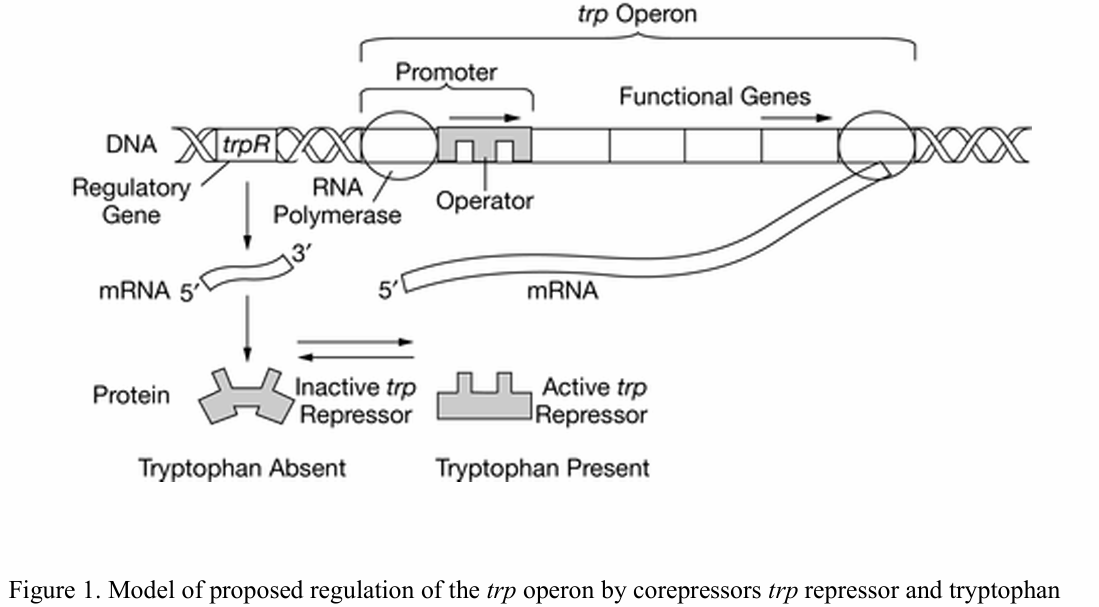
B. Tryptophan is absent, so the repressor protein is active.
C. Tryptophan is present, so the repressor protein is inactive.
D. Tryptophan is absent, so the repressor protein is inactive.
▶️ Answer/Explanation
Correct Option: D
The $trp$ operon is a repressible system designed to save energy when tryptophan is abundant.
When tryptophan is absent, the repressor protein cannot bind to the operator on its own.
In this state, the repressor is inactive and does not block the promoter region.
Consequently, RNA polymerase can bind to the DNA and transcribe the functional genes.
Therefore, the operon is “on” only when tryptophan levels are low or absent.
Tryptophan acts as a corepressor, activating the repressor only when present.
Question
▶️ Answer/Explanation
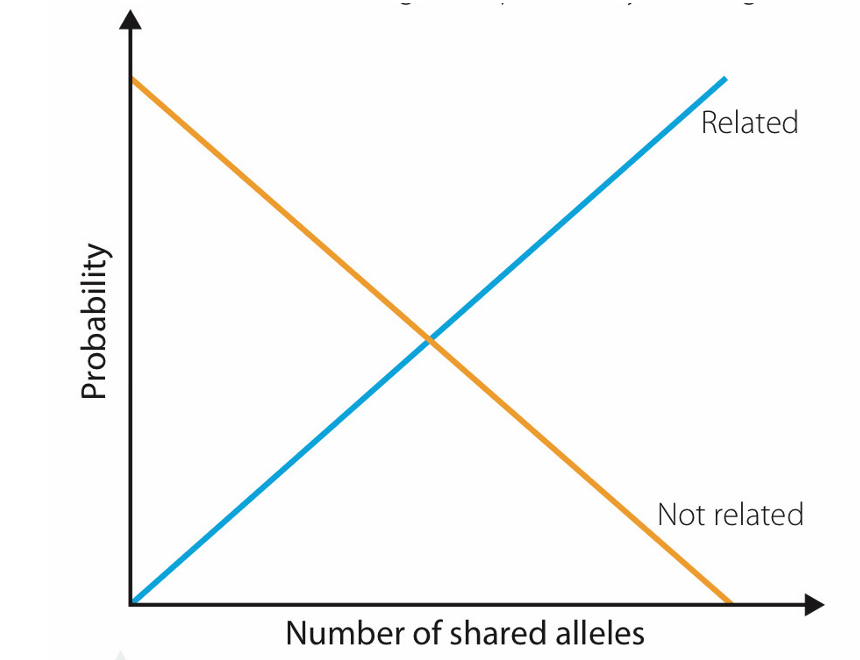
The $x$-axis represents the number of shared alleles, while the $y$-axis represents probability.
The orange line labeled “Not related” shows a negative correlation ($y \propto -x$).
As the number of shared alleles increases, the probability of being “not related” drops toward zero.
Conversely, at low numbers of shared alleles, the probability of being “not related” is at its highest.
Therefore, individuals who are not related have a significantly lower chance of sharing many alleles.
Options (A) and (D) provide external facts about $\text{STRs}$ that are not directly shown by the graph data.