
Pre AP Biology -GEN 4.2 Sexual Reproduction (Meiosis)- MCQ Exam Style Questions -New Syllabus 2025-2026
Pre AP Biology -GEN 4.2 Sexual Reproduction (Meiosis)- MCQ Exam Style Questions – New Syllabus 2025-2026
Pre AP Biology -GEN 4.2 Sexual Reproduction (Meiosis)- MCQ Exam Style Questions – Pre AP Biology – per latest Pre AP Biology Syllabus.
Question
▶️ Answer/Explanation
The correct option is a.
Angiosperms are the only group of plants that produce true flowers as reproductive structures.
They undergo double fertilization, where one sperm fuses with the egg and another with the polar nuclei.
Germination is not unique to angiosperms, as gymnosperms and ferns also germinate from seeds or spores.
Coevolution occurs across many kingdoms, such as between predators and prey or hosts and parasites.
Therefore, the combination of flowers and double fertilization defines the uniqueness of angiosperms.
This process ensures the formation of both a diploid zygote ($2n$) and a triploid endosperm ($3n$).
Question
▶️ Answer/Explanation
The correct option is b.
Double fertilization is a unique process in angiosperms involving two sperm cells.
The first $1$st sperm fuses with the egg cell to form a diploid ($2n$) zygote.
The $2$nd sperm fuses with the central cell (containing two polar nuclei).
This second fusion creates a triploid ($3n$) primary endosperm nucleus.
The zygote develops into the embryo, while the endosperm provides nutrition.
Options a, c, and d are incorrect as they misidentify the target cells or outcomes.
Question
▶️ Answer/Explanation
The correct option is d.
The microspore is the first cell of the male gametophyte generation.
It undergoes an asymmetrical mitotic division ($1$ mitosis).
This division results in a large tube cell (vegetative cell) and a smaller generative cell.
The tube cell is responsible for pollen tube growth.
The generative cell later divides to form two male gametes (sperm cells).
At the initial stage of microspore division, only two cells are formed.
Question
b. embryo sac, by mitosis
c. central cell, by mitosis
d. female gametophyte, by meiosis
▶️ Answer/Explanation
The correct option is b.
In angiosperms, a diploid ($2n$) megaspore mother cell undergoes meiosis to produce four haploid ($n$) megaspores.
One functional megaspore then undergoes three rounds of mitosis to form the embryo sac (the female gametophyte).
The embryo sac typically contains $8$ haploid nuclei, one of which differentiates into the egg cell.
Since the embryo sac itself is already haploid ($n$), the egg cell is produced via mitosis within this structure.
Therefore, the egg cell is located in the embryo sac and formed through the process of mitosis.
Question
b. DNA from RNA
c. proteins from DNA
d. proteins from RNA
▶️ Answer/Explanation
The correct option is b.
Reverse transcriptase is an enzyme that catalyzes the process of reverse transcription.
In this process, a complementary \(\text{DNA}\) (\(\text{cDNA}\)) strand is synthesized using an \(\text{RNA}\) template.
This mechanism effectively reverses the standard flow of genetic information (Transcription).
It is primarily used by retroviruses, such as \(\text{HIV}\), to integrate their genome into the host cell.
Option a refers to transcription, while c and d involve translation and gene expression.
Therefore, the enzyme specifically builds \(\text{DNA}\) from an \(\text{RNA}\) source.
Question
b. a fern
c. a pine tree
d. an angiosperm
▶️ Answer/Explanation
In bryophytes like mosses, the sporophyte is a stalk-like structure that often lacks true leaves.
The moss sporophyte consists of a foot, seta, and a capsule where spores are produced.
Despite being leafless, these sporophytes possess a waxy cuticle to prevent desiccation.
They also feature stomata on the capsule for regulated gas exchange during development.
In contrast, ferns, pine trees, and angiosperms have dominant, leafy sporophyte generations.
Therefore, a leafless sporophyte with these specific adaptations is most characteristic of a moss.
Question
▶️ Answer/Explanation
Ans : d. a sporophyte generation
The tiny brown stalks with round tops are sporophytes in mosses. The leafy shoots are the gametophyte, from which the sporophyte emerges after fertilization. The round tops are spore capsules.
Explanation :
In moss life cycle, the green leafy part is the dominant haploid gametophyte.
Antheridia (a) are male gametangia producing sperm on the gametophyte.
Archegonia (b) are female gametangia producing eggs on the gametophyte.
Gametophyte generation (c) refers to the leafy base, not the emerging stalks.
Sporophyte generation (d) is the diploid phase: a stalk (seta) with a round capsule containing spores.
These brown structures match the sporophyte, which depends on the gametophyte for nutrition.
This alternation of generations is typical in bryophytes like mosses.
The description fits common moss sporophytes seen in damp areas like patios.
Question
b. posttranslational
c. transcriptional
d. posttranscriptional
▶️ Answer/Explanation
The correct option is d. posttranscriptional.
In eukaryotes, transcription occurs within the nucleus to produce pre-$\text{mRNA}$.
Post-transcriptional regulation includes processing steps like capping, splicing, and polyadenylation.
The nuclear pore complex strictly regulates the export of only mature $\text{mRNA}$ to the cytoplasm.
This transport mechanism is a key checkpoint occurring after transcription but before translation.
Therefore, the control of $\text{mRNA}$ delivery is classified as post-transcriptional regulation.
Other levels like translational or post-translational occur only after the $\text{mRNA}$ has reached the cytoplasm.
Question
b. It winds genes tightly around histones.
c. It inserts nucleosomes into chromatin.
d. It recruits a protein complex that displaces nucleosomes from the promoter.
▶️ Answer/Explanation
The correct option is d.
Chromatin remodeling involves the restructuring of nucleosomes to change DNA accessibility.
Specific protein complexes use energy from $ATP$ hydrolysis to slide or eject nucleosomes.
This process clears the promoter region of the gene.
By displacing these nucleosomes, the underlying $DNA$ sequences become accessible.
This allows RNA polymerase and transcription factors to bind to the promoter.
Consequently, the initiation of transcription is triggered, thereby activating gene expression.
Question
▶️ Answer/Explanation
The correct option is b.
The $trp$ operon is a repressible system used by bacteria to synthesize tryptophan.
Tryptophan acts as a corepressor, not an inducer.
When tryptophan levels are high, it binds to the inactive $trp$ repressor protein.
This binding activates the repressor, allowing it to attach to the operator site.
Once bound, the repressor physically blocks RNA polymerase from transcribing the genes.
This feedback inhibition ensures the cell does not waste energy producing excess tryptophan.
Question

b. $MHv$
c. $mHV$
d. $mhV$
▶️ Answer/Explanation
The bacterial chromosome starts with the alleles $m$, $H$, and $V$.
The first crossover occurs between the $M/m$ and $H/h$ loci.
This switches the segment from the bacterial strand ($m$) to the transformed strand ($h$).
The second crossover occurs between the $H/h$ and $V/v$ loci.
This switches the segment back from the transformed strand ($h$) to the bacterial strand ($V$).
Tracing the resulting continuous line on the chromosome: we start with $m$, cross over to pick up $h$, and cross back to pick up $V$.
Therefore, the final genotype of the integrated bacterial chromosome is $mhV$.
Correct Option: d. $mhV$
Question
▶️ Answer/Explanation
The correct option is b. $46; 23$.
In prophase I, the human cell is diploid ($2n$) and contains $46$ chromosomes.
Each chromosome consists of two sister chromatids, but the count remains $46$.
Meiosis I is a reduction division that separates homologous pairs.
Meiosis II then separates sister chromatids into individual cells.
By telophase II, each resulting daughter cell is haploid ($n$).
Therefore, the final count per nucleus in telophase II is $23$ chromosomes.
Question
▶️ Answer/Explanation
The correct answer is a. when the dog’s parents made gametes.
Genetic recombination happens during meiosis in the parents.
This process shuffles alleles through crossing over and independent assortment.
As a result, each gamete (sperm or egg) gets a unique combination of alleles.
When gametes fuse to form a zygote, the offspring inherits this recombined set.
Siblings get different combinations because each fertilization involves different gametes.
Recombination does not occur in the zygote, during growth, or at maturity.
These later stages involve mitosis, which does not recombine alleles.
Question
b. Yes, both plants and animals make gametes. The difference is that plant gametes divide by mitosis and animal gametes do not.
c. Yes, plants are simpler organisms than animals and have fewer chromosomes in their cells.
d. Yes, plants and animals use meiosis for different purposes. Animals make gametes by meiosis and plants make zygotes.
▶️ Answer/Explanation
The correct answer is a.
In plants, the alternation of generations involves both a multicellular $n$ (haploid) and $2n$ (diploid) stage.
Plants produce gametes via mitosis from the haploid gametophyte stage.
Animals are primarily diploid ($2n$) and produce gametes ($n$) directly via meiosis.
Both kingdoms utilize both stages, though the dominance of each stage varies significantly.
Meiosis in plants actually produces spores, not gametes directly.
Therefore, both organisms transition between haploid and diploid phases during their life cycles.
Question
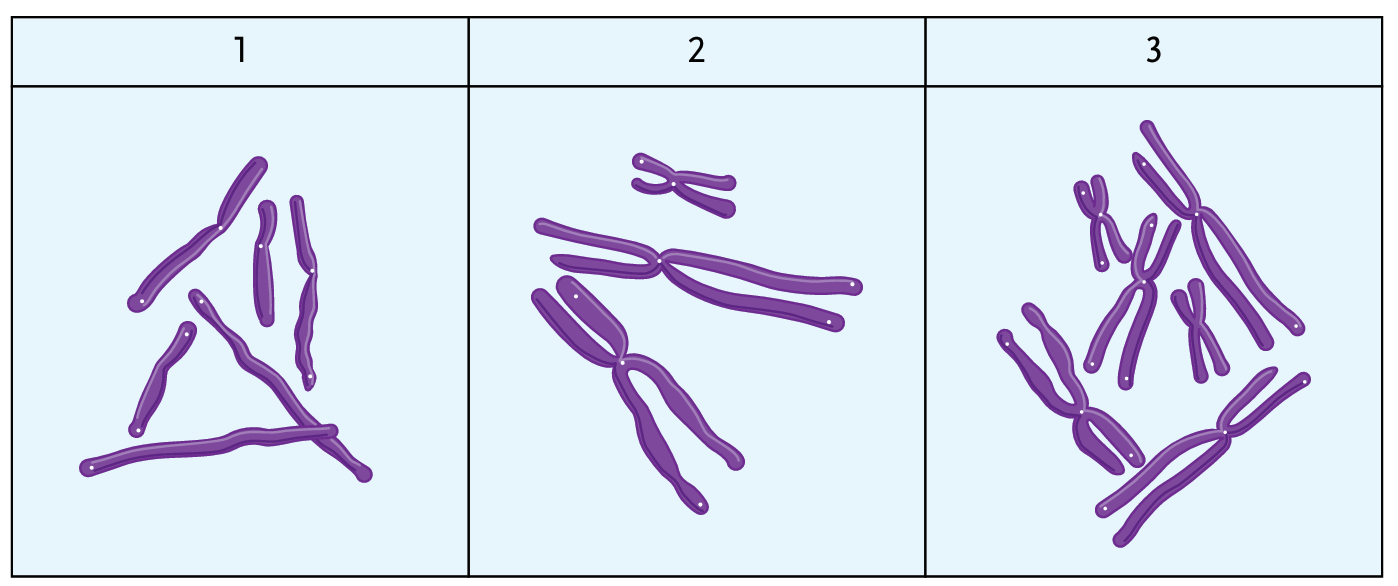
b. $2$ only
c. $3$ only
d. $1$ and $3$
▶️ Answer/Explanation
Correct Answer: d. $1$ and $3$
In cell $1$, there are $3$ distinct types of chromosomes, each present in $2$ copies (homologous pairs), making it diploid ($2n = 6$).
In cell $2$, there are $3$ different types of chromosomes but only $1$ of each, indicating it is haploid ($n = 3$).
In cell $3$, there are $3$ types of chromosomes, each consisting of $2$ sister chromatids, but still organized in homologous pairs ($2n = 6$).
A cell is diploid if it contains two complete sets of chromosomes, regardless of whether they consist of one or two chromatids.
Cell $1$ represents a diploid cell in $G_1$ phase where chromosomes are unreplicated.
Cell $3$ represents a diploid cell in $G_2$ or Prophase where chromosomes have been replicated into sister chromatids.
Therefore, both cells $1$ and $3$ satisfy the criteria for being diploid.
Question
B. sister chromatids are separated.
C. the DNA is replicated.
D. two cells divide into four cells.
▶️ Answer/Explanation
The correct option is A.
Meiosis I is known as the reductional division phase.
During Anaphase I, homologous chromosomes move toward opposite poles.
Unlike mitosis, the sister chromatids remain attached at their centromeres.
DNA replication occurs only once during the $S$ phase of interphase, before Meiosis I begins.
The separation of sister chromatids occurs later, during Meiosis II.
This process results in two haploid cells, each containing half the original chromosome count.
Question
B. $46$ chromosomes
C. $44$ chromosomes
D. $46 + XX$ chromosomes
▶️ Answer/Explanation
The correct answer is B.
In humans, a diploid ($2N$) cell contains two complete sets of chromosomes.
One set of $n = 23$ is inherited from the mother and one set of $n = 23$ from the father.
Therefore, the total count is $23 + 23 = 46$ chromosomes.
These include $44$ autosomes and $2$ sex chromosomes ($XX$ or $XY$).
Option A refers to the haploid ($N$) number found in gametes.
Option D is mathematically incorrect as it suggests a total of $48$ chromosomes.
Question
B. $25\%$
C. $50\%$
D. $100\%$
▶️ Answer/Explanation
Let $X^B$ be the normal allele and $X^b$ be the recessive colorblind allele.
The colorblind husband’s genotype is $X^b Y$.
The homozygous normal wife’s genotype is $X^B X^B$.
A daughter receives one $X$ chromosome from each parent ($X^B$ from mother and $X^b$ from father).
All daughters will have the genotype $X^B X^b$, making them carriers with normal vision.
Since $0$ out of $100\%$ of daughters will express the recessive phenotype, the probability is $0\%$.
Therefore, the correct option is A.
Question
B. Crossing over and the exchange of alleles during Meiosis.
C. The random combination of different egg or sperm cells during fertilization.
D. The separation of sister chromatids during Anaphase of Mitosis.
▶️ Answer/Explanation
Correct Option: D
Meiosis creates variation via independent assortment and crossing over.
Fertilization increases diversity by combining unique gametes randomly.
Mitosis is a process of asexual cellular replication.
During Anaphase of Mitosis, identical sister chromatids are separated.
This results in two daughter cells that are genetically identical.
Therefore, Mitosis does not contribute to genetic variation in the population.
Question
B. Meiosis I
C. Meiosis II
D. Fertilization
▶️ Answer/Explanation
The correct answer is B. Meiosis I.
In Meiosis I, homologous pairs align at the metaphase plate and separate during anaphase I.
In Mitosis and Meiosis II, it is the sister chromatids that are separated, not homologous pairs.
Fertilization is the fusion of gametes, which combines chromosomes rather than separating them.
This specific separation in Meiosis I reduces the chromosome number from $2n$ to $n$.
Therefore, the organization and segregation of homologs is unique to the first division of meiosis.
Question
▶️ Answer/Explanation
The correct answer is (B).
A frameshift mutation occurs when nucleotides are added or removed in numbers not divisible by $3$.
Since $mRNA$ is read in triplets, this alters the grouping of every subsequent codon downstream.
This typically changes every amino acid in the polypeptide chain following the mutation site.
It often results in a premature stop codon, leading to a truncated, non-functional protein.
Options (A) and (C) describe point mutations, specifically silent mutations, which do not shift the frame.
Option (D) describes the location of a mutation rather than its biochemical mechanism or consequence.
Question
▶️ Answer/Explanation
The offspring are genetically identical because they are clones, meaning their DNA sequences are the same.
Variation in physical traits (phenotypes) like height often results from environmental factors.
Different zoos provide different diets, climates, and care, which trigger different gene expressions.
This interaction between genes and the environment is known as phenotypic plasticity.
Mutations (Options A and C) are rare and unlikely to occur identically or insignificantly across all five.
Environmental influence on gene expression (epigenetics) perfectly explains how identical DNA produces different results.
Question
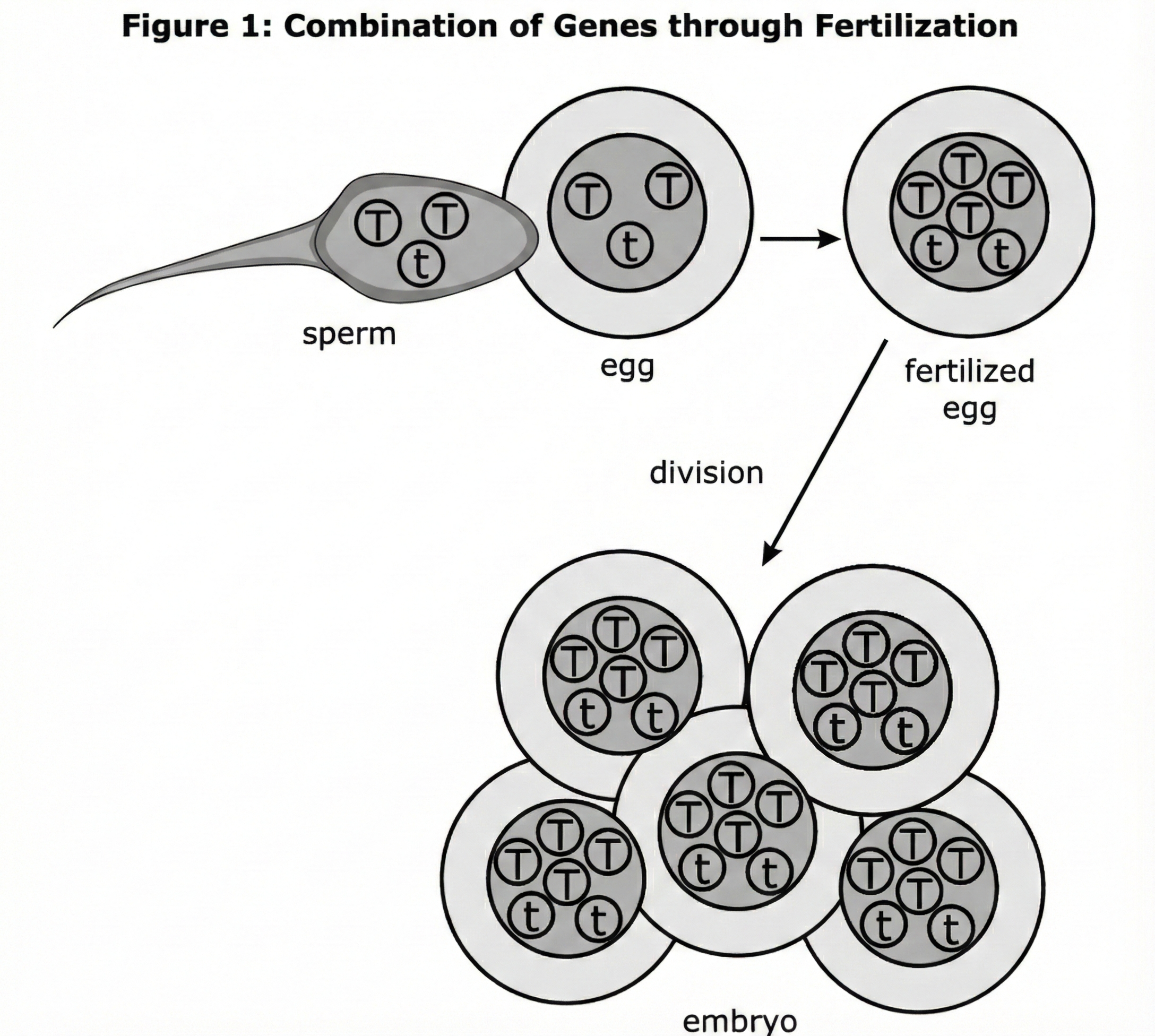
Q. Select the choice that best completes the statement.
The cells of the embryo are 1 because of 2 .
Q. Judd has a 20-year-old sister. Her height is \(5’4”\). Which statement best explains why his sister is shorter than him and their parents?
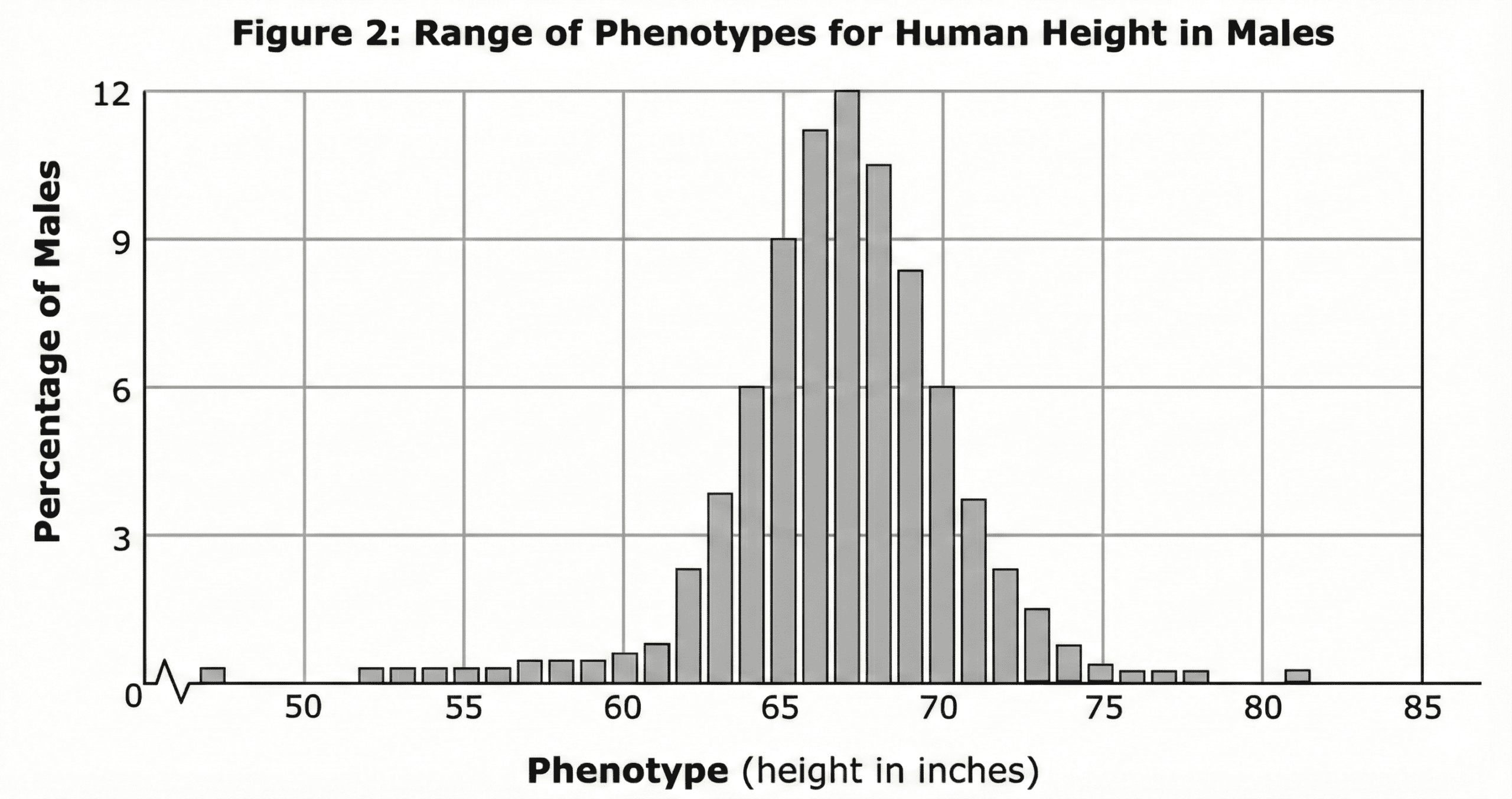
Q. Which statement best describes the trait for height, based on Figure 2?
Q. Some of the phenotypes for male height are identified by two distinct ranges.
- Range 1: 50-55 inches
- Range 2: 75-80 inches
Which choice best describes how these height ranges are represented in Figure 2?
Q. Judd visits an exhibit at a local museum. A display there describes a recent research study where people from several distinct neighborhoods in a large U.S. city were surveyed for height. The display features the data table below.
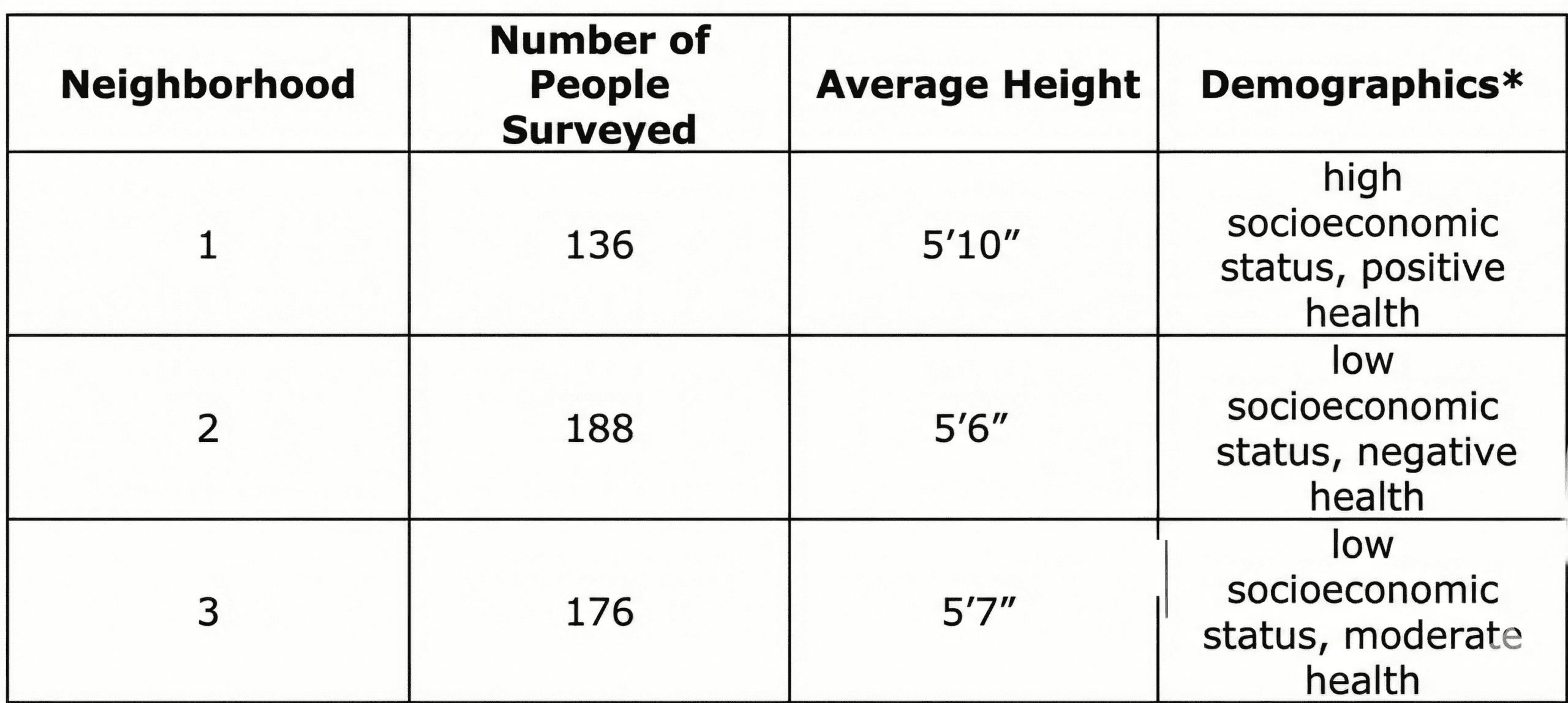
What can most likely be inferred from the research data?
▶️ Answer/Explanation
A. (C)
Gametes (sperm and egg) are haploid cells produced by meiosis. When they fuse during the process of fertilization, they combine their genetic material to form a zygote (embryo). The resulting embryo is diploid, meaning it contains two full sets of chromosomes (one from each parent).
A. (C)
Height is a polygenic trait determined by multiple alleles (represented by \(T\) and \(t\)). Because parents are heterozygous for various genes, independent assortment during meiosis creates diverse combinations. The sister received a higher percentage of recessive “short” alleles (\(t\)) compared to Judd, resulting in a shorter phenotype.
A. (B)
Figure 2 shows a continuous bell-shaped distribution of height. Traits that show a continuous range of phenotypes (rather than distinct categories like “tall” or “short”) are typically polygenic, meaning they are controlled by the interaction of multiple genes.
A. (A)
In a normal distribution histogram (Figure 2), the height of the bars represents the frequency of the trait. The ranges 50–55 inches and 75–80 inches are located at the extreme “tails” of the graph where the bars are very short or non-existent. This indicates that both ranges represent rare phenotypes.
A. (B)
The data shows a correlation between socioeconomic status/health and average height. Neighborhood 1 (positive health/high status) has the tallest average, while Neighborhood 2 (negative health/low status) has the shortest. This suggests that environmental factors like nutrition and healthcare availability significantly influence the phenotypic expression of height.
Question
A farmer reads this information:
- A bacterium has a gene that allows it to create pesticide.
- The gene has been transferred into a corn plant, allowing the corn plant to produce pesticide.
Why might a farmer choose to plant genetically engineered corn?
▶️ Answer/Explanation
The correct option is B because:
Genetically engineered corn (such as Bt corn) produces its own internal pesticide.
This biological trait allows the plant to defend itself against specific insect pests naturally.
Consequently, farmers do not need to apply as many external chemical sprays to the fields.
Reducing chemical use lowers production costs and minimizes environmental runoff.
Options A, C, and D are not direct biological outcomes of producing an internal pesticide.
Question
B. Baby X
C. Baby Y
D. Baby Z
▶️ Answer/Explanation
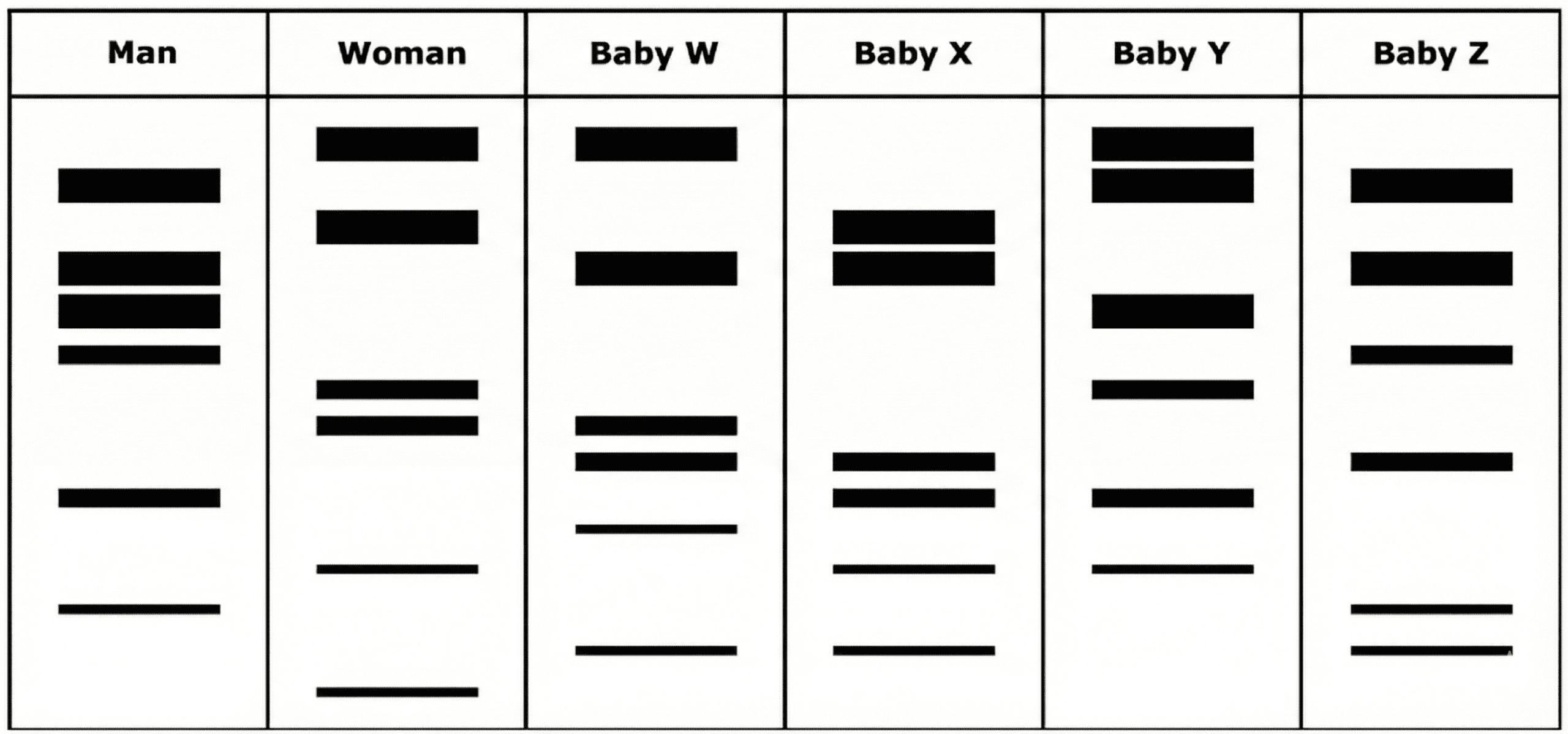
In DNA fingerprinting, every band in a child’s profile must be present in at least one parent’s profile.
By comparing Baby Y to the parents, we see that its top two bands match the Woman.
The middle thick band and the next two lower bands in Baby Y match the Man’s profile.
The bottom-most band in Baby Y matches a corresponding band in the Woman’s profile.
Other babies (W, X, and Z) possess unique bands that do not appear in either the Man or the Woman.
Since all bands in Baby Y are accounted for by the potential parents, it is the biological offspring.