Home / AP® Exam / Pre AP Biology / Exam Style Questions

Pre AP Biology -GEN 5.1 Inheritance Patterns- FRQ Exam Style Questions -New Syllabus

Pre AP Biology -GEN 5.1 Inheritance Patterns- FRQ Exam Style Questions – New Syllabus 2025-2026

Pre AP Biology -GEN 5.1 Inheritance Patterns- FRQ Exam Style Questions – Pre AP Biology – per latest Pre AP Biology Syllabus.

Pre AP Biology – FRQ Exam Style Questions- All Topics

Question

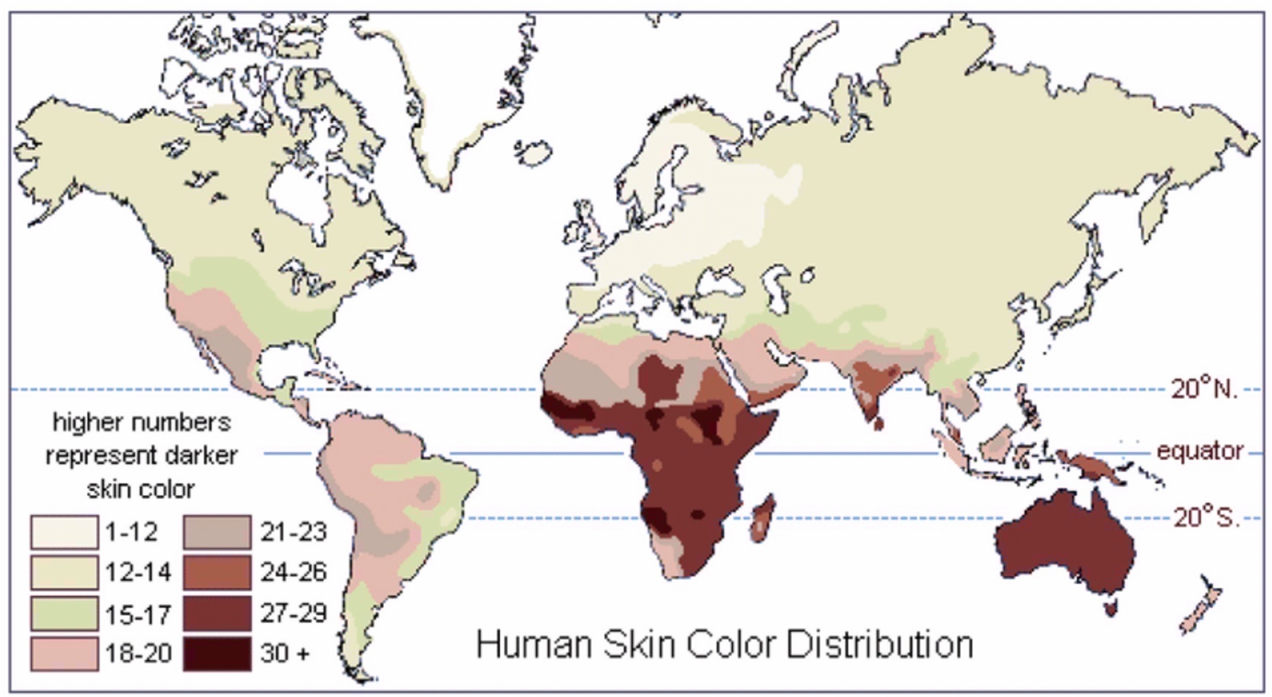
The map shows the global skin colour distribution of native populations relative to the equator where UV levels are the highest. The colours on the map are based on the 36-tone chromatic scale to assess the unexposed skin of human populations.
Melanin is a substance in your body that produces hair, eye and skin pigmentation. The more melanin you produce, the darker your eyes, hair and skin will be. The substance also absorbs harmful UV (ultraviolet) rays and protects your cells from sun damage. MC1R is a key gene in normal human pigmentation with 80 variants.
With reference to evolution and DNA, provide a possible reason for the distribution shown in the map.

Most-appropriate topic codes:

TOPIC: EVO 2.2 — Selective Mechanisms: Abiotic ecosystem components (such as UV radiation) act as selective pressures, and favorable traits in a given environment lead to changes in phenotypic and/or allele frequencies over time.
TOPIC: GEN 3.4 — Mutations: Random changes in DNA sequences (like MC1R variants) affect an organism’s phenotype and can produce beneficial variation.
TOPIC: GEN 5.1 — Inheritance Patterns: Many of an organism’s traits (phenotype, such as skin pigmentation) are determined by the organism’s genes (genotype).
▶️ Answer/Explanation
Detailed solution

The distribution of skin colour is a result of natural selection acting on genetic variations (DNA) in response to varying levels of ultraviolet (UV) radiation across the globe.

1. High UV Regions (Near the Equator):
Regions near the equator receive high intensity UV radiation. High UV levels can damage DNA (causing cancer) and break down essential nutrients like folate.
Individuals with DNA variants (such as specific MC1R alleles) that produce more melanin (darker skin) had a survival advantage. The melanin acted as a natural sunscreen, protecting them from UV damage.
Consequently, these individuals were more likely to survive and reproduce, passing these “dark skin” genes to the next generation.

2. Low UV Regions (Higher Latitudes):
As populations migrated away from the equator to areas with lower UV radiation (e.g., Northern Europe), the selection pressure changed.
While high UV is harmful, a certain amount of UV is necessary for the skin to synthesize Vitamin D, which is crucial for bone health and immunity.
In these low-light environments, dark skin blocked too much UV, leading to Vitamin D deficiency. Individuals with DNA mutations resulting in less melanin (lighter skin) were favored because their skin allowed enough UV penetration to produce adequate Vitamin D.
Over time, lighter skin alleles became dominant in these populations.

Conclusion:
Therefore, the gradient of skin colour from the equator to the poles represents an evolutionary trade-off balanced by the need for protection against UV damage and the need for Vitamin D synthesis.

Scroll to Top