
Home / AP® Exam / Pre AP Biology / Exam Style Questions

Pre AP Biology -GEN 5.1 Inheritance Patterns- MCQ Exam Style Questions -New Syllabus 2025-2026

Pre AP Biology -GEN 5.1 Inheritance Patterns- MCQ Exam Style Questions – New Syllabus 2025-2026

Pre AP Biology -GEN 5.1 Inheritance Patterns- MCQ Exam Style Questions – Pre AP Biology – per latest Pre AP Biology Syllabus.

Pre AP Biology – MCQ Exam Style Questions- All Topics

Question

Which of these environmental factors is particularly important for reptiles, and why?
a. humidity, because it determines their body temperature
b. humidity, because it determines their food quality
c. temperature, because it determines their sex
d. temperature, because it determines their nesting sites
▶️ Answer/Explanation
Detailed solution

The correct option is c. temperature, because it determines their sex.
In many reptile species, such as crocodiles and turtles, the sex of the offspring is not determined by chromosomes.
Instead, it is determined by the incubation temperature of the eggs during a critical period of development.
This biological phenomenon is known as Temperature-dependent Sex Determination (TSD).
Higher or lower temperatures can result in a clutch being entirely male or entirely female.
Environmental temperature changes can therefore significantly impact the population sex ratios.
Other options are incorrect as humidity does not regulate internal body temperature in reptiles.

Question

Perky ears in a certain mammal are coded by a dominant allele; the recessive allele codes for droopy ears. In males of these mammals, the gene encoding ear shape is transcribed only from the chromosome received from the female parent. This is because the gene from the male parent is silenced by methylation. What will be the result of a cross of a droopy-eared female and a homozygous, perky-eared male?
a. Daughters’ ears will be perky and sons’ ears will be droopy.
b. All offspring will have perky ears.
c. Sons will have one perky ear and one droopy ear.
d. There will be equal numbers of perky-eared and droopy-eared sons and daughters.
▶️ Answer/Explanation
Detailed solution

Let $P$ be the dominant perky allele and $p$ be the recessive droopy allele.
The female parent is droopy-eared, so her genotype must be $pp$.
The male parent is homozygous perky-eared, so his genotype is $PP$.
All offspring (sons and daughters) will inherit the genotype $Pp$ ($P$ from father, $p$ from mother).
In daughters, genomic imprinting is not mentioned as sex-specific, so $P$ is dominant over $p$, resulting in perky ears.
In sons, the paternal allele ($P$) is silenced by methylation, meaning only the maternal allele ($p$) is expressed.
Since sons only express the maternal $p$ allele, they will have droopy ears.
Therefore, the correct result is option a.

Question

Context: Most fruit flies have red eyes; some have white eyes. The gene affecting color is on the X chromosome. Red allele (\(X^R\)) is dominant to white allele (\(X^r\)).

  • Experiment 1: Red female (\(X^R X^R\)) x White male. Result: 100% Red eyes.
  • Experiment 2: Offspring from Exp 1 mated. Result: Females 100% Red; Males 50% Red, 50% White.
  • Experiment 3: Female offspring from Exp 1 x White male. Result: 50% Red, 50% White (both sexes).
  • Experiment 4: White female from Exp 3 x Red male. Result: Females 100% Red; Males 100% White.
Q. To produce only white-eyed offspring, one would mate fruit flies with which of the following sets of genotypes?
A. \(X^r X^r\) and \(X^r Y\)
B. \(X^R X^r\) and \(X^r Y\)
C. \(X^r X^r\) and \(X^R Y\)
D. \(X^R X^r\) and \(X^R Y\)
Q. Which of the four Experiments contained male offspring with one copy of the white-eye allele?
A. 2 and 4 only
B. 3 and 4 only
C. 1, 2, and 3 only
D. 2, 3, and 4 only
Q. The total ratio of red-eyed offspring to white-eyed offspring produced in Experiment 2 was
A. 1:0
B. 1:1
C. 2:1
D. 3:1
▶️ Answer/Explanation
A. Answer: A
To get 100% white-eyed offspring, every child must receive the recessive allele (\(X^r\)) and no dominant alleles (\(X^R\)).
The father must be white-eyed (\(X^r Y\)) to pass the allele to daughters (and Y to sons).
The mother must be homozygous recessive (\(X^r X^r\)) to pass the white allele to all offspring.
Therefore, the cross is \(X^r X^r \times X^r Y\).
A. Answer: D
Males have one X chromosome, so a male with a white-eye allele has the genotype \(X^r Y\) (white eyes).
Experiment 1 produced 100% red-eyed males (\(X^R Y\)).
Experiment 2 produced 50% white-eyed males (\(X^r Y\)).
Experiment 3 produced 50% white-eyed males (\(X^r Y\)).
Experiment 4 produced 100% white-eyed males (\(X^r Y\)).
Thus, the correct experiments are 2, 3, and 4.
A. Answer: D
Experiment 2 is a cross between offspring of Exp 1: \(X^R X^r\) (female) \(\times\) \(X^R Y\) (male).
The possible genotypes are: \(X^R X^R\) (Red Female), \(X^R X^r\) (Red Female), \(X^R Y\) (Red Male), and \(X^r Y\) (White Male).
Counting the phenotypes: 3 offspring are Red-eyed and 1 offspring is White-eyed.
Therefore, the ratio of Red:White is 3:1.

Question

In a certain species of plant, the \(D\) allele for tall plants is dominant to the \(d\) allele for dwarf, and the \(W\) allele for violet colored flowers is dominant to the \(w\) allele for white flowers. A cross of a true-breeding dwarf (\(dd\)), white (\(ww\)) flowered plant with a tall (\(DD\)), violet (\(WW\)) flowered plant yielded all heterozygous tall violet plants. A dihybrid cross of two F1 offspring was conducted, and the F2 progeny listed in the table below. The Chi-square test for the null hypothesis that the F2 data fit the expected proportions for such a dihybrid cross with two independently assorting genes that are not linked was performed.

Q. Using the observed data in the table provided, which of the following is the approximate chi-square value?

A. \(2.99\)
B. \(10.49\)
C. \(238.55\)
D. \(719.21\)

Q. What are the degrees of freedom for the Chi-square test of this cross? (Hint: Degrees of freedom are equal to the number of possible outcomes – 1)

A. \(3\)
B. \(4\)
C. \(5\)
D. \(6\)

Q. Using the degrees of freedom and a \(p\) value of \(0.05\), which of the following is the correct critical value?

A. \(5.99\)
B. \(7.81\)
C. \(9.49\)
D. \(11.07\)

Q. Based on the results, which of the following is the conclusion of the chi-square test?

A. The null hypothesis is not rejected, because the chi-square value of \(2.99\) is less than the critical value of \(5.99\).
B. The null hypothesis is rejected, because the chi-square value of \(238.55\) is greater than the critical value of \(9.49\).
C. The null hypothesis is not rejected, because the chi-square value of \(10.49\) is less than the critical value of \(11.07\).
D. The null hypothesis is rejected, because the chi-square value of \(719.21\) is greater than the critical value of \(7.81\).
▶️ Answer/Explanation
Detailed solution
A: D (\(719.21\))
A: A (\(3\))
A: B (\(7.81\))
A3: D

Explanation:
For Q: A standard dihybrid cross results in \(4\) possible phenotypic classes (Tall/Violet, Tall/White, Dwarf/Violet, Dwarf/White). The degrees of freedom are calculated as \(df = n – 1 = 4 – 1 = 3\).
For Q: Referring to the Chi-square table provided, find the intersection of the column for \(df = 3\) and the row for \(p = 0.05\). The value listed is \(7.81\).
For Q: The conclusion relies on comparing the calculated \(\chi^2\) to the critical value (\(7.81\)). Only option D correctly identifies the critical value for \(3\) degrees of freedom (\(7.81\)).
For Q: Since option D in Q184 is the only logically consistent conclusion (citing the correct critical value), the calculated \(\chi^2\) value must be \(719.21\). This extremely high value suggests the genes are linked rather than independent.
Question

In rabbits, black fur is dominant to white fur. What are the predicted phenotype ratios of the offspring of a cross between a homozygous black and a heterozygous black parent?
A. $75\%$ black: $25\%$ white
B. $50\%$ black: $50\%$ white
C. $100\%$ black
D. $100\%$ white
▶️ Answer/Explanation
Detailed solution

Let $B$ represent the dominant allele for black fur and $b$ represent the recessive allele for white fur.
The homozygous black parent has the genotype $BB$.
The heterozygous black parent has the genotype $Bb$.
The cross is $BB \times Bb$.
The resulting offspring genotypes are $50\%$ $BB$ and $50\%$ $Bb$.
Since both $BB$ and $Bb$ genotypes result in the black fur phenotype, $100\%$ of the offspring will be black.
Therefore, the predicted phenotype ratio is $100\%$ black.
The correct option is C.

Question

A student in a biology class crossed a male Drosophila melanogaster having a gray body and long wings with a female D. melanogaster having a black body and apterous wings. The following distribution of traits was observed in the offspring:
PhenotypeNumber of Offspring
Gray body, long wings$42$
Black body, apterous wings$41$
Gray body, apterous wings$9$
Black body, long wings$8$
Which of the following claims is supported by the data?
A. The alleles for gray body and long wings are dominant.
B. The alleles for gray body and long wings are recessive.
C. Genes for the two traits are located on two different chromosomes, and independent assortment occurred.
D. Genes for the two traits are linked on the same chromosome, but crossing over produced a few recombinant offspring.
▶️ Answer/Explanation
Correct Option: D
Detailed solution

The parental phenotypes (Gray/Long and Black/Apterous) appear in much higher frequencies ($42$ and $41$) than the non-parental types.
If independent assortment occurred, we would expect a phenotypic ratio of approximately $1:1:1:1$ (roughly $25$ each).
The high frequency of parental combinations indicates the genes are linked on the same chromosome.
The small number of Gray/Apterous ($9$) and Black/Long ($8$) offspring are recombinants.
These recombinants resulted from crossing over during meiosis in the parent.
Therefore, the data supports that these genes are linked with a recombination frequency of approximately $17\%$.

Question

In a fruit fly experiment, a homozygous red-eyed female is crossed with a homozygous white-eyed male fly. All $F_1$ offspring had red eyes. Then two $F_1$ heterozygotes were mated to produce the $F_2$ generation, which consisted of a $3$ to $1$ ratio of red to white-eyed flies. However, after further investigation the scientists noticed that all females had red eyes and only males had white eyes in a $1$ to $1$ ratio.
Which pattern of inheritance is consistent with the information provided above?
A. Autosomal dominant inheritance
B. Autosomal recessive inheritance
C. Codominance
D. X-linked inheritance
▶️ Answer/Explanation
Detailed solution

The correct option is D. X-linked inheritance.
In the $P$ generation, the cross is $X^W X^W$ (red female) $\times$ $X^w Y$ (white male).
All $F_1$ offspring ($X^W X^w$ and $X^W Y$) have red eyes, showing red is dominant.
In the $F_2$ cross ($X^W X^w \times X^W Y$), all females receive a $X^W$ allele from the father.
This results in $100\%$ red-eyed females ($X^W X^W$ and $X^W X^w$).
Males receive either $X^W$ or $X^w$ from the mother, creating a $1:1$ red to white ratio.
The unequal distribution of the trait between sexes confirms the gene is on the $X$ chromosome.

Question

The ABO blood types are determined by multiple alleles ($I^A, I^B, i$). Individuals with blood type A can be genotype $I^A I^A$ or $I^A i$. Individuals with blood type B can be genotype $I^B I^B$ or $I^B i$. Individuals with blood type AB are genotype $I^A I^B$. Individuals with blood type O are genotype $ii$.
Based on this information above, if a man with blood type A has a child with a woman with blood type O, what are the possible phenotypes of the child?
A. The child can only be blood type A or blood type O
B. The child can only be blood type AB
C. The child can only be blood type A or blood type B
D. The child can be blood type A, B, AB, or O
▶️ Answer/Explanation
Detailed solution

The man has blood type A, so his genotype is either $I^A I^A$ or $I^A i$.
The woman has blood type O, meaning her genotype must be $ii$.
If the father is $I^A I^A$, all children will be $I^A i$ (Type A).
If the father is $I^A i$, the children could be $I^A i$ (Type A) or $ii$ (Type O).
In either scenario, the only possible phenotypes are blood type A or blood type O.
Therefore, the correct option is A.

Question

In dogs, fur coat can be brown ($G$) or golden ($g$). In addition, ears can be pointed ($P$) or floppy ($p$). In a dihybrid cross of dogs $GgPp \times GgPp$, what will the resulting phenotype ratio be?
A. $1:1:1:1$
B. $3:3:1:1$
C. $9:3:3:1$
D. $16:9:3:1$
▶️ Answer/Explanation
Detailed solution

The cross $GgPp \times GgPp$ involves two organisms heterozygous for two distinct traits.
According to Mendel’s Law of Independent Assortment, alleles for different traits segregate independently.

The four possible phenotypes resulting from this cross are expressed in a specific distribution.
Dominant for both traits ($G\_P\_$) occurs in $9/16$ of the offspring.
Dominant for one and recessive for the other ($G\_pp$ and $ggP\_$) each occur in $3/16$ of the offspring.
Recessive for both traits ($ggpp$) occurs in $1/16$ of the offspring.
Therefore, the classic Mendelian dihybrid ratio is $9:3:3:1$.
The correct option is C.

Question

Gregor Mendel discovered many aspects of inheritance in peas. One aspect of inheritance that Mendel discovered is the principle of dominance, which states that:
A. all alleles are dominant.
B. all alleles are recessive.
C. some alleles are dominant and others are recessive.
D. alleles are neither dominant nor recessive.
▶️ Answer/Explanation
Detailed solution

The correct answer is C.
Mendel’s Principle of Dominance states that in a heterozygote, one allele can mask the presence of another.
Organisms possess two alleles for a single trait, often inherited as one from each parent.
An allele is defined as dominant if it determines the phenotype even when only one copy is present.
An allele is recessive if its expression is masked by the dominant allele in a hybrid ($F_1$) generation.
Therefore, this principle establishes that some alleles are dominant and others are recessive.

Question

In a cross between a red flowered plant and a white flowered plant, the phenotype of $F_1$ offspring was $100\%$ pink flowered plants. A cross of two $F_1$ pink flowered plants together produced an $F_2$ offspring ratio of $1$ red $:$ $2$ pink $:$ $1$ white. Based on the results, the inheritance pattern of flower color in this case is incomplete dominance. If a red offspring and a pink offspring from the $F_2$ were crossed, what would the phenotype ratio of their offspring?
A. All red flowers
B. All pink flowers
C. $50\%$ pink and $50\%$ white
D. $50\%$ red and $50\%$ pink
▶️ Answer/Explanation
Detailed solution

Let the genotype for red be $RR$ and white be $WW$, resulting in pink $RW$.
The cross requested is between a red ($RR$) and a pink ($RW$) offspring.
The gametes from the red parent are all $R$.
The gametes from the pink parent are $50\% R$ and $50\% W$.
Offspring genotypes will be $50\% RR$ (red) and $50\% RW$ (pink).
Therefore, the phenotype ratio is $50\%$ red and $50\%$ pink.
The correct option is D.

Question

During Mendel’s experiments with pea plants, most traits were in pairs of two, such as tall and short plants. However, not all inheritance patterns contain only two possible phenotypes. For example, human skin color is determined by several genes and can lead to a large number of different phenotypes (\(>60\)). What type of inheritance is human skin color?
A. Simple dominance
B. Codominance
C. Multiple allele
D. Polygenic inheritance
▶️ Answer/Explanation
Detailed solution

The correct answer is D. Polygenic inheritance.
Polygenic inheritance occurs when a single characteristic is controlled by two or more genes.
Unlike Mendelian traits, these genes exert an additive effect on the final phenotype.
This results in continuous variation, creating a wide spectrum of possibilities (\(>60\) in this case).
Human skin color, height, and eye color are classic examples of this complex pattern.
Options A, B, and C typically involve a single gene locus and fewer distinct phenotypes.

Question

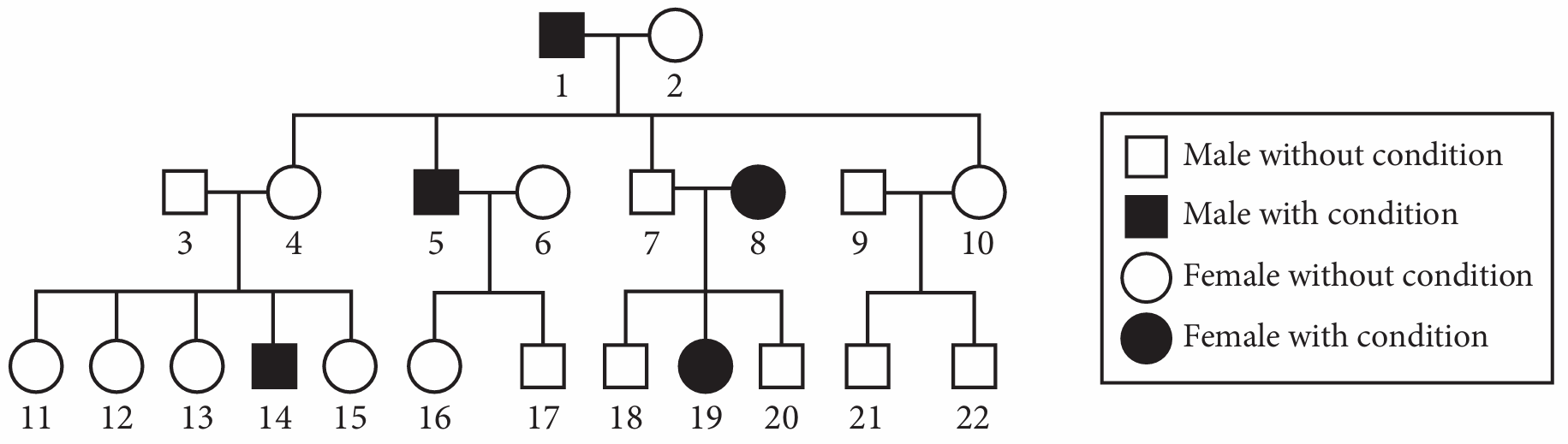
Q. Which of the following is the best evidence to support the claim that the inheritance pattern shown in the pedigree above is recessive and NOT dominant?
A. Individual \(5\) produces no affected offspring (individuals \(16\) and \(17\) are without condition).
B. Individual \(14\) has the condition, but has no affected parent (individuals \(3\) and \(4\) are without condition).
C. Males and females are affected by the conditional relatively equally in the pedigree.
D. Individual \(5\) is affected, but individuals \(4\), \(7\), and \(10\) are not affected.
Q. Which of the following is the best evidence to support the claim that the inheritance pattern shown in the pedigree above is NOT sex-linked?
A. There is no skipping of generations.
B. Individual \(19\) is an effected female and so is individual \(8\).
C. Males and females are affected by the conditional relatively equally in the pedigree.
D. Individual \(5\) is affected, but individuals \(4\), \(7\), and \(10\) are not affected.
▶️ Answer/Explanation
Detailed solution

A: B

The definitive proof of a recessive trait is the appearance of the condition in the offspring of unaffected parents.

If a trait were dominant, every affected child must have at least one affected parent.

In this pedigree, Individual \(14\) is affected, yet both parents (Individuals \(3\) and \(4\)) are unaffected.

This “skipping of generations” confirms that individuals \(3\) and \(4\) are heterozygous carriers for a recessive allele.

A: B

We test for sex-linkage (specifically X-linked recessive) by looking for violations of X-linked inheritance rules.

Rule 1: An affected daughter (\(X^r X^r\)) must have an affected father (\(X^r Y\)). Individual \(19\) is affected, but her father (\(7\)) is not.

Rule 2: An affected mother (\(X^r X^r\)) must pass the trait to all her sons (\(X^r Y\)). Individual \(8\) is affected, but her sons (\(18, 20\)) are not.

Therefore, the existence of affected females \(8\) and \(19\) (given their family context) provides the best evidence that the trait is autosomal, not sex-linked.
Question

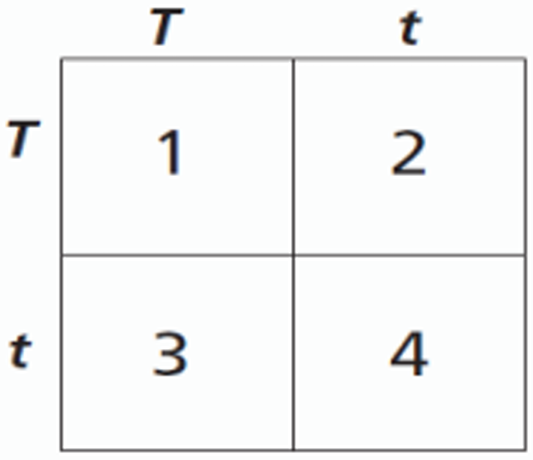
In pea plants, height is controlled by the T gene with two possible alleles. The T allele is dominant and codes for the tall plant trait, whereas the t allele is recessive and codes for short plant trait. A cross between a Tt and Tt plant are shown above.

Q. Based on the incomplete punnett square provided, which of the following correctly states the phenotype ratio of the cross of two heterozygous tall plants?

A. 2 tall and 2 short offspring
B. 3 tall and 1 short offspring
C. All offspring will be tall
D. All offspring will be short

Q. Based on the Punnett square above, which of the following is true about the cross?

A. Individual 1 is heterozygous.
B. Individuals 2 and 3 are homozygous dominant.
C. Individual 4 is homozygous recessive.
D. All individuals will be male.

Q. Which individuals in the offspring has the \(Tt\) genotype?

A. Individual 2 only
B. Individual 3 only
C. Individual 1 and 4 only
D. Individual 2 and 3 only

Q. In pea plants, pea color is controlled by the \(Y\) and \(y\) alleles. The \(Y\) allele codes for the yellow pea color phenotype, while the \(y\) allele codes for the green phenotype. If a particular pea plant is heterozygous for color, which of the following MUST BE TRUE of its parents?

A. Both parents must have contributed a \(Y\) allele.
B. Both parents must be green.
C. One parent must be homozygous dominant and the other homozygous recessive.
D. One parent must have contributed a \(Y\) allele while the other contributed a \(y\) allele.
▶️ Answer/Explanation
Detailed solution

A. Correct Answer: B
The cross shown is between two heterozygotes (\(Tt \times Tt\)).
This produces genotypes: \(TT\) (homozygous dominant), \(2 \times Tt\) (heterozygous), and \(tt\) (homozygous recessive).
Both \(TT\) and \(Tt\) genotypes result in the dominant “Tall” phenotype, totaling 3 offspring.
The \(tt\) genotype results in the recessive “Short” phenotype, totaling 1 offspring.
Therefore, the phenotypic ratio is 3 tall and 1 short.

A. Correct Answer: C
Individual 1 inherits a \(T\) from both parents, making it homozygous dominant (\(TT\)).
Individuals 2 and 3 inherit one \(T\) and one \(t\), making them heterozygous (\(Tt\)).
Individual 4 inherits a \(t\) allele from both parents (\(t \times t\)).
This results in the genotype \(tt\), which is classified as homozygous recessive.

A. Correct Answer: D
The \(Tt\) genotype represents a heterozygous individual.
In the Punnett square, Box 2 is formed by \(t\) (top) and \(T\) (side), resulting in \(Tt\).
Box 3 is formed by \(T\) (top) and \(t\) (side), resulting in \(Tt\).
Boxes 1 and 4 are homozygous (\(TT\) and \(tt\)).
Thus, only Individual 2 and 3 have the \(Tt\) genotype.

A. Correct Answer: D
A heterozygous pea plant has the genotype \(Yy\).
Organisms inherit one allele for a specific trait from each parent.
To possess both a \(Y\) and a \(y\) allele, the offspring must receive \(Y\) from one parent and \(y\) from the other.
It is not required for parents to be homozygous; they just need to contribute those specific alleles.
Therefore, one parent must have contributed a \(Y\) allele while the other contributed a \(y\) allele.
Question

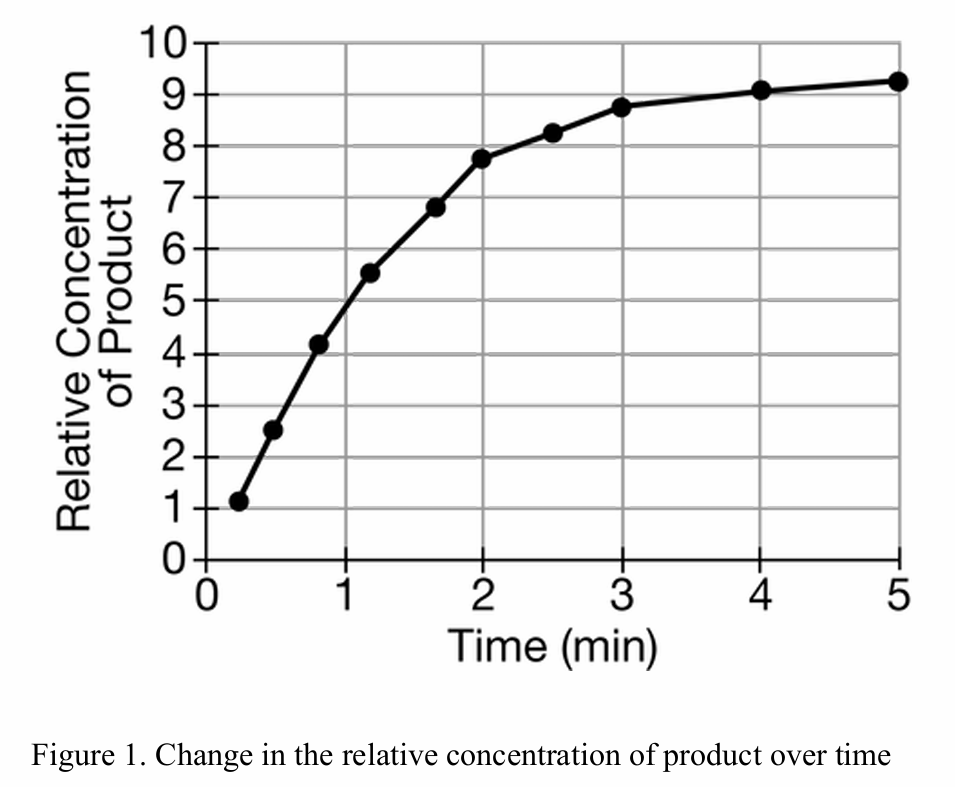
Figure 1 shows the amount of product produced in an enzyme-catalyzed reaction over five minutes. No environmental conditions were altered.

Q. How is this rate of this enzymatic chemical reaction being measured? (Hint: What is the DV?)

A. Relative product produced.
B. The time.
C. Substrates consumed.
D. The change in pH.

Q. Which of the following is another method to measure the rate of an enzyme catalyzed reaction?

A. The amount of enzyme.
B. The rate that substrates/reactants are consumed.
C. The change in pH over time.
D. The change in temperature over time.

Q. Which of the following best explains how the rate of the reaction changes over time?

A. The rate increases because more products are made over time.
B. The rate increases because the ratio of product to substrate increases.
C. The rate decreases because the ratio of product to substrate increases.
D. The rate decreases because the enzyme is used up as the reaction progresses.

Q. If a competitive inhibitor were added at one minute time for this reaction, predict the relative concentration of product produced at time 2 minutes?

A. Between \(0\) and \(2\).
B. Between \(3\) and \(5\).
C. Between \(5\) and \(7\).
D. Between \(8\) and \(10\).
▶️ Answer/Explanation
Detailed solution

A. Correct Answer: A
The dependent variable (DV) is the variable being measured and is typically plotted on the Y-axis. The Y-axis label in Figure 1 is “Relative Concentration of Product”. Therefore, the rate is being measured by tracking the relative product produced over time.

A. Correct Answer: B
The rate of an enzymatic reaction can be determined by measuring the appearance of product or the disappearance of substrate. Since the conversion of reactants to products is stoichiometric, measuring the rate at which substrates/reactants are consumed is a valid alternative method.

A. Correct Answer: C
The slope of the curve (representing the rate) flattens over time, indicating the rate is decreasing. This happens because the substrate concentration drops as it is converted to product. Option D is incorrect because enzymes are not consumed in the reaction. Option C correctly describes the kinetic shift: as product accumulates and substrate depletes (increasing the product:substrate ratio), the reaction slows.

A. Correct Answer: C
At \(t=1\) minute, the product concentration is approximately \(4.2\). Under normal conditions, at \(t=2\) minutes, it reaches approximately \(7.8\). A competitive inhibitor would slow the reaction rate but not stop it immediately. Therefore, the product concentration would increase from \(4.2\), but to a level lower than the uninhibited \(7.8\). The range of \(5\) to \(7\) fits a reaction that is proceeding at a reduced rate.
Question

What type of disease is Huntington’s disease?
(A) A recessive, sex-linked genetic disease
(B) A recessive, autosomal genetic disease
(C) A dominant, sex-linked genetic disease
(D) A dominant, autosomal genetic disease
▶️ Answer/Explanation
Correct Option: (D)
Detailed solution

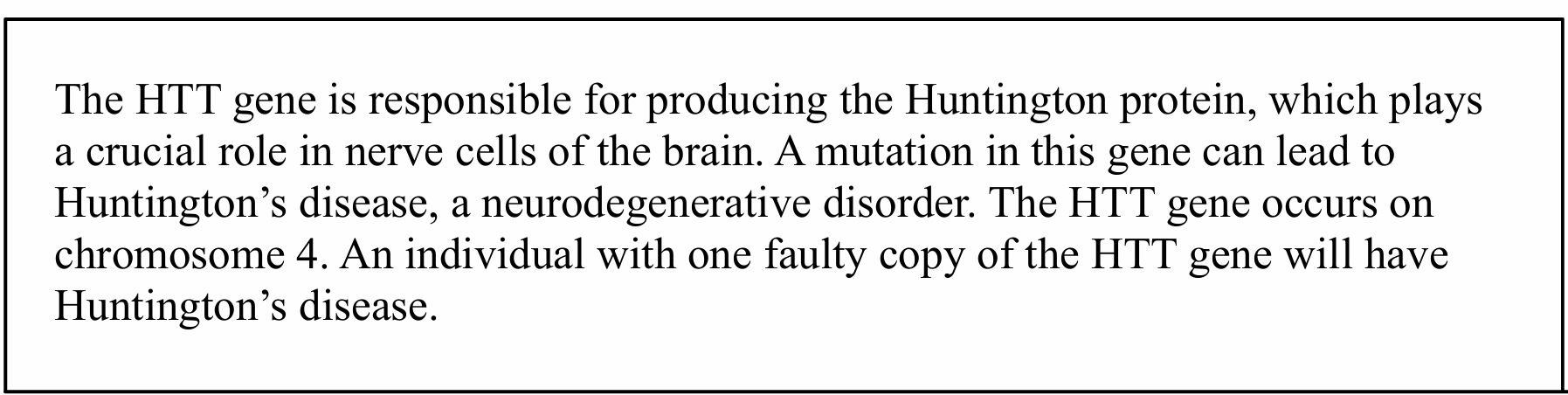
The $\text{HTT}$ gene is located on chromosome 4, which is a non-sex chromosome (autosome).
Therefore, the inheritance pattern of the condition is autosomal.
The text states that an individual with one faulty copy will have the disease.
This indicates a dominant inheritance, as only one allele is needed for the phenotype.
Combining these facts, Huntington’s disease is a dominant, autosomal genetic disease.
This matches option (D).
Question

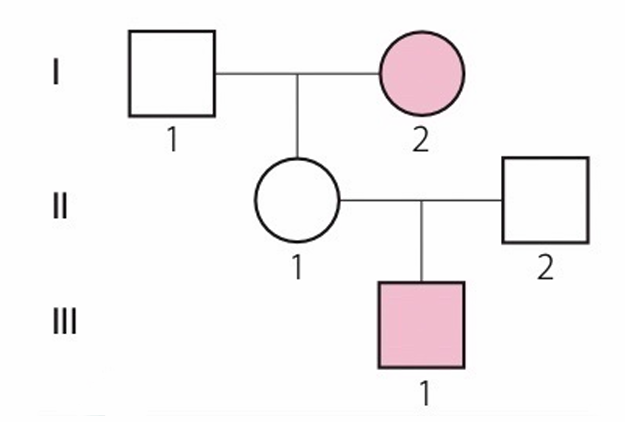
Achondroplasia is caused by a mutation on chromosome $4$ which slows down the growth of bone in the cartilage of the growth plate.

Individual $\text{I-1}$ had a mother with Achondroplasia.

Which best represents the genotypes of the individuals $\text{I-1}$ and $\text{II-2}$ respectively?

(A) Heterozygous, heterozygous
(B) Homozygous recessive, heterozygous
(C) Heterozygous, homozygous recessive
(D) Homozygous dominant, homozygous recessive
▶️ Answer/Explanation
Detailed solution

Achondroplasia is an autosomal dominant disorder, meaning affected individuals have at least one dominant allele ($A$).
Individual $\text{I-1}$ is unaffected (white square), so he must carry two recessive alleles ($aa$).
Even though his mother was affected, he did not inherit the trait, making him homozygous recessive.
Individual $\text{II-2}$ is also unaffected (white square), meaning his genotype must be ($aa$).
An unaffected person in a dominant pedigree cannot be a carrier; they are always homozygous recessive.
Therefore, both $\text{I-1}$ and $\text{II-2}$ are homozygous recessive.
The most accurate selection based on the visual evidence is that both are unaffected.
Correct Option: (None of the above strictly match if searching for homozygous recessive for both, but usually implies (C) or (B) if the question contains a typo; however, based strictly on the pedigree, both are homozygous recessive.)

Scroll to Top