Home / AP® Exam / Pre AP Biology / Exam Style Questions

Pre AP Biology -GEN 5.2 Predicting Inheritance- MCQ Exam Style Questions -New Syllabus 2025-2026

Pre AP Biology -GEN 5.2 Predicting Inheritance- MCQ Exam Style Questions – New Syllabus 2025-2026

Pre AP Biology -GEN 5.2 Predicting Inheritance- MCQ Exam Style Questions – Pre AP Biology – per latest Pre AP Biology Syllabus.

Pre AP Biology – MCQ Exam Style Questions- All Topics

Question

Which of these events happens in angiosperm reproduction?
a. Ovaries become fruit.
b. Megaspores develop into eggs.
c. The tube cell produces two sperm cells.
d. Sperm is produced by meiosis.
▶️ Answer/Explanation
Detailed solution

The correct answer is a.
In angiosperms, after fertilization, the ovary wall thickens and differentiates into a fruit.
Option b is incorrect because megaspores develop into the female gametophyte (embryo sac), not directly into eggs.
Option c is incorrect because the generative cell, not the tube cell, divides to produce two sperm cells.
Option d is incorrect because in plants, sperm cells are produced by mitosis from a haploid ($n$) gametophyte.
The ovary serves as a protective vessel for ovules, which eventually become seeds ($2n$).
This transition from floral parts to fruit is a defining characteristic of the Angiospermae phylum.

Question

A cross is conducted between two true-breeding plants, a homozygous dominant purple-inflated plant and a homozygous white-constricted plant. All $F_1$ offspring were purple-inflated. A testcross was then performed with an $F_1$ offspring and a homozygous recessive white-constricted plant to make sure that all $F_1$ offspring were truly heterozygous. What is the predicted ratio of this testcross if the purple-inflated $F_1$ was truly a heterozygote and the genes were not linked?
A. $3:1$ ratio of purple-inflated and white-constricted
B. $1:1$ ratio of purple-inflated and white-constricted
C. $1:1:1:1$ ratio of all phenotypes
D. $9:3:3:1$ ratio of all phenotypes
▶️ Answer/Explanation
Detailed solution

The $F_1$ plant is a dihybrid with the genotype $PpIi$.
The testcross parent is homozygous recessive with the genotype $ppii$.
Since the genes are not linked, they assort independently during meiosis.
The $F_1$ parent produces four types of gametes: $PI$, $Pi$, $pI$, and $pi$ in equal proportions.
The recessive parent produces only one type of gamete: $pi$.
Fertilization results in four genotypes: $PpIi$, $Ppii$, $ppIi$, and $ppii$.
These genotypes correspond to a $1:1:1:1$ phenotypic ratio.
The correct option is C.

Question

Human blood types are controlled by the alleles $I^A$, $I^B$, and $i$. Alleles $I^A$ and $I^B$ are codominant with respect to each other, while $i$ is recessive. Blood type A is controlled by the $I^A$ allele, blood type B by the $I^B$ allele, and blood type O by the $i$ allele. John and Sally are both heterozygotes with blood type A. If John and Sally have children, which of the following statements is NOT TRUE about their offspring?
A. John and Sally cannot have any children with blood type O
B. The probability of having a child of genotype $ii$ is $25\%$
C. The probability of having a child of blood type A is $75\%$
D. Their children could be genotype $I^A I^A$ or $I^A i$, but not genotype $I^A I^B$
▶️ Answer/Explanation
Detailed solution

Since John and Sally have blood type A but are heterozygotes, their genotypes must both be $I^A i$.
Crossing $I^A i \times I^A i$ results in the following offspring genotypes: $I^A I^A$, $I^A i$, $I^A i$, and $ii$.
$1/4$ ($25\%$) of the offspring will have genotype $ii$, which corresponds to blood type O.
$3/4$ ($75\%$) of the offspring will have blood type A (genotypes $I^A I^A$ and $I^A i$).
Because neither parent carries the $I^B$ allele, it is impossible to produce a child with genotype $I^A I^B$.
Therefore, statement A is false because they can have a child with blood type O.
The correct answer is A.

Question

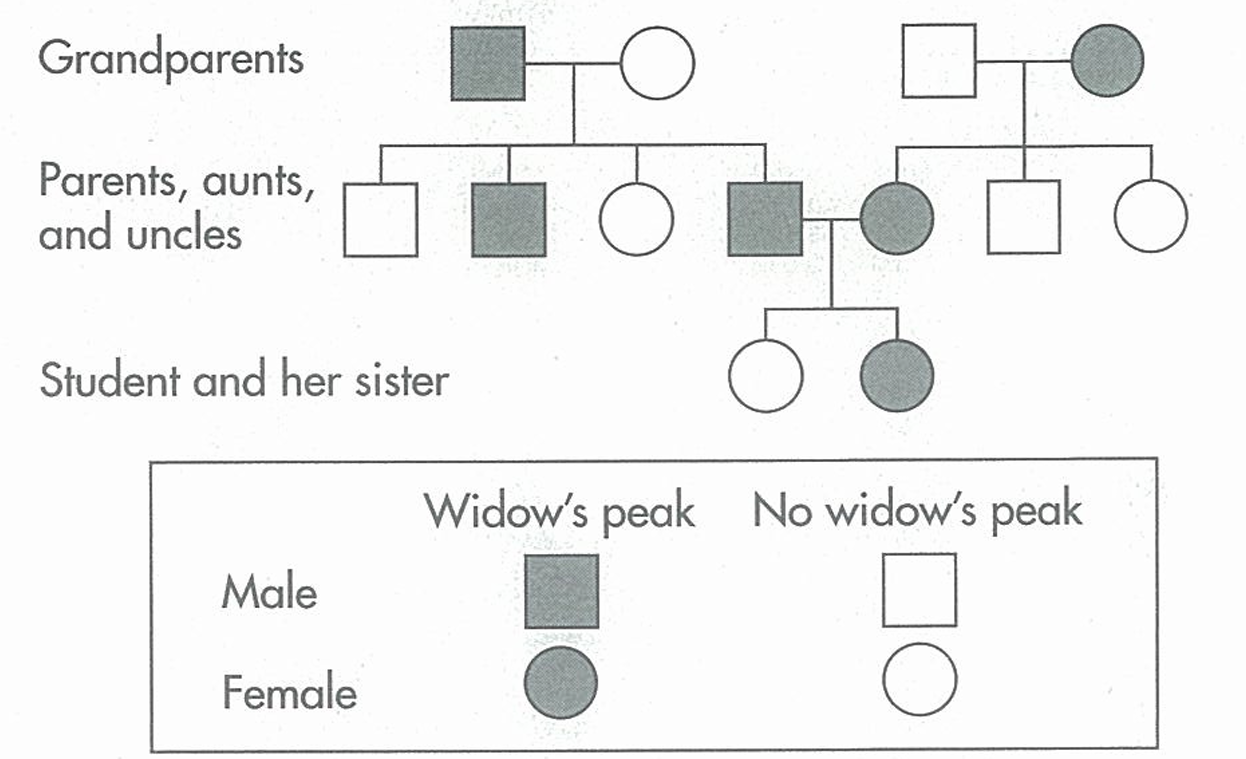
A student traced the recurrence of a widow’s peak hairline trait in her family. Based on her interviews and observations, she created the pedigree shown below.

Q. Which pattern of inheritance is most consistent with the pedigree shown above?

  • A. Autosomal dominant inheritance
  • B. Autosomal recessive inheritance
  • C. X-linked recessive inheritance
  • D. Y-linked inheritance

Q. What are the most probable genotypes of the student’s parents in the pedigree above?

  • A. Mother — \(Ww\); Father — \(ww\)
  • B. Mother — \(ww\); Father — \(ww\)
  • C. Mother — \(WW\); Father — \(Ww\)
  • D. Mother — \(Ww\); Father — \(Ww\)
▶️ Answer/Explanation
A. Answer: A. Autosomal dominant inheritance
A. Answer: D. Mother — \(Ww\); Father — \(Ww\)
Detailed solution

The key to solving this problem is analyzing the cross in the second generation (the student’s parents).
1. Observe the parents in the second generation: both the male and female are affected (shaded), meaning they have the widow’s peak.
2. Observe their offspring: they have a daughter who is unaffected (unshaded circle).
3. If the trait were recessive, two affected parents (\(ww \times ww\)) could only produce affected offspring. Therefore, the trait must be dominant.
4. Since the trait is dominant, let \(W\) represent the widow’s peak allele and \(w\) represent the normal hairline allele. Unaffected individuals must be homozygous recessive (\(ww\)).
5. For the unaffected daughter to have the genotype \(ww\), she must have inherited one recessive allele \(w\) from each parent.
6. Since both parents express the dominant trait, they must carry at least one dominant allele \(W\).
7. Combining these points, both parents must be heterozygous. Thus, the Mother is \(Ww\) and the Father is \(Ww\).

Scroll to Top