Home / AP® Exam / Pre AP Biology / Exam Style Questions

Pre AP Biology -GEN 6 Biotechnology- MCQ Exam Style Questions -New Syllabus 2025-2026

Pre AP Biology -GEN 6 Biotechnology- MCQ Exam Style Questions – New Syllabus 2025-2026

Pre AP Biology -GEN 6 Biotechnology- MCQ Exam Style Questions – Pre AP Biology – per latest Pre AP Biology Syllabus.

Pre AP Biology – MCQ Exam Style Questions- All Topics

Question

Which of these statements applies to plasmids?
a. They are pieces of \(\text{RNA}\) taken up from the environment by prokaryotic cells.
b. They are small circular pieces of \(\text{RNA}\) outside a cell’s chromosomes.
c. They are small circular pieces of non-chromosomal \(\text{DNA}\).
d. They are pieces of \(\text{DNA}\) taken up from the environment by prokaryotic cells.
▶️ Answer/Explanation
Detailed solution

Correct Option: c
Plasmids are extrachromosomal genetic elements found primarily in bacteria.
They consist of small, circular double-stranded \(\text{DNA}\) molecules.
Unlike the main chromosome, they replicate independently within the cell.
They typically carry accessory genes, such as those for antibiotic resistance.
Options a and b are incorrect because plasmids are made of \(\text{DNA}\), not \(\text{RNA}\).
Option d is incorrect because it describes transformation rather than the definition of a plasmid itself.

Question

For which of these reasons is the Solexa/Illumina DNA sequencing method faster and less expensive than the Sanger method?
a. It sequences longer fragments of DNA.
b. It sequences more DNA fragments at the same time.
c. It does not require amplification of DNA fragments before sequencing.
d. It does not require the use of computer algorithms to find places where sequence fragments overlap.
▶️ Answer/Explanation
Correct Option: b
Detailed solution

The Illumina method utilizes massive parallel sequencing, allowing millions of fragments to be processed simultaneously.
In contrast, the Sanger method is relatively low-throughput, typically sequencing only one DNA fragment per reaction.
By sequencing many fragments at once, the time per base pair is significantly reduced.
This high-throughput capability drastically lowers the cost per gigabase (Gb) of data generated.
While Sanger reads are longer ($800-1000$ bp), Illumina’s speed comes from the sheer volume of short reads ($50-300$ bp).
Therefore, the ability to sequence more fragments at the same time is the primary reason for its efficiency.

Question

Suppose that you work in an institution that uses DNA technologies to distinguish between individuals who have sickle cell disease and those who have sickle cell trait or are sickle cell free. Which of these techniques would be the most applicable one in this situation?
a. cloning technique
b. transgenic technique
c. DNA fingerprinting technique
d. Southern blot technique
▶️ Answer/Explanation
Detailed solution

The correct option is d. Southern blot technique.
Sickle cell disease is caused by a point mutation in the \(\beta\)-globin gene.
This mutation often eliminates a specific restriction enzyme recognition site.

Southern blotting allows researchers to detect these Restriction Fragment Length Polymorphisms (RFLPs).
By comparing fragment sizes, one can distinguish between homozygous dominant, heterozygous (trait), and homozygous recessive (disease) genotypes.
Cloning and transgenic techniques are used for gene manipulation, not primary diagnosis.
DNA fingerprinting is typically used for forensics or paternity rather than specific single-gene mutations.

Question

Which of these statements accurately describes the separation of DNA fragments by gel electrophoresis?
a. Smaller fragments travel more quickly than larger fragments.
b. Smaller fragments travel in the opposite direction of larger fragments.
c. Smaller fragments float to the top of the gel; larger fragments sink to the bottom.
d. Smaller fragments are visible under UV illumination; larger fragments are not.
▶️ Answer/Explanation
Detailed solution

The correct option is (a).
DNA fragments possess a uniform negative charge due to their phosphate backbone.
In an electric field, all fragments migrate toward the positive anode.
The agarose gel matrix acts as a molecular sieve.
Smaller DNA fragments move through the pores with less resistance.
Consequently, smaller fragments travel faster and further than larger ones.
Both small and large fragments are visible under UV light if a fluorescent dye is used.

Question

You would use a $\text{cDNA}$ library rather than a genomic library to:
a. find introns.
b. find promoters.
c. determine relative expression of genes.
d. create libraries that can maintain themselves on their own.
▶️ Answer/Explanation
Detailed solution

The correct option is c.
$\text{cDNA}$ is synthesized from $\text{mRNA}$ using the enzyme reverse transcriptase.
Unlike genomic DNA, $\text{cDNA}$ contains only the exons (expressed sequences).
Because $\text{mRNA}$ levels reflect gene activity, $\text{cDNA}$ libraries show which genes are active.
Introns and promoters are non-coding regions found only in genomic libraries.
Therefore, $\text{cDNA}$ libraries are ideal for comparing relative gene expression across tissues.
This allows researchers to identify proteins being produced in specific cellular conditions.

Question

Which of these statements describes the value of DNA fingerprinting?
a. It can distinguish between human individuals, and between other animals, but not between plants.
b. It can distinguish between plants, but not between animals or humans.
c. It can distinguish between human individuals, between plants, and between animals.
d. It can distinguish between human individuals, and between plants, but not between animals.
▶️ Answer/Explanation
Detailed solution

DNA fingerprinting identifies unique genetic sequences present in all living organisms.
The process utilizes non-coding regions of $\text{DNA}$ that vary significantly between individuals.
Since humans, animals, and plants all possess unique $\text{DNA}$ profiles, the technique is universal.
In humans, it is a primary tool for forensics and determining biological parentage.
In animals, it is used for tracking wildlife diversity and verifying pedigrees.
In plants, it facilitates cultivar identification and ensures agricultural consistency.
Therefore, the value of $\text{DNA}$ fingerprinting extends across all three biological groups.
The correct option is c.

Question

Vectors in a ligation mix are of two varieties: recombinant (those carrying the DNA of interest) and nonrecombinant (the original vector without new DNA). Suppose these are transformed into bacterial hosts for replication (see Figure $14.3$). Which of the following characteristics can be used to identify colonies of bacteria transformed with nonrecombinant vectors relative to those colonies of bacteria transformed with recombinant vectors?
a. Recombinant vectors carry DNA that interrupts and inactivates the $lacZ$ gene. Colonies are white.
b. Recombinant vectors make their hosts more antibiotic resistant. Colonies are larger.
c. Recombinant vectors make their hosts replicate more slowly. Colonies are smaller.
d. Recombinant vectors have more restriction enzymes to degrade X-gal. Colonies are blue.
▶️ Answer/Explanation
Detailed solution

The correct option is a.
In blue-white screening, the vector contains a $lacZ$ gene encoding $\beta$-galactosidase.
Insertion of foreign DNA into the Multiple Cloning Site (MCS) causes insertional inactivation of $lacZ$.
Recombinant colonies cannot process X-gal and appear white.
Nonrecombinant colonies have a functional $lacZ$ gene, process X-gal, and appear blue.
Therefore, white colonies indicate successful insertion, while blue colonies identify nonrecombinants.
Antibiotic resistance genes are typically used for selection of transformants, not for distinguishing recombinants.

Question

Which of these cells are crucial in the method of creating a knockout mouse?
a. skin cells
b. stem cells
c. bone cells
d. muscle cells
▶️ Answer/Explanation
Detailed solution

The correct answer is b. stem cells.

To create a knockout mouse, specific genes are disrupted in embryonic stem (ES) cells.
These modified $ES$ cells are pluripotent, meaning they can differentiate into any cell type.
The cells are injected into a blastocyst to create a chimeric mouse.
Through breeding, the genetic “knockout” is eventually passed into the germline.
Somatic cells like skin, bone, or muscle cells cannot be used as they are already differentiated.
Only $ES$ cells allow the altered DNA to contribute to the entire offspring’s development.

Question

Which of these characteristics of the $\text{Ti}$ plasmid makes this vector particularly useful in genetic engineering?
a. It is circular.
b. It carries antibiotic resistance.
c. Its natural host cells are plant cells.
d. It has sites that are cut by restriction endonucleases.
▶️ Answer/Explanation
Detailed solution

The correct option is c. Its natural host cells are plant cells.
The $\text{Ti}$ (Tumor-inducing) plasmid is derived from the bacterium Agrobacterium tumefaciens.

It is uniquely useful because it can naturally transfer a segment of its $\text{DNA}$ ($\text{T-DNA}$) into the plant genome.
While characteristics like being circular or having restriction sites are common to many vectors, the ability to infect plants is specific to $\text{Ti}$.
Scientists “disarm” the plasmid by removing disease-causing genes and replacing them with desired foreign genes.
This makes it the most effective tool for creating transgenic plants or Genetically Modified Organisms ($\text{GMOs}$).

Question

Which of these statements applies to somatic cell gene therapy?
a. Red blood cells can be used as a target tissue.
b. The technique is potentially useful for all types of genetic diseases.
c. The inserted genes are passed on to the offspring.
d. The desired DNA can be introduced to somatic cells cultured outside the body.
▶️ Answer/Explanation
Detailed solution

[Image of ex vivo gene therapy process] The correct option is d.
Somatic cell gene therapy targets non-germline cells, so genetic changes are not inherited by offspring.
Mature red blood cells lack a nucleus, making them unsuitable for direct gene insertion.
The therapy is primarily effective for monogenic disorders rather than complex polygenic diseases.
In ex vivo techniques, patient cells are harvested and cultured outside the body.
Desired DNA is then integrated into these cultured cells using viral or non-viral vectors.
The modified, functional cells are then re-infused back into the patient’s body.

Question

Dolly, a sheep, was an example of reproductive (germ-line) cloning. Which of these examples of cell fusion was required to perform this process?
a. the fusion of a somatic cell from one organism with an enucleated egg of another
b. the fusion of an egg from one organism with the egg of a different one
c. the fusion of an embryonic diploid cell of one organism with an adult haploid cell (gamete) from another
d. the fusion of two enucleated mammary cells from two different organisms
▶️ Answer/Explanation
Detailed solution

The correct answer is a.

Dolly was created using Somatic Cell Nuclear Transfer ($SCNT$).
A nucleus from a $2n$ (diploid) mammary gland cell was extracted.
This somatic nucleus was fused with an enucleated egg cell.
The egg’s cytoplasm “reprogrammed” the somatic DNA to an embryonic state.
The resulting embryo was genetically identical to the original somatic cell donor.
This process bypasses traditional fertilization between two haploid ($n$) gametes.

Question

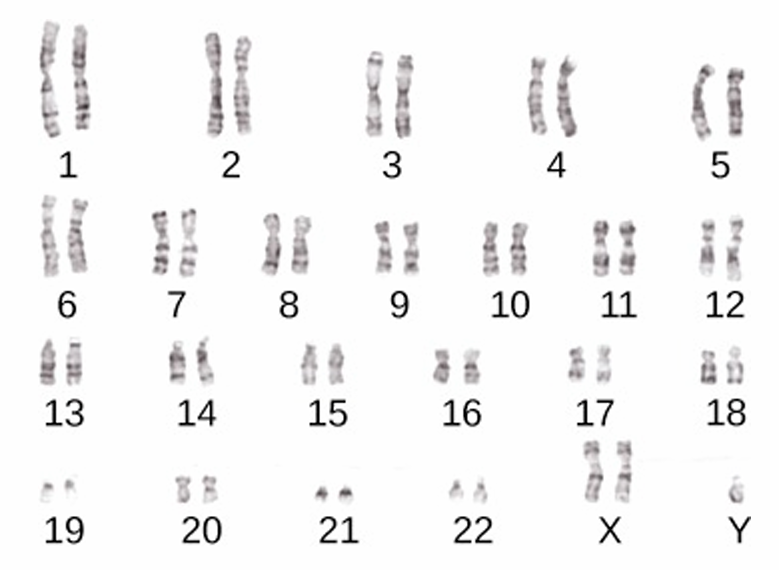
Analyze the human karyotype above. Which chromosomal disorder does it show?
A. Down syndrome (trisomy $21$) – the individual has three chromosome number $21$.
B. Turner’s syndrome (mono X) – the individual is a female that has only one $X$ chromosome.
C. Klinefelter’s syndrome ($XXY$) – the individual is a male that has an extra $X$ chromosome.
D. Cystic Fibrosis Disease – the individual has a mutation that created a mutant recessive allele.
▶️ Answer/Explanation
Detailed solution

The correct option is C.
By examining the sex chromosomes in the bottom right, there are two $X$ chromosomes and one $Y$ chromosome.
This $XXY$ configuration is the hallmark of Klinefelter’s syndrome.
The individual is phenotypically male due to the presence of the $Y$ chromosome.
The total chromosome count for this individual is $47$ instead of the typical $46$.
All other autosomal pairs, including pair $21$, consist of only two chromosomes.
Cystic Fibrosis is a gene mutation and would not be visible on a standard karyotype.
Question

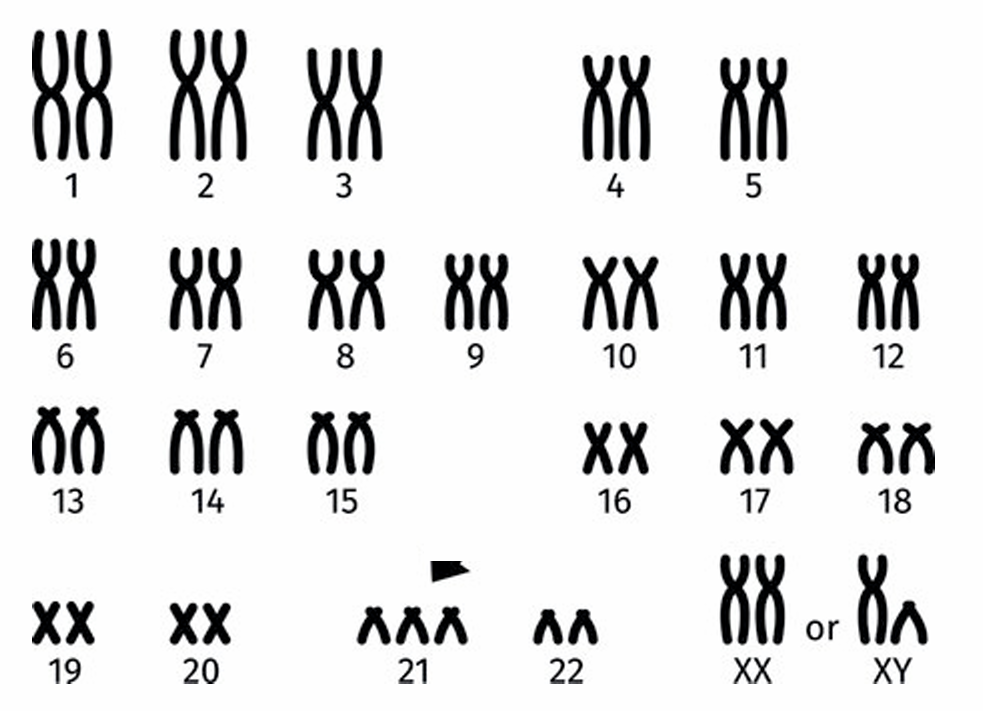
A human karyotype diagram is showing a possible chromosomal disorder. This disorder can be found in males ($XY$) or females ($XX$). Which chromosomal disorder does the karyotype show?
A. Trisomy $13$, in which the individual has a third or extra chromosome number $13$.
B. Trisomy $18$, in which the individual has a third or extra chromosome number $18$.
C. Trisomy $21$ (Down syndrome), in which the individual has a third or extra chromosome number $21$.
D. Turner’s syndrome, in which a person has only one sex chromosome, such as only one $X$.
▶️ Answer/Explanation
Detailed solution

The karyotype displays $22$ pairs of autosomes and one pair of sex chromosomes.
By inspecting chromosome pair $21$, there are three chromosomes instead of the usual two.
This condition of having an extra chromosome at position $21$ is known as Trisomy $21$.
Trisomy $21$ is the genetic cause of Down syndrome.
The sex chromosomes show both $XX$ and $XY$ options, indicating the disorder affects both genders.
Other pairs, such as $13$ and $18$, correctly show only two chromosomes.
Therefore, the correct option is C.
Question

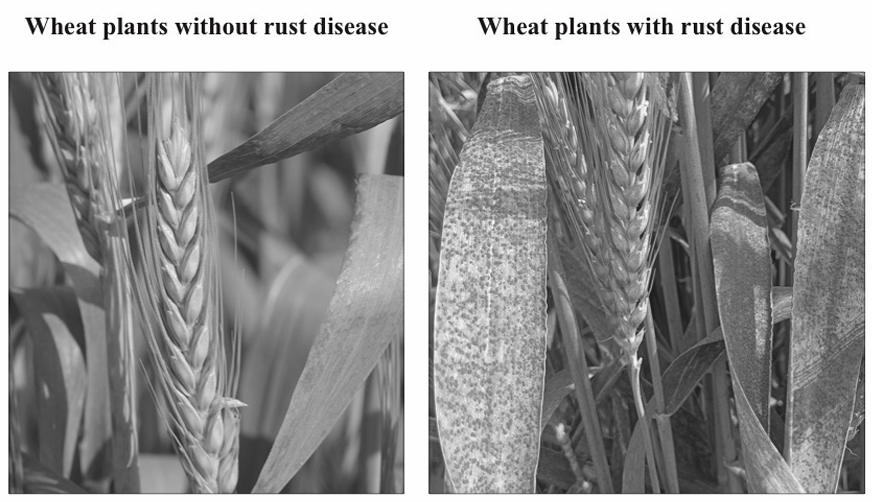
Wheat plants can be affected by rust disease, which is caused by a number of different fungal pathogens.
To determine the uptake of resistance genes by the wheat plants, scientists investigate gene fragments using electrophoresis to:
(A) cut the $\text{DNA}$
(B) amplify the $\text{DNA}$
(C) separate the $\text{DNA}$
(D) denature the $\text{DNA}$
▶️ Answer/Explanation
Detailed solution

The correct option is (C).
Gel electrophoresis is a technique used to separate macromolecules like $\text{DNA}$ or proteins.
$\text{DNA}$ fragments are loaded into a gel and an electric current is applied.
Since $\text{DNA}$ is negatively charged, it migrates toward the positive electrode.
Fragments are separated based on their size and charge.
Smaller fragments move faster and further through the gel matrix than larger ones.
This allows scientists to identify the presence of specific resistance gene fragments.

Question

Wheat plants can be affected by rust disease, which is caused by a number of different fungal pathogens.
Some plants, such as rye and wild grasses, have genes that code for proteins that make them resistant to rust disease. Recently, scientists have taken genes coding for resistance to rust disease and transferred them into a variety of wheat plants susceptible to rust disease.
Wheat plants with transferred genes for resistance to rust disease are known as:
(A) recombinant
(B) transgenic
(C) polyploid
(D) vectors
▶️ Answer/Explanation
Detailed solution

The correct answer is (B) transgenic.
A transgenic organism contains genetic material into which DNA from an unrelated organism has been artificially introduced.
In this case, genes from rye or wild grasses were moved into the wheat genome.
Option (A) recombinant usually refers to the DNA molecule itself rather than the whole organism.
Option (C) polyploid refers to organisms with more than two complete sets of chromosomes.
Option (D) vectors are the vehicles (like plasmids or viruses) used to carry the DNA into the host cell.
Therefore, the modified wheat plant is specifically described as being transgenic.
Question

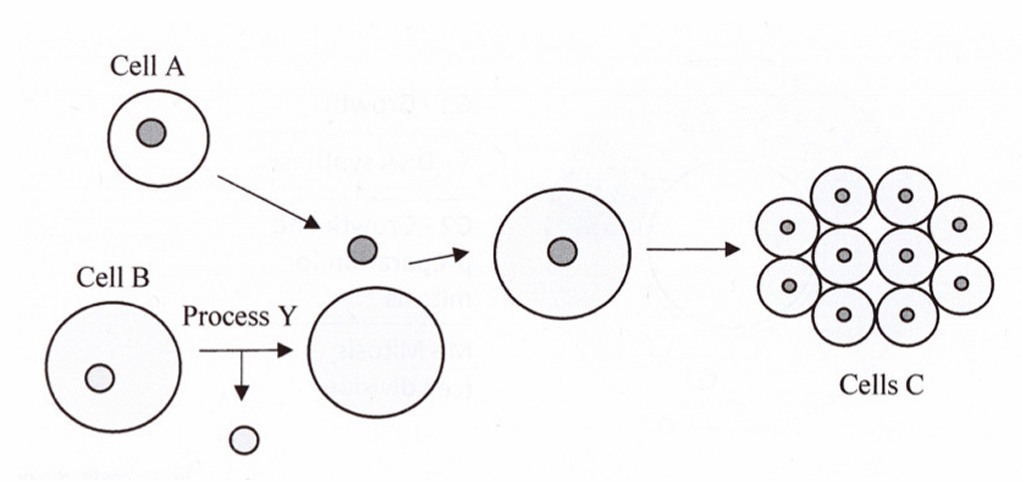
This diagram shows a simplified summary of a process called somatic cell nuclear transfer (SCNT). This process can be used to clone whole organisms, such as mice.
The DNA present in each of the cells of the embryo, labelled C, will be:
(A) identical to Cell A.
(B) identical to Cell B.
(C) very similar to Cell A, with some DNA from Cell B.
(D) very similar to Cell B, with some DNA from Cell A.
▶️ Answer/Explanation
Detailed solution

The correct option is (C).
In SCNT, the nucleus containing the nuclear DNA is taken from Cell A.
This nucleus is inserted into Cell B, which has had its own nucleus removed (enucleated).
The resulting embryo, Cells C, inherits the nuclear DNA exclusively from Cell A.
However, Cell B (the egg cell) still contains mitochondrial DNA in its cytoplasm.
Therefore, the offspring is genetically very similar to Cell A but not 100% identical.
It contains a small fraction of DNA (mitochondrial) from Cell B.

Question

This diagram shows a simplified summary of a process called somatic cell nuclear transfer ($\text{SCNT}$). This process can be used to clone whole organisms, such as mice.
What is occurring during process $Y$?
(A) Cell $B$ is gaining additional genetic material.
(B) Cell $B$ is being stimulated with electricity.
(C) Cell $B$ is having its nuclear $\text{DNA}$ removed.
(D) Cell $B$ is transferring out its somatic nucleus.
▶️ Answer/Explanation
Detailed solution

The correct option is (C).
Process $Y$ illustrates the enucleation of Cell $B$, which is an unfertilized egg cell.
The arrow pointing away from the cell indicates the removal of the original nucleus.
This ensures the egg contains no genetic material before the somatic nucleus from Cell $A$ is inserted.
In $\text{SCNT}$, the egg serves only as a cytoplasmic environment to support development.
Therefore, Cell $B$ is having its nuclear $\text{DNA}$ removed to make room for the donor nucleus.
This step is essential to ensure the clone has the exact $\text{DNA}$ of the donor organism.
Question

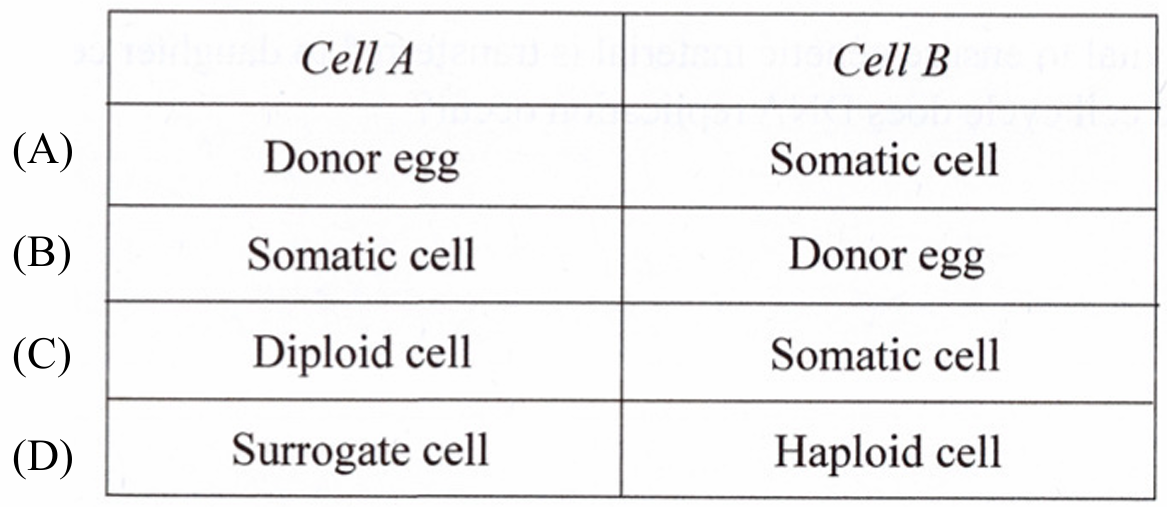
This diagram shows a simplified summary of a process called somatic cell nuclear transfer (SCNT). This process can be used to clone whole organisms, such as mice.
Which row in this table correctly identifies Cell $A$ and Cell $B$?
▶️ Answer/Explanation
Detailed solution

The correct option is (B).

In SCNT, Cell $A$ is the Somatic cell which provides the diploid ($2n$) nucleus containing the donor’s DNA.
Cell $B$ is the Donor egg (oocyte) used as the host for the transferred nucleus.
Process $Y$ represents enucleation, where the original haploid ($n$) nucleus is removed from the egg.
The nucleus from Cell $A$ is then inserted into the enucleated egg from Cell $B$.
The resulting cell is stimulated to divide, forming the cluster of Cells $C$ (the embryo).
The offspring will be genetically identical to the individual that provided the somatic Cell $A$.
Therefore, Cell $A$ must be the somatic cell and Cell $B$ must be the egg cell.

Scroll to Top