
1.1.A.1 — Particle Motion and Arrangement in Solids, Liquids, and Gases
Matter is made of tiny particles (atoms or molecules) that are in constant motion. The state of matter (solid, liquid, or gas) depends on:
- How closely packed the particles are
- How the particles move
- The strength of attraction between particles
Scientists use particle models to illustrate and explain these differences. These models are not drawn to scale but accurately show relative spacing, motion, and arrangement.
Solids
In a solid, particles are packed very closely together in a fixed, orderly arrangement.
- Particles vibrate about fixed positions
- They do not move from place to place
- Strong attractive forces hold particles together
This explains why solids have:
- A fixed shape
- A fixed volume
- Very low compressibility
Liquids
In a liquid, particles are close together but arranged randomly rather than in fixed positions.
- Particles can slide past one another
- They move more freely than in solids
- Attractive forces are weaker than in solids but still significant
This explains why liquids:
- Have a fixed volume
- Take the shape of their container
- Are only slightly compressible
Gases
In a gas, particles are far apart and move rapidly in random directions.
- Particles move freely and independently
- They collide with each other and the container walls
- Attractive forces are very weak or negligible
This explains why gases:
- Have no fixed shape
- Have no fixed volume
- Are highly compressible
Comparing Particle Motion and Arrangement
| State | Particle Arrangement | Particle Motion |
|---|---|---|
| Solid | Closely packed, fixed positions | Vibrate in place |
| Liquid | Close together, random arrangement | Slide past each other |
| Gas | Far apart, no regular arrangement | Rapid, random motion |
Using Particle Models
When creating or evaluating a particle model, check that it correctly shows:
- Relative distance between particles
- Type of motion (vibration, sliding, free movement)
- Degree of order or randomness
A correct model explains observable properties such as shape, volume, and compressibility.
Example
A diagram shows particles close together in a random arrangement that can move past one another. Identify the state of matter and justify your answer.
▶️ Answer / Explanation
The state is a liquid.
The particles are close together but not in fixed positions, and their ability to slide past each other explains why liquids flow and take the shape of their container.
Example
Two particle models are shown. Model A has particles vibrating in fixed positions. Model B has particles far apart moving rapidly. Explain which model represents a system with higher temperature and why.
▶️ Answer / Explanation
Model B represents the system with the higher temperature.
Higher temperature corresponds to greater average kinetic energy. In Model B, particles move rapidly and freely, indicating much higher kinetic energy than particles vibrating in fixed positions in Model A.
1.1.A.2 — Linking Properties of Matter to Particle Arrangement
The physical properties of solids, liquids, and gases can be explained by how their particles are arranged and how strongly they attract one another.
Key properties such as shape, volume, compressibility, and ability to flow arise directly from:
- Distance between particles
- Freedom of particle motion
- Strength of interparticle attractions
Solids: Properties Explained by Particle Arrangement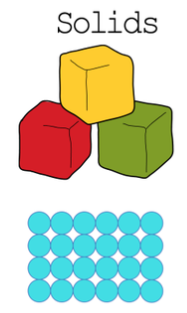
In a solid, particles are packed closely together in a fixed, orderly arrangement.
- Particles vibrate about fixed positions
- Strong attractive forces hold particles tightly together
As a result, solids:
- Have a fixed shape because particles cannot move past one another
- Have a fixed volume because particles are closely packed
- Are not easily compressed due to little empty space between particles
Liquids: Properties Explained by Particle Arrangement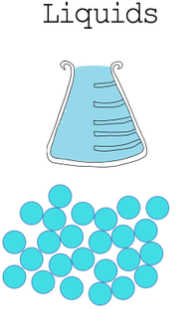
In a liquid, particles are close together but arranged randomly rather than in fixed positions.
- Particles can slide past one another
- Attractive forces are weaker than in solids but still significant
As a result, liquids:
- Have no fixed shape and take the shape of their container
- Have a fixed volume because particles remain close together
- Are only slightly compressible
Gases: Properties Explained by Particle Arrangement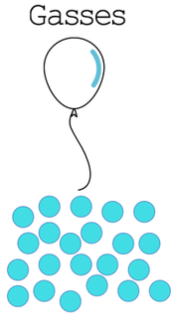
In a gas, particles are very far apart and move freely in random directions.
- Particles experience very weak or negligible attractive forces
- There is a large amount of empty space between particles
As a result, gases:
- Have no fixed shape
- Have no fixed volume and expand to fill their container
- Are highly compressible
How Particle Arrangement Explains Properties

| State of Matter | Particle Arrangement | Resulting Properties |
|---|---|---|
| Solid | Very close, fixed positions | Fixed shape and volume, low compressibility |
| Liquid | Close together, random arrangement | Fixed volume, variable shape, flows easily |
| Gas | Far apart, no regular arrangement | No fixed shape or volume, highly compressible |
Cause-and-Effect Summary
The greater the distance between particles and the weaker the attractive forces, the more freely particles can move. This leads to greater compressibility and less defined shape and volume.
Example
Explain why liquids can flow but solids cannot, using particle arrangement.
▶️ Answer / Explanation
In liquids, particles are close together but not fixed in place, allowing them to slide past one another. In solids, particles are held in fixed positions by strong attractive forces and can only vibrate, so solids cannot flow.
Example
A gas is easily compressed, but a liquid is not. Describe how particle arrangement accounts for this difference.
▶️ Answer / Explanation
Gas particles are far apart with large amounts of empty space between them, so they can be pushed closer together. Liquid particles are already close together with very little empty space, making liquids difficult to compress.
1.1.A.3 — Effect of Temperature on Particle Motion
Temperature is a measure of the average kinetic energy of particles. Changing temperature changes how fast particles move, but does not change the type of particle.
When evaluating or creating particle models, temperature changes must be shown by:
- Changes in particle speed
- Changes in vibration or movement intensity
- Possible changes in spacing (especially for gases)
Increasing Temperature: Effect on Particle Motion
When temperature increases, particles gain kinetic energy and move faster.

Solids (Heating)
- Particles vibrate more vigorously about fixed positions
- The arrangement remains fixed (unless melting occurs)
- Increased vibration can weaken attractive forces
Liquids (Heating)
- Particles move faster and slide past each other more easily
- Particles spread slightly farther apart
- Higher temperatures can lead to evaporation
Gases (Heating)
- Particles move much faster in random directions
- Collisions with container walls become more frequent and forceful
- Gas volume increases if the container is flexible
Decreasing Temperature: Effect on Particle Motion
When temperature decreases, particles lose kinetic energy and move more slowly.

Solids (Cooling)
- Particles vibrate less intensely
- Attractive forces dominate particle motion
Liquids (Cooling)
- Particle motion slows
- Particles become more ordered
- Further cooling may cause freezing
Gases (Cooling)
- Particles move more slowly
- Collisions become less frequent
- Condensation may occur at low temperatures
Temperature and Particle Motion Comparison
| State of Matter | Low Temperature Motion | High Temperature Motion |
|---|---|---|
| Solid | Low-energy vibrations | More energetic vibrations |
| Liquid | Slow sliding motion | Faster particle movement |
| Gas | Slow random motion | Rapid random motion |
Example
A particle model of a liquid is heated. Describe how the motion of the particles changes.
▶️ Answer / Explanation
As temperature increases, the particles gain kinetic energy and move faster. They slide past one another more quickly, although they remain close together unless the liquid begins to evaporate.
Example
Two gas particle models are shown. Both contain the same number of particles in the same volume. Model A shows short motion arrows, and Model B shows long motion arrows. Identify which model represents the higher temperature and justify your reasoning.
▶️ Answer / Explanation
Model B represents the higher temperature.
Longer motion arrows indicate faster particle speed, which corresponds to greater average kinetic energy. Higher average kinetic energy means higher temperature.