
2.1.C.1 — Total and Partial Pressure in Gas Mixtures
In a mixture of gases, each gas behaves independently. The total pressure of the mixture depends on the number of particles of each gas and their proportions. This relationship is explained by particle collisions and summarized by Dalton’s Law of Partial Pressures.
Key Idea
Each gas in a mixture contributes to the total pressure as if it were the only gas present in the container.
Particle-Level Explanation
In a gas mixture:
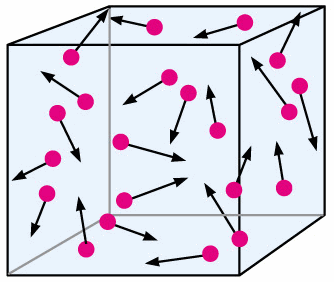
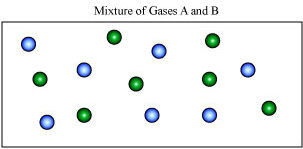
- Gas particles move independently
- Different gases do not significantly attract each other
- All particles collide with the container walls
Each collision contributes to pressure, regardless of which gas the particle belongs to.
Total Pressure
The total pressure is the combined effect of collisions from all gas particles in the mixture.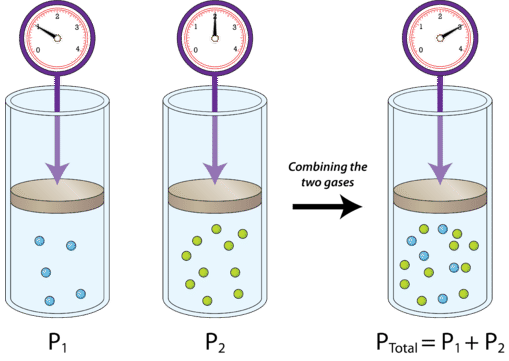
More total particles → more collisions → higher total pressure.
Partial Pressure
The partial pressure of a gas is the pressure that gas would exert if it occupied the container alone at the same temperature and volume.
A gas with more particles contributes a larger partial pressure.
Dalton’s Law of Partial Pressures
The total pressure of a gas mixture is the sum of the partial pressures of each component:
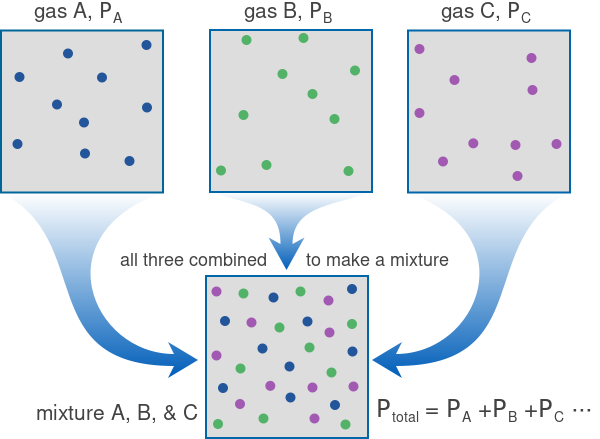
\( \mathrm{P_{total} = P_1 + P_2 + P_3 + \dots} \)
Each partial pressure depends on the proportion of particles of that gas in the mixture.
Relationship to Number of Particles
At constant temperature and volume:
- Partial pressure is proportional to the number of particles of that gas
- The gas with the greatest number of particles has the highest partial pressure
This means:
\( \mathrm{\dfrac{P_{gas}}{P_{total}} = \dfrac{\text{number of particles of gas}}{\text{total number of particles}}} \)
Connecting Partial Pressure to Proportion
| Gas in Mixture | Relative Number of Particles | Partial Pressure Contribution |
|---|---|---|
| Gas A | Large proportion | Large partial pressure |
| Gas B | Small proportion | Small partial pressure |
Evaluating Particle Models
A correct model of partial pressure should show:
- Different gases represented by different colors or shapes
- All particles colliding with container walls
- More frequent collisions from the gas with more particles
Partial pressure depends on number of particles, not particle mass.
Example
A gas mixture contains nitrogen and oxygen. Nitrogen makes up about 80% of the particles. Explain which gas has the higher partial pressure and why.
▶️ Answer / Explanation
Nitrogen has the higher partial pressure.
Because nitrogen particles make up a larger proportion of the mixture, they collide with the container walls more frequently and contribute more to the total pressure.
Example
A sealed container holds a mixture of three gases at constant temperature and volume. Gas A contributes 30% of the particles, Gas B contributes 50%, and Gas C contributes 20%. Relate these proportions to the partial and total pressures.
▶️ Answer / Explanation
Each gas contributes a partial pressure proportional to its fraction of particles.
Gas B has the largest partial pressure, followed by Gas A, then Gas C. The total pressure is the sum of all three partial pressures.
Example
A sealed container holds a mixture of nitrogen and oxygen gases. The partial pressure of nitrogen is \( \mathrm{78\ kPa} \) and the partial pressure of oxygen is \( \mathrm{21\ kPa} \). Calculate the total pressure of the gas mixture.
▶️ Answer / Explanation
Use Dalton’s Law of Partial Pressures:
\( \mathrm{P_{total} = P_{N_2} + P_{O_2}} \)
\( \mathrm{P_{total} = 78 + 21} \)
\( \mathrm{P_{total} = 99\ kPa} \)
The total pressure of the gas mixture is \( \mathrm{99\ kPa} \).