
2.3.C.1 — Strength of Attractions in Ionic Solids
Ionic solids are composed of cations and anions arranged in a regular, repeating crystal lattice. The relative strength of attraction between these ions depends on two key factors: the charges of the ions and the distance between them.
These attractions are electrostatic in nature and are responsible for many macroscopic properties of ionic compounds, such as high melting points and brittleness.
Electrostatic Nature of Ionic Bonding
Ionic bonding results from the attraction between oppositely charged ions:
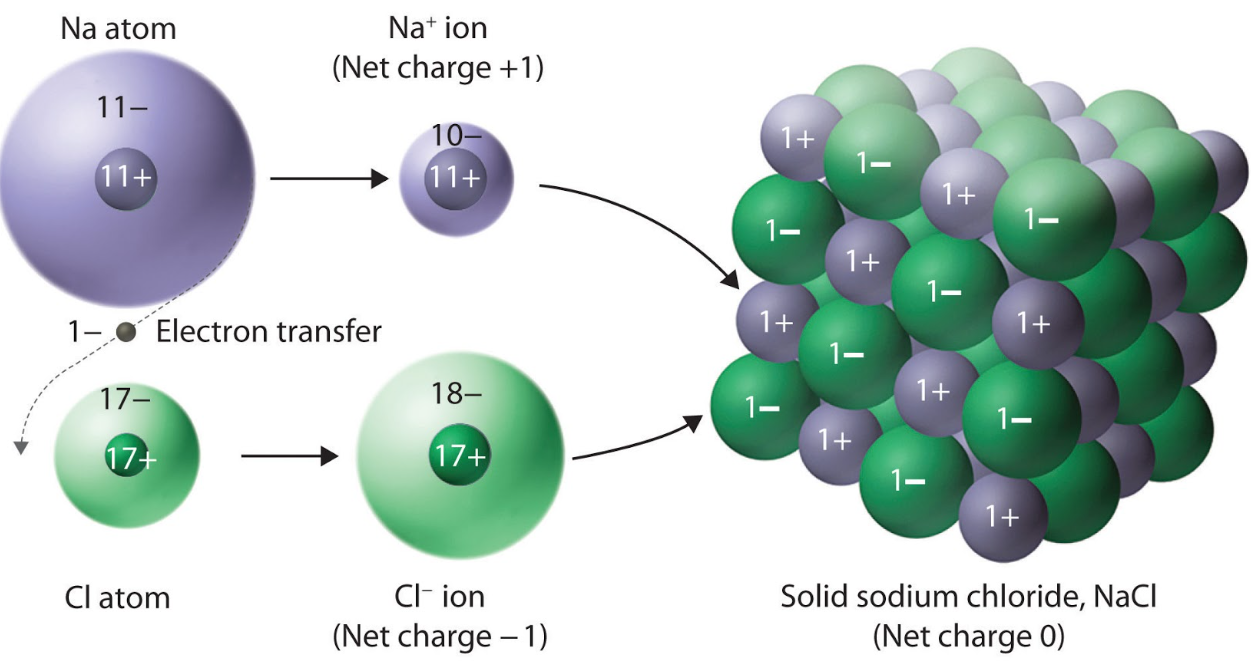
- Cations have a positive charge
- Anions have a negative charge
- Opposite charges attract due to electrostatic forces
The strength of this attraction determines how strongly the ions are held together in the solid lattice.
Overall Electrical Neutrality
In an ionic solid, the ratio of cations to anions is such that the total positive charge equals the total negative charge.
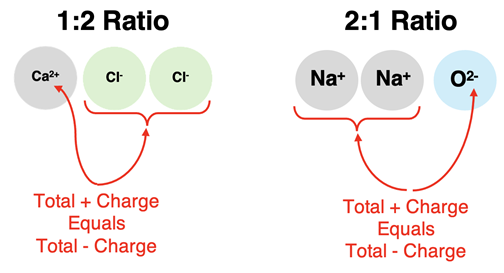
- This ensures overall electrical neutrality
- The ratio depends on the charges of the ions, not on equal numbers of ions
For example:
- One \( \mathrm{Mg^{2+}} \) ion balances two \( \mathrm{Cl^-} \) ions
- Two \( \mathrm{Na^+} \) ions balance one \( \mathrm{O^{2-}} \) ion
Effect of Ion Charge on Attraction Strength
As the magnitude of ionic charge increases, the strength of electrostatic attraction also increases.
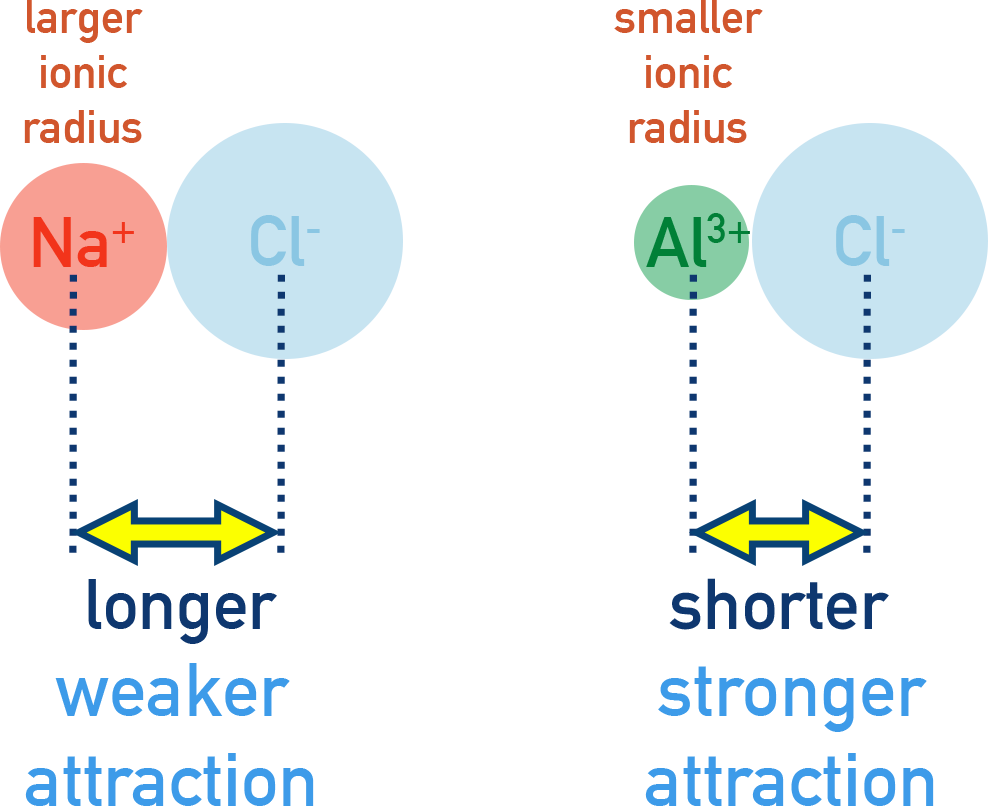
- Ions with larger charges exert stronger forces on each other
- Greater charge → stronger attraction → more stable lattice
For example, the attraction between \( \mathrm{Al^{3+}} \) and \( \mathrm{Cl^{-}} \) is stronger than between \( \mathrm{Na^+} \) and \( \mathrm{Cl^-} \).
Effect of Distance Between Ions
The distance between ions also affects the strength of attraction.
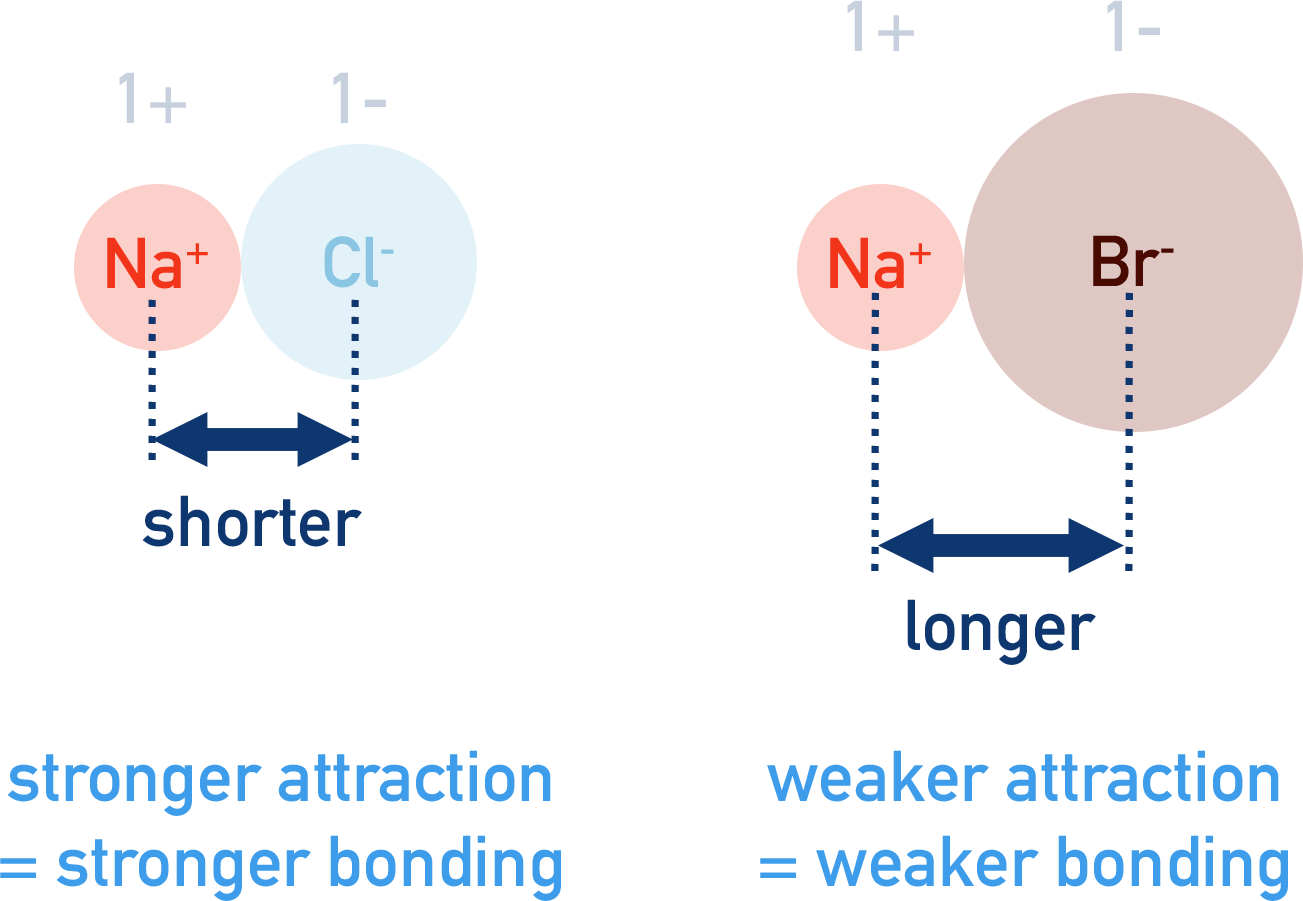
- Shorter distance → stronger attraction
- Greater distance → weaker attraction
Smaller ions can get closer together, increasing electrostatic attraction, while larger ions are held farther apart.
Combining Charge and Distance Effects
The strongest ionic attractions occur when:
- The ions have large charges
- The ions are small, allowing close approach
Ionic compounds with strong attractions typically have higher melting points and greater lattice stability.
Summary of Factors Affecting Ionic Attraction
| Factor | Change | Effect on Attraction Strength |
|---|---|---|
| Ionic charge | Increase in charge magnitude | Attraction increases |
| Ion distance | Increase in distance | Attraction decreases |
Creating and Evaluating Claims
A correct claim about ionic attraction strength must:
- Reference the charges of the ions
- Discuss the distance between ions
- Connect these factors to electrostatic attraction
Claims that mention only charge or only size are incomplete.
Example
Compare the strength of attraction between the ions in sodium chloride and magnesium oxide. Which compound has stronger ionic attractions?
▶️ Answer / Explanation
Magnesium oxide has stronger ionic attractions than sodium chloride.
The ions in magnesium oxide carry charges of \( \mathrm{2+} \) and \( \mathrm{2-} \), which results in stronger electrostatic attraction than the \( \mathrm{1+} \) and \( \mathrm{1-} \) charges in sodium chloride.
Example
Explain why an ionic compound composed of small, doubly charged ions has a higher melting point than an ionic compound composed of large, singly charged ions.
▶️ Answer / Explanation
Doubly charged ions create stronger electrostatic attractions due to their larger charges.
Additionally, smaller ions can be closer together, reducing the distance between charges and further increasing attraction strength. Stronger attractions require more energy to overcome, leading to a higher melting point.