
2.3.D.1 — Representations of Ionic and Covalent Compounds
Ionic and covalent compounds can be represented in multiple ways to show their composition, structure, and particle-level behavior. Each representation emphasizes different aspects of bonding and is useful for explaining or evaluating chemical claims.
Common representations include: particulate models, structural formulas, chemical formulas, and chemical nomenclature.
Particulate Models
Particulate models show how particles are arranged and interact at the microscopic level.
Ionic Compounds
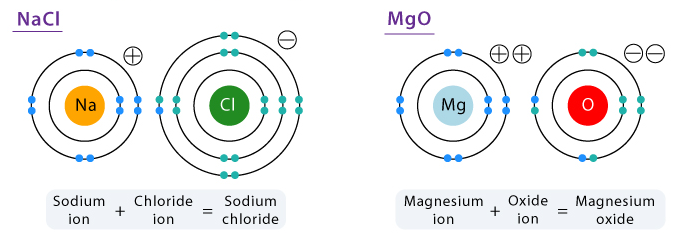
- Shown as repeating arrays of cations and anions
- Oppositely charged ions arranged in a lattice
- No individual “molecules” are present
Covalent Compounds
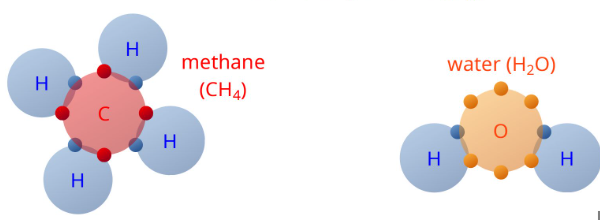
- Shown as discrete, individual molecules
- Atoms connected by shared electron pairs
- Molecules separated by intermolecular forces
Particulate models help explain differences in melting point, conductivity, and physical state.
Structural Formulas
Structural formulas show how atoms are bonded and arranged within a molecule.
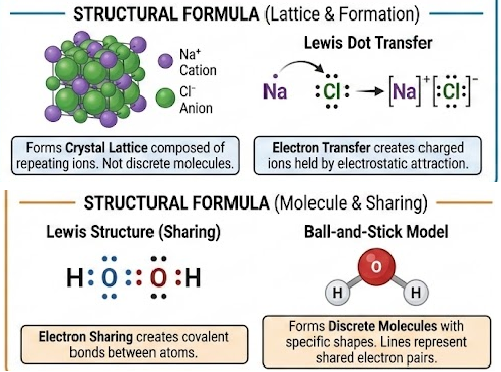
- Used primarily for covalent compounds
- Show single, double, or triple bonds
- Reflect actual atom connectivity
Ionic compounds do not use structural formulas because they do not exist as separate molecules.
Chemical Formulas
Chemical formulas show the ratio and type of atoms or ions in a compound.
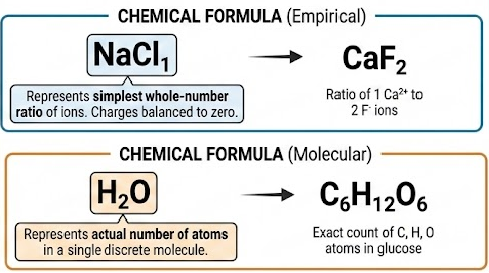
Ionic Compounds
- Formula represents the simplest whole-number ratio of ions
- Called a formula unit
- Example: NaCl represents a 1:1 ratio of \( \mathrm{Na^+} \) to \( \mathrm{Cl^-} \)
Covalent Compounds
- Formula shows the actual number of atoms in one molecule
- Called a molecular formula
- Example: H₂O represents two H atoms bonded to one O atom
Chemical Nomenclature
Chemical nomenclature provides standardized names for compounds based on their composition and bonding type.
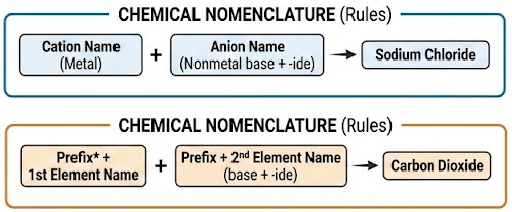
Ionic Compound Naming
- Name the cation first, then the anion
- Metal name stays the same
- Nonmetal name ends in –ide
- Transition metals may require Roman numerals
Covalent Compound Naming
- Uses prefixes to indicate number of atoms
- Second element ends in –ide
- Prefixes reflect molecular formula
Linking Representation to Bonding Type
| Representation | Ionic Compound | Covalent Compound |
|---|---|---|
| Particulate model | Ions in lattice | Individual molecules |
| Structural formula | Not used | Shows bonds |
| Chemical formula | Formula unit | Molecular formula |
| Nomenclature | Cation + anion | Prefixes used |
Creating and Evaluating Representations
Accurate representations must:
- Match the bonding type of the compound
- Correctly show particles involved (ions vs molecules)
- Use appropriate notation and naming conventions
Using a molecular-style diagram for an ionic compound is incorrect.
Example
Explain why NaCl is best represented by a lattice particulate model rather than a structural formula.
▶️ Answer / Explanation
Sodium chloride is an ionic compound made of \( \mathrm{Na^+} \) and \( \mathrm{Cl^-} \) ions.
These ions form a repeating lattice and do not exist as individual molecules, so a lattice particulate model is the correct representation.
Example
A compound has the formula CO₂. Evaluate which representations are appropriate for this substance and justify your reasoning.
▶️ Answer / Explanation
CO₂ is a covalent compound composed of nonmetals.
Appropriate representations include a particulate model showing discrete molecules, a structural formula with double bonds, a molecular formula, and covalent nomenclature. An ionic lattice representation would be incorrect.