
3.2.B.1 — Quantitative Relationships in Chemical Transformations
In a chemical transformation, the quantity of reactants consumed is directly related to the quantity of products formed. This relationship is governed by the balanced chemical equation, which reflects the law of conservation of matter.
Because atoms are rearranged but not created or destroyed, the amounts of substances involved in a reaction are linked by fixed numerical ratios.
Balanced Chemical Equations as Quantitative Models
A balanced chemical equation represents: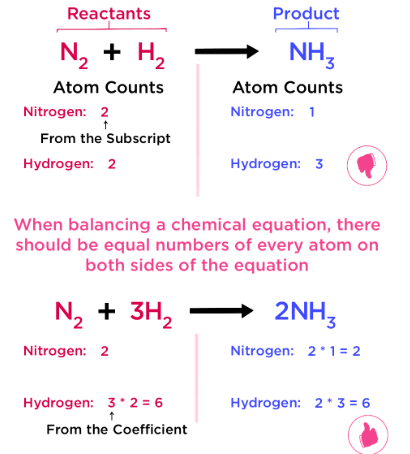
- The substances reacting (reactants)
- The substances produced (products)
- The ratio in which particles react and form
For example:
\( \mathrm{2H_2 + O_2 \rightarrow 2H_2O} \)
This equation shows that:
- 2 moles of hydrogen react with 1 mole of oxygen
- 2 moles of water are formed
These ratios apply to molecules, moles, or particles.
Mole Ratios and Substance Quantities
The coefficients in a balanced equation represent mole ratios. These ratios determine how much product can form from a given amount of reactant.
General relationship:
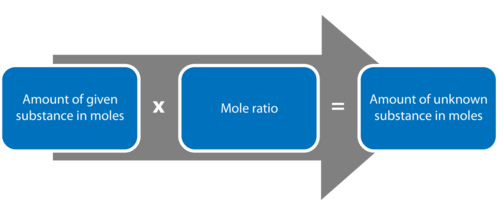
If one reactant is consumed, the amount of product formed is fixed by the equation.
Why Mass Is Conserved but Amounts Change
Although the total mass remains constant during a reaction, the masses of individual substances change because:
- Reactants are consumed
- New substances with different molar masses are formed
Balanced equations ensure that:
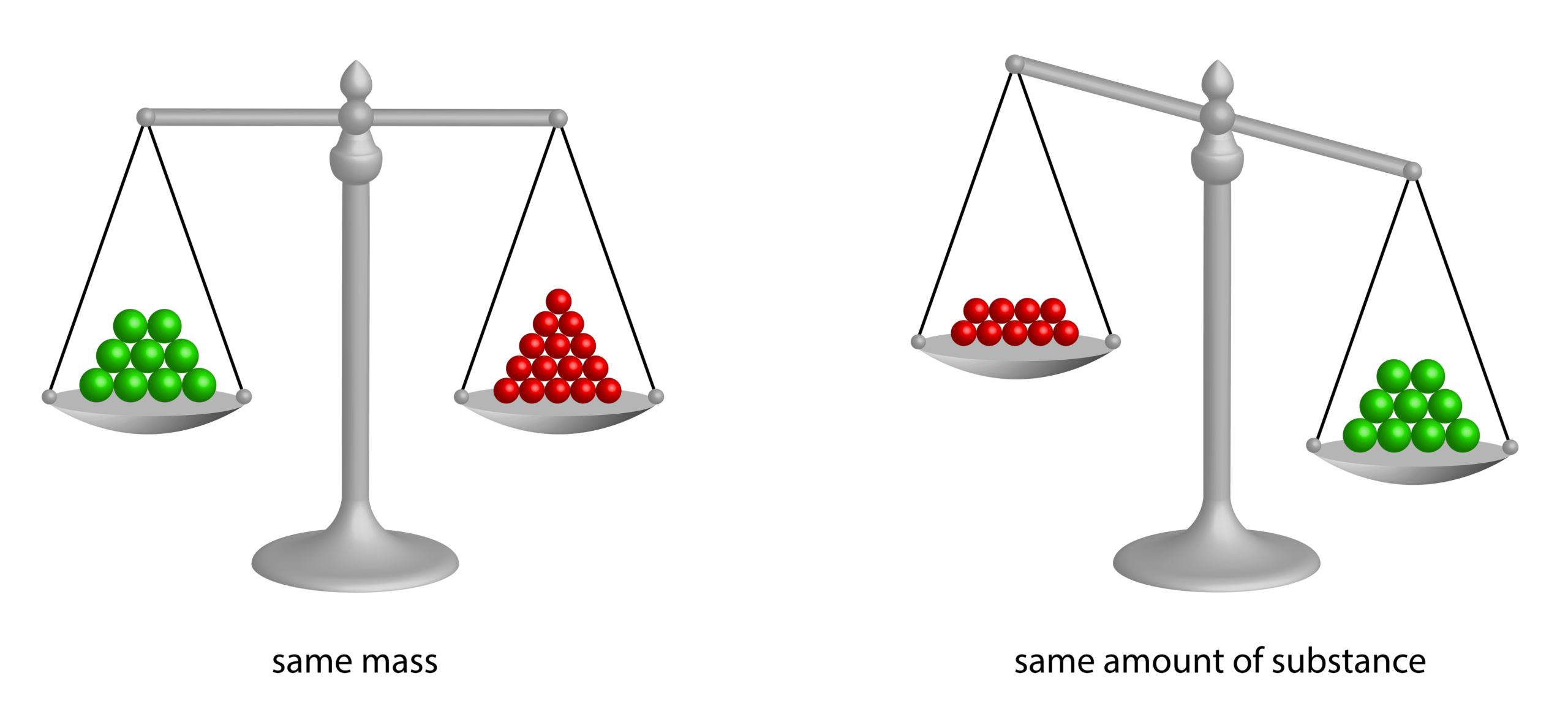
- The same atoms appear on both sides
- Mass before reaction equals mass after reaction
Particle-Level Interpretation
At the particle level:
- A fixed number of reactant particles must collide
- Those particles rearrange into a fixed number of product particles

If fewer reactant particles are present than required by the ratio, less product will form.
Using Chemical Equations to Predict Quantities
Chemical equations allow chemists to:
- Predict how much product can form
- Determine how much reactant is required
- Explain why reactants are used up in fixed proportions
This forms the basis of stoichiometry.
Summary of Reactant–Product Relationships
| Aspect | Description |
|---|---|
| Coefficients | Represent mole ratios |
| Atoms | Conserved during reaction |
| Reactants | Consumed according to fixed ratios |
| Products | Formed in amounts fixed by equation |
Evaluating Claims About Quantities
A valid explanation must:
- Reference the balanced chemical equation
- Explain the role of coefficients
- Link conservation of atoms to amounts formed
Claims based only on mass or only on appearance are incomplete.
Example
The reaction below occurs:
\( \mathrm{N_2 + 3H_2 \rightarrow 2NH_3} \)
Explain how the equation shows the relationship between reactants consumed and products formed.
▶️ Answer / Explanation
The equation shows that one mole of nitrogen reacts with three moles of hydrogen to form two moles of ammonia.
These fixed ratios mean the amounts of reactants consumed directly determine the amount of product formed.
Example
A reaction produces 4.0 moles of carbon dioxide according to the equation:
\( \mathrm{CH_4 + 2O_2 \rightarrow CO_2 + 2H_2O} \)
Explain how much methane must have reacted and justify your answer using the balanced equation.
▶️ Answer / Explanation
According to the equation, one mole of methane produces one mole of carbon dioxide.
Therefore, producing 4.0 moles of carbon dioxide requires 4.0 moles of methane. This follows directly from the 1:1 mole ratio shown by the coefficients.
3.2.B.2 — Stoichiometric Calculations in Chemical Systems
Stoichiometry is the process of using a balanced chemical equation to calculate the quantity of reactants consumed or products formed in a chemical transformation. These calculations rely on the fact that substances react in fixed mole ratios.
Stoichiometry connects: mass, moles, and particles using the mole concept and conservation of atoms.
Foundation of Stoichiometric Calculations
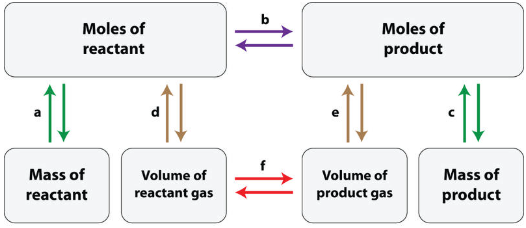
- a) Apply molar mass as a conversion factor: 1 mole = ? g (refer to Periodic table).
- b) Apply mole ratio as a conversion factor: (refer to balanced equation coefficient).
- c) Apply molar mass as a conversion factor: 1 mole = ? g (refer to Periodic table).
- d) Apply molar volume as a conversion factor: 1 mole = 22.4 L at STP.
- e) Apply molar volume as a conversion factor: 1 mole = 22.4 L at STP.
- f) Apply volume ratio as a conversion factor: (refer to balanced equation coefficient).
All stoichiometric calculations are based on:
- A balanced chemical equation
- Mole ratios from equation coefficients
- The mole concept and molar mass
If the equation is not balanced, any calculation based on it is invalid.
Mole Ratios
Coefficients in a balanced equation represent mole-to-mole ratios.
Example equation:

This shows:
- 2 mol H₂ react with 1 mol O₂
- 2 mol H₂O are produced
These ratios allow conversion between different substances in a reaction.
General Stoichiometry Roadmap
Most stoichiometry problems follow this sequence:
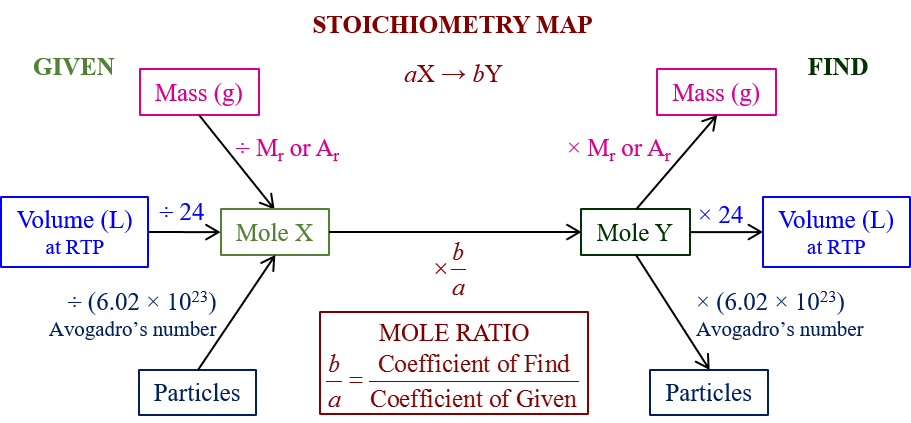
- Convert given quantity to moles
- Use the mole ratio from the balanced equation
- Convert moles of desired substance to required units
This applies whether the quantities are given in mass, particles, or volume (for gases).
Types of Stoichiometric Calculations
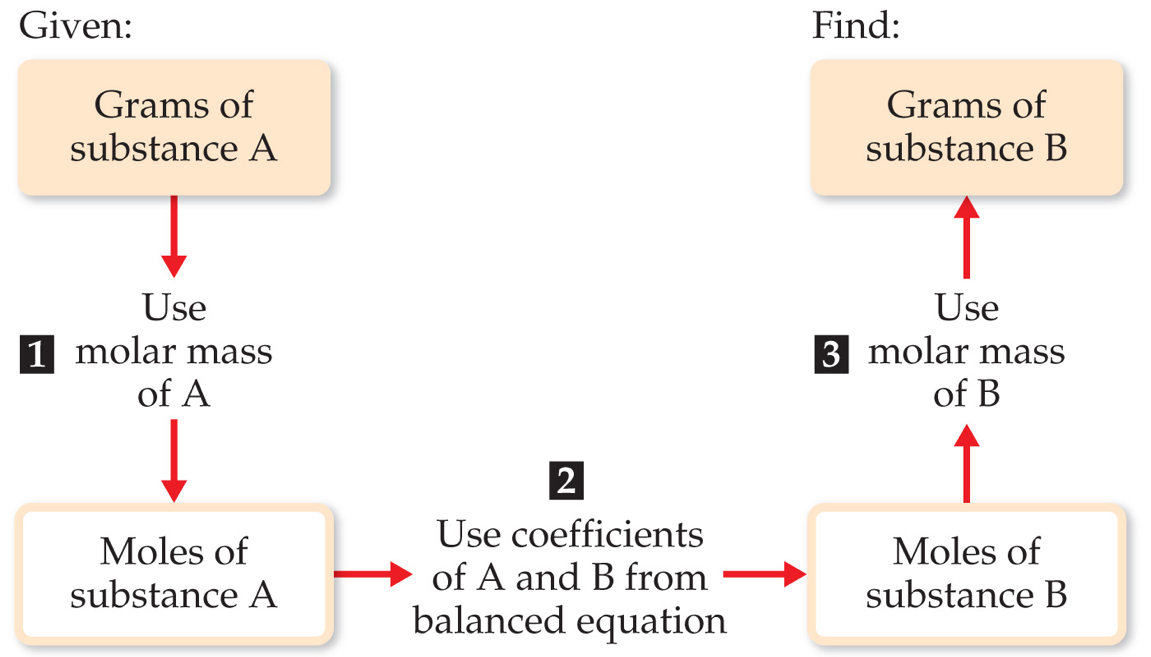
- Mass → mass
- Moles → moles
- Particles → moles → particles
- Mass → moles → mass
All types rely on the same mole-ratio logic.
Stoichiometry and Limiting Reactants
In real chemical systems, reactants may not be present in exact stoichiometric ratios.
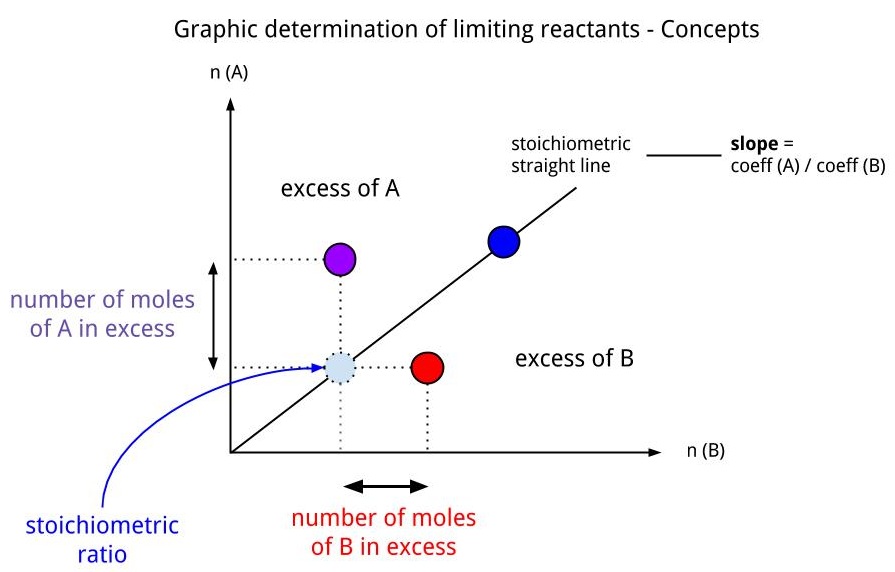
- The limiting reactant is consumed first
- It determines the maximum amount of product formed
- Other reactants are in excess
Stoichiometric calculations must be based on the limiting reactant.
Particle-Level Interpretation
At the particle level:
- Only certain ratios of particles can react completely
- Extra particles remain unreacted if the ratio is not met
- The limiting reactant controls product formation
Evaluating Stoichiometric Calculations
Correct stoichiometric work must:
- Use a balanced equation
- Show clear mole conversions
- Apply correct mole ratios
- Include appropriate units
Skipping steps or guessing ratios leads to incorrect results.
Example
How many moles of water are produced when 4.0 moles of hydrogen react according to the equation below?
\( \mathrm{2H_2 + O_2 \rightarrow 2H_2O} \)
▶️ Answer / Explanation
From the balanced equation, the mole ratio of H₂ to H₂O is 2:2.
This simplifies to a 1:1 ratio.
Therefore, 4.0 moles of H₂ produce 4.0 moles of H₂O.
Example
Calcium carbonate reacts according to the equation:
\( \mathrm{CaCO_3 \rightarrow CaO + CO_2} \)
Calculate the mass of carbon dioxide produced from 50.0 g of calcium carbonate.
▶️ Answer / Explanation
Step 1: Convert mass of CaCO₃ to moles.
Molar mass of CaCO₃ = \( \mathrm{100.1\ g\,mol^{-1}} \)
\( \mathrm{n = \dfrac{50.0}{100.1} = 0.500\ mol} \)
Step 2: Use the mole ratio.
From the equation, CaCO₃ and CO₂ have a 1:1 mole ratio.
\( \mathrm{n_{CO_2} = 0.500\ mol} \)
Step 3: Convert moles of CO₂ to mass.
Molar mass of CO₂ = \( \mathrm{44.0\ g\,mol^{-1}} \)
\( \mathrm{m = 0.500 \times 44.0 = 22.0\ g} \)