
4.1.D.1 — Gravimetric Analysis and Predicting the Mass of a Precipitate
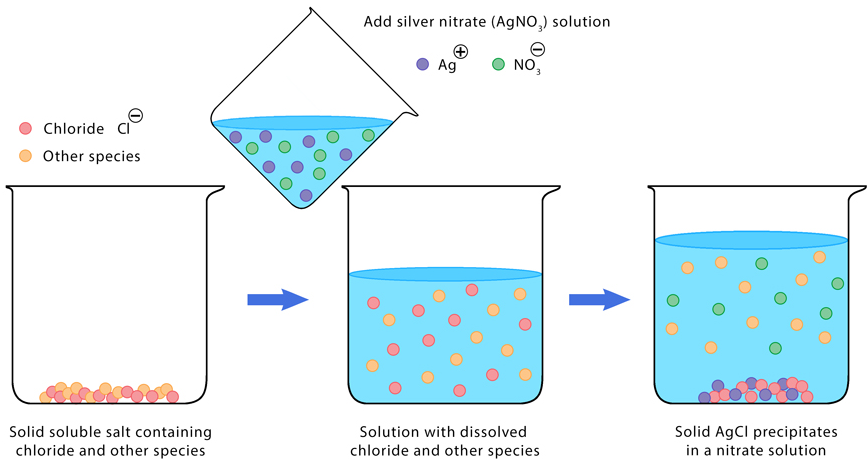
Gravimetric analysis is a quantitative method used to determine the amount of a substance by forming a solid precipitate and measuring its mass. In precipitation reactions, gravimetric analysis allows us to predict the amount of solid produced using the concentrations and volumes of the reacting solutions.
This method relies on careful application of molarity calculations, stoichiometry, and balanced chemical equations.
Core Idea of Gravimetric Analysis
In gravimetric analysis:
- A specific ion is selectively precipitated from solution
- The precipitate has a known chemical formula
- The mass of the precipitate is directly related to the amount of analyte
The amount of precipitate formed depends on the number of reacting particles present in solution.
Overall Strategy for Gravimetric Calculations
To predict the mass of a precipitate:
- Write and balance the molecular equation
- Determine moles of reacting ions using molarity
- Identify the limiting reactant
- Use mole ratios to calculate moles of precipitate
- Convert moles of precipitate to mass
Step 1: Balanced Precipitation Equation
A gravimetric analysis always begins with a balanced equation.
\( \mathrm{BaCl_2(aq) + Na_2SO_4(aq) \rightarrow BaSO_4(s) + 2NaCl(aq)} \)
The solid product \( \mathrm{BaSO_4(s)} \) is the precipitate analyzed.
Step 2: Calculating Moles from Solution Data
Moles of each reactant are calculated using molarity:
\( \mathrm{n = M \times V} \)
Volume must be converted to liters before substitution.
Step 3: Limiting Reactant Determination
The limiting reactant is the reactant that produces the smallest amount of precipitate.
It controls the maximum mass of solid that can form.
- Compare mole ratios from the balanced equation
- Excess reactant does not affect final precipitate mass
Step 4: Mole-to-Mole Stoichiometry
Stoichiometric coefficients are used to relate moles of reactants to moles of precipitate.
Example ratio:
\( \mathrm{1\ mol\ Ba^{2+} \rightarrow 1\ mol\ BaSO_4(s)} \)
This relationship is fixed by the balanced equation.
Step 5: Converting Moles of Precipitate to Mass
Mass of precipitate is calculated using molar mass:
\( \mathrm{m = n \times M_r} \)
- \( \mathrm{m} \) = mass (\( \mathrm{g} \))
- \( \mathrm{n} \) = moles of precipitate
- \( \mathrm{M_r} \) = molar mass (\( \mathrm{g\,mol^{-1}} \))
Particle-Level Interpretation
At the particle level:
- Ions move freely in solution before mixing
- Only specific ions form an insoluble lattice
- The number of ion pairs formed determines precipitate mass
More reacting particles result in more solid forming—until a reactant is exhausted.
Evaluating Gravimetric Analysis Claims
A valid quantitative claim must:
- Use correct molarity-to-moles conversions
- Identify the limiting reactant
- Apply proper stoichiometric ratios
- Include correct units and significant figures
Answers listing a mass without mathematical justification are incomplete.
Example
What mass of solid calcium carbonate forms when \( \mathrm{0.50\ L} \) of \( \mathrm{0.20\ M} \) calcium nitrate reacts with excess sodium carbonate?
▶️ Answer / Explanation
Step 1: Calculate moles of calcium nitrate:
\( \mathrm{n = M \times V = 0.20 \times 0.50 = 0.10\ mol} \)
Calcium ions react 1:1 to form calcium carbonate:
\( \mathrm{Ca^{2+} + CO_3^{2-} \rightarrow CaCO_3(s)} \)
Moles of \( \mathrm{CaCO_3} = 0.10\ mol \)
Molar mass of \( \mathrm{CaCO_3} = 100.1\ g\,mol^{-1} \)
\( \mathrm{m = 0.10 \times 100.1 = 10.0\ g} \)
Example
\( \mathrm{250\ mL} \) of \( \mathrm{0.60\ M} \) silver nitrate is mixed with \( \mathrm{400\ mL} \) of \( \mathrm{0.40\ M} \) sodium chloride. Calculate the mass of precipitate formed.
▶️ Answer / Explanation
Balanced equation:
\( \mathrm{AgNO_3(aq) + NaCl(aq) \rightarrow AgCl(s) + NaNO_3(aq)} \)
Moles of \( \mathrm{Ag^+} \):
\( \mathrm{n = 0.60 \times 0.250 = 0.150\ mol} \)
Moles of \( \mathrm{Cl^-} \):
\( \mathrm{n = 0.40 \times 0.400 = 0.160\ mol} \)
Limiting reactant: \( \mathrm{Ag^+} \)
Moles of \( \mathrm{AgCl} = 0.150\ mol \)
Molar mass of \( \mathrm{AgCl} = 143.3\ g\,mol^{-1} \)
\( \mathrm{m = 0.150 \times 143.3 = 21.5\ g} \)
4.1.D.2 — Evaluating the Results of a Gravimetric Analysis
Evaluating a gravimetric analysis involves determining how reliable and accurate the experimentally obtained mass of a precipitate is when compared to the theoretical mass predicted by stoichiometric calculations. This evaluation requires both quantitative analysis and particle-level reasoning.
A high-quality evaluation explains why results may differ from the theoretical value, rather than simply stating that an error occurred.
Theoretical vs Experimental Results
In gravimetric analysis:
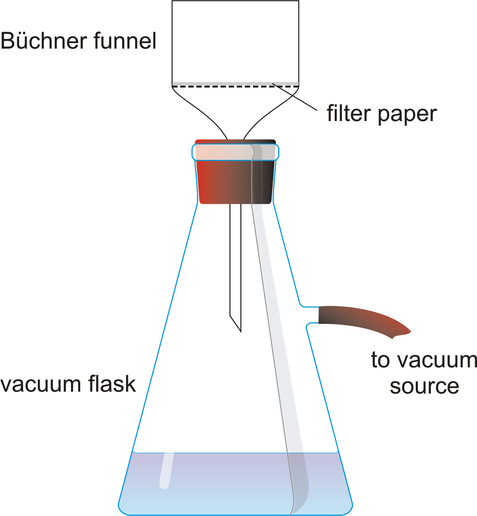
- Theoretical mass is the calculated mass of precipitate based on limiting reactant
- Experimental mass is the mass actually collected in the lab
Theoretical mass represents the maximum amount of solid that should form under ideal conditions.
Percent Yield as an Evaluation Tool
One common way to evaluate gravimetric results is by calculating percent yield:
\( \mathrm{\%\,yield = \dfrac{\text{experimental\ mass}}{\text{theoretical\ mass}} \times 100} \)
Percent yield compares actual results to expected results.
- \( \mathrm{\%\,yield < 100\%} \): some precipitate was lost
- \( \mathrm{\%\,yield > 100\%} \): extra mass was measured
Interpreting Low Percent Yield (< 100%)
A percent yield less than 100% usually indicates loss of precipitate.
Common causes include:
- Incomplete precipitation

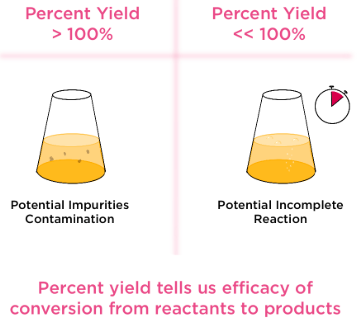
- Loss of solid during filtration or transfer
- Precipitate dissolving slightly in water
- Precipitate passing through filter paper
At the particle level, fewer ion pairs formed or were retained than predicted.
Interpreting High Percent Yield (> 100%)
A percent yield greater than 100% usually indicates contamination or measurement error.
Common causes include:
- Precipitate not fully dried
- Water trapped within the crystal lattice
- Impurities or spectator ions trapped in the solid
- Mass of filter paper incorrectly included
Extra mass does not mean more product formed—it means extra material was measured.
Evaluating Experimental Procedure
To properly evaluate results, the experimental method must be examined.
Key procedural checks:
- Was the correct limiting reactant identified?
- Was precipitation complete before filtration?
- Was the precipitate washed and dried properly?
- Were mass measurements recorded accurately?
Errors in procedure directly affect final mass measurements.
Consistency with Chemical Theory
An evaluated result must align with known chemical principles:
- Mass cannot be created during precipitation
- Ion ratios must match the balanced equation
- Only insoluble products contribute to precipitate mass
Claims that violate these principles are scientifically invalid.
Evaluating Claims from Gravimetric Data
A strong evaluation must:
- Compare experimental and theoretical values
- Use percent yield when appropriate
- Identify likely sources of error
- Explain errors using particle-level reasoning
Statements such as “human error” without explanation are insufficient.
Example
A gravimetric analysis predicts \( \mathrm{12.5\ g} \) of precipitate, but only \( \mathrm{11.0\ g} \) is collected. Calculate the percent yield and evaluate the result.
▶️ Answer / Explanation
Percent yield:
\( \mathrm{\%\,yield = \dfrac{11.0}{12.5} \times 100 = 88.0\%} \)
The percent yield is below 100%, indicating loss of precipitate. This could result from incomplete precipitation or loss during filtration.
Example
A student calculates a theoretical yield of \( \mathrm{18.2\ g} \) for a gravimetric reaction but measures \( \mathrm{19.6\ g} \) of solid after drying. Evaluate the validity of the result and identify the most likely error.
▶️ Answer / Explanation
The percent yield is:
\( \mathrm{\%\,yield = \dfrac{19.6}{18.2} \times 100 \approx 108\%} \)
A percent yield above 100% is not physically realistic. The most likely error is that the precipitate was not fully dried or contained impurities that increased the measured mass.