
4.3.A.1 — Modeling Strong and Weak Acids and Bases
Acids and bases can be classified as strong or weak based on how completely they ionize in water. This behavior is best understood using particulate (particle-level) models that show the extent of ion formation in aqueous solution.
This standard focuses on using models to create and evaluate explanations, not memorizing lists of substances.
Key Definitions
- Acid: produces \( \mathrm{H^+} \) (or \( \mathrm{H_3O^+} \)) in water
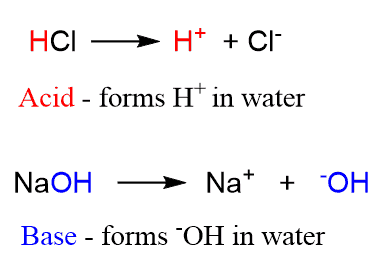
- Base: produces \( \mathrm{OH^-} \) in water or accepts \( \mathrm{H^+} \)
- Strong: completely ionizes in water
- Weak: partially ionizes in water

Strength refers to the extent of ionization, not the concentration of the solution.
Modeling Strong Acids
A strong acid ionizes almost completely in water.

Particulate model characteristics:
- Nearly all acid molecules are separated into ions
- Large numbers of \( \mathrm{H^+} \) (or \( \mathrm{H_3O^+} \)) ions
- Very few undissociated molecules remain
This can be represented symbolically as:
\( \mathrm{HCl(aq) \rightarrow H^+(aq) + Cl^-(aq)} \)
Modeling Weak Acids
A weak acid only partially ionizes in water.
Particulate model characteristics:
- Most particles remain as intact acid molecules
- Relatively few \( \mathrm{H^+} \) ions are present
- An equilibrium exists between ions and molecules
Symbolic representation:
\( \mathrm{CH_3COOH(aq) \rightleftharpoons H^+(aq) + CH_3COO^-(aq)} \)
Modeling Strong Bases
A strong base dissociates completely to produce hydroxide ions.
Particulate model characteristics:
- Complete separation into ions

- High concentration of \( \mathrm{OH^-} \) ions
- No undissociated base units present

Symbolic representation:
\( \mathrm{NaOH(aq) \rightarrow Na^+(aq) + OH^-(aq)} \)
Modeling Weak Bases
A weak base produces fewer hydroxide ions because it reacts only partially with water.
Particulate model characteristics:
- Mostly neutral base molecules present
- Small number of ions formed
- Dynamic equilibrium in solution
Symbolic representation:
\( \mathrm{NH_3(aq) + H_2O(l) \rightleftharpoons NH_4^+(aq) + OH^-(aq)} \)
Comparing Strong and Weak Using Models
Correct particle models must show:
- Degree of ionization (many ions vs few ions)
- Presence or absence of undissociated molecules
- Relative number of charged particles
Models that show equal ion numbers for strong and weak substances are incorrect.
Evaluating Models of Acid–Base Strength
To evaluate a model, check whether it:
- Represents partial vs complete ionization accurately
- Correctly distinguishes molecules from ions
- Uses equilibrium arrows appropriately for weak substances
Strength is determined by ionization, not by how much acid or base is added.
Example
Two particulate diagrams represent acids in water. Diagram A shows almost all particles as ions. Diagram B shows mostly neutral molecules with a few ions.
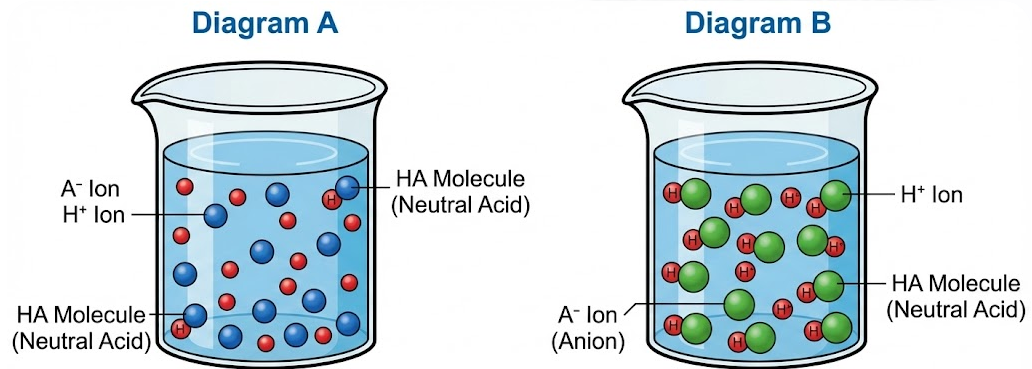
Identify which represents a strong acid and explain why.
▶️ Answer / Explanation
Diagram A represents a strong acid.
Strong acids ionize completely in water, so most particles appear as ions rather than intact molecules.
Example
A student models a weak acid by showing all molecules ionized but labels the solution “dilute.” Evaluate this model.
▶️ Answer / Explanation
The model is incorrect.
Dilution affects concentration, not strength. A weak acid must be shown as only partially ionized, regardless of how dilute the solution is.
4.3.A.2 — Distinguishing Strong and Weak Acids by Degree of Dissociation
Strong and weak acids are distinguished by their degree of dissociation in aqueous solution. The degree of dissociation describes how completely acid molecules separate into ions when dissolved in water.
This distinction is essential for understanding acid strength, particle behavior in solution, and observable properties such as conductivity and reactivity.
Degree of Dissociation
The degree of dissociation refers to the fraction of acid molecules that ionize to form ions in water.

- High degree of dissociation → many ions formed
- Low degree of dissociation → few ions formed
Acid strength depends on degree of dissociation, not on how concentrated or dilute the solution is.
Strong Acids
A strong acid dissociates almost completely in water.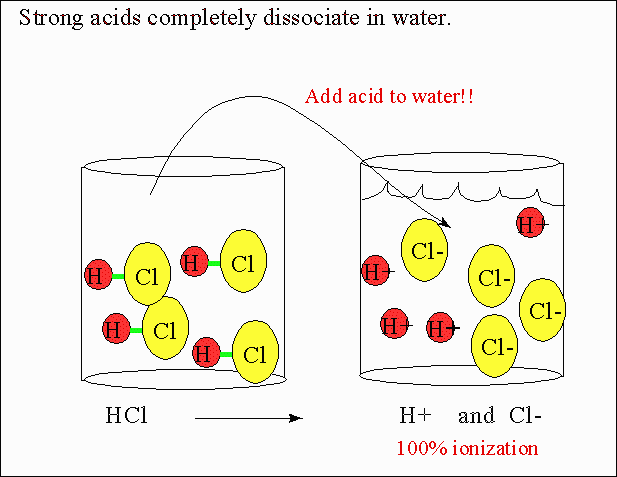
Key characteristics:
- Very high degree of dissociation
- Nearly all acid molecules form ions
- Very few neutral acid molecules remain
Typical strong-acid representation:
\( \mathrm{HCl(aq) \rightarrow H^+(aq) + Cl^-(aq)} \)
In particulate models, strong acids are shown as mostly ions dispersed in water.
Weak Acids
A weak acid dissociates only partially in water.
Key characteristics:
- Low degree of dissociation
- Most particles remain as intact acid molecules
- Small number of ions present
- Dynamic equilibrium between molecules and ions
Typical weak-acid representation:
\( \mathrm{CH_3COOH(aq) \rightleftharpoons H^+(aq) + CH_3COO^-(aq)} \)
In particulate models, weak acids are shown as mostly molecules with a few ions.
Direct Comparison: Strong vs Weak Acids
The key distinction is not how much acid is present, but how completely it dissociates.
- Strong acids → almost complete dissociation
- Weak acids → partial dissociation
Even a very dilute strong acid has a higher degree of dissociation than a concentrated weak acid.
Evaluating Particle Models
A correct particulate model must show:
- Many ions and few molecules for strong acids
- Many molecules and few ions for weak acids
- Equilibrium arrows only for weak acids
Models that only change the number of particles without showing dissociation are incorrect.
Common Misconceptions
- Strong acid means concentrated → incorrect
- Weak acid means dilute → incorrect
- Strength depends on degree of dissociation
Example
Two acids are shown in particulate diagrams. Diagram A contains mostly ions. Diagram B contains mostly intact molecules. Identify which acid is strong and justify your answer.
▶️ Answer / Explanation
Diagram A represents the strong acid.
Strong acids have a high degree of dissociation, so most particles appear as ions in solution.
Example
A student claims that acetic acid becomes a strong acid when its concentration is increased. Evaluate this claim using degree of dissociation.
▶️ Answer / Explanation
The claim is incorrect.
Acid strength depends on degree of dissociation, not concentration. Acetic acid remains only partially dissociated in water, regardless of how concentrated the solution is.