
4.3.B.1 — Relationship Between Hydrogen Ion Concentration and pH
The pH of a solution is a numerical scale used to describe the hydrogen ion concentration, \( \mathrm{[H^+]} \), in aqueous solutions. Because hydrogen ion concentrations can vary over a very wide range, pH uses a logarithmic scale to make comparisons easier.
Definition of pH
The pH of a solution is defined mathematically as:
\( \mathrm{pH = -\log[H^+]} \)
This equation shows that pH depends directly on the hydrogen ion concentration.

Logarithmic Nature of the pH Scale
The pH scale is logarithmic, meaning:
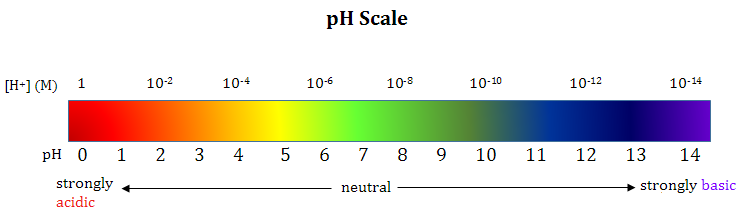
- A change of 1 pH unit represents a tenfold change in \( \mathrm{[H^+]} \)
- A decrease of 1 pH unit means \( \mathrm{[H^+]} \) increases by a factor of 10
- An increase of 1 pH unit means \( \mathrm{[H^+]} \) decreases by a factor of 10
Therefore, small numerical changes in pH correspond to large changes in hydrogen ion concentration.
Inverse Relationship Between pH and \( \mathrm{[H^+]} \)
pH and hydrogen ion concentration are inversely related:
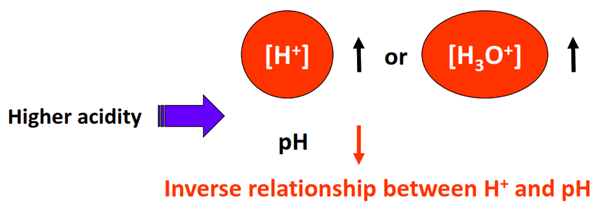
- As \( \mathrm{[H^+]} \) increases, pH decreases
- As \( \mathrm{[H^+]} \) decreases, pH increases
More acidic solutions have higher hydrogen ion concentrations and lower pH values.
Acidic, Neutral, and Basic Solutions
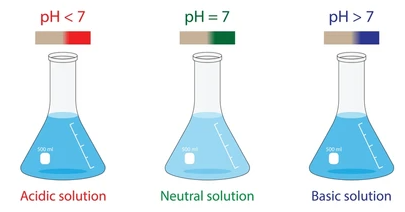
- Acidic: \( \mathrm{pH < 7} \), high \( \mathrm{[H^+]} \)
- Neutral: \( \mathrm{pH = 7} \), \( \mathrm{[H^+] = 1.0 \times 10^{-7}\,M} \)
- Basic: \( \mathrm{pH > 7} \), low \( \mathrm{[H^+]} \)
Neutral water has equal concentrations of \( \mathrm{H^+} \) and \( \mathrm{OH^-} \).
Comparing Hydrogen Ion Concentrations
Using the logarithmic relationship:
- A solution with pH 3 has 10 times more \( \mathrm{H^+} \) than pH 4
- A solution with pH 3 has 100 times more \( \mathrm{H^+} \) than pH 5
This explains why lower-pH acids are much more reactive and corrosive.
Using pH to Evaluate Acid Strength (Conceptually)
At the same concentration:
- Strong acids produce higher \( \mathrm{[H^+]} \)
- Weak acids produce lower \( \mathrm{[H^+]} \)
- Lower pH indicates greater ionization
However, pH alone does not define acid strength unless concentrations are equal.
Evaluating Claims About pH and \( \mathrm{[H^+]} \)
A complete explanation must:
- Reference hydrogen ion concentration
- Use the logarithmic nature of the pH scale
- Explain the inverse relationship between pH and \( \mathrm{[H^+]} \)
Claims that say “lower pH means stronger acid” without discussing \( \mathrm{[H^+]} \) are incomplete.
Example
Compare the hydrogen ion concentrations of two solutions: one with pH 4 and one with pH 6.
▶️ Answer / Explanation
The pH 4 solution has a lower pH and therefore a higher hydrogen ion concentration.
Because the pH difference is 2 units, the pH 4 solution has \( \mathrm{10^2 = 100} \) times more \( \mathrm{H^+} \) than the pH 6 solution.
Example
A solution’s hydrogen ion concentration increases by a factor of 100. Explain how the pH of the solution changes.
▶️ Answer / Explanation
An increase in \( \mathrm{[H^+]} \) by a factor of 100 corresponds to a decrease in pH of 2 units.
This is because the pH scale is logarithmic, and each pH unit represents a tenfold change in hydrogen ion concentration.