
Question 1
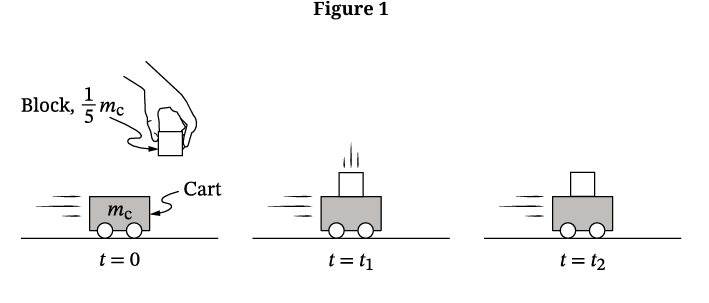
• At \( t=t_1 \), the block collides with and sticks to the top of the cart. The block does not slide on the cart.
• At \( t=t_2 \), the block-cart system continues to move to the right with constant speed \( v_f \).
Most-appropriate topic codes (AP Physics 1):
• Topic \( 4.2 \) — Change in Momentum and Impulse (Part \( \mathrm{B} \))
• Topic \( 4.3 \) — Conservation of Linear Momentum (Part \( \mathrm{A(ii)} \), Part \( \mathrm{B} \))
• Topic \( 4.4 \) — Elastic and Inelastic Collisions (Part \( \mathrm{A(ii)} \), Part \( \mathrm{A(iii)} \))
• Topic \( 3.1 \) — Translational Kinetic Energy (Part \( \mathrm{A(iii)} \))
▶️ Answer/Explanation
A(i)
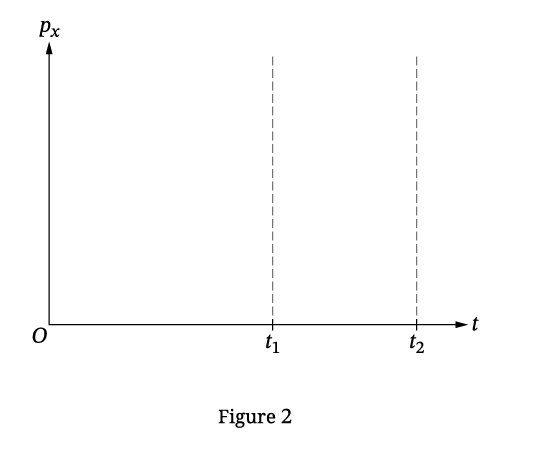
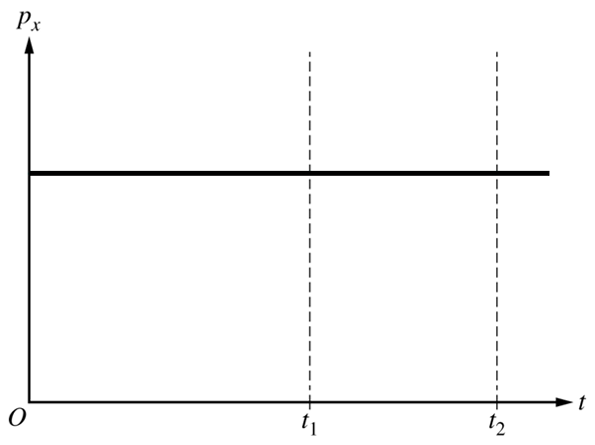
The graph of \( p_x \) versus \( t \) is a horizontal line above zero from \( t=0 \) all the way to \( t_2 \).
Since there is no net external horizontal force on the block-cart system, the \( x \)-component of momentum remains constant throughout the motion, including during the collision at \( t=t_1 \).
So the sketch should show one continuous, nonzero, horizontal line from \( t=0 \) to \( t=t_2 \).
A(ii)
Use conservation of linear momentum:
\( p_i = p_f \)
Initially, only the cart has horizontal momentum, because the block is released from rest and has no initial horizontal speed. Therefore,
\( p_i = m_c v_c \)
After the collision, the cart and block stick together, so the total mass is
\( m_c + \dfrac{1}{5}m_c = \dfrac{6}{5}m_c \)
Thus,
\( m_c v_c = \left(\dfrac{6}{5}m_c\right)v_f \)
Solving for \( v_f \),
\( v_f = \dfrac{m_c v_c}{(6/5)m_c} = \dfrac{5}{6}v_c \)
Therefore, \( \boxed{v_f=\dfrac{5}{6}v_c} \)
The final speed is smaller than \( v_c \), which makes sense because the cart has to carry extra mass after the perfectly inelastic collision.
A(iii)
Use
\( \Delta K = K_f – K_i \)
Initial kinetic energy:
\( K_i = \dfrac{1}{2}m_c v_c^2 \)
Final kinetic energy:
\( K_f = \dfrac{1}{2}\left(\dfrac{6}{5}m_c\right)v_f^2 \)
Substitute \( v_f=\dfrac{5}{6}v_c \):
\( K_f = \dfrac{1}{2}\left(\dfrac{6}{5}m_c\right)\left(\dfrac{5}{6}v_c\right)^2 \)
\( K_f = \dfrac{1}{2}\left(\dfrac{6}{5}m_c\right)\left(\dfrac{25}{36}v_c^2\right) \)
\( K_f = \dfrac{1}{2}\left(\dfrac{5}{6}\right)m_c v_c^2 = \dfrac{5}{12}m_c v_c^2 \)
Therefore,
\( \Delta K = \dfrac{5}{12}m_c v_c^2 – \dfrac{1}{2}m_c v_c^2 \)
\( \Delta K = \dfrac{5}{12}m_c v_c^2 – \dfrac{6}{12}m_c v_c^2 \)
\( \Delta K = -\dfrac{1}{12}m_c v_c^2 \)
Therefore, \( \boxed{\Delta K=-\dfrac{1}{12}m_c v_c^2} \)
The negative sign shows that kinetic energy decreases, which is expected in a perfectly inelastic collision.
B
\( \boxed{\text{Remains constant}} \)
The friction force between the new block and the cart is internal to the block-cart system. During \( \Delta t \), the friction force on the block and the friction force on the cart are equal in magnitude and opposite in direction, so they do not create a net external horizontal force on the system.
Because only a net external force can change the momentum of the system, the \( x \)-component of the momentum of the new block-cart system remains constant during \( \Delta t \).
Question 2

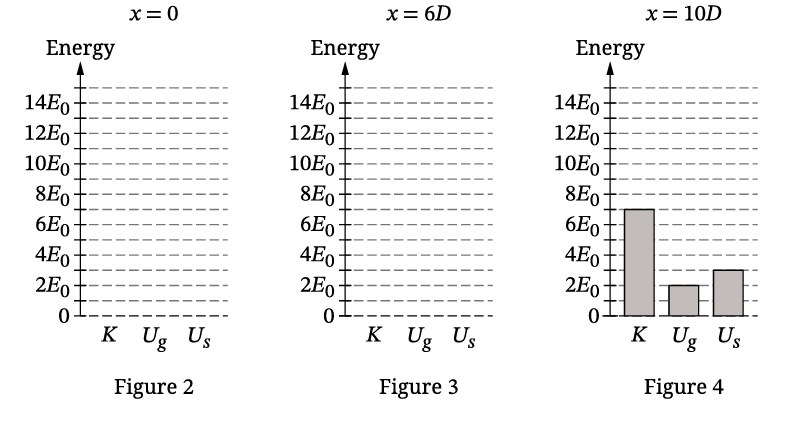
• Represent any energy that is equal to zero with a distinct line on the zero-energy line.
• The relative heights of each shaded bar should reflect the magnitude of the respective energy consistent with the scale used in Figure \( 4 \).
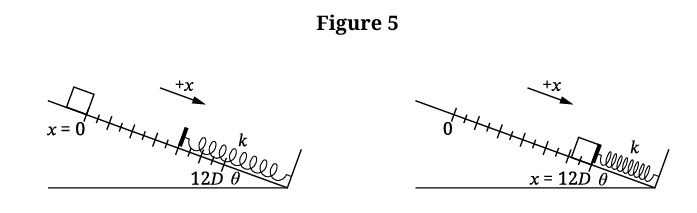
(ii) Sketch and label a line or curve that represents the gravitational potential energy \( U_g \) for the block-spring-Earth system as a function of the position of the block from \( x=8D \) to \( x=12D \).
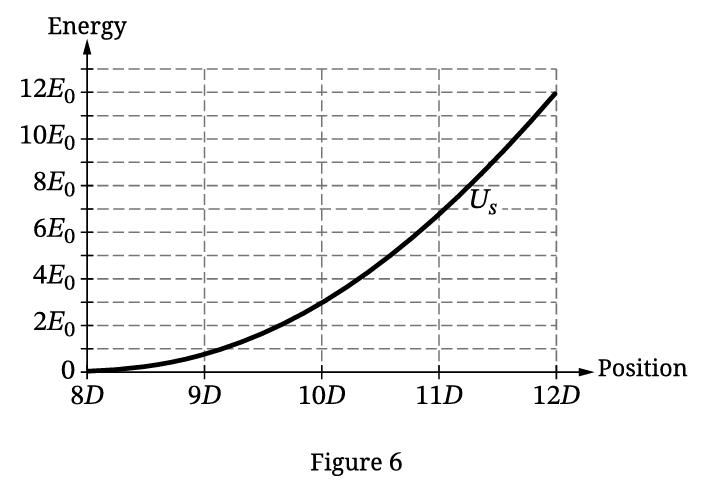
_____ \( v_{9D} < v_{8D} \)
_____ \( v_{9D} = v_{8D} \)
Most-appropriate topic codes (AP Physics 1):
• Topic \( 3.3 \) — Potential Energy (Part \( \mathrm{A} \), Part \( \mathrm{B} \), Part \( \mathrm{C} \))
• Topic \( 3.4 \) — Conservation of Energy (Part \( \mathrm{A} \), Part \( \mathrm{B} \), Part \( \mathrm{C} \), Part \( \mathrm{D} \))
▶️ Answer/Explanation
A
For \( x=0 \): the block is released from rest, so \( K=0 \), \( U_s=0 \), and all the mechanical energy is gravitational potential energy.
Therefore, in Figure \( 2 \):
\( K=0 \)
\( U_g=12E_0 \)
\( U_s=0 \)
For \( x=6D \): the block has not yet touched the spring, so \( U_s=0 \). Since total mechanical energy is conserved and still equals \( 12E_0 \), the remaining energy is split between \( K \) and \( U_g \).
Therefore, in Figure \( 3 \):
\( K=6E_0 \)
\( U_g=6E_0 \)
\( U_s=0 \)
This is consistent with Figure \( 4 \), where at \( x=10D \) the energies add to \( 12E_0 \):
\( 7E_0 + 2E_0 + 3E_0 = 12E_0 \).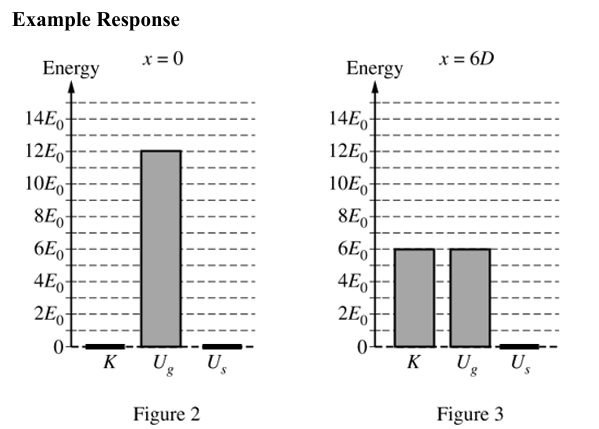
B
Start with conservation of energy:
\( E_i = E_f \)
At \( x=0 \), the block is released from rest, so all the energy is gravitational potential energy. At \( x=12D \), the block is momentarily at rest, so all the energy is spring potential energy.
Thus,
\( U_g = U_s \)
The vertical drop from \( x=0 \) to \( x=12D \) is
\( \Delta y = 12D\sin\theta \)
The spring is first contacted at \( x=8D \), so the compression at \( x=12D \) is
\( \Delta x = 12D-8D = 4D \)
Therefore,
\( Mg(12D\sin\theta)=\dfrac{1}{2}k(4D)^2 \)
\( 12MgD\sin\theta = 8kD^2 \)
Solving for \( k \),
\( k=\dfrac{12MgD\sin\theta}{8D^2} \)
\( k=\dfrac{3Mg\sin\theta}{2D} \)
Therefore, \( \boxed{k=\dfrac{3Mg\sin\theta}{2D}} \)
C(i)
The total mechanical energy \( E \) is constant from \( x=8D \) to \( x=12D \), so the graph should be a horizontal line at \( 12E_0 \).
Even though \( U_s \), \( U_g \), and \( K \) individually change, their sum stays the same because friction is negligible.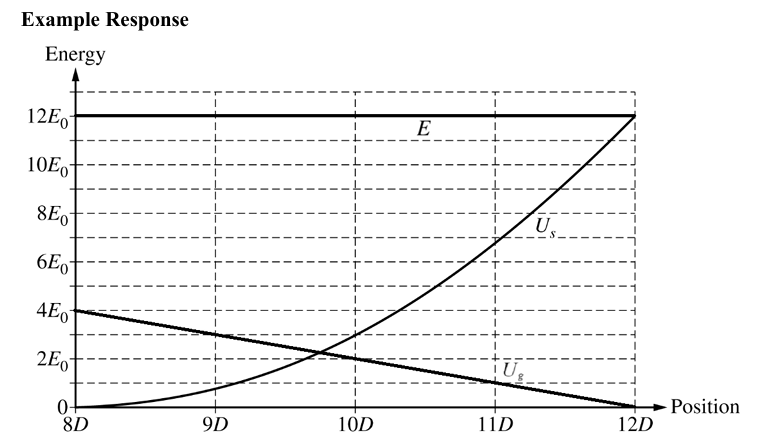
C(ii)
The gravitational potential energy \( U_g \) decreases linearly as the block moves down the ramp from \( x=8D \) to \( x=12D \).
So the graph should be a straight line decreasing from \( (8D,4E_0) \) to \( (12D,0) \).
The decrease is linear because height decreases linearly with distance traveled along a straight ramp.
D
\( \boxed{v_{9D} > v_{8D}} \)
At \( x=8D \), the spring is just uncompressed, so \( U_s=0 \). From the graph in part \( \mathrm{C} \), the total energy is \( 12E_0 \) and \( U_g=4E_0 \), so the kinetic energy at \( x=8D \) is
\( K_{8D}=12E_0-4E_0-0=8E_0 \)
At \( x=9D \), the spring potential energy is still less than \( E_0 \) while the gravitational potential energy is \( 3E_0 \). Therefore the total of \( U_g+U_s \) at \( x=9D \) is less than \( 4E_0 \), which means the kinetic energy at \( x=9D \) is greater than \( 8E_0 \).
Since the mass is the same at both positions and \( K=\dfrac{1}{2}Mv^2 \), greater kinetic energy means greater speed. Therefore, \( v_{9D} > v_{8D} \).
Question 3
| \( \theta \) \( (\mathrm{degrees}) \) | \( F_T \) \( (\mathrm{N}) \) |
|---|---|
| \( 22 \) | \( 21 \) |
| \( 31 \) | \( 17 \) |
| \( 36 \) | \( 13 \) |
| \( 45 \) | \( 12 \) |
| \( 80 \) | \( 8 \) |
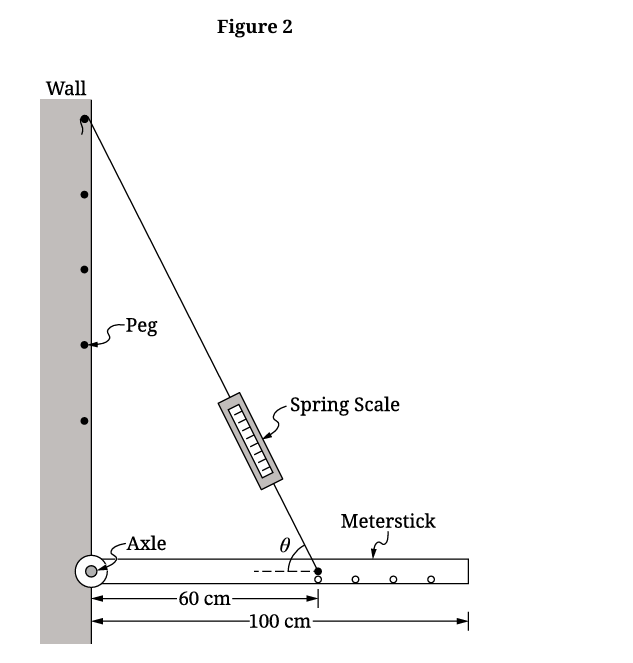
\( F_T = \dfrac{5Mg}{6\sin\theta} \)
Vertical axis: _____ Horizontal axis: \( \dfrac{1}{\sin\theta} \)
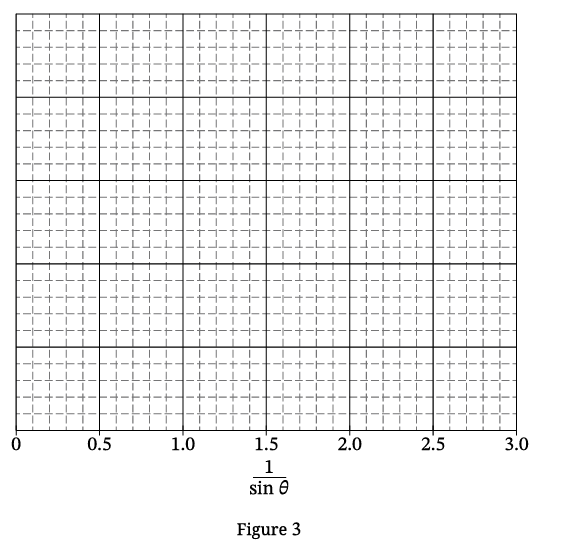
• Clearly label the vertical axis, including units as appropriate.
• Plot the points you recorded in Table \( 2 \).
Most-appropriate topic codes (AP Physics 1):
• Topic \( 5.5 \) — Rotational Equilibrium and Newton’s First Law in Rotational Form (Part \( \mathrm{A} \), Part \( \mathrm{B} \), Part \( \mathrm{C} \), Part \( \mathrm{D} \))
• Topic \( 2.2 \) — Forces and Free-Body Diagrams (Part \( \mathrm{A} \), Part \( \mathrm{C} \))
• Topic \( 1.1 \) — Scalars and Vectors in One Dimension (Part \( \mathrm{C} \), graphing and measured quantities)
▶️ Answer/Explanation
A
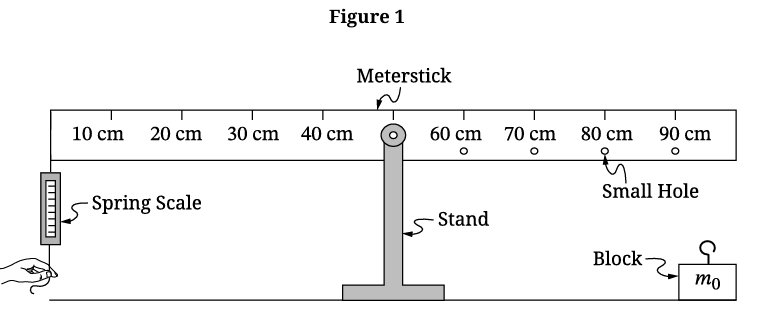
Attach the block of unknown mass \( m_0 \) to one of the small holes in the meterstick. Keep the meterstick horizontal and record the force reading from the spring scale.
Repeat the measurement for several different block positions \( r_b \) measured from the stand \( (\text{pivot}) \). For each position, also record the distance from the stand to the spring scale attachment point, which stays fixed.
To reduce experimental uncertainty, repeat the spring-scale reading multiple times for each block position and average the values. It also helps to use many different hole positions so the graph is based on several data points instead of only one or two.
A good experimental habit is to make sure the meterstick is level before reading the scale each time and to read the scale at eye level to reduce parallax error.
B
One valid graph is force as a function of the distance from the stand to the block.
Taking torques about the stand,
\( F_s r_s = m_0 g\, r_b \)
where \( F_s \) is the spring-scale force, \( r_s \) is the distance from the stand to the spring scale, and \( r_b \) is the distance from the stand to the block.
Rearranging,
\( F_s = \left(\dfrac{m_0 g}{r_s}\right) r_b \)
So a graph of \( F_s \) on the vertical axis versus \( r_b \) on the horizontal axis is linear. Its slope is
\( \text{slope} = \dfrac{m_0 g}{r_s} \)
Therefore,
\( m_0 = \dfrac{(\text{slope})\,r_s}{g} \)
Any equivalent linear graph that correctly relates force and distance also earns full credit.
C(i)
Vertical axis: \( F_T \)
Since \( F_T = \dfrac{5Mg}{6\sin\theta} = \left(\dfrac{5Mg}{6}\right)\left(\dfrac{1}{\sin\theta}\right) \), a plot of \( F_T \) versus \( \dfrac{1}{\sin\theta} \) is linear.
C(ii)
Use the calculated values of \( \dfrac{1}{\sin\theta} \) together with the measured values of \( F_T \).
| Table \( 2 \) | \( \theta \) \( (\mathrm{degrees}) \) | \( \dfrac{1}{\sin\theta} \) | \( F_T \) \( (\mathrm{N}) \) |
|---|---|---|---|
| Point \( 1 \) | \( 22 \) | \( 2.67 \) | \( 21 \) |
| Point \( 2 \) | \( 31 \) | \( 1.94 \) | \( 17 \) |
| Point \( 3 \) | \( 36 \) | \( 1.70 \) | \( 13 \) |
| Point \( 4 \) | \( 45 \) | \( 1.41 \) | \( 12 \) |
| Point \( 5 \) | \( 80 \) | \( 1.02 \) | \( 8 \) |
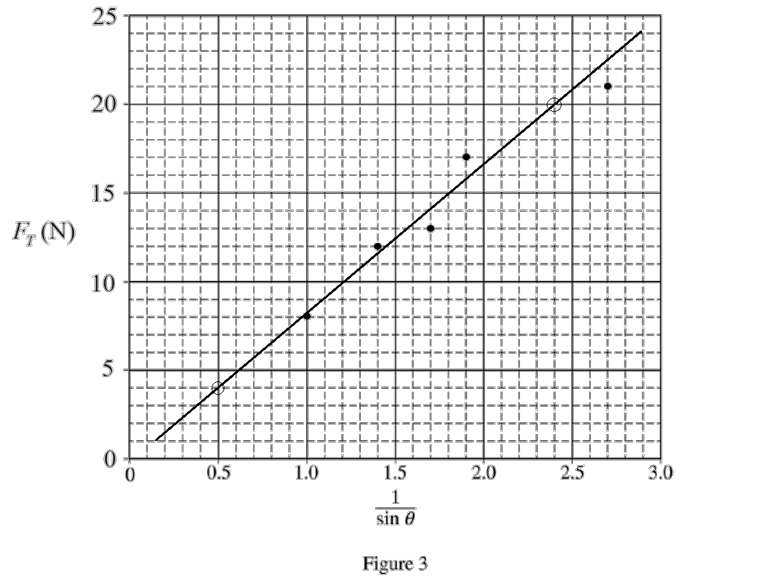
The graph should have vertical axis \( F_T\ (\mathrm{N}) \) and horizontal axis \( \dfrac{1}{\sin\theta} \). Plot the points:
\( (2.67,21),\ (1.94,17),\ (1.70,13),\ (1.41,12),\ (1.02,8) \)
These points lie approximately on a straight line.
C(iii)
Draw a straight best-fit line through the plotted data. It should have positive slope and pass close to the origin.
Because the equation has the form \( F_T = \left(\dfrac{5Mg}{6}\right)\left(\dfrac{1}{\sin\theta}\right) \), the slope of the best-fit line is the important quantity for finding \( M \).
D
From a reasonable best-fit line, the slope is about \( 8.4\ \mathrm{N} \).
Since
\( F_T = \left(\dfrac{5Mg}{6}\right)\left(\dfrac{1}{\sin\theta}\right) \),
the slope is \( \dfrac{5Mg}{6} \).
Therefore,
\( M = \dfrac{6(\text{slope})}{5g} \)
\( M = \dfrac{6(8.4\ \mathrm{N})}{5(9.8\ \mathrm{N/kg})} \)
\( M \approx 1.03\ \mathrm{kg} \)
So an experimental value for the mass of the meterstick is \( \boxed{1.0\ \mathrm{kg}} \) \( (\text{approximately}) \).
Question 4
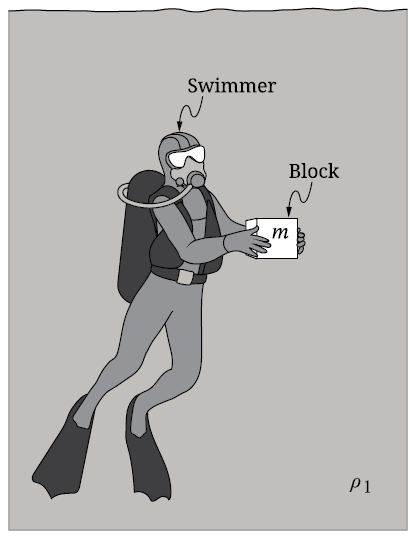
• \( a_1 < a_2 \)
• \( a_1 = a_2 \)
Most-appropriate topic codes (AP Physics 1):
• Topic \( 8.3 \) — Fluids and Newton’s Laws (Part \( \mathrm{A} \), Part \( \mathrm{B} \), Part \( \mathrm{C} \))
• Topic \( 2.5 \) — Newton’s Second Law (Part \( \mathrm{B} \))
• Topic \( 2.6 \) — Gravitational Force (Part \( \mathrm{A} \), Part \( \mathrm{B} \))
▶️ Answer/Explanation
A
\( \boxed{a_1 < a_2} \)
In both scenarios, the block has the same mass, so the downward gravitational force \( mg \) is the same. The upward force is the buoyant force.
Because salt water has greater density than fresh water \( (\rho_2 > \rho_1) \), the buoyant force exerted on the same fully submerged block is larger in salt water. Therefore, the net upward force is larger in Scenario \( 2 \), so the initial upward acceleration is larger in Scenario \( 2 \).
So the block speeds up more quickly in salt water because the upward push from the fluid is greater while the weight stays unchanged.
B
Start with Newton’s second law:
\( \sum F_y = ma \)
Take upward as positive. The forces on the block are: buoyant force upward and weight downward.
\( F_B – mg = ma \)
For a completely submerged block, the buoyant force is
\( F_B = \rho V g \)
Substitute into Newton’s second law:
\( \rho V g – mg = ma \)
Factor out \( g \):
\( g(\rho V – m) = ma \)
Solve for \( a \):
\( a = \dfrac{\rho V g – mg}{m} \)
\( a = \dfrac{\rho V g}{m} – g \)
Therefore, \( \boxed{a=\dfrac{\rho V g}{m}-g} \)
This makes sense physically: if the buoyant force exactly equals weight, then \( \rho V g = mg \) and the acceleration would be \( 0 \).
C
Yes, the expression is consistent with the claim in part \( \mathrm{A} \).
From \( a=\dfrac{\rho V g}{m}-g \), the acceleration increases as \( \rho \) increases because the term \( \dfrac{\rho V g}{m} \) increases, while \( g \) and the block’s \( m \) and \( V \) stay the same.
Since \( \rho_2 > \rho_1 \), it follows that \( a_2 > a_1 \), which agrees with the conclusion in part \( \mathrm{A} \).