
Question 1
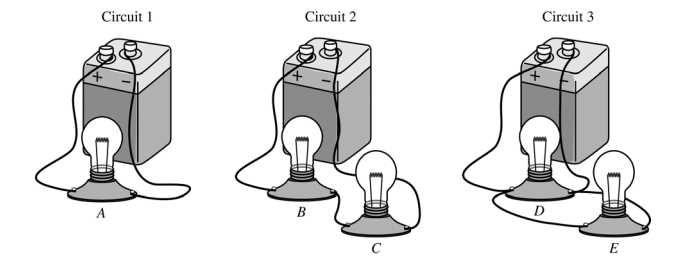
Most-appropriate topic codes (AP Physics \(2\)):
• Topic \(11.4\) — Electric Power (Part \( \mathrm{(b)} \))
• Topic \(11.5\) — Compound Direct Current \(\left(\mathrm{DC}\right)\) Circuits (Part \( \mathrm{(a)} \), Part \( \mathrm{(b)} \))
• Topic \(11.6\) — Kirchhoff’s Loop Rule (Part \( \mathrm{(a)} \))
• Topic \(11.7\) — Kirchhoff’s Junction Rule (Part \( \mathrm{(b)} \))
▶️ Answer/Explanation
(a)
The correct ranking is
\(\boxed{A=D=E>B=C}\)
Bulb \(A\) is connected directly across the battery in circuit \(1\), so the potential difference across bulb \(A\) is the full battery potential difference:
\(\Delta V_A=\mathcal{E}\)
In circuit \(3\), bulbs \(D\) and \(E\) are connected in parallel. Each bulb is connected directly across the battery, so each gets the full battery potential difference:
\(\Delta V_D=\mathcal{E}\)
\(\Delta V_E=\mathcal{E}\)
In circuit \(2\), bulbs \(B\) and \(C\) are identical and connected in series. The battery potential difference is shared equally between them, so
\(\Delta V_B=\Delta V_C=\dfrac{\mathcal{E}}{2}\)
Therefore,
\(\boxed{\Delta V_A=\Delta V_D=\Delta V_E>\Delta V_B=\Delta V_C}\)
(b)
\(\boxed{\text{The battery in circuit }3\text{ runs out first.}}\)
\(\boxed{\text{The battery in circuit }2\text{ runs out last.}}\)
The battery that delivers energy at the greatest rate will run out first. The rate at which the battery supplies energy is power:
\(P=I\Delta V\)
Since all batteries have the same potential difference \(\mathcal{E}\), the circuit with the greatest current draws the greatest power from the battery.
Let each bulb have resistance \(R\). In circuit \(1\), the equivalent resistance is
\(R_{\text{eq},1}=R\)
so the power delivered by the battery is
\(P_1=\dfrac{\mathcal{E}^2}{R}\)
In circuit \(2\), the two bulbs are in series:
\(R_{\text{eq},2}=R+R=2R\)
so
\(P_2=\dfrac{\mathcal{E}^2}{2R}\)
In circuit \(3\), the two bulbs are in parallel:
\(\dfrac{1}{R_{\text{eq},3}}=\dfrac{1}{R}+\dfrac{1}{R}=\dfrac{2}{R}\)
\(R_{\text{eq},3}=\dfrac{R}{2}\)
so
\(P_3=\dfrac{\mathcal{E}^2}{R/2}=\dfrac{2\mathcal{E}^2}{R}\)
Thus,
\(\boxed{P_3>P_1>P_2}\)
Since circuit \(3\) uses energy at the greatest rate, its battery runs out first. Since circuit \(2\) uses energy at the smallest rate, its battery runs out last.
Question 2
| Lab Group Number | Coefficient of Kinetic Friction | Coefficient of Static Friction |
|---|---|---|
| \(1\) | \(0.45\) | \(0.54\) |
| \(2\) | \(0.46\) | \(0.52\) |
| \(3\) | \(0.42\) | \(0.56\) |
| \(4\) | \(0.43\) | \(0.55\) |
| \(5\) | \(0.74\) | \(0.23\) |
| \(6\) | \(0.44\) | \(0.54\) |
| Average | \(0.49\) | \(0.49\) |
Most-appropriate topic codes (AP Physics \(1\)):
• Topic \(2.5\) — Newton’s Second Law (Part \( \mathrm{(b)} \))
• Topic \(2.7\) — Kinetic and Static Friction (Part \( \mathrm{(a)} \), Part \( \mathrm{(b)} \), Part \( \mathrm{(c)} \), Part \( \mathrm{(d)} \))
▶️ Answer/Explanation
(a)(i)
A valid setup is an adjustable inclined board with the wood block resting on it. Slowly raise one end of the board until the block just begins to slide.
Measure the angle \(\theta\) that the board makes with the horizontal using a protractor or angle-measuring app. The measured quantity is the critical angle \(\theta\), the angle at which the block is just about to move.
A simple diagram should show the board tilted at angle \(\theta\), the block on the board, and a protractor used to measure \(\theta\).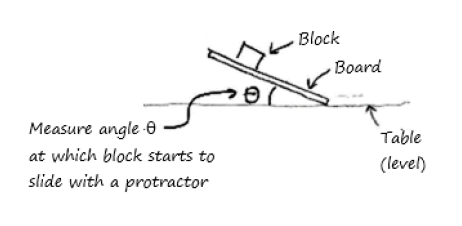
(a)(ii)
Place the block at rest on the board. Slowly lift one end of the board until the block just begins to slide. Record the angle \(\theta\) at that instant.
To reduce uncertainty, repeat the trial several times and use the average value of \(\theta\). The block can also be placed at different locations on the board to check that the result is not caused by one unusual rough or smooth section of the board.
(b)
At the instant the block is just about to slide, static friction is at its maximum value.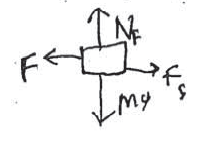
Along the direction parallel to the incline:
\(mg\sin\theta=f_s\)
At the threshold of slipping,
\(f_s=f_{s,\max}=\mu_sN\)
Perpendicular to the incline:
\(N=mg\cos\theta\)
Substitute into the parallel-force equation:
\(mg\sin\theta=\mu_smg\cos\theta\)
Divide both sides by \(mg\cos\theta\):
\(\mu_s=\dfrac{\sin\theta}{\cos\theta}\)
\(\boxed{\mu_s=\tan\theta}\)
(c)
\(\boxed{\text{The static and kinetic coefficients are not equal.}}\)
Group \(5\) is an outlier because its kinetic friction value, \(0.74\), is much larger than the other kinetic friction values, and its static friction value, \(0.23\), is much smaller than the other static friction values.
If group \(5\) is removed, the remaining groups show a consistent pattern: the static friction coefficient is about \(0.52\) to \(0.56\), while the kinetic friction coefficient is about \(0.42\) to \(0.46\). Therefore, the data support the conclusion that the coefficients are different.
(d)
\(\boxed{\text{Remain the same}}\)
The coefficient of static friction is a property of the two surfaces in contact. Since the same wood block bottom is still in contact with the same wood board, the coefficient \(\mu_s\) does not depend on the mass of the block-disk system.
Adding the metal disk increases the normal force and therefore increases the maximum static friction force, since \(f_{s,\max}=\mu_sN\). However, the coefficient \(\mu_s\) itself remains the same.
Question 3
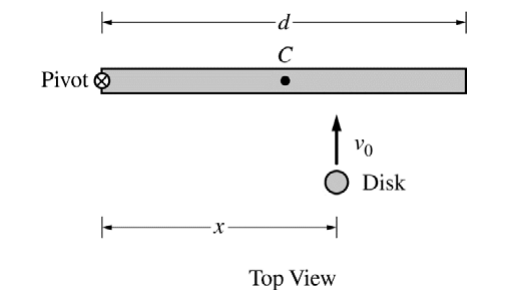
Most-appropriate topic codes (AP Physics \(1\)):
• Topic \(4.3\) — Conservation of Linear Momentum (Part \( \mathrm{(e)} \))
• Topic \(4.4\) — Elastic and Inelastic Collisions (Part \( \mathrm{(d)} \), Part \( \mathrm{(e)} \))
• Topic \(5.3\) — Torque (Part \( \mathrm{(a)} \))
• Topic \(5.4\) — Rotational Inertia (Part \( \mathrm{(c)} \), Part \( \mathrm{(d)} \))
• Topic \(6.3\) — Angular Momentum and Angular Impulse (Part \( \mathrm{(a)} \), Part \( \mathrm{(b)} \), Part \( \mathrm{(c)} \), Part \( \mathrm{(d)} \), Part \( \mathrm{(e)} \))
▶️ Answer/Explanation
(a)
\(\boxed{\text{To the right of }C}\)
The disk should hit the rod as far from the pivot as possible. A collision farther from the pivot gives the disk a larger angular momentum about the pivot. Since angular momentum about the pivot is transferred to the rod-disk system, a larger distance from the pivot produces a larger final angular speed.
(b)
\(\boxed{\text{Yes}}\)
The equation \(\omega=\dfrac{m_{\text{disk}}xv_0}{I}\) shows that \(\omega\) increases as \(x\) increases. That matches the reasoning in part (a): hitting farther from the pivot gives the system more angular momentum and therefore a larger angular speed.
(c)
The equation \(\omega=\dfrac{Iv_0}{m_{\text{disk}}d^4}\) is not plausible because it predicts the wrong dependence on important physical quantities.
If \(m_{\text{disk}}\) increases, the incoming disk has more angular momentum, so the final angular speed should generally increase. But this equation has \(m_{\text{disk}}\) in the denominator, so it predicts that a larger disk mass would make \(\omega\) smaller.
Also, if the rod’s rotational inertia \(I\) is larger, the system should be harder to rotate, so \(\omega\) should decrease. But this equation has \(I\) in the numerator, so it predicts the opposite.
The units are also not consistent with angular speed. Since angular speed should have units of \(\text{s}^{-1}\), the expression \(\dfrac{Iv_0}{m_{\text{disk}}d^4}\) does not have the correct dimensions.
(d)
Use conservation of angular momentum about the pivot during the collision. The pivot can exert an external force, but it exerts no torque about the pivot point itself.
Initial angular momentum:
\(L_i=m_{\text{disk}}v_0x\)
After the disk sticks to the rod, the total rotational inertia about the pivot is
\(I_{\text{total}}=I+m_{\text{disk}}x^2\)
Final angular momentum:
\(L_f=\left(I+m_{\text{disk}}x^2\right)\omega\)
Set \(L_i=L_f\):
\(m_{\text{disk}}v_0x=\left(I+m_{\text{disk}}x^2\right)\omega\)
Solve for \(\omega\):
\(\boxed{\omega=\dfrac{m_{\text{disk}}v_0x}{I+m_{\text{disk}}x^2}}\)
(e)
\(\boxed{\text{Greater than}}\)
If the disk sticks, it keeps moving with the rod after the collision, so some angular momentum remains associated with the disk as part of the rotating rod-disk system.
If the disk bounces backward, its angular momentum about the pivot changes direction. To conserve total angular momentum about the pivot, the rod must gain more angular momentum than in the sticking case.
Since the rod gains more angular momentum in the bounce case, its postcollision angular speed is greater than when the disk sticks to the rod.
Question 4
Most-appropriate topic codes (AP Physics \(1\)):
• Topic \(3.1\) — Translational Kinetic Energy (Part \( \mathrm{(a)} \), Part \( \mathrm{(b)} \))
• Topic \(3.3\) — Potential Energy (Part \( \mathrm{(a)} \), Part \( \mathrm{(b)} \))
• Topic \(3.4\) — Conservation of Energy (Part \( \mathrm{(a)} \), Part \( \mathrm{(b)} \))
▶️ Answer/Explanation
(a)
\(\boxed{\text{No}}\)
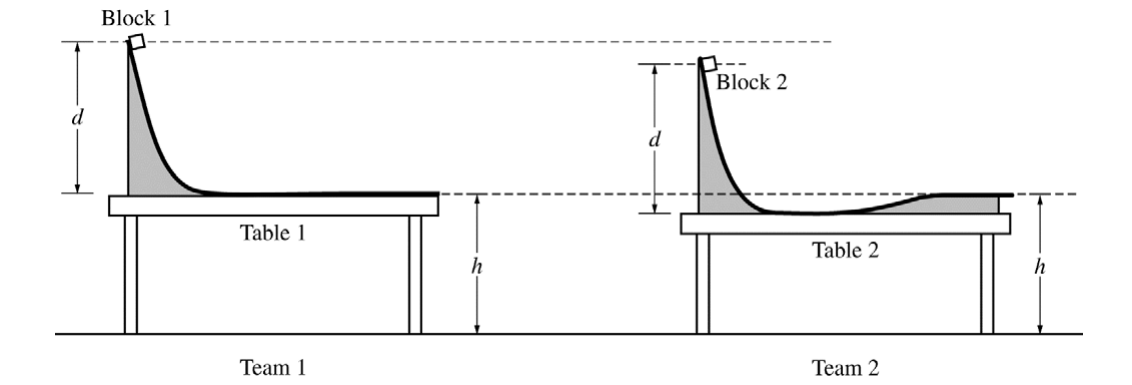
The two blocks leave their slides from the same height above the floor, so the time each block spends in the air is the same.
However, the launch speeds are different. The slide for block \(1\) has a larger vertical drop from the release point to the launch point, so more gravitational potential energy is converted into kinetic energy.
For a low-friction slide, the launch speed depends on the vertical drop:
\(mg\Delta y=\dfrac{1}{2}mv^2\)
\(v=\sqrt{2g\Delta y}\)
Since block \(1\) has a larger \(\Delta y\), block \(1\) leaves the slide with a greater horizontal speed. Because both blocks are in the air for the same time but have different horizontal speeds, they do not land the same distance from their tables.
(b)(i)
\(\boxed{\text{The two blocks land the same distance from their respective tables.}}\)
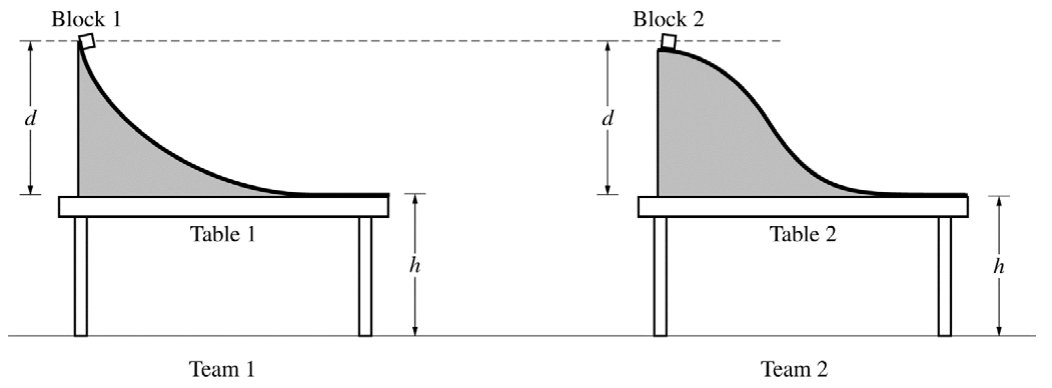
In this experiment, the two slides start at the same height and end at the same tabletop height. Therefore, both blocks have the same vertical drop.
Since the slides are low friction, the shape of the slide does not change the final launch speed; only the change in height matters. Thus, both blocks leave the table with the same horizontal speed.
The tables also have the same height, so the blocks spend the same amount of time falling. Same horizontal speed and same time in the air means the horizontal distances are the same.
(b)(ii)
\(\boxed{\text{Block }1}\)
Block \(1\) hits the floor first because the slide for block \(1\) is initially steeper. This means block \(1\) gains speed earlier and has a greater average speed while traveling along the slide.
Even though both blocks leave their slides with the same final launch speed, block \(1\) reaches the end of its slide sooner. Since both blocks then fall from the same table height, their time in the air after leaving the table is the same. Therefore, the block that leaves the table first also hits the floor first.
Question 5
Most-appropriate topic codes (AP Physics \(2\)):
▶️ Answer/Explanation
(a)
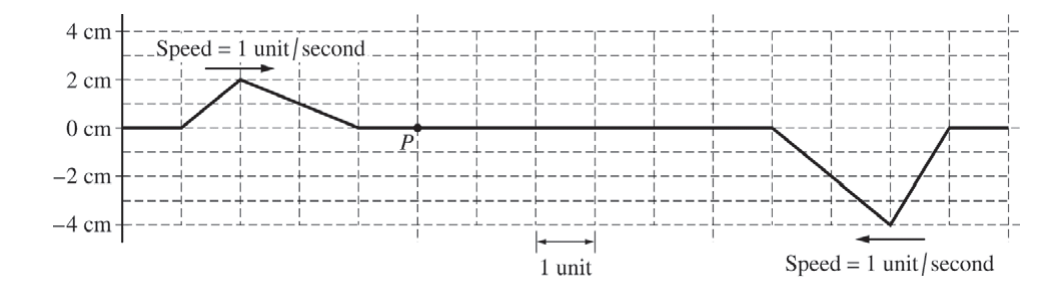
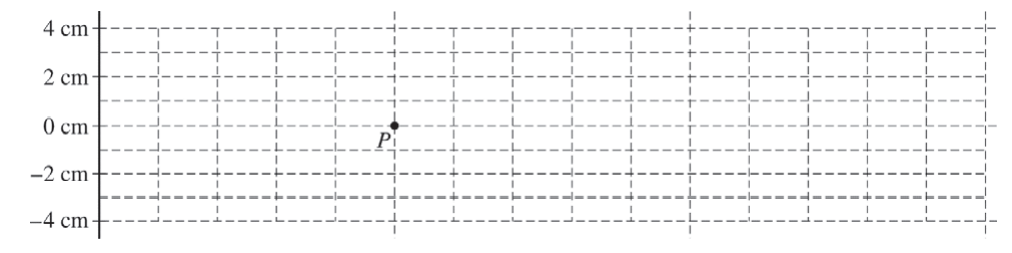
The velocity of point \(P\) depends on the slope of the pulse as the pulse passes through point \(P\).
For a pulse moving to the right, the vertical velocity of a point on the string is opposite in sign to the local slope of the pulse.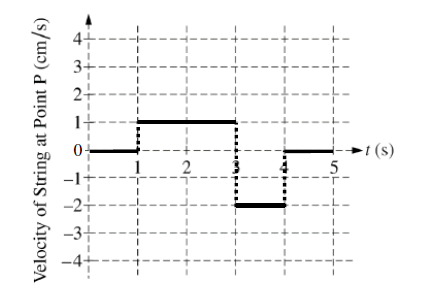
From \(0<t<1\), the pulse has not reached point \(P\), so
\(v_P=0\)
From \(1<t<3\), the section of the pulse passing point \(P\) gives point \(P\) a constant upward velocity:
\(v_P=+1\text{ cm/s}\)
From \(3<t<4\), the steeper section of the pulse gives point \(P\) a constant downward velocity:
\(v_P=-2\text{ cm/s}\)
From \(4<t<5\), the pulse has passed point \(P\), so
\(v_P=0\)
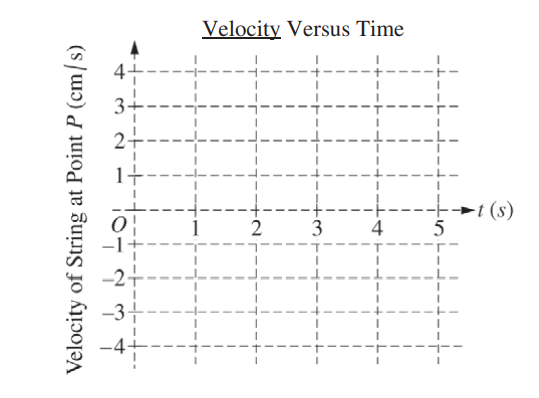
Therefore, the velocity-time graph should show:
\(\boxed{v_P=0\text{ for }0<t<1}\)
\(\boxed{v_P=+1\text{ cm/s for }1<t<3}\)
\(\boxed{v_P=-2\text{ cm/s for }3<t<4}\)
\(\boxed{v_P=0\text{ for }4<t<5}\)
(b)
At \(t=5\text{ s}\), the two pulses completely overlap. The displacement of the string is found by superposition, meaning the vertical displacements of the two pulses are added point by point.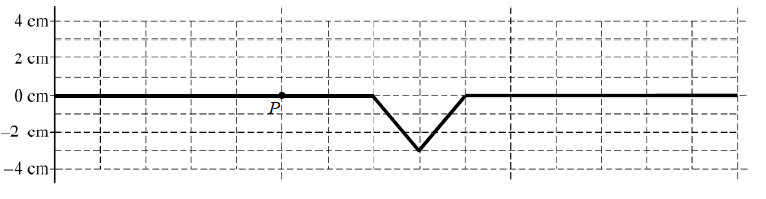
Where the positive pulse and negative pulse overlap, their displacements combine algebraically.
The resulting shape is a single triangular pulse below the equilibrium line. The pulse has maximum displacement
\(\boxed{-3\text{ cm}}\)
The string is at \(0\text{ cm}\) everywhere else.
The triangular pulse should be drawn \(2\) grid units wide, located from \(2\) grid units to the right of point \(P\) to \(4\) grid units to the right of point \(P\), with the lowest point halfway between them.
\(\boxed{\text{Draw one downward triangular pulse with minimum }-3\text{ cm, and zero displacement elsewhere.}}\)