Home / ap-Physics-2-2025-free-response-questions-and-answer/

Question 1

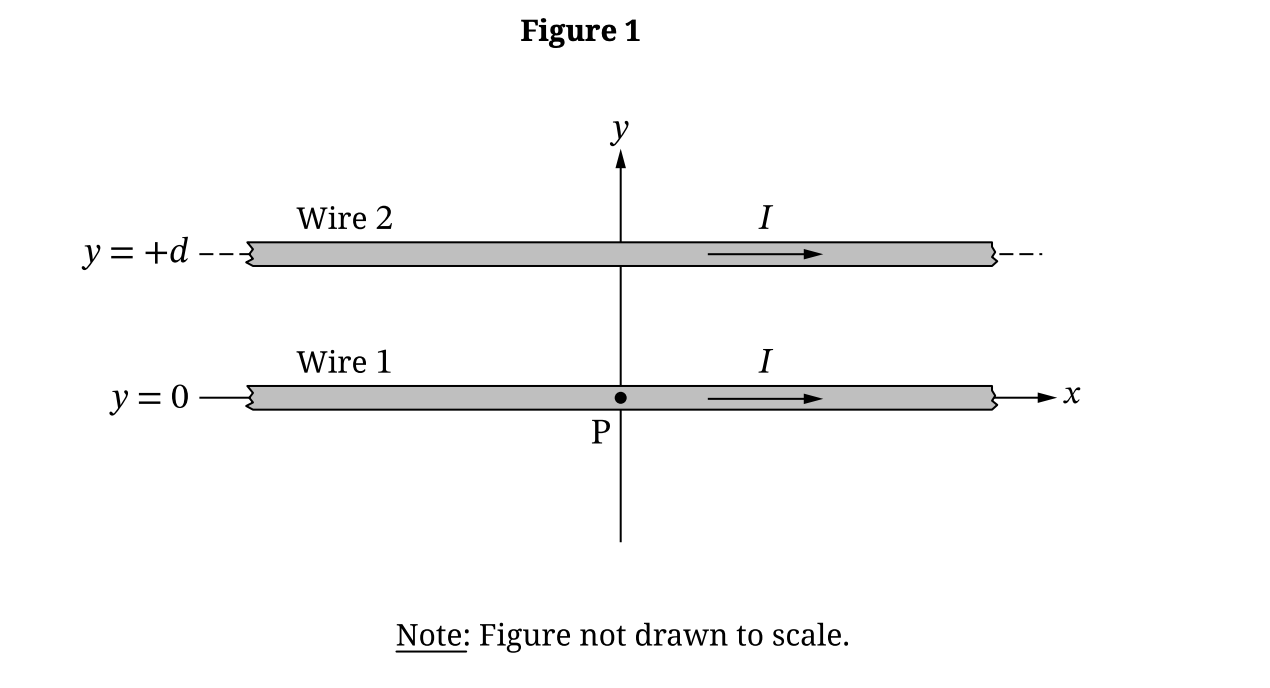
Very long Wire 1 carries current \(I\) in the \(+x\)-direction along the line \(y=0\). Very long Wire 2 carries current \(I\) in the \(+x\)-direction along the line \(y=+d\). Point \(P\) is located along Wire 1 at the origin, as shown in Figure 1. The diameters of the wires are small compared to the distance between the wires. Both wires are in the \(xy\)-plane.
 
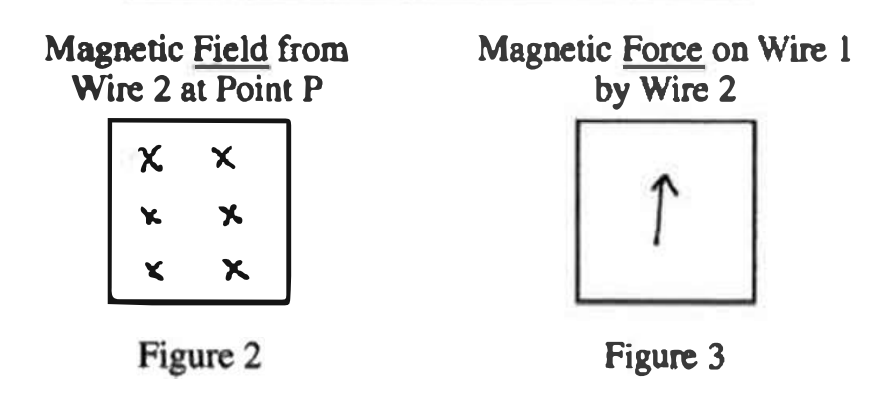
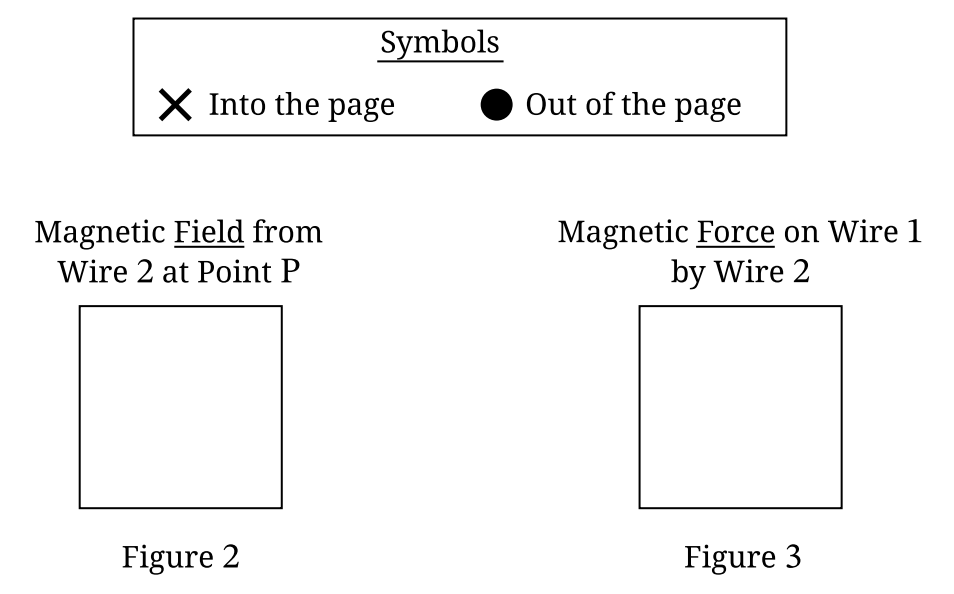
(a)(i) Complete the following tasks in figures 2 and 3. Use either arrows or the symbols shown in the box above the figures for your response.
• Indicate the direction of the magnetic field from Wire 2 at Point \(P\) in Figure 2.
• Indicate the direction of the magnetic force that is exerted on Wire 1 by Wire 2 in Figure 3.
(a)(ii) Very long Wire 3 carrying current \(2I\) in the \(+x\)-direction is placed in the \(xy\)-plane along the line \(y=y_{3}\). The net magnetic force exerted on Wire 1 by the currents in wires 2 and 3 is zero. Derive an expression for \(y_{3}\) in terms of \(d\). Begin your derivation by writing a fundamental physics principle or an equation from the reference information.
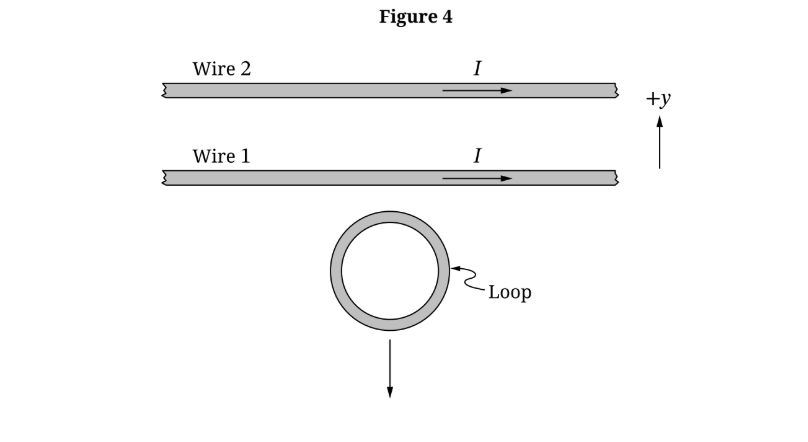
(b) Wire 3 is moved very far away from wires 1 and 2. A circular conducting loop in the \(xy\)-plane is initially held at rest below Wire 1. The loop is then moved at a constant speed in the \(-y\)-direction, as shown in Figure 4. Indicate whether there is a clockwise induced current in the loop, a counterclockwise induced current in the loop, or no induced current in the loop.

Most-appropriate topic codes (CED):

TOPIC 4.2: Contact Forces and Fields (Magnetic Field of a Wire) — part (a-i)
TOPIC 4.3: Magnetic Force (Force Between Current-Carrying Wires) — part (a-i, a-ii)
TOPIC 4.4: Electromagnetic Induction (Lenz’s Law) — part (b)
▶️ Answer/Explanation
Detailed solution

(a)(i)
Magnetic Field: Into the page (\(\otimes\)). Using the Right Hand Rule for Wire 2 (current \(+x\)), the field below the wire (at \(y=0\)) points into the page.
Magnetic Force: Up (\(+y\) direction). Parallel currents attract; Wire 2 attracts Wire 1 upwards.

(a)(ii)
We require the net force on Wire 1 to be zero, so the force from Wire 3 must cancel the force from Wire 2.
\( \vec{F}_{2 \to 1} + \vec{F}_{3 \to 1} = 0 \)
Since \(\vec{F}_{2 \to 1}\) is attractive (upward), \(\vec{F}_{3 \to 1}\) must be downward.
Since Wire 3 carries current \(2I\) in the same direction (\(+x\)) as Wire 1, it exerts an attractive force. For an attractive force to be downward, Wire 3 must be located below Wire 1 (\(y_3 < 0\)).
Setting the magnitudes equal:
\( \frac{\mu_0 I_1 I_2 L}{2\pi d} = \frac{\mu_0 I_1 I_3 L}{2\pi |y_3|} \)
\( \frac{I(I)}{d} = \frac{I(2I)}{|y_3|} \)
\( \frac{1}{d} = \frac{2}{|y_3|} \Rightarrow |y_3| = 2d \)
Since \(y_3\) is below the origin:
\( y_3 = -2d \) .

(b)
Clockwise.
The magnetic field from Wire 1 in the region below the wire (where the loop is) points into the page. As the loop moves away (\(-y\) direction), the magnitude of the magnetic field and thus the magnetic flux into the page decreases. According to Lenz’s Law, the induced current creates a field to oppose this change (i.e., into the page). By the Right Hand Rule, a current creating a field into the page inside the loop must flow clockwise .

Question 2

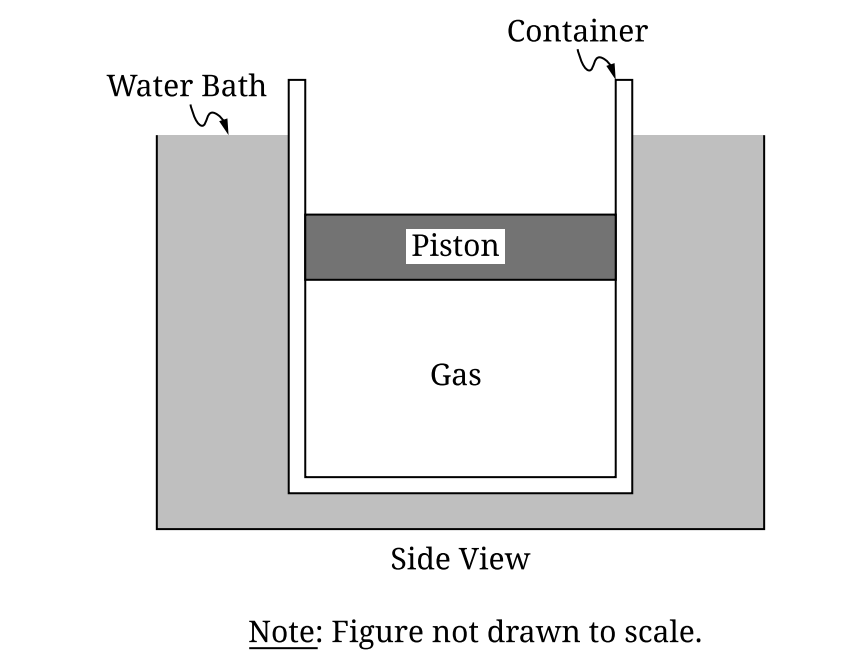
A sample of a monatomic ideal gas is sealed in a thermally conducting container by a movable piston of mass \(M\) and area \(A\). The container is in a large water bath that is held at a constant temperature \(T_{0}\). The piston is free to move with negligible friction. At the instant shown, the gas is in thermal equilibrium with the water bath, the piston is at rest, and the gas occupies volume \(V_{0}\). The pressure of the air above the piston is \(P_{atm}\).
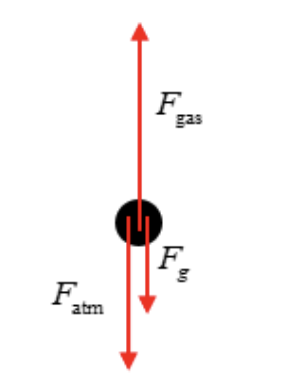
(a) On the dot shown, representing the piston, draw and label the forces that are exerted on the piston. Each force must be represented by a distinct arrow starting on, and pointing away from, the dot.
\(\bullet\)
(b) Derive an expression for the internal energy of the gas in terms of \(M\), \(A\), \(V_{0}\), \(P_{atm}\) and physical constants, as appropriate. Begin your derivation by writing a fundamental physics principle or an equation from the reference information.

(c) A block, also of mass \(M\), is placed on the piston at time \(t=t_{0}\) and is slowly lowered. The piston comes to rest at \(t=t_{f}\) when the block is completely released.

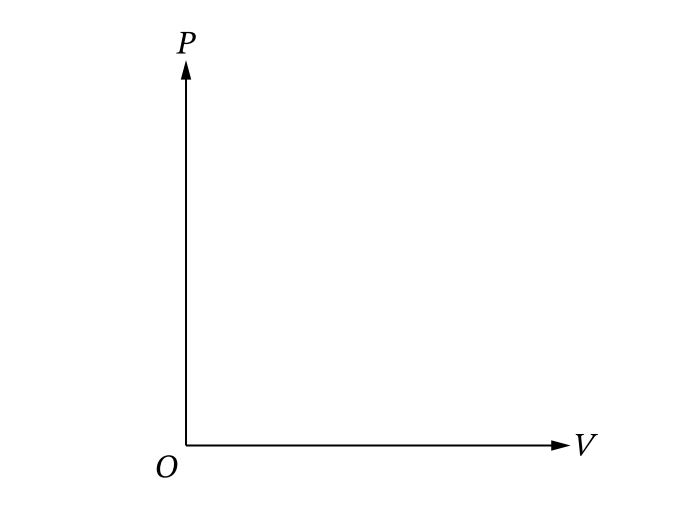
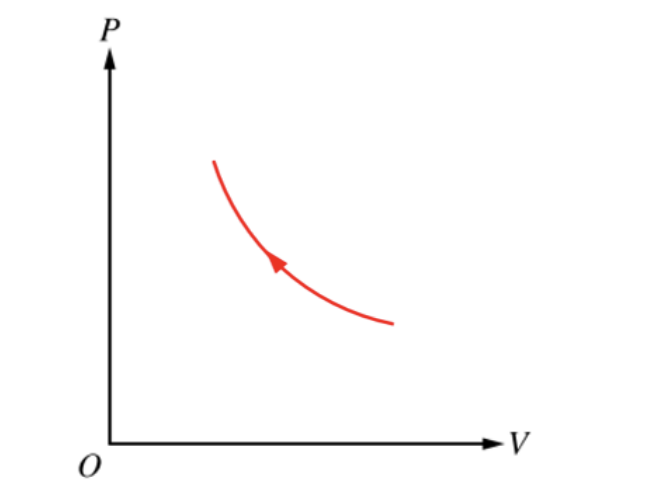
On the axes provided, sketch the expected relationship between the pressure \(P\) and volume \(V\) of the gas for the thermodynamic process that the gas undergoes during time interval \(t_{0}\le t\le t_{f}\). Draw an arrow on your sketch to represent the direction of the thermodynamic process.

(d) With the block still on the piston, the temperature of the water bath is changed to a new constant temperature \(T_{new}\). The gas occupies the original volume \(V_{0}\) when the sample of gas and the water bath come to thermal equilibrium.

Indicate whether \(T_{new}\) is greater than, less than, or equal to \(T_{0}\).
\(\square \ T_{new}>T_{0}\)
\(\square \ T_{new}<T_{0}\)
\(\square \ T_{new}=T_{0}\)

Briefly justify your answer by referencing at least one feature of your answers to parts (a), (b), or (c).

Most-appropriate topic codes (CED):

TOPIC 2.3: Thermodynamics and Forces — part (a)
TOPIC 2.2: Pressure, Thermal Equilibrium, and the Ideal Gas Law — part (b)
TOPIC 2.5: Thermodynamic Processes and PV Diagrams — part (c)
TOPIC 2.2: Pressure, Thermal Equilibrium, and the Ideal Gas Law — part (d)
▶️ Answer/Explanation
Detailed solution

(a)
The Free Body Diagram should show three forces:
• An arrow pointing downward labeled \(F_{g}\) or \(Mg\) (Weight of the piston).
• An arrow pointing downward labeled \(F_{atm}\) or \(P_{atm}A\) (Force from the atmosphere).
• An arrow pointing upward labeled \(F_{gas}\) or \(PA\) (Force from the gas).

(b)
The internal energy of a monatomic ideal gas is given by:
\( U = \frac{3}{2}nRT \)
Using the Ideal Gas Law, \( PV = nRT \), we can substitute:
\( U = \frac{3}{2}PV_{0} \)
From the equilibrium of the piston in part (a), the upward force equals the sum of downward forces:
\( P A = P_{atm} A + Mg \)
Solving for pressure \( P \):
\( P = P_{atm} + \frac{Mg}{A} \)
Substituting \( P \) back into the energy equation:
\( U = \frac{3}{2} \left( P_{atm} + \frac{Mg}{A} \right) V_{0} \)

(c)
The process involves adding mass to the piston, which increases the pressure required to support it, causing the gas to compress (volume decreases).
• The graph should show a curve starting from an initial point \((V_0, P_i)\) in the lower right and moving to a final point \((V_f, P_f)\) in the upper left.
• The curve should be concave up.
• The arrow on the curve should point up and to the left (indicating decreasing volume and increasing pressure).

(d)
\(T_{new} > T_{0}\)
Justification: Based on the free-body analysis, the pressure of the gas is determined by the forces acting on the piston. With the block added, the total downward force increases, so the gas pressure must increase to maintain equilibrium (\(P_{new} > P_{initial}\)).
We are given that the final volume is \(V_{0}\) (the same as the initial volume). Using the Ideal Gas Law, \( PV = nRT \), if the volume \(V\) is constant and the pressure \(P\) increases, the temperature \(T\) must increase. Therefore, \(T_{new}\) must be greater than \(T_{0}\).

Question 3

In Experiment 1, a student is given a resistor of unknown resistance and an air-filled parallel-plate capacitor of unknown capacitance. The student is asked to predict the expected time constant \(\tau\) of a circuit if these two circuit elements were connected in series with a battery. The student has access to a battery of known emf, a switch, an ammeter, a ruler, and wires, as shown in Figure 1. The plates of the capacitor are square, and the separation between the plates is small compared to the dimensions of the plates. The capacitor is initially uncharged. Assume that the dielectric constant of air is \(1\).
(a) Describe a procedure for collecting data that would allow the student to determine the expected time constant \(\tau\). In your description, include the measurements to be made. Include any steps necessary to reduce experimental uncertainty.
(b) Describe how the collected data could be analyzed to determine \(\tau\). Include references to appropriate equations and to relationships between measured and known quantities.
(c) In Experiment 2, the student is asked to determine the capacitance \(C\) of a new parallel-plate capacitor. For each trial, the absolute value \(|\Delta V|\) of the potential difference across the capacitor is varied and the charge \(q\) stored on one plate of the fully charged capacitor is measured. Table 1 contains the data collected.
\(|\Delta V|\) (V)\(3.0\)\(5.0\)\(7.2\)\(8.0\)\(10.0\)
\(q (\times 10^{-10} \text{C})\)\(2.4\)\(4.2\)\(5.6\)\(6.6\)\(8.0\)
(i) Indicate two quantities, either measured quantities from Table 1 or additional calculated quantities, that could be graphed to produce a straight line that could be used to determine \(C\).
Vertical axis: ____________________
Horizontal axis: __________________
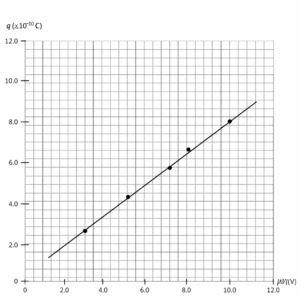
(ii) On the grid provided, create a graph of the quantities indicated in part (c)(i). Clearly label the axes, including units as appropriate. Plot the points you recorded in Table 2.
(iii) Draw a best-fit line for the data plotted in part (c)(ii).
(iv) Using the best-fit line, determine the capacitance \(C\) of the capacitor. Show your work.

Most-appropriate topic codes (CED):

TOPIC 3.10: Capacitance and Geometry of Parallel Plates — part (a, b)
TOPIC 3.8: Ohm’s Law and RC Circuits — part (a, b)
TOPIC 3.12: Capacitance (Q=CV relationship) — part (c)
▶️ Answer/Explanation
Detailed solution

(a)
Since a stopwatch is not provided, the time constant cannot be measured directly via time-decay. The student must determine \(R\) and \(C\) independently.
Procedure:
1. Use the ruler to measure the side length \(s\) of the square capacitor plates and the separation distance \(d\) between them. Repeat measurements at different locations to reduce uncertainty and find an average.
2. Construct a series circuit with the battery, switch, resistor, and ammeter. (The capacitor is not needed for this step).
3. Close the switch and immediately measure the current \(I\) using the ammeter.
(Alternatively, connect the capacitor in series as well, and measure the initial current \(I_0\) at the instant the switch is closed, as the uncharged capacitor acts as a short circuit).

(b)
Analysis:
1. Calculate the capacitance using the geometric formula for a parallel-plate capacitor: \(C = \frac{\epsilon_0 A}{d} = \frac{\epsilon_0 s^2}{d}\), where \(\epsilon_0\) is the vacuum permittivity.
2. Calculate the resistance using Ohm’s Law and the known emf \(\mathcal{E}\) of the battery: \(R = \frac{\mathcal{E}}{I}\) (or \(R = \frac{\mathcal{E}}{I_0}\)).
3. Determine the time constant using the equation: \(\tau = RC\).

(c)(i)
Vertical axis: Charge \(q\) (or \(|\Delta V|\))
Horizontal axis: Potential Difference \(|\Delta V|\) (or \(q\))

(c)(ii) & (iii)
The graph should show \(q\) on the y-axis (units \(10^{-10} \text{C}\)) and \(|\Delta V|\) on the x-axis (units \(\text{V}\)). The points (3.0, 2.4), (5.0, 4.2), (7.2, 5.6), (8.0, 6.6), and (10.0, 8.0) should be plotted. A straight best-fit line should be drawn passing through or near the origin and the data points.

(c)(iv)
The capacitance \(C\) is the slope of the best-fit line of \(q\) vs. \(|\Delta V|\) (since \(q = C|\Delta V|\)).
Using two points on the line, for example \((3.0, 2.4)\) and \((10.0, 8.0)\):
\(\text{Slope} = \frac{8.0 – 2.4}{10.0 – 3.0} \times 10^{-10} = \frac{5.6}{7.0} \times 10^{-10}\)
\(C = 0.8 \times 10^{-10} \text{F}\).

Question 4

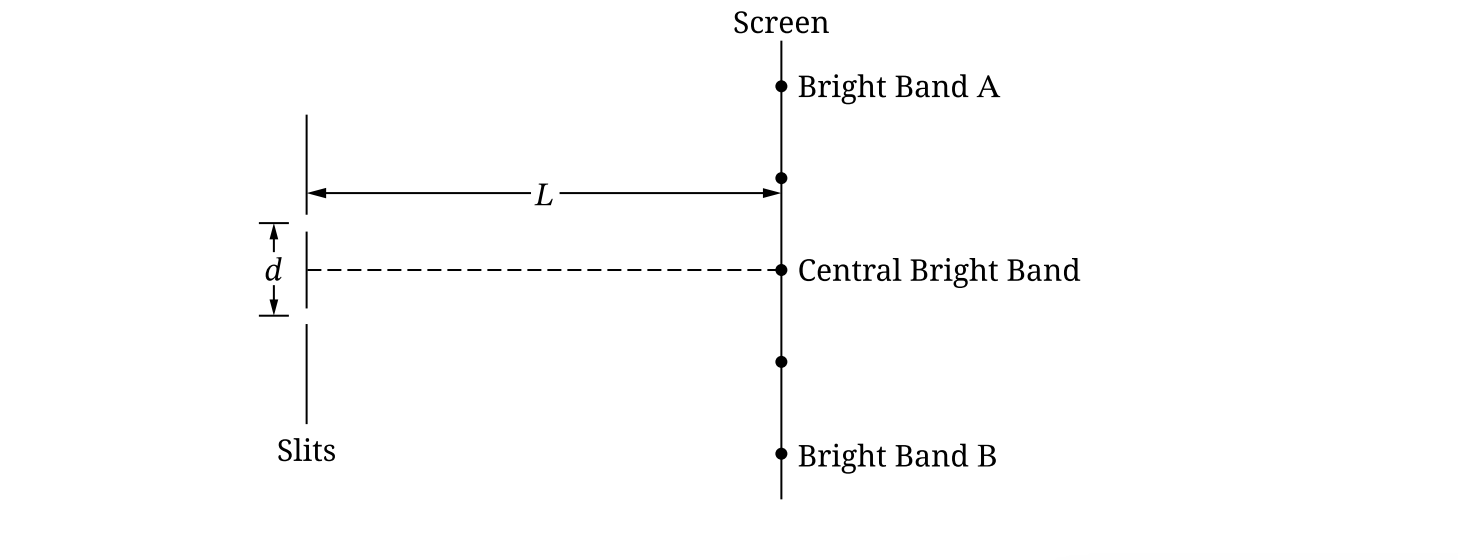
Two narrow slits are a distance \(d\) apart. A screen is a distance \(L\) from the midpoint of the slits, where \(L\gg d\). When a laser emits monochromatic light toward the slits, a pattern of narrow bright and dark bands is observed on the screen. The centers of bright bands A and B are indicated. Three additional bright bands, including the central bright band, are observed on the screen between bands A and B, as shown.
A student claims that the distance between the center of Band A and the center of the central bright band is smaller when using a laser that emits violet light than when using a laser that emits red light.
(a) Indicate whether the student’s claim is correct or incorrect. Without manipulating equations, justify your answer by referencing the difference in path length traveled by the light from each slit to the center of Band A.
(b) Derive an expression for the distance between the centers of bands A and B when light of frequency \(f\) is emitted toward the slits. Express your answer in terms of \(d\), \(L\), \(f\), and physical constants, as appropriate. Begin your derivation by writing a fundamental physics principle or an equation from the reference information.
(c) Indicate whether the expression you derived in part (b) is or is not consistent with your answer from part (a). Briefly justify your answer.

Most-appropriate topic codes (CED):

TOPIC 6.6: Interference and Diffraction — part (a), (b), (c)
▶️ Answer/Explanation
Detailed solution

(a)
Correct.
Justification: The condition for a bright band (constructive interference) is that the path length difference \(\Delta \ell\) must be an integer multiple of the wavelength \(\lambda\) (\(\Delta \ell = m\lambda\)). Violet light has a shorter wavelength than red light. For a specific band (like Band A, which corresponds to a fixed integer \(m\)), the required path length difference is smaller for violet light. Since \(\Delta \ell \approx d\sin\theta\), a smaller path difference corresponds to a smaller angle and thus a smaller distance from the central maximum .

(b)
Start with the condition for constructive interference:
\( d\sin\theta = m\lambda \)
Using the small angle approximation (\(\sin\theta \approx \tan\theta = \frac{y}{L}\)):
\( d\frac{y}{L} = m\lambda \implies y = \frac{m\lambda L}{d} \)
Since there are three bright bands between A and B (the central band \(m=0\), plus \(m=1\) and \(m=-1\)), Band A corresponds to \(m=2\) and Band B corresponds to \(m=-2\).
The position of Band A is \(y_A = \frac{2\lambda L}{d}\).
The position of Band B is \(y_B = \frac{-2\lambda L}{d}\).
The distance between them is \(y_A – y_B = \frac{4\lambda L}{d}\).
Substitute \(\lambda = \frac{c}{f}\) (where \(c\) is the speed of light):
Distance \(= \frac{4cL}{fd}\) .

(c)
Consistent.
Justification: The derived expression is proportional to \(\frac{1}{f}\). Violet light has a higher frequency \(f\) than red light. A larger \(f\) results in a smaller distance. This matches the conclusion in part (a) that the distance is smaller for violet light .

Scroll to Top