
AP Physics C E&M - 9.2 Electrostatics: Electric Potential Due to Point Charges and Uniform Fields- Exam Style questions- MCQs
Question
Two point objects produce electric potentials at the origin. Object 1, located along the positive \(x\)-axis, produces an electric potential of \(+100\ \mathrm{V}\) at the origin. Object 2, located along the negative \(y\)-axis, produces an electric potential of \(+100\ \mathrm{V}\) at the origin.
What is the net electric potential at the origin?
(B) \(0\ \mathrm{V}\)
(C) \(+100\sqrt{2}\ \mathrm{V}\)
(D) The answer cannot be determined without knowing the relative distances of the charges from the origin.
(E) \((+200\ \mathrm{V})\cos45^\circ\)
▶️ Answer/Explanation
Correct Answer: \( \boxed{\mathrm{A}} \)
Electric potential is a scalar quantity, so the net electric potential is the algebraic sum of the individual potentials.
Thus,
\(V_{\mathrm{net}}=V_1+V_2\)
Substituting the given values,
\(V_{\mathrm{net}}=(+100\ \mathrm{V})+(+100\ \mathrm{V})=+200\ \mathrm{V}\)
Unlike electric fields, electric potentials do not depend on direction and are not added as vectors.
Therefore, the correct answer is (A).
Question
Two point objects produce electric potentials at the origin. Object 1, located along the positive \(x\)-axis, produces an electric potential of \(+100\ \mathrm{V}\) at the origin. Object 2, located along the negative \(y\)-axis, produces an electric potential of \(+100\ \mathrm{V}\) at the origin.
The magnitude of the charge on object 1 is twice the magnitude of the charge on object 2. What is the ratio of object 1’s distance from the origin to object 2’s distance from the origin?
(B) \(1:1\)
(C) \(1:4\)
(D) \(4:1\)
(E) \(1:2\)
▶️ Answer/Explanation
Correct Answer: \( \boxed{\mathrm{A}} \)
The electric potential due to a point charge is
\(V=\dfrac{kQ}{r}\)
Since both objects produce the same potential at the origin,
\(\dfrac{kQ_1}{r_1}=\dfrac{kQ_2}{r_2}\)
Given that
\(Q_1=2Q_2\)
Substituting,
\(\dfrac{2Q_2}{r_1}=\dfrac{Q_2}{r_2}\)
Cancelling \(Q_2\) and solving gives
\(r_1=2r_2\)
Therefore, the ratio of the distances is
\(r_1:r_2=2:1\)
Therefore, the correct answer is (A).
Question
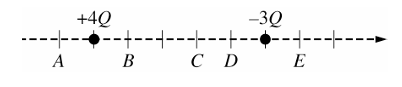
Two small spheres are arranged along a line and carry charges \(+4Q\) and \(-3Q\), as shown in the figure above. The vertical lines are equally spaced.
At which of the labeled points does the electric potential have the largest positive value?
(B) \(B\)
(C) \(C\)
(D) \(D\)
(E) \(E\)
▶️ Answer/Explanation
Correct Answer: \( \boxed{\mathrm{A}} \)
The electric potential due to point charges is given by
\( V=\dfrac{1}{4\pi\varepsilon_{0}}\sum\dfrac{q}{r} \)
Potential is a scalar quantity, so the contributions from the two charges are added algebraically.
Point \(A\) is closest to the larger positive charge \(+4Q\) and farthest from the negative charge \(-3Q\). Therefore, the positive contribution dominates, giving the largest positive electric potential.
At points \(B\), \(C\), \(D\), and \(E\), the influence of the negative charge becomes increasingly significant, reducing the net potential or making it negative.
Thus, point \(A\) has the greatest positive electric potential.
Therefore, the correct answer is (A).