
AP Physics C E&M - 10.1 Electrostatics with Conductors- Exam Style questions- MCQs
Question
A physics problem starts: “A solid sphere has charge distributed uniformly throughout. . .” It may be correctly concluded that the
(B) electric potential on the surface of the sphere is not constant
(C) electric potential at the center of the sphere is zero
(D) sphere is not made of metal
▶️ Answer/Explanation
Correct Answer: \( \boxed{\mathrm{D}} \)
In electrostatic equilibrium, any excess charge on a conductor resides entirely on its outer surface. It cannot remain uniformly distributed throughout the volume.
Since the problem states that the charge is uniformly distributed throughout the solid sphere, the sphere must be an insulator (nonconducting material).
Thus, the sphere cannot be made of metal.
Options (A), (B), and (C) are incorrect because they describe properties that do not generally apply to a uniformly charged insulating sphere.
Therefore, the correct answer is (D).
Question
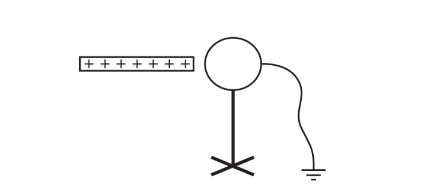
A grounded spherical conductor is on an insulating stand. A positively charged rod is brought close to the sphere but does not touch the sphere, as shown above. The rod is moved far away and then the grounding wire is removed. Which of the following describes the resulting charge on the sphere?
(B) Negative
(C) No net charge, but it is polarized with positive charges on the left side of the sphere
(D) No net charge, but it is polarized with negative charges on the left side of the sphere
(E) No net charge and no polarization
▶️ Answer/Explanation
Correct Answer: \( \boxed{\mathrm{E}} \)
When the positively charged rod is brought near the grounded conducting sphere, free electrons are attracted toward the left side of the sphere, causing the sphere to become polarized.
Because the sphere is connected to the ground, electrons can flow between the sphere and Earth as needed to maintain electrical equilibrium.
The positively charged rod is then moved far away while the sphere is still grounded. With the external electric field removed, the excess electrons flow back to Earth through the grounding wire, leaving the sphere electrically neutral.
Finally, the grounding wire is removed. Since the sphere is already neutral when the connection is broken, it remains uncharged and unpolarized.
Therefore, the sphere has no net charge and no polarization.
Therefore, the correct answer is (E).
Question
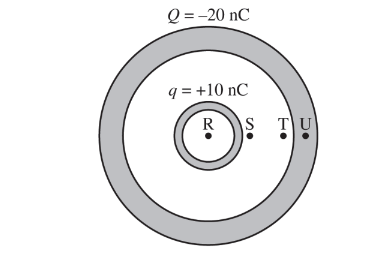
Two concentric spherical conducting shells and four labeled points are shown above. The outer shell has a net charge \(Q=-20\,\mathrm{nC}\). The inner shell has a net charge \(q=+10\,\mathrm{nC}\).
What is the charge on the outer surface of the outer shell?
(B) \(-20\,\mathrm{nC}\)
(C) \(-10\,\mathrm{nC}\)
(D) \(+10\,\mathrm{nC}\)
(E) \(+30\,\mathrm{nC}\)
▶️ Answer/Explanation
Correct Answer: \( \boxed{\mathrm{C}} \)
In electrostatic equilibrium, the electric field inside the conducting material of the outer shell must be zero.
The inner conducting shell has a charge of
\( +10\,\mathrm{nC} \)
Therefore, the inner surface of the outer shell must acquire an induced charge of
\( -10\,\mathrm{nC} \)
The total charge on the outer shell is
\( -20\,\mathrm{nC} \)
Hence, the charge on its outer surface is
\( Q_{\mathrm{outer}}=(-20\,\mathrm{nC})-(-10\,\mathrm{nC})=-10\,\mathrm{nC} \)
Thus, the outer surface carries a charge of
\( \boxed{-10\,\mathrm{nC}} \)
Therefore, the correct answer is (C).