
AP Physics C E&M - 11.3 Current, Resistance, and Power- Exam Style questions- MCQs
Question
Two conducting cylindrical wires are made of the same material. Wire X has twice the length and half the radius of wire Y. What is the ratio \( \dfrac{R_X}{R_Y} \) of their resistances?
(B) \(4\)
(C) \(1\)
(D) \( \dfrac{1}{2} \)
(E) \( \dfrac{1}{4} \)
▶️ Answer/Explanation
Correct Answer: \( \boxed{\mathrm{A}} \)
The resistance of a cylindrical wire is given by
\( R=\dfrac{\rho L}{A}=\dfrac{\rho L}{\pi r^2} \)
Since the two wires are made of the same material, their resistivity \( \rho \) is the same.
For wire X:
\( L_X=2L_Y \)
\( r_X=\dfrac{r_Y}{2} \)
Therefore,
\( \dfrac{R_X}{R_Y}=\dfrac{L_X}{L_Y}\cdot\dfrac{r_Y^2}{r_X^2} \)
\( \dfrac{R_X}{R_Y}=2\cdot\dfrac{r_Y^2}{\left(\dfrac{r_Y}{2}\right)^2}=2\cdot4=8 \)
Thus, wire X has eight times the resistance of wire Y.
Hence, the correct answer is (A).
Question
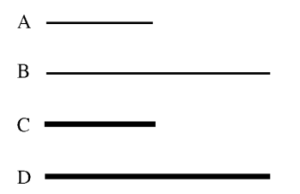
The four wires shown above are each made of aluminum. Which wire will have the greatest resistance?
(B) Wire B
(C) Wire C
(D) Wire D
(E) All the wires have the same resistance because they are all composed of the same material.
▶️ Answer/Explanation
Correct Answer: \( \boxed{\mathrm{B}} \)
The resistance of a cylindrical wire is given by
\( R=\dfrac{\rho L}{A} \)
where \( \rho \) is the resistivity of the material, \(L\) is the length of the wire, and \(A\) is its cross-sectional area.
Since all four wires are made of aluminum, they have the same resistivity \( \rho \). Therefore, the resistance depends only on the ratio \( \dfrac{L}{A} \).
A wire with a greater length and a smaller cross-sectional area has the largest resistance.
From the figure, Wire B is the longest wire while also having the smallest cross-sectional area.
Therefore, Wire B has the greatest resistance.
Hence, the correct answer is (B).
Question
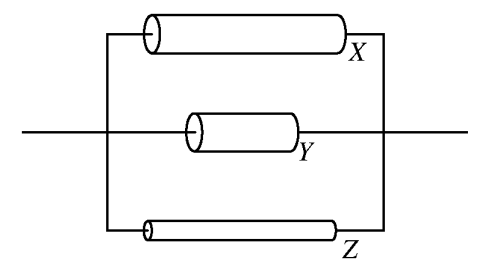
The figure above represents a section of a circuit containing three resistors, \(X\), \(Y\), and \(Z\), of different sizes but made of the same material.
Which of the following correctly ranks the current in the resistors?
(B) \(I_Z=I_X>I_Y\)
(C) \(I_Z=I_X=I_Y\)
(D) \(I_Y>I_X>I_Z\)
▶️ Answer/Explanation
Correct Answer: \( \boxed{\mathrm{D}} \)
Since all three resistors are made of the same material, their resistances are determined by
\(R=\rho\dfrac{L}{A}\),
where \(L\) is the length, \(A\) is the cross-sectional area, and \(\rho\) is the resistivity.
The three resistors are connected in parallel, so each has the same potential difference across it. Therefore,
\(I=\dfrac{V}{R}\),
meaning the resistor with the smallest resistance carries the greatest current.
Resistors \(X\) and \(Y\) have the same cross-sectional area, but \(Y\) is shorter, so \(R_Y<R_X\).
Resistors \(X\) and \(Z\) have approximately the same length, but \(X\) has a larger cross-sectional area, so \(R_X<R_Z\).
Combining these comparisons gives
\(R_Y<R_X<R_Z\).
Since current is inversely proportional to resistance,
\(I_Y>I_X>I_Z\).
Therefore, the correct answer is (D).