
AP Physics C E&M - 13.4 Inductance (Including LR circuits)- Exam Style questions- MCQs
Question
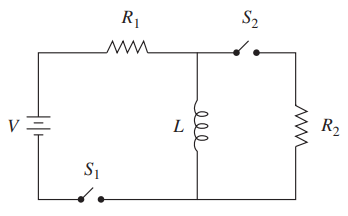
A battery with voltage \(V\), two resistors \(R_1\) and \(R_2\), two switches \(S_1\) and \(S_2\), and an inductor \(L\) are connected in a circuit as shown. The resistance of \(R_2\) is twice that of \(R_1\). At time \(t=0\), the switches have been open for a long time and the inductor stores no energy. At time \(t=0\), switch \(S_1\) is closed. At time \(t=t_1\), switch \(S_1\) is opened and, simultaneously, switch \(S_2\) is closed.
What is the maximum energy stored in the inductor?
(B) \(0\)
(C) \(\dfrac{LV^{2}}{2R_{2}^{2}}\)
(D) \(\dfrac{LV^{2}}{2\left(\dfrac{R_{1}R_{2}}{R_{1}+R_{2}}\right)^{2}}\)
(E) \(\dfrac{LV^{2}}{2\left(R_{1}+R_{2}\right)^{2}}\)
▶️ Answer/Explanation
Correct Answer: \( \boxed{\mathrm{A}} \)
The energy stored in an inductor is
\(U_L=\dfrac{1}{2}LI^2\)
The maximum energy occurs when the current through the inductor is maximum.
Before \(S_2\) is closed, only \(S_1\) is closed. After a long time, the inductor behaves like a short circuit, so the branch containing \(R_2\) is disconnected and has no effect on the circuit.
Thus, the steady-state current through the inductor is determined only by \(R_1\):
\(I_{\max}=\dfrac{V}{R_1}\)
Substituting this current into the energy expression gives
\(U_{\max}=\dfrac{1}{2}L\left(\dfrac{V}{R_1}\right)^2=\dfrac{LV^2}{2R_1^2}\)
After \(S_2\) is closed, the battery is disconnected and the current in the inductor decreases, so the stored energy can only decrease from this maximum value.
Therefore, the correct answer is (A).
Question
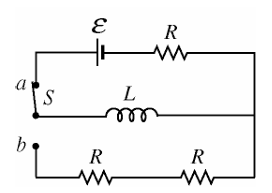
In the circuit above, all of the resistors have the same resistance \(R\). Switch \(S\) has been in position \(a\) for a very long time. What is the energy stored by the inductor?
(B) \( \dfrac{\mathcal{E}^{2}}{R} \)
(C) \( \dfrac{1}{2}L\mathcal{E}^{2} \)
(D) \( \dfrac{1}{2}L\dfrac{\mathcal{E}}{R} \)
(E) \( \dfrac{1}{2}L\dfrac{\mathcal{E}^{2}}{R^{2}} \)
▶️ Answer/Explanation
Correct Answer: \( \boxed{\mathrm{E}} \)
After the switch has remained in position \(a\) for a long time, the circuit reaches steady state. An inductor behaves like a short circuit under steady-state DC conditions.
Thus, the current through the inductor is determined only by the battery and the single resistor in the upper branch:
\( I=\dfrac{\mathcal{E}}{R} \)
The energy stored in an inductor is
\( U=\dfrac{1}{2}LI^{2} \)
Substituting the steady-state current,
\( U=\dfrac{1}{2}L\left(\dfrac{\mathcal{E}}{R}\right)^{2}=\dfrac{1}{2}L\dfrac{\mathcal{E}^{2}}{R^{2}} \)
Therefore, the correct answer is (E).
Question
A variable voltage source is connected to an inductor of inductance \(L\). The voltage \(V\) as a function of time \(t\) is given by
\(V(t)=\beta t^{2}\), where \(\beta\) is a constant with units of \(\dfrac{\mathrm{V}}{\mathrm{s}^{2}}\). The current in the inductor at time \(t=0\) is zero.
Which of the following equations gives the magnitude of the current in the inductor as a function of time?
(B) \(I(t)=\dfrac{2\beta}{L}t\)
(C) \(I(t)=\dfrac{\beta}{L}t^{2}\)
(D) \(I(t)=\dfrac{\beta}{3L}t^{3}\)
(E) \(I(t)=\dfrac{\beta}{L}t^{2}\sin(\omega t)\)
▶️ Answer/Explanation
Correct Answer: \( \boxed{\mathrm{D}} \)
For an inductor, the voltage-current relationship is
\(V=L\dfrac{dI}{dt}\)
Substitute the given voltage:
\(\beta t^{2}=L\dfrac{dI}{dt}\)
Hence,
\(\dfrac{dI}{dt}=\dfrac{\beta}{L}t^{2}\)
Integrate both sides from \(0\) to \(t\), using the initial condition \(I(0)=0\):
\(I(t)=\int_{0}^{t}\dfrac{\beta}{L}t’^{\,2}\,dt’=\dfrac{\beta}{L}\left[\dfrac{t’^{\,3}}{3}\right]_{0}^{t}\)
Therefore,
\(I(t)=\dfrac{\beta}{3L}t^{3}\)
This expression satisfies both the differential equation and the initial condition \(I(0)=0\).
Therefore, the correct answer is (D).