
AP Physics C- E&M- 12.4 Ampère’s Law - Exam Style questions - FRQs- New Syllabus
Question
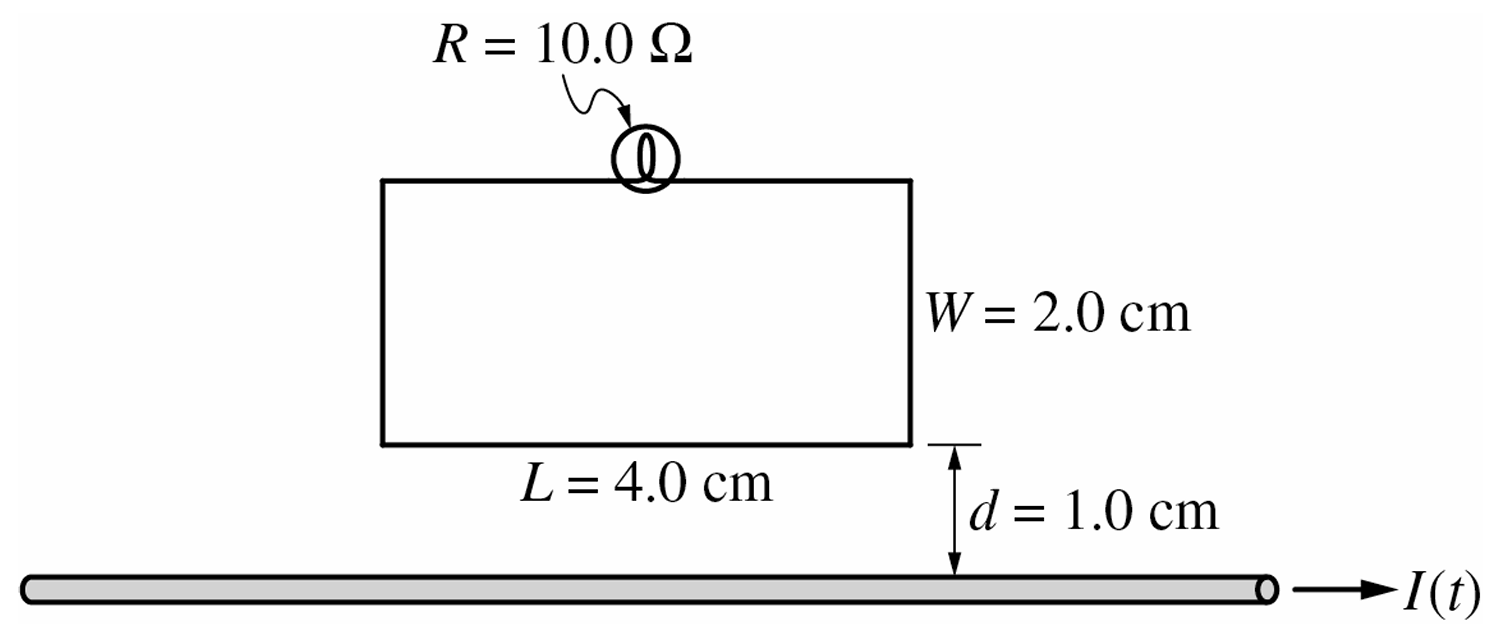
_____ Out of the page
_____ No direction, because the field is zero
_____ The rectangular loop is tilted and is not in the same plane as the wire.
_____ The resistance of the lightbulb is greater than the recorded value.
_____ The long side of the rectangular loop is shorter than the recorded value.
_____ The current in the long wire changes at a faster rate than expected.
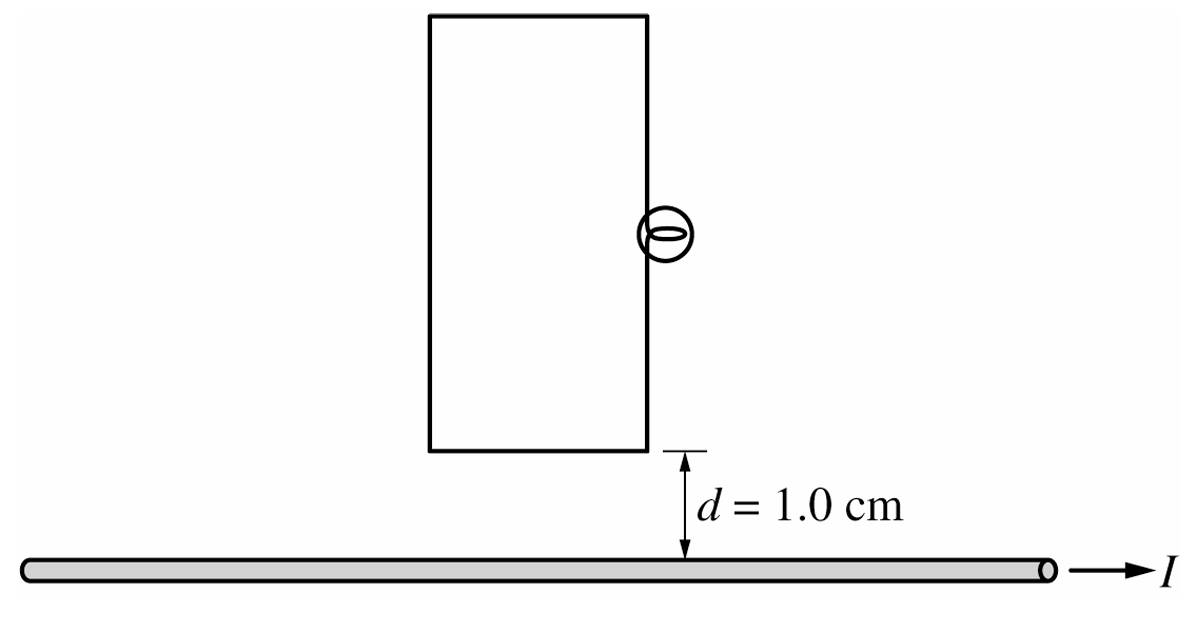
_____ $I_2 = I_1$
_____ $I_2 > I_1$
Most-appropriate topic codes (AP Physics C: Electricity and Magnetism):
• Topic 13.1 — Magnetic Flux (Parts b, e)
• Topic 13.2 — Electromagnetic Induction (Parts a, c, d, e)
▶️ Answer/Explanation
(a)
Correct selection: Out of the page
Before $t = 5.0\text{ s}$, the current flows to the right, which creates a magnetic field pointing out of the page inside the loop according to the right-hand rule. Because the current is decreasing over time ($D = 2.0\text{ A/s}$), this outward magnetic flux is dropping. Lenz’s law states that the induced current must create its own magnetic field to counteract this decrease, meaning the induced field must also point out of the page to support the fading flux.
(b)
First, find the current in the long wire at $t = 3.0\text{ s}$:
$I(3) = 10.0 – (2.0)(3.0) = 4.0\text{ A}$
The magnetic field at a distance $r$ from a long wire is given by:
$B = \frac{\mu_0 I}{2\pi r}$
Set up the flux integral over the width of the loop using an area element $dA = L \, dr$:
$\Phi_B = \int_d^{d+W} B \, dA = \int_d^{d+W} \frac{\mu_0 I}{2\pi r} L \, dr$
$\Phi_B = \frac{\mu_0 I L}{2\pi} \ln\left(\frac{d+W}{d}\right)$
Substitute the given numerical values into the formula ($d = 0.01\text{ m}$, $W = 0.02\text{ m}$, $L = 0.04\text{ m}$):
\(
\Phi_B = \frac{(4\pi \times 10^{-7})(4.0)(0.04)}{2\pi} \ln\left(\frac{0.01 + 0.02}{0.01}\right)
\)
\(
\Phi_B = (3.2 \times 10^{-8}) \ln(3) \approx 3.52 \times 10^{-8}\text{ T}\cdot\text{m}^2
\)
\(
\boxed{\Phi_B = 3.52 \times 10^{-8}\text{ T}\cdot\text{m}^2}
\)
(c)
Use Faraday’s law to find the magnitude of the induced emf by taking the time derivative of the flux expression:
$\varepsilon = \left|\frac{d\Phi_B}{dt}\right| = \frac{\mu_0 L}{2\pi} \ln\left(\frac{d+W}{d}\right) \left|\frac{dI}{dt}\right|$
Given that \(\left|\frac{dI}{dt}\right| = D = 2.0\text{ A/s}\):
\(\varepsilon = \frac{(4\pi \times 10^{-7})(0.04)}{2\pi} \ln(3) \times 2.0\)
\(\varepsilon = (1.6 \times 10^{-8})\ln(3) \approx 1.76 \times 10^{-8}\text{ V}\)
Now, use Ohm’s law to calculate the current passing through the lightbulb:
\(I_1 = \frac{\varepsilon}{R} = \frac{1.76 \times 10^{-8}}{10.0}\)
\(I_1 = 1.76 \times 10^{-9}\text{ A}\)
\(\boxed{I_1 = 1.76 \times 10^{-9}\text{ A}}\)
(d)
Correct selection: The current in the long wire changes at a faster rate than expected.
If the current changes quicker than predicted, the value of $\left|\frac{dI}{dt}\right|$ is larger than expected. According to Faraday’s law, a higher rate of change in current causes a faster rate of change in the magnetic flux, which directly leads to a larger induced emf and a greater measured current flowing through the loop.
(e)
Correct selection: $I_2 < I_1$
In this new orientation, the longer sides of the loop ($4.0\text{ cm}$) extend vertically away from the wire rather than running parallel to it. This means that a large portion of the loop’s surface area is pulled significantly further away from the wire where the magnetic field is much weaker. Consequently, both the total magnetic flux passing through the loop and its rate of change over time decrease, resulting in a lower induced emf and a smaller current $I_2$.