Home / ap precal mcq set 4

Question 1

The function \( g \) is a function of the form \( g(x) = a \cdot b^x \), where \( a \neq 0 \) and \( b > 0 \). The function \( f \) is given by \( f(x) = g(x) + 4 \). Which of the following statements is true?
(A) The output values of both \( f \) and \( g \) are proportional over equal-length input-value intervals.
(B) The output values of \( f \) only, not \( g \), are proportional over equal-length input-value intervals.
(C) The output values of \( g \) only, not \( f \), are proportional over equal-length input-value intervals.
(D) The output values of neither \( f \) nor \( g \) are proportional over equal-length input-value intervals.
▶️ Answer/Explanation
Detailed solution

The function \( g(x) = a \cdot b^x \) is an exponential function. A defining property of exponential functions is that for equal intervals of input (constant change in \( x \)), the output changes by a constant ratio (constant factor).
Mathematically, the ratio \( \frac{g(x+h)}{g(x)} = \frac{a \cdot b^{x+h}}{a \cdot b^x} = b^h \), which is constant regardless of \( x \). Thus, \( g \) has proportional outputs.
The function \( f(x) = a \cdot b^x + 4 \) is vertically shifted by 4. Due to this added constant, the ratio \( \frac{f(x+h)}{f(x)} \) is not constant and depends on the value of \( x \).
Therefore, only the output values of \( g \) are proportional over equal-length intervals.
Correct Option: (C)

Question 2

The value \( (2 \cdot 2 \cdot 2 \cdot 2 \cdot 2 \cdot 4.7) \) is the output value of an exponential function of the form \( f(x) = a \cdot b^x \), where \( a \) and \( b \) are constants. Which of the following describes the function and input value that corresponds to this output value?
(A) The exponential function has an initial value of \( 1 \) and a base of \( (2 \cdot 4.7) \), and the input value is \( 5 \).
(B) The exponential function has an initial value of \( 2 \) and a base of \( 2 \), and the input value is \( 4.7 \).
(C) The exponential function has an initial value of \( 4.7 \) and a base of \( 2 \), and the input value is \( 4.7 \).
(D) The exponential function has an initial value of \( 4.7 \) and a base of \( 2 \), and the input value is \( 5 \).
▶️ Answer/Explanation
Detailed solution

The correct option is (D).

First, observe the given numerical expression: \( 2 \cdot 2 \cdot 2 \cdot 2 \cdot 2 \cdot 4.7 \).
We can group the repeated factors of \( 2 \) using an exponent: \( 2^5 \).
This allows us to rewrite the expression as: \( 4.7 \cdot 2^5 \).
Now, compare this to the standard form of an exponential function: \( f(x) = a \cdot b^x \).
By matching terms, the coefficient \( 4.7 \) corresponds to the initial value \( a \).
The base of the exponent, \( 2 \), corresponds to the constant \( b \).
The exponent, \( 5 \), corresponds to the input variable \( x \).
Therefore, the function has an initial value of \( 4.7 \), a base of \( 2 \), and the input value is \( 5 \).

Question 3

The function \( f \) is given by \( f(x) = 5 \cdot (0.7)^x \). Which of the following describes \( f \)?
(A) The function \( f \) models exponential decay and \( \lim_{x\to\infty} f(x) = 0 \).
(B) The function \( f \) models exponential decay and \( \lim_{x\to\infty} f(x) = \infty \).
(C) The function \( f \) models exponential growth and \( \lim_{x\to\infty} f(x) = 0 \).
(D) The function \( f \) models exponential growth and \( \lim_{x\to\infty} f(x) = \infty \).
▶️ Answer/Explanation
Detailed solution

The given function is in the form \( f(x) = a \cdot b^x \), where \( a = 5 \) and the base \( b = 0.7 \).

First, we analyze the growth factor (base) \( b \). Since \( 0 < 0.7 < 1 \), the function models exponential decay.

Next, we determine the end behavior by evaluating the limit as \( x \) approaches infinity: \( \lim_{x\to\infty} 5 \cdot (0.7)^x \).

Because the base \( 0.7 \) is less than \( 1 \), the term \( (0.7)^x \) approaches \( 0 \) as \( x \) increases.

Substituting this back into the limit, we get \( \lim_{x\to\infty} f(x) = 5 \cdot 0 = 0 \).

Therefore, the function represents exponential decay with a limit of \( 0 \).

This matches the description in option (A).

Question 4

The function \( m \) is given by \( m(x) = 36^{(x/2)} \). Which of the following expressions could also define \( m(x) \)?
(A) \( 6^x \)
(B) \( 6 \cdot 6^x \)
(C) \( 18^x \)
(D) \( 18 \cdot 36^x \)
▶️ Answer/Explanation
Detailed solution

To find the equivalent expression for the function \( m(x) = 36^{(x/2)} \), we need to simplify the base using exponent rules.
First, express the base \( 36 \) as a power of \( 6 \), since \( 36 = 6^2 \).
Substitute this into the original equation: \( m(x) = (6^2)^{(x/2)} \).
Apply the power of a power rule, \( (a^b)^c = a^{b \cdot c} \), to multiply the exponents.
The exponents multiply as follows: \( 2 \cdot \frac{x}{2} = x \).
This simplifies the expression to \( m(x) = 6^x \).
Therefore, the expression corresponds to option (A).

Question 5

The function \( h \) is given by \( h(x) = 5 \cdot 3^{(-x/2)} \). What is the value of \( h(1) \)?
(A) \( -5\sqrt{3} \)
(B) \( \frac{1}{\sqrt{15}} \)
(C) \( \frac{5}{9} \)
(D) \( \frac{5}{\sqrt{3}} \)
▶️ Answer/Explanation
Detailed solution

To find the value of \( h(1) \), substitute \( x = 1 \) into the given function \( h(x) = 5 \cdot 3^{(-x/2)} \).
This gives the expression \( h(1) = 5 \cdot 3^{-1/2} \).
Using the negative exponent rule \( a^{-n} = \frac{1}{a^n} \), rewrite the term as \( h(1) = 5 \cdot \frac{1}{3^{1/2}} \).
Recall that a fractional exponent of \( 1/2 \) is equivalent to a square root, so \( 3^{1/2} = \sqrt{3} \).
Substituting this back into the equation yields \( h(1) = 5 \cdot \frac{1}{\sqrt{3}} \).
Multiplying the values results in \( h(1) = \frac{5}{\sqrt{3}} \).
Comparing this result with the given options, it corresponds to option (D).

Question 6

The function \( f \) is given by \( f(x) = 2^x \), and the function \( g \) is given by \( g(x) = \frac{f(x)}{8} \). For which of the following transformations is the graph of \( g \) the image of the graph of \( f \)?
(A) A horizontal translation to the left \( 3 \) units
(B) A horizontal translation to the right \( 3 \) units
(C) A vertical translation up \( \frac{1}{8} \) unit
(D) A vertical translation down \( \frac{1}{8} \) unit
▶️ Answer/Explanation
Detailed solution

The correct answer is (B).

Given the functions \( f(x) = 2^x \) and \( g(x) = \frac{f(x)}{8} \).
Substitute the expression for \( f(x) \) into \( g(x) \) to get \( g(x) = \frac{2^x}{8} \).
Rewrite the denominator \( 8 \) as a base of \( 2 \), so \( 8 = 2^3 \).
Apply the laws of exponents (\( \frac{a^m}{a^n} = a^{m-n} \)) to simplify: \( g(x) = 2^{x-3} \).
This is equivalent to the transformation \( f(x-3) \).
The transformation \( f(x-h) \) represents a horizontal translation to the right by \( h \) units.
Therefore, the graph of \( g \) is a horizontal translation of the graph of \( f \) to the right by \( 3 \) units.

Question 7

The function \( k \) is given by \( k(x) = 9^x \). Which of the following expressions also defines \( k(x) \)?
(A) \( 2^{(3x)} \)
(B) \( 3^{(2x)} \)
(C) \( 3^{(3x)} \)
(D) \( 3^{(x/2)} \)
▶️ Answer/Explanation
Detailed solution

The correct answer is (B).

To rewrite the function \( k(x) = 9^x \), follow these steps:

1. Identify that the base \( 9 \) is a perfect square and can be written as \( 3^2 \).

2. Substitute \( 3^2 \) for \( 9 \) in the original function: \( k(x) = (3^2)^x \).

3. Apply the Power of a Power Property of exponents, which states that \( (a^m)^n = a^{m \cdot n} \).

4. Multiply the exponents \( 2 \) and \( x \) together: \( 2 \cdot x = 2x \).

5. The function simplifies to \( k(x) = 3^{2x} \).

6. Comparing this result with the given choices, it matches option (B).

Question 8

The function \( f \) is given by \( f(x) = 3^x \). The function \( g \) is given by \( g(x) = (f(x))^b \), where \( b < 0 \). Which of the following describes the relationship between the graphs of \( f \) and \( g \)?
(A) The graph of \( g \) is a combination of a horizontal dilation of the graph of \( f \) and a reflection over the \( x \)-axis.
(B) The graph of \( g \) is a combination of a horizontal dilation of the graph of \( f \) and a reflection over the \( y \)-axis.
(C) The graph of \( g \) is a combination of a vertical dilation of the graph of \( f \) and a reflection over the \( x \)-axis.
(D) The graph of \( g \) is a combination of a vertical dilation of the graph of \( f \) and a reflection over the \( y \)-axis.
▶️ Answer/Explanation
Detailed solution

The correct answer is (B).

1. Substitute the expression for \( f(x) \) into the equation for \( g(x) \) to get \( g(x) = (3^x)^b \).
2. Apply the exponent rule \( (a^m)^n = a^{mn} \) to simplify the function to \( g(x) = 3^{bx} \).
3. Observe that the transformation involves multiplying the input variable \( x \) by the constant \( b \).
4. A multiplication of the input variable corresponds to a horizontal transformation (dilation).
5. Since \( b < 0 \), the factor \( b \) includes a negative sign.
6. Replacing \( x \) with a negative value (effectively \( -x \)) corresponds to a reflection over the \( y \)-axis.
7. Thus, the graph of \( g \) results from a horizontal dilation and a reflection over the \( y \)-axis.

Question 9

The functions \( f \) and \( g \) are given by \( f(x) = 2^x \) and \( g(x) = 2^x \cdot 2^a \), where \( a > 0 \). Which of the following describes the relationship between the graph of \( f \) and the graph of \( g \)?
(A) The graph of \( g \) is a vertical translation of the graph of \( f \) by \( a \) units.
(B) The graph of \( g \) is a horizontal translation of the graph of \( f \) by \( a \) units.
(C) The graph of \( g \) is a vertical translation of the graph of \( f \) by \( -a \) units.
(D) The graph of \( g \) is a horizontal translation of the graph of \( f \) by \( -a \) units.
▶️ Answer/Explanation
Detailed solution

First, use the product rule for exponents to simplify the function \( g(x) \).

Combining the terms with the same base, we get \( g(x) = 2^x \cdot 2^a = 2^{x+a} \).

Next, relate \( g(x) \) back to the original function \( f(x) = 2^x \).

Substituting \( f \) into the equation, we find that \( g(x) = f(x+a) \).

In function transformations, \( f(x+c) \) represents a horizontal shift to the left by \( c \) units.

Since \( a > 0 \), this is a shift to the left, which corresponds to a horizontal translation by \( -a \).

Therefore, option (D) is the correct answer.

Question 10

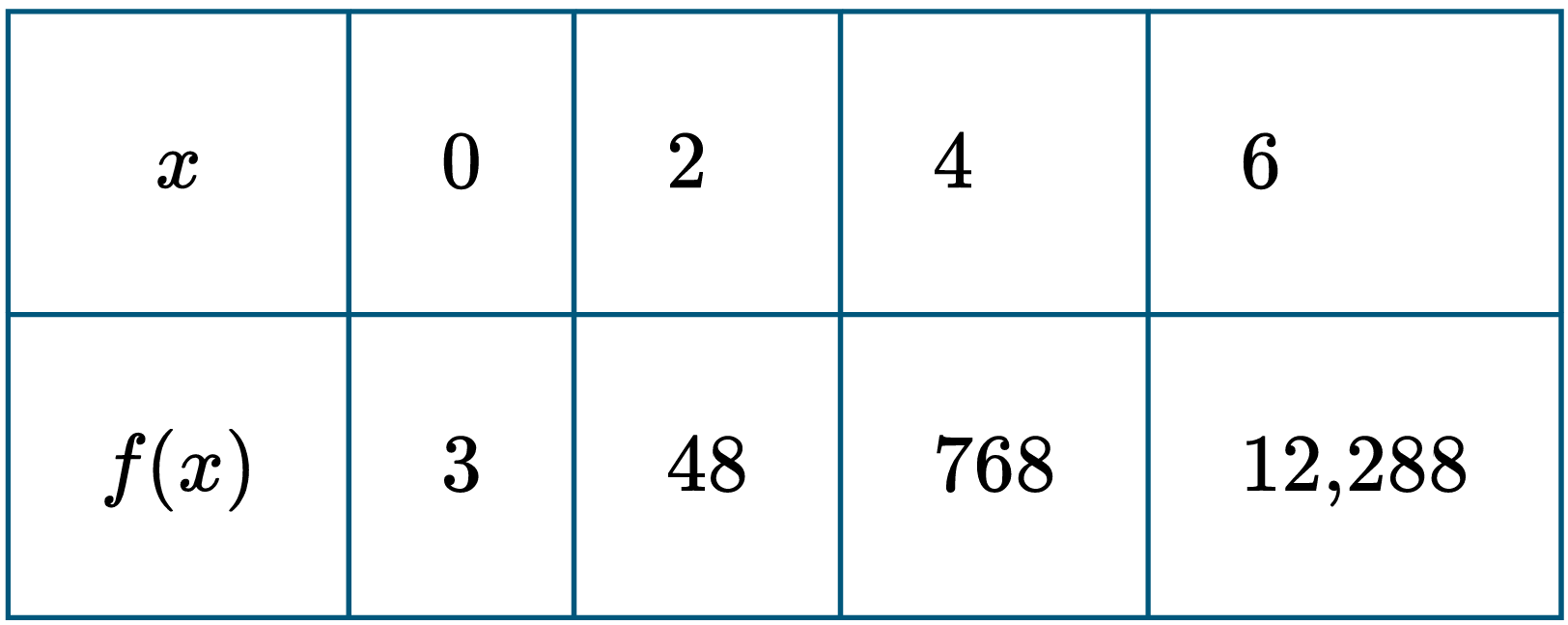
The table gives values of the function \(f\) for selected values of \(x\). Which of the following expressions could define \(f(x)\)?
(A) \(2 + 4^x\)
(B) \(3 \cdot 4^x\)
(C) \(3 \cdot 16^x\)
(D) \(4 \cdot 3^x\)
▶️ Answer/Explanation
Detailed solution

The correct option is (B).
To determine the correct function, we substitute the values of \(x\) from the table into the given expressions and check if the result matches \(f(x)\).
1. First, check for \(x = 0\), where \(f(0) = 3\).
   • Option (A): \(2 + 4^0 = 2 + 1 = 3\) (Match)
   • Option (B): \(3 \cdot 4^0 = 3 \cdot 1 = 3\) (Match)
   • Option (C): \(3 \cdot 16^0 = 3 \cdot 1 = 3\) (Match)
   • Option (D): \(4 \cdot 3^0 = 4 \cdot 1 = 4\) (Mismatch, so D is incorrect)
2. Next, check for \(x = 2\), where \(f(2) = 48\).
   • Option (A): \(2 + 4^2 = 2 + 16 = 18\) (Mismatch)
   • Option (B): \(3 \cdot 4^2 = 3 \cdot 16 = 48\) (Match)
   • Option (C): \(3 \cdot 16^2 = 3 \cdot 256 = 768\) (Mismatch)
3. Since Option (B) is the only one that satisfies the condition for \(x = 2\), we can verify it with \(x = 4\): \(3 \cdot 4^4 = 3 \cdot 256 = 768\), which matches the table.
Question 11

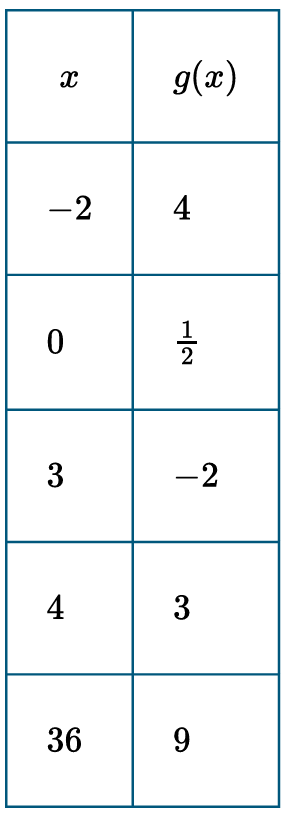
The table gives values of the function \(g\) for selected values of \(x\). The function \(f\) is given by \(f(x) = 3^x + x^2\).
What is the value of \(f(g(3))\) ?
(A) \(-72\)
(B) \(\frac{37}{9}\)
(C) \(9\)
(D) \(97\)
▶️ Answer/Explanation
Detailed solution

To find the value of the composite function \(f(g(3))\), we first evaluate the inner function \(g(3)\).
According to the table provided, when \(x = 3\), the value of \(g(x)\) is \(-2\). Therefore, \(g(3) = -2\).
Now, substitute this result into the outer function \(f(x)\), so we need to calculate \(f(-2)\).
The function \(f\) is defined as \(f(x) = 3^x + x^2\).
Substituting \(-2\) for \(x\), we get \(f(-2) = 3^{-2} + (-2)^2\).
Calculating the terms: \(3^{-2} = \frac{1}{3^2} = \frac{1}{9}\) and \((-2)^2 = 4\).
Adding them together: \(\frac{1}{9} + 4 = \frac{1}{9} + \frac{36}{9} = \frac{37}{9}\).
Thus, the correct option is (B).
Question 12

The function \(f\) is defined by \(f(x) = \sqrt{4-x^2}\) for \(-2 \le x \le 0\). Which of the following expressions defines \(f^{-1}(x)\)?
(A) \(-\sqrt{4-x^2}\) for \(-2 \le x \le 0\)
(B) \(\sqrt{4-x^2}\) for \(-2 \le x \le 0\)
(C) \(-\sqrt{4-x^2}\) for \(0 \le x \le 2\)
(D) \(\sqrt{4-x^2}\) for \(0 \le x \le 2\)
▶️ Answer/Explanation
Detailed solution

To find the inverse function, let \(y = f(x)\), so \(y = \sqrt{4-x^2}\).
Determine the domain and range: The original domain is \(-2 \le x \le 0\). Consequently, the range is \(0 \le y \le 2\).
Swap the variables \(x\) and \(y\) to solve for the inverse: \(x = \sqrt{4-y^2}\).
Square both sides of the equation: \(x^2 = 4 – y^2\).
Rearrange the terms to isolate \(y^2\): \(y^2 = 4 – x^2\).
Take the square root of both sides: \(y = \pm\sqrt{4-x^2}\).
Determine the correct sign: Since the original domain was negative (\(-2 \le x \le 0\)), the range of the inverse function (the new \(y\)) must be negative.
Therefore, we select the negative root: \(y = -\sqrt{4-x^2}\).
The domain of the inverse function is the range of the original function, which is \(0 \le x \le 2\).
Thus, the correct expression is \(-\sqrt{4-x^2}\) for \(0 \le x \le 2\), which corresponds to option (C).

Question 13

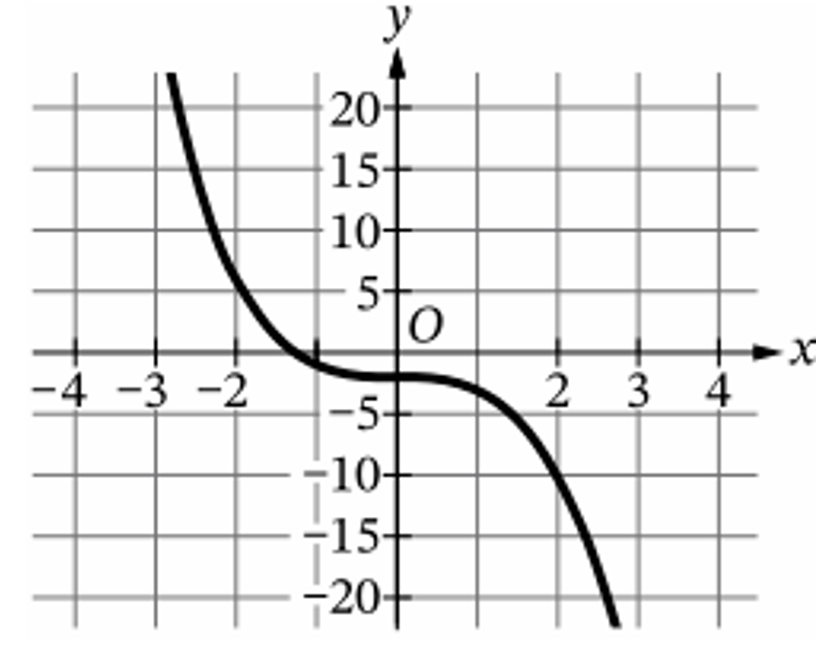
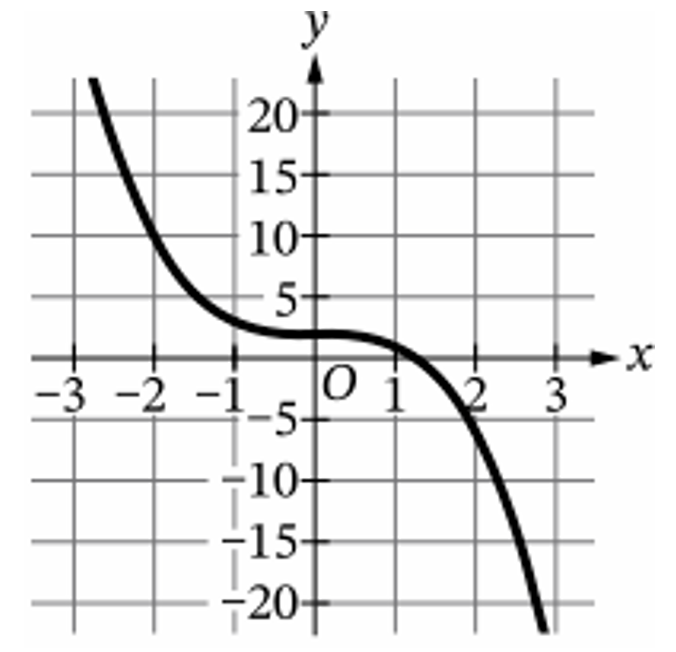
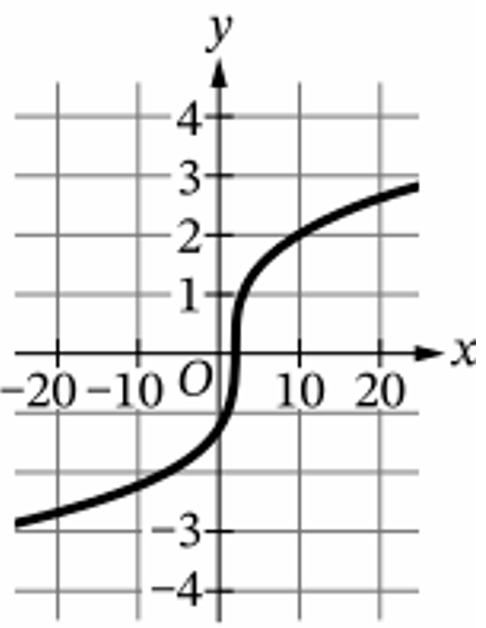
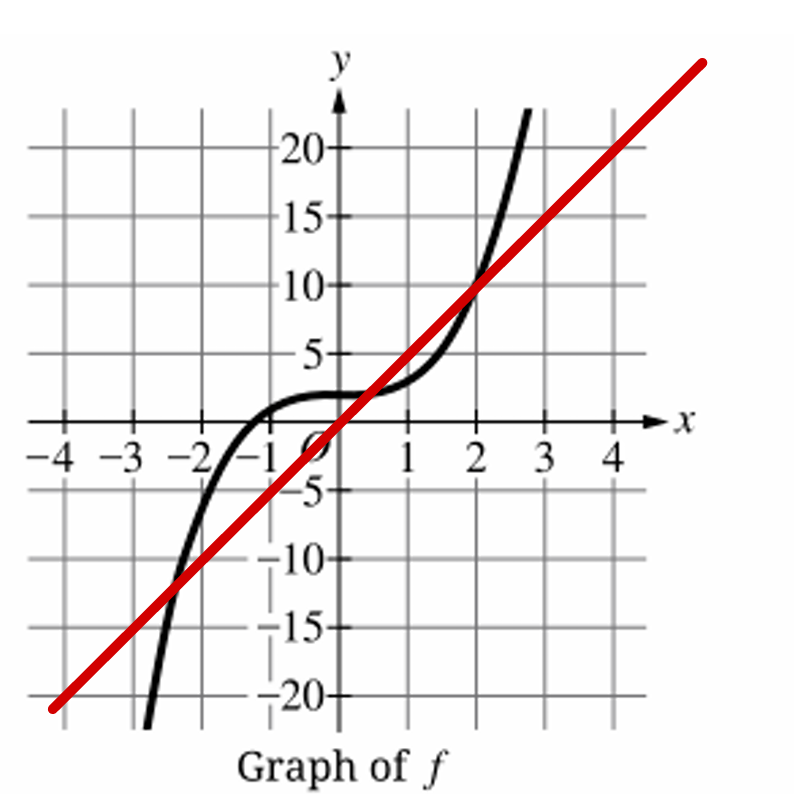
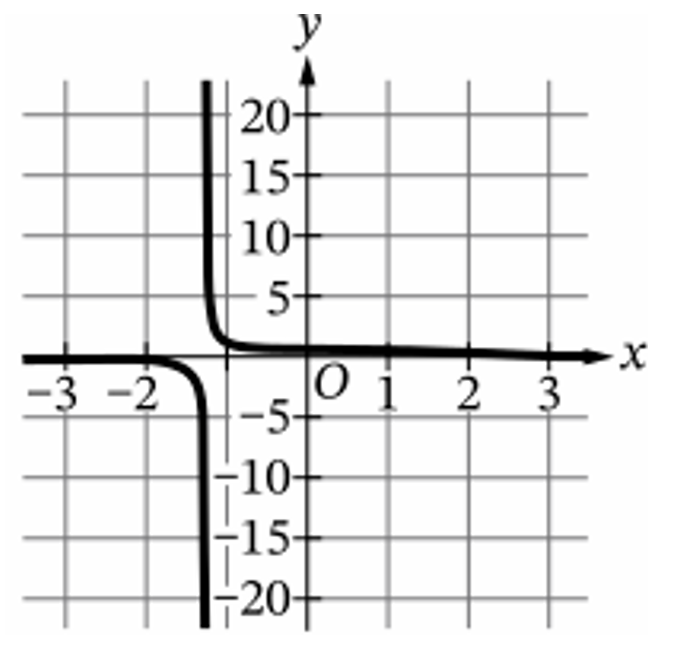
The graph of the function \( y = f(x) \) is given. Which of the following is the graph of \( y = f^{-1}(x) \)?
(A)
(B)
(C)
(D)
▶️ Answer/Explanation
Detailed solution

The correct option is (D).

The graph of an inverse function \( y = f^{-1}(x) \) is obtained by reflecting the graph of \( y = f(x) \) across the line \( y = x \) (indicated by the red line in the problem image).
From the original graph of \( f(x) \), we can identify the point \( (2, 10) \) based on the grid lines.
For the inverse function, the coordinates are swapped, so \( f^{-1}(x) \) must pass through the point \( (10, 2) \).
The graph also passes through the origin \( (0,0) \), so its inverse must also pass through \( (0,0) \).
Checking the options, only the graph in Option (D) passes through the point \( (10, 2) \) and the origin.
Question 14

The function \(g\) is given by \(g(x) = \frac{4x+6}{5}\). Which of the following defines \(g^{-1}(x)\) ?
(A) \(\frac{5}{4x+6}\)
(B) \(\frac{5x+6}{4}\)
(C) \(\frac{5x}{4} – 6\)
(D) \(\frac{5x-6}{4}\)
▶️ Answer/Explanation
Detailed solution

To find the inverse function \(g^{-1}(x)\), follow these steps:

Step 1: Replace \(g(x)\) with \(y\).
\(y = \frac{4x+6}{5}\)

Step 2: Swap the variables \(x\) and \(y\).
\(x = \frac{4y+6}{5}\)

Step 3: Multiply both sides by 5 to clear the fraction.
\(5x = 4y + 6\)

Step 4: Subtract 6 from both sides.
\(5x – 6 = 4y\)

Step 5: Divide by 4 to solve for \(y\).
\(y = \frac{5x-6}{4}\)

Therefore, \(g^{-1}(x) = \frac{5x-6}{4}\).

Correct Option: (D)

Question 15

The function \( f \) is defined by \( f(x) = 4x^2 + 3 \) for \( x \ge 0 \). Which of the following expressions defines the inverse function of \( f \)?
(A) \( f^{-1}(x) = \frac{x^2}{4} – 3 \) for \( x \ge 0 \)
(B) \( f^{-1}(x) = \sqrt{\frac{x}{4}} – 3 \) for \( x \ge 0 \)
(C) \( f^{-1}(x) = \sqrt{\frac{x-3}{4}} \) for \( x \ge 3 \)
(D) \( f^{-1}(x) = \frac{\sqrt{x-3}}{4} \) for \( x \ge 3 \)
▶️ Answer/Explanation
Detailed solution

The correct option is (C).

Step 1: Replace \( f(x) \) with \( y \): \( y = 4x^2 + 3 \).
Step 2: Swap \( x \) and \( y \) to find the inverse: \( x = 4y^2 + 3 \).
Step 3: Isolate the \( y^2 \) term by subtracting \( 3 \) from both sides: \( x – 3 = 4y^2 \).
Step 4: Divide by \( 4 \): \( \frac{x – 3}{4} = y^2 \).
Step 5: Solve for \( y \) by taking the square root: \( y = \sqrt{\frac{x – 3}{4}} \). (We take the positive root because the original domain is \( x \ge 0 \)).
Step 6: Determine the new domain. Since the original range was \( y \ge 3 \), the domain of the inverse is \( x \ge 3 \).
Conclusion: \( f^{-1}(x) = \sqrt{\frac{x-3}{4}} \) for \( x \ge 3 \).

Question 16

A water tank is leaking water from a crack in its base. The amount of water, in hundreds of gallons, remaining in the tank \( t \) hours after the crack formed can be modeled by \( W \), a decreasing function of time \( t \). Which of the following gives a verbal representation of the function \( W^{-1} \), the inverse function of \( W \)?
(A) \( W^{-1} \) is an increasing function of the amount of time after the crack formed.
(B) \( W^{-1} \) is a decreasing function of the amount of time after the crack formed.
(C) \( W^{-1} \) is an increasing function of the amount of water in the tank.
(D) \( W^{-1} \) is a decreasing function of the amount of water in the tank.
▶️ Answer/Explanation
Detailed solution

The correct option is (D).

The original function \( W(t) \) takes time \( t \) as the input and outputs the amount of water.

By definition, the inverse function \( W^{-1} \) reverses this process, taking the amount of water as the input and outputting time \( t \).

This implies that \( W^{-1} \) is a function of the amount of water, which eliminates options (A) and (B) as they describe functions of time.

Since water leaks out over time, \( W \) is a decreasing function; this means a later time corresponds to less water.

Conversely, for the inverse relationship, a smaller amount of water implies that more time has passed (a later time).

Therefore, as the input (amount of water) increases, the output (time) must decrease (an earlier time).

Because the output decreases as the input increases, \( W^{-1} \) is a decreasing function.

Thus, \( W^{-1} \) is a decreasing function of the amount of water in the tank.

Question 17

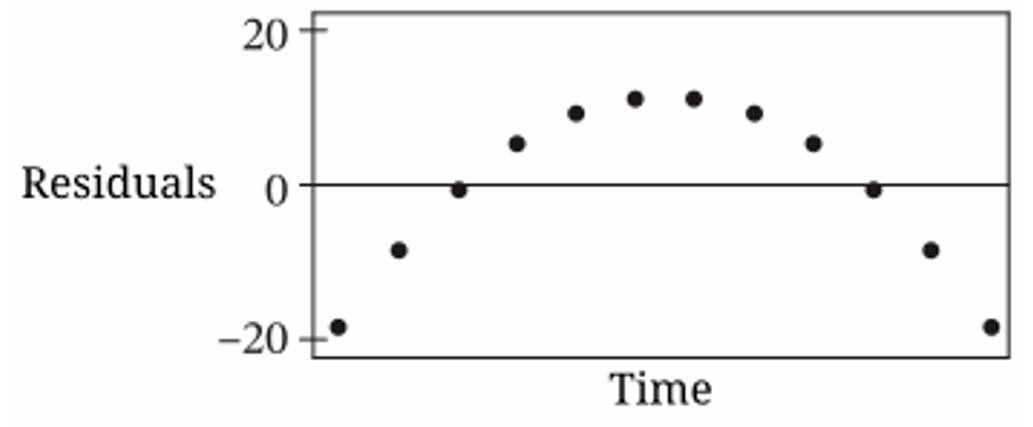
A food vendor developed a new sandwich type for sale. The vendor made estimates about the sales of the new sandwich type over time. A linear regression was used to develop a model for the sales over time. The figure shows a graph of the residuals of the linear regression. Which of the following statements about the linear regression is true?
(A) The linear model is not appropriate, because there is a clear pattern in the graph of the residuals.
(B) The linear model is not appropriate, because the graph of the residuals has more points above \(0\) than below \(0\).
(C) The linear model is appropriate, because there is a clear pattern in the graph of the residuals.
(D) The linear model is appropriate, because the positive residual farthest from \(0\) and the negative residual farthest from \(0\) are about the same distance, although more points are above \(0\) than below \(0\).
▶️ Answer/Explanation
Detailed solution
Correct Option: (A)
A residual plot is used to evaluate the appropriateness of a regression model.
For a linear model to be appropriate, the residuals should be randomly scattered around \(0\) with no discernible pattern.
The provided graph shows a distinct curved (parabolic) pattern in the residuals.
This pattern indicates that the relationship between the variables is non-linear and the linear model has failed to capture this trend.
Therefore, the linear model is not appropriate specifically because of the clear pattern observed in the residuals.
Scroll to Top