Home / ap-precalculus-2023-practice-exam-1-free-response-questions

Question 1

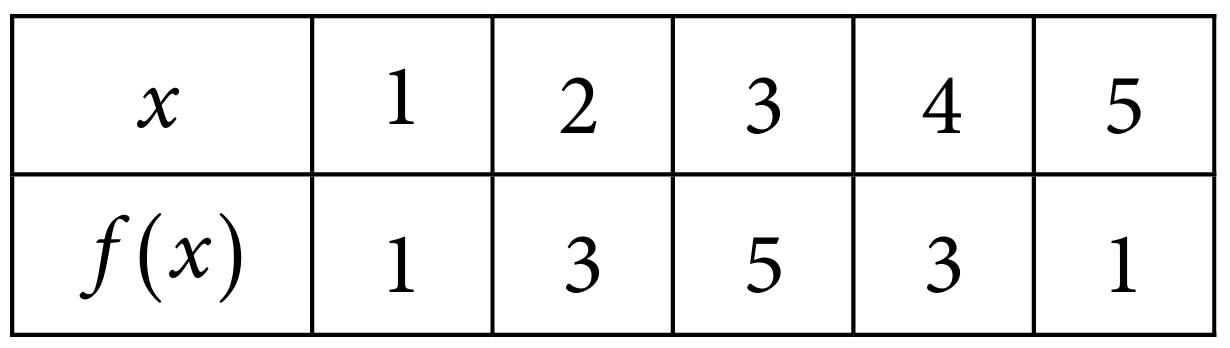
The domain of \( f \) consists of the five real numbers 1, 2, 3, 4, and 5. The table defines the function \( f \) for these values. The function \( g \) is given by \( g(x) = 2 \ln x \).
A. i. The function \( h \) is defined by \( h(x) = (g \circ f)(x) = g(f(x)) \). Find the value of \( h(4) \) as a decimal approximation, or indicate that it is not defined. Show the work that leads to your answer.
ii. Find all values of \( x \) for which \( f(x) = 3 \), or indicate there are no such values.
B. i. Find all values of \( x \), as decimal approximations, for which \( g(x) = 3 \), or indicate there are no such values.
ii. Determine the end behavior of \( g \) as \( x \) increases without bound. Express your answer using the mathematical notation of a limit.
C. i. Does the function \( f \) have an inverse function?
ii. Give a reason for your answer in part C (i) based on properties of the function \( f \). Refer to the values in the table in your reasoning.
▶️ Answer/Explanation
Detailed solution

A. i.
To find \( h(4) \), we use the definition \( h(x) = g(f(x)) \).
Substitute \( x = 4 \) into the equation: \( h(4) = g(f(4)) \).
From the table, locate \( x = 4 \) to find the value of \( f(4) \).
\( f(4) = 3 \).
Now substitute this value into \( g \): \( h(4) = g(3) \).
Using the function definition \( g(x) = 2 \ln x \), substitute \( 3 \) for \( x \).
\( g(3) = 2 \ln(3) \).
Calculate the decimal value: \( 2 \times 1.0986… \approx 2.1972… \)
Rounding to three decimal places, \( h(4) \approx 2.197 \).

A. ii.
We must identify the input values \( x \) where the output \( f(x) \) equals 3.
Looking at the row for \( f(x) \) in the table:
The value 3 appears in the column where \( x = 2 \).
The value 3 appears in the column where \( x = 4 \).
Therefore, the values are \( x = 2 \) and \( x = 4 \).

B. i.
Set the expression for \( g(x) \) equal to 3: \( 2 \ln x = 3 \).
Divide both sides by 2: \( \ln x = 1.5 \).
Convert to exponential form to solve for \( x \): \( x = e^{1.5} \).
Calculate the decimal value: \( e^{1.5} \approx 4.48168… \)
Rounding to three decimal places, \( x \approx 4.482 \).

B. ii.
As \( x \) increases without bound (\( x \rightarrow \infty \)), the natural logarithm function \( \ln x \) increases continuously.
Consequently, \( 2 \ln x \) also grows infinitely large.
The end behavior using limit notation is: \( \lim_{x \to \infty} g(x) = \infty \).

C. i.
No, the function \( f \) does not have an inverse function.

C. ii.
For a function to have an inverse, it must be one-to-one (injective), meaning every unique input \( x \) must map to a unique output \( f(x) \).
Referring to the table, we can see that \( f(2) = 3 \) and \( f(4) = 3 \).
Since two different input values (2 and 4) produce the same output value (3), the function fails the horizontal line test.
Therefore, \( f \) is not one-to-one and cannot have an inverse.
Question 2

An ecologist began studying a certain type of plant species in a wetlands area in 2013. In 2015 (\(t=2\)), there were 59 plants. In 2021 (\(t=8\)), there were 118 plants.
The number of plants in this species can be modeled by the function \(P\) given by \(P(t)=ab^t\), where \(P(t)\) is the number of plants during year \(t\), and \(t\) is the number of years since 2013.
A. i. Use the given data to write two equations that can be used to find the values for constants \(a\) and \(b\) in the expression for \(P(t)\).
     ii. Find the values for \(a\) and \(b\) as decimal approximations.
B. i. Use the given data to find the average rate of change of the number of plants, in plants per year, from \(t=2\) to \(t=8\) years. Express your answer as a decimal approximation. Show the computations          that lead to your answer.
    ii. Use the average rate of change found in part B (i) to estimate the number of plants for \(t=10\) years. Show the work that leads to your answer.
   iii. The average rate of change found in part B (i) can be used to estimate the number of plants during year \(t\) for \(t > 10\) years. Will these estimates, found using the average rate of change, be less                than or greater than the number of plants predicted by the model \(P\) during year \(t\) for \(t > 10\) years? Explain your reasoning. Your explanation should include a reference to the graph of \(P\)            and its relationship to the estimates found using the average rate of change.
C. For which \(t\)-value, \(t=6\) years or \(t=20\) years, should the ecologist have more confidence in when using the model \(P\)? Give a reason for your answer in the context of the problem.
▶️ Answer/Explanation
Detailed solution

Part A

i.
We are given the model \(P(t) = ab^t\).
At \(t=2\) (year 2015), the number of plants \(P(2) = 59\). Substituting this into the equation gives:
\(59 = ab^2\)
At \(t=8\) (year 2021), the number of plants \(P(8) = 118\). Substituting this into the equation gives:
\(118 = ab^8\)

ii.
To find \(b\), divide the second equation by the first equation:
\(\frac{118}{59} = \frac{ab^8}{ab^2}\)
\(2 = b^{8-2}\)
\(2 = b^6\)
\(b = \sqrt[6]{2} \approx 1.1225\)
Now, substitute the value of \(b\) back into the first equation to solve for \(a\):
\(59 = a(1.1225)^2\)
\(59 = a(2^{2/6}) = a(2^{1/3})\)
\(a = \frac{59}{2^{1/3}} \approx \frac{59}{1.2599}\)
\(a \approx 46.828\)
Values: \(a \approx 46.83\) and \(b \approx 1.12\)

Part B

i.
The average rate of change from \(t=2\) to \(t=8\) is given by the slope formula \(\frac{P(8) – P(2)}{8 – 2}\).
Average Rate = \(\frac{118 – 59}{8 – 2}\)
Average Rate = \(\frac{59}{6}\)
Average Rate \(\approx 9.833\)
The average rate of change is approximately \(9.83\) plants per year.

ii.
To estimate the number of plants at \(t=10\), we use the rate of change calculated above to project forward from \(t=8\).
Time difference \(\Delta t = 10 – 8 = 2\) years.
Estimated \(P(10) = P(8) + (\text{Average Rate} \times \Delta t)\)
Estimated \(P(10) = 118 + (9.833 \times 2)\)
Estimated \(P(10) = 118 + 19.666\)
Estimated \(P(10) \approx 137.67\)
The estimated number of plants is approximately \(137.67\).

iii.
The estimates will be less than the number of plants predicted by the model \(P\).
Reasoning: The model \(P(t) = ab^t\) is an exponential growth function with \(b > 1\) and \(a > 0\). The graph of such a function is concave up, meaning the rate of growth is constantly increasing. The average rate of change calculated in Part B(i) represents the slope of the secant line connecting \(t=2\) and \(t=8\). When we use this linear rate to estimate values for \(t > 8\), we are following the straight line path. Because the actual graph curves upward (becoming steeper), the straight line lies below the curve for \(t > 8\). Therefore, the linear estimate underestimates the actual exponential growth.

Part C

The ecologist should have more confidence in the model for \(t=6\) years.
Reason: \(t=6\) falls within the interval of the collected data (between \(t=2\) and \(t=8\)), which is known as interpolation. Predictions made within the range of observed data are generally more reliable. Conversely, \(t=20\) is far outside the range of observed data (extrapolation). Over a long period (12 years past the last data point), environmental conditions could change, or the population might reach a carrying capacity, rendering the exponential growth model invalid.

Question 3

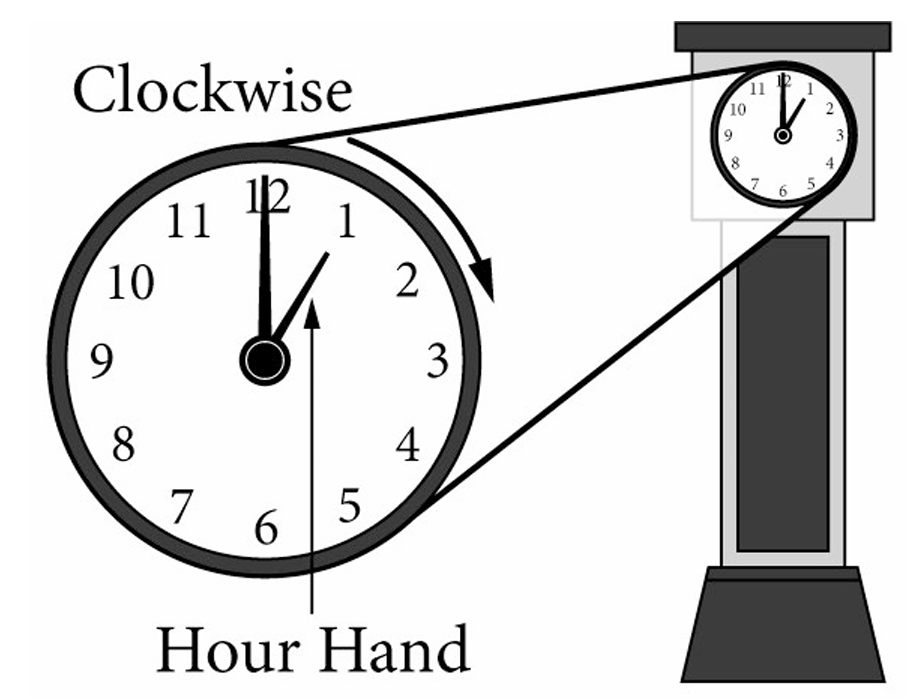
The figure shows a clock standing on a level floor. The clock face has a 10-centimeter-long moving hour hand. The center of the clock face is 200 centimeters from the floor. At time \( t=0 \) hours, the hour hand is pointing directly up to the 12. The next time the hour hand points directly up to the 12 is at time \( t=12 \) hours. The sinusoidal function \( h \) models the distance, in centimeters, of the endpoint of the hour hand from the floor as a function of time \( t \), in hours.
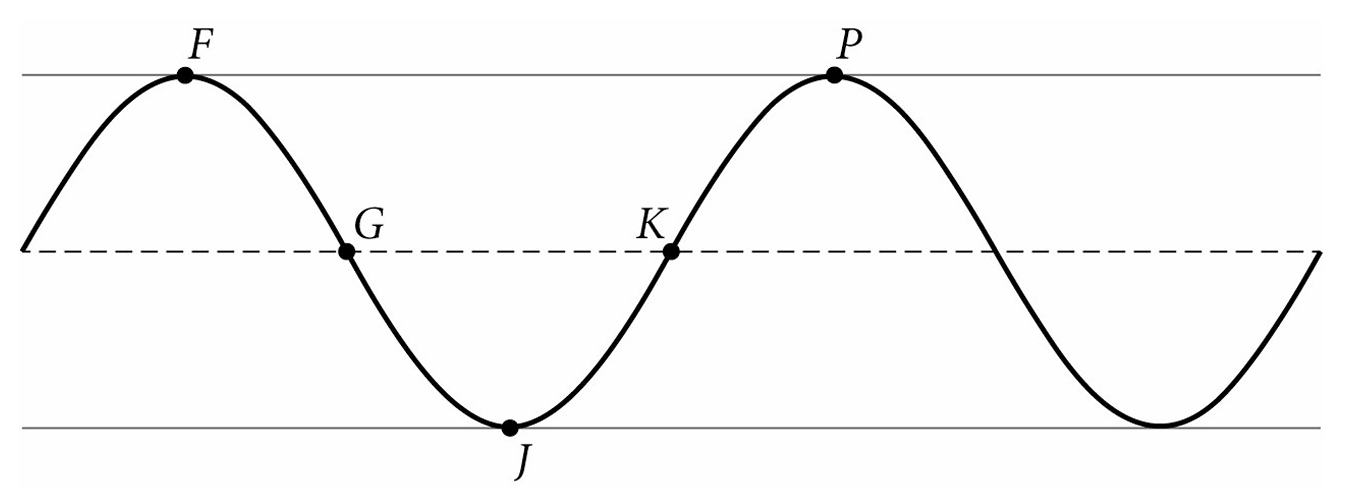
A. The graph of \( h \) and its dashed midline for two full cycles is shown. Five points, \( F, G, J, K, \) and \( P \), are labeled on the graph. Determine possible coordinates \( (t, h(t)) \) for the five points: \(       F, G, J, K, \) and \( P \).
B. The function \( h \) can be written in the form \( h(t) = a\sin(b(t+c)) + d \). Find values of constants \( a, b, c, \) and \( d \).
C. Refer to the graph of \( h \) in part A. The \( t \)-coordinate of \( J \) is \( t_1 \), and the \( t \)-coordinate of \( K \) is \( t_2 \).
     i. On the interval \( (t_1, t_2) \), which of the following is true about \( h \)?
          a. \( h \) is positive and increasing.
          b. \( h \) is positive and decreasing.
          c. \( h \) is negative and increasing.
          d. \( h \) is negative and decreasing.
     ii. On the interval \( (t_1, t_2) \), describe the concavity of the graph of \( h \) and determine whether the rate of change of \( h \) is increasing or decreasing.
▶️ Answer/Explanation
Part A: Coordinates

\( F = (0, 210) \)
\( G = (3, 200) \)
\( J = (6, 190) \)
\( K = (9, 200) \)
\( P = (12, 210) \)

Part B: Constants

\( a = 10 \)
\( b = \frac{\pi}{6} \)
\( c = 3 \)
\( d = 200 \)

Part C

i. (a) \( h \) is positive and increasing.
ii. The graph is concave up, and the rate of change of \( h \) is increasing.

Detailed solution

Part A: Determine Coordinates

1. Identify Vertical Parameters: The center of the clock is 200 cm from the floor, so the midline of the function is \( y = 200 \). The hour hand is 10 cm long, which is the amplitude.
– Maximum height = \( 200 + 10 = 210 \) cm.
– Minimum height = \( 200 – 10 = 190 \) cm.

2. Identify Time Parameters: At \( t = 0 \), the hand points to 12 (up), which corresponds to the maximum height. The period is 12 hours.
– Maxima occur at \( t = 0, 12, 24, \dots \)
– Minima occur at \( t = 6, 18, \dots \) (halfway through the cycle).
– Midline crossings occur at \( t = 3, 9, 15, \dots \)

3. Map Points to Coordinates:
Point F: This is a maximum peak. Since \( t=0 \) is the first maximum, \( F = (0, 210) \).
Point G: This is the midline crossing on the way down, occurring \( \frac{1}{4} \) of the period after the peak. \( t = 3 \). \( G = (3, 200) \).
Point J: This is the minimum (trough), occurring \( \frac{1}{2} \) of the period after the peak. \( t = 6 \). \( J = (6, 190) \).
Point K: This is the midline crossing on the way up, occurring \( \frac{3}{4} \) of the period after the peak. \( t = 9 \). \( K = (9, 200) \).
Point P: This is the next maximum, occurring one full period after \( F \). \( t = 12 \). \( P = (12, 210) \).

Part B: Find Constants for \( h(t) = a\sin(b(t+c)) + d \)

\( d \) (Vertical Shift): This is the midline height. \( d = 200 \).
\( a \) (Amplitude): This is the length of the hand. \( a = 10 \).
\( b \) (Frequency Coefficient): The period is 12 hours. Using the formula \( \text{Period} = \frac{2\pi}{b} \):
\( 12 = \frac{2\pi}{b} \implies b = \frac{2\pi}{12} = \frac{\pi}{6} \).
\( c \) (Phase Shift): A standard sine function \( \sin(bt) \) starts at the midline and goes up. We need our function to be at a maximum at \( t=0 \).
A sine wave hits its maximum when the argument is \( \frac{\pi}{2} \).
\( b(0 + c) = \frac{\pi}{2} \)
\( \frac{\pi}{6}(c) = \frac{\pi}{2} \)
\( c = 3 \).
(Alternatively, a cosine function starts at a max. \( \cos(x) = \sin(x + \frac{\pi}{2}) \). A shift of 3 hours is \( \frac{1}{4} \) of the 12-hour period, which aligns the sine start (midline) to the cosine start (max)).

Part C: Analysis on Interval \( (t_1, t_2) \)

The interval \( (t_1, t_2) \) corresponds to the section of the graph from point \( J \) (minimum at \( t=6 \)) to point \( K \) (midline at \( t=9 \)).

i. Properties of \( h \):
Value: The function values rise from 190 to 200. These are all positive numbers. So, \( h \) is positive.
Direction: The graph is going upwards from the minimum. So, \( h \) is increasing.
Conclusion: Option (a) is correct.

ii. Concavity and Rate of Change:
Concavity: On the interval from a minimum to an inflection point (the midline), the graph is shaped like part of a cup holding water. This shape is concave up (or \( h”(t) > 0 \)).
Rate of Change: The rate of change is the slope of the tangent line. At \( J \) (the minimum), the slope is 0. As it moves toward \( K \), the slope becomes more positive (steeper). Since the slope is increasing from 0 to a positive value, the rate of change of \( h \) is increasing.

Question 4

Directions:

  • Unless otherwise specified, the domain of a function \(f\) is assumed to be the set of all real numbers \(x\) for which \(f(x)\) is a real number. Angle measures for trigonometric functions are assumed to be in radians.
  • Solutions to equations must be real numbers. Determine the exact value of any expression that can be obtained without a calculator. For example, \(\log_2 8\), \(\cos\left(\frac{\pi}{2}\right)\), and \(\sin^{-1}(1)\) can be evaluated without a calculator.
  • Unless otherwise specified, combine terms using algebraic methods and rules for exponents and logarithms, where applicable. For example, \(2x+3x\), \(5^2 \cdot 5^3\), \(\frac{x^5}{x^2}\), and \(\ln 3 + \ln 5\) should be rewritten in equivalent forms.
  • For each part of the question, show the work that leads to your answers.

A. The functions \(g\) and \(h\) are given by

\(g(x) = \log_4(2x)\)
\(h(x) = \frac{(e^x)^5}{e^{1/4}}\)
i. Solve \(g(x)=3\) for values of \(x\) in the domain of \(g\).
ii. Solve \(h(x)=e^{1/2}\) for values of \(x\) in the domain of \(h\).

B. The functions \(j\) and \(k\) are given by

\(j(x) = \log_{10}(x+1) – 5\log_{10}(2-x) + \log_{10} 3\)
\(k(x) = \sec x – \cos x\)
i. Rewrite \(j(x)\) as a single logarithm base 10 without negative exponents in any part of the expression. Your result should be of the form \(\log_{10}(\text{expression})\).
ii. Rewrite \(k(x)\) as a product involving \(\tan x\) and \(\sin x\) and no other trigonometric functions.

C. The function \(m\) is given by

\(m(x) = 2 \tan^{-1}(\sqrt{3}\pi x)\)
Find all input values in the domain of \(m\) that yield an output value of \(\sin^{-1}\left(\frac{\sqrt{3}}{2}\right)\).
▶️ Answer/Explanation
Detailed solution

A. i. Solve \(g(x) = 3\)
We are given the equation:
\(\log_4(2x) = 3\)
To solve for \(x\), convert the logarithmic equation to its exponential form using the definition \(y = \log_b(a) \iff b^y = a\):
\(2x = 4^3\)
Evaluate the power of 4:
\(2x = 64\)
Divide both sides by 2:
\(x = 32\)

A. ii. Solve \(h(x) = e^{1/2}\)
We are given the equation:
\(\frac{(e^x)^5}{e^{1/4}} = e^{1/2}\)
First, simplify the numerator using the power of a power rule \((a^m)^n = a^{mn}\):
\(\frac{e^{5x}}{e^{1/4}} = e^{1/2}\)
Simplify the left side using the quotient rule for exponents \(\frac{a^m}{a^n} = a^{m-n}\):
\(e^{5x – 1/4} = e^{1/2}\)
Since the bases are the same, we can equate the exponents:
\(5x – \frac{1}{4} = \frac{1}{2}\)
Add \(\frac{1}{4}\) to both sides (note that \(\frac{1}{2} = \frac{2}{4}\)):
\(5x = \frac{2}{4} + \frac{1}{4}\)
\(5x = \frac{3}{4}\)
Divide by 5:
\(x = \frac{3}{20}\)

B. i. Rewrite \(j(x)\)
We are given:
\(j(x) = \log_{10}(x+1) – 5\log_{10}(2-x) + \log_{10} 3\)
Use the power rule for logarithms \(n\log_b a = \log_b(a^n)\) to move the coefficient 5:
\(j(x) = \log_{10}(x+1) – \log_{10}((2-x)^5) + \log_{10} 3\)
Rearrange to group positive terms:
\(j(x) = \log_{10}(x+1) + \log_{10} 3 – \log_{10}((2-x)^5)\)
Use the product rule \(\log_b a + \log_b c = \log_b (ac)\) for the positive terms:
\(j(x) = \log_{10}(3(x+1)) – \log_{10}((2-x)^5)\)
Use the quotient rule \(\log_b a – \log_b c = \log_b (\frac{a}{c})\):
\(j(x) = \log_{10}\left( \frac{3(x+1)}{(2-x)^5} \right)\)

B. ii. Rewrite \(k(x)\)
We are given:
\(k(x) = \sec x – \cos x\)
Rewrite \(\sec x\) in terms of cosine:
\(k(x) = \frac{1}{\cos x} – \cos x\)
Find a common denominator:
\(k(x) = \frac{1 – \cos^2 x}{\cos x}\)
Use the Pythagorean identity \(1 – \cos^2 x = \sin^2 x\):
\(k(x) = \frac{\sin^2 x}{\cos x}\)
Separate the expression into a product:
\(k(x) = \sin x \cdot \frac{\sin x}{\cos x}\)
Substitute \(\tan x\) for \(\frac{\sin x}{\cos x}\):
\(k(x) = \sin x \tan x\)

C. Solve for \(m(x) = \sin^{-1}\left(\frac{\sqrt{3}}{2}\right)\)
We are given the equation:
\(2 \tan^{-1}(\sqrt{3}\pi x) = \sin^{-1}\left(\frac{\sqrt{3}}{2}\right)\)
First, evaluate the right side. The principal value of \(\sin^{-1}\left(\frac{\sqrt{3}}{2}\right)\) is \(\frac{\pi}{3}\):
\(2 \tan^{-1}(\sqrt{3}\pi x) = \frac{\pi}{3}\)
Divide both sides by 2:
\(\tan^{-1}(\sqrt{3}\pi x) = \frac{\pi}{6}\)
Take the tangent of both sides to remove the inverse tangent:
\(\sqrt{3}\pi x = \tan\left(\frac{\pi}{6}\right)\)
Evaluate \(\tan\left(\frac{\pi}{6}\right)\), which is \(\frac{1}{\sqrt{3}}\):
\(\sqrt{3}\pi x = \frac{1}{\sqrt{3}}\)
Isolate \(x\) by dividing both sides by \(\sqrt{3}\pi\):
\(x = \frac{1}{\sqrt{3} \cdot \sqrt{3} \pi}\)
Simplify the denominator (\(\sqrt{3} \cdot \sqrt{3} = 3\)):
\(x = \frac{1}{3\pi}\)

Scroll to Top