
▶️ Answer/Explanation
Part (A)
(i) Finding \( h(6) \):
The function is defined as \( h(6) = g(f(6)) \).
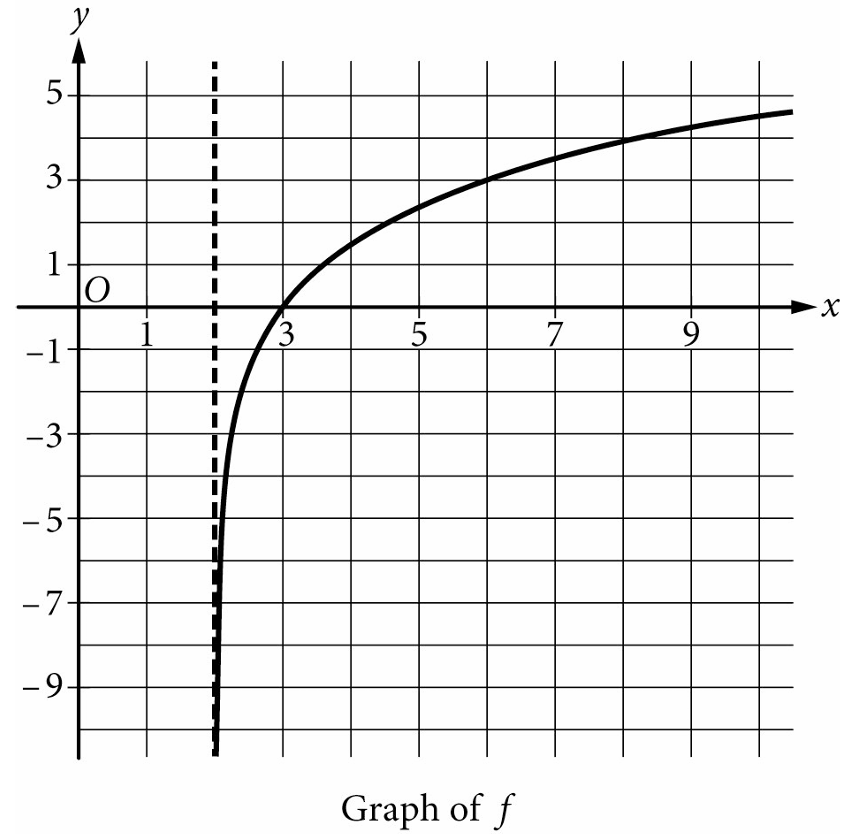
First, identify \( f(6) \) from the graph or text.
According to the problem statement, the point \( (6, 3) \) is on the graph of \( f \), so \( f(6) = 3 \).
Next, substitute this value into \( g(x) \): \( h(6) = g(3) \).
Using the equation for \( g(x) \):
\( g(3) = \frac{9}{3 – 3} = \frac{9}{0} \).
Division by zero is undefined.
Answer: Value is not defined.
(ii) Finding real zeros of \( f \):
A real zero occurs where the graph intersects the \( x \)-axis (where \( f(x) = 0 \)).
Observing the graph and the given points, the graph passes through \( (3, 0) \).
Answer: \( x = 3 \) is the only real zero.
Part (B)
(i) Solving for \( g(x) = -5.8 \):
Set up the equation: \( \frac{9}{x – 3} = -5.8 \).
Multiply both sides by \( (x – 3) \): \( 9 = -5.8(x – 3) \).
Divide both sides by \( -5.8 \): \( x – 3 = \frac{9}{-5.8} \).
Calculate the fraction: \( \frac{9}{-5.8} \approx -1.5517 \).
Solve for \( x \): \( x = 3 – 1.5517 \).
Answer: \( x \approx 1.448 \).
(ii) End behavior as \( x \to -\infty \):
Consider the limit \( \lim_{x \to -\infty} \frac{9}{x – 3} \).
As \( x \) decreases without bound (becomes a large negative number), the denominator \( (x – 3) \) becomes a large negative number.
The value of the fraction \( \frac{9}{\text{large negative number}} \) gets closer and closer to 0.
Answer: \( \lim_{x \to -\infty} g(x) = 0 \).
Part (C)
(i) Invertibility:
Answer: \( f \) is invertible (it has an inverse function on its domain \( x > 2 \)).
(ii) Reason:
Based on the graph, \( f \) is a strictly increasing function.
This means that each output value \( f(x) \) is mapped from a unique input value \( x \) (the function is one-to-one).
There are no repeated \( f(x) \) values.
(Note: Simply stating that it “passes the horizontal line test” is often considered insufficient without explaining the concept of unique mapping.)
▶️ Answer/Explanation
(A) Determining the Constants
(i) Three Equations:
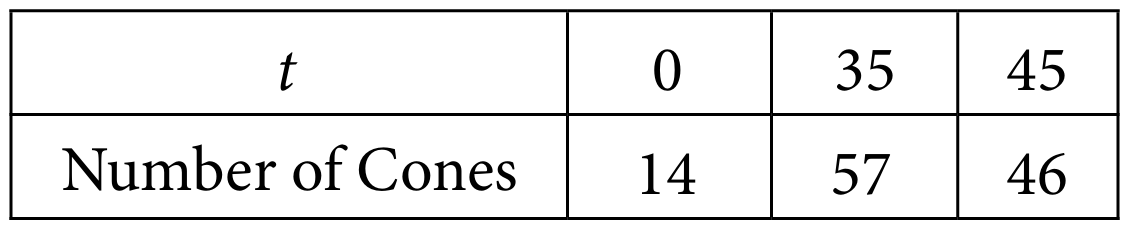
We substitute the data points \((0, 14)\), \((35, 57)\), and \((45, 46)\) into the quadratic equation \(I(t) = at^2 + bt + c\).
- For \(t=0\), \(I(0)=14\):
\(a(0)^2 + b(0) + c = 14 \implies c = 14\) - For \(t=35\), \(I(35)=57\):
\(a(35)^2 + b(35) + c = 57\) - For \(t=45\), \(I(45)=46\):
\(a(45)^2 + b(45) + c = 46\)
(ii) Solving for \(a, b, c\):
From the first equation, we know \(c = 14\).
Substitute \(c=14\) into the other two equations:
- \(1225a + 35b + 14 = 57 \implies 1225a + 35b = 43\)
- \(2025a + 45b + 14 = 46 \implies 2025a + 45b = 32\)
Multiply the first equation by 9 and the second by 7 to align the \(b\) coefficients (LCD of 35 and 45 is 315), or solve by substitution.
Solving this system yields:
- \(a = -\frac{163}{3150} \approx -0.051746\)
- \(b \approx 3.039683\)
Thus, the model is:
\(I(t) \approx -0.052t^2 + 3.040t + 14\)
(B) Average Rate of Change and Estimation
(i) Average Rate of Change (\(t=35\) to \(t=45\)):
The formula for average rate of change is \(\frac{I(t_2) – I(t_1)}{t_2 – t_1}\).
\(\text{Average Rate} = \frac{I(45) – I(35)}{45 – 35} = \frac{46 – 57}{10} = \frac{-11}{10} = \mathbf{-1.1}\) cones per day.
(ii) Estimate for \(t=40\):
Using the average rate of change found in (i), which represents the slope of the secant line between \(t=35\) and \(t=45\), we can estimate the value at the midpoint \(t=40\).
Using point \((35, 57)\):
\(y – 57 = -1.1(t – 35)\)
Let \(t = 40\):
\(y = 57 + -1.1(40 – 35)\)
\(y = 57 + -1.1(5)\)
\(y = 57 – 5.5 = \mathbf{51.5}\)
(iii) Comparison and Explanation:
First, find the model value \(I(40)\) using the constants from part (A):
\(I(40) = -0.051746(40)^2 + 3.039683(40) + 14 \approx \mathbf{52.8}\)
Comparison: The estimated value (51.5) is less than the model value (approx 52.8).
Explanation: The quadratic coefficient \(a\) is negative (\(a < 0\)), meaning the graph of the function \(I\) is concave down. The estimate in part (ii) lies on the secant line connecting \((35, 57)\) and \((45, 46)\). Since the curve is concave down, the secant line lies below the curve on the interval \((35, 45)\). Therefore, the linear estimate is lower than the actual function value.
(C) Range Limitations
The range of function \(I\) must be limited by the context of selling physical items:
- Non-negative values: The number of cones sold cannot be negative, so \(I(t) \ge 0\).
- Maximum value: Since the parabola opens downward (\(a < 0\)), there is a maximum number of cones sold at the vertex. The calculated maximum is approximately \(58.6\). Since you cannot sell partial cones, the maximum integer value is roughly 58 or 59.
Therefore, a reasonable range is \(0 \le I(t) \le 59\).
▶️ Answer/Explanation
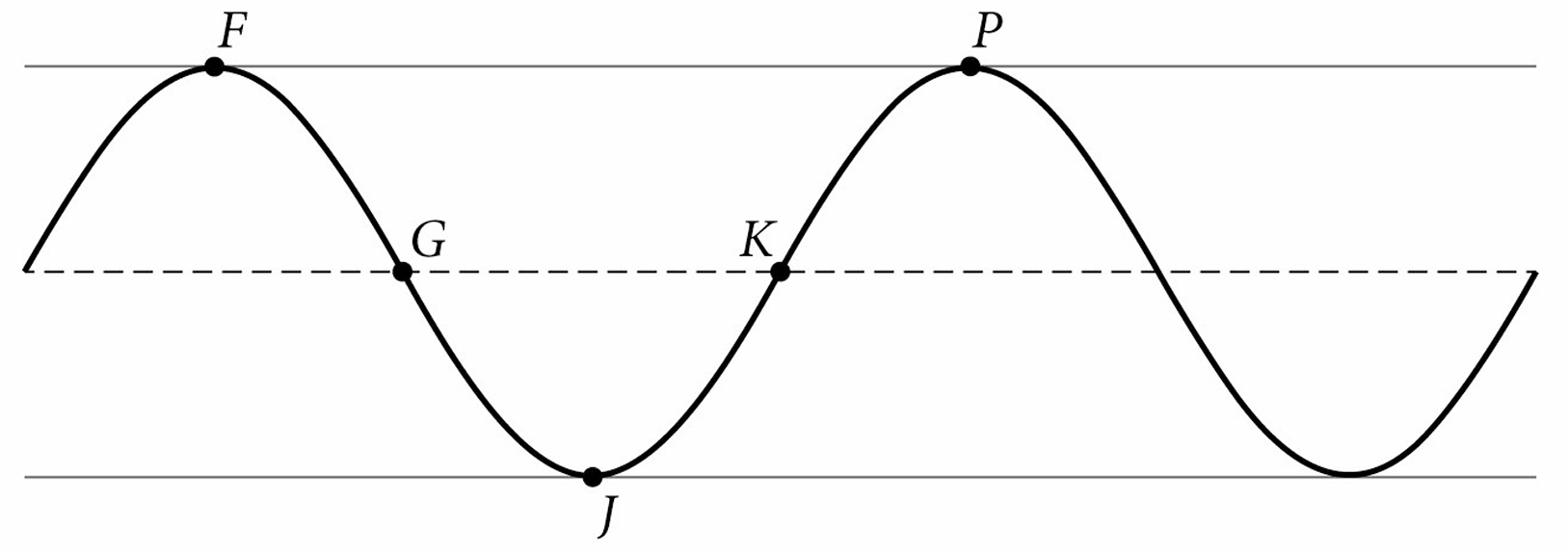
- \(F\) has coordinates \((2, 0.5)\)
- \(G\) has coordinates \((3, 0)\)
- \(J\) has coordinates \((4, -0.5)\)
- \(K\) has coordinates \((5, 0)\)
- \(P\) has coordinates \((6, 0.5)\)
Using the form \(h(t) = a\cos(b(t+c)) + d\):
- \(d = 0\) (Vertical shift is zero)
- \(b = \frac{\pi}{2}\) (Derived from Period = 4)
- Possible solution 1: \(a = -\frac{1}{2}\), \(c = 0\)
\(\Rightarrow h(t) = -\frac{1}{2}\cos\left(\frac{\pi}{2}t\right)\) - Possible solution 2: \(a = \frac{1}{2}\), \(c = -2\) (or \(+2\))
\(\Rightarrow h(t) = \frac{1}{2}\cos\left(\frac{\pi}{2}(t-2)\right)\)
- (i) Choice c. \(h\) is negative and increasing.
- (ii) Because the graph of \(h\) is concave up on the interval \((t_1, t_2)\), the rate of change of \(h\) is increasing on the interval \((t_1, t_2)\).
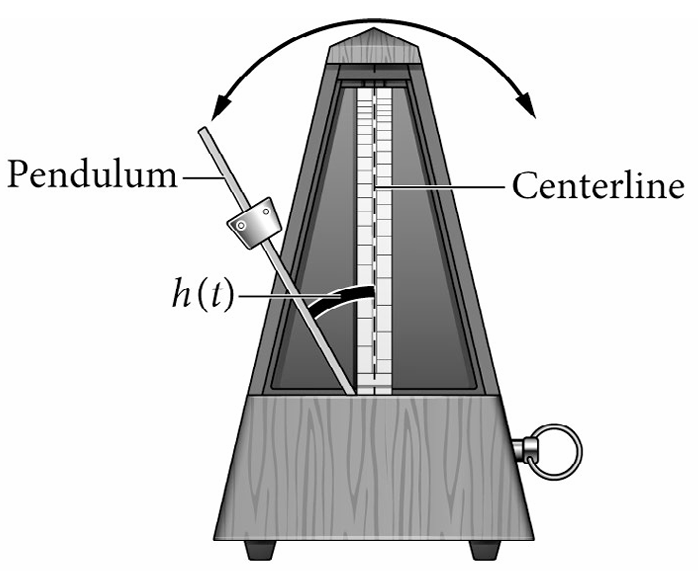
• At \(t=0\), it is farthest left (position \(-0.5\)). This is a minimum.
• At \(t=2\), it is farthest right (position \(0.5\)). This is a maximum.
• At \(t=4\), it is farthest left again (position \(-0.5\)). This is a minimum.
From this, we can deduce the period is \(4\) seconds. We map these times to the points on the graph:
• Point \(F\) is the first maximum shown. Since the max occurs at \(t=2\), \(F\) is at \((2, 0.5)\).
• Point \(J\) is the minimum following the max. The minimum occurs at \(t=4\), so \(J\) is at \((4, -0.5)\).
• Point \(G\) lies on the midline halfway between the max (\(t=2\)) and min (\(t=4\)). The midpoint is \(t=3\), so \(G\) is at \((3, 0)\).
• Point \(K\) lies on the midline after the minimum (\(t=4\)) but before the next max. Since the pattern repeats every 4 seconds, the next max is at \(t=6\). The midpoint between \(t=4\) and \(t=6\) is \(t=5\), so \(K\) is at \((5, 0)\).
• Point \(P\) is the next maximum at \(t=6\), so \(P\) is at \((6, 0.5)\).
Part (B)
• Vertical Shift (\(d\)): The oscillation is centered around the vertical centerline (\(0\)), so the midline \(d = 0\).
• Amplitude (\(a\)): The maximum displacement from the center is \(0.5\), so \(|a| = 0.5\).
• Period (\(b\)): The period \(T\) is \(4\) seconds. Using the formula \(T = \frac{2\pi}{b}\), we solve \(4 = \frac{2\pi}{b} \Rightarrow b = \frac{\pi}{2}\).
• Phase Shift (\(c\)):
– If we use a negative cosine function (\(a = -0.5\)), we look for where the graph starts at a minimum. The graph has a minimum at \(t=0\). A standard \(-\cos(t)\) graph also starts at a minimum at \(0\). Therefore, no horizontal shift is needed (\(c=0\)).
– Equation: \(h(t) = -\frac{1}{2}\cos\left(\frac{\pi}{2}t\right)\).
Part (C)
(i) Function Behavior:
• Between \(t=4\) and \(t=5\), the graph is rising from \(-0.5\) to \(0\).
• Since the values are below the x-axis, \(h\) is negative.
• Since the graph is going up, \(h\) is increasing.
• This matches option c.
(ii) Rate of Change:
• The rate of change is the slope of the graph.
• In this interval, the graph is “cup-shaped” or curved upwards. This geometric property is called being concave up.
• When a function is concave up, its derivative (rate of change) is increasing. Visually, the slope starts at 0 at the valley (\(J\)) and becomes steeper in the positive direction as it approaches \(K\).