Question 1

▶️ Answer/Explanation
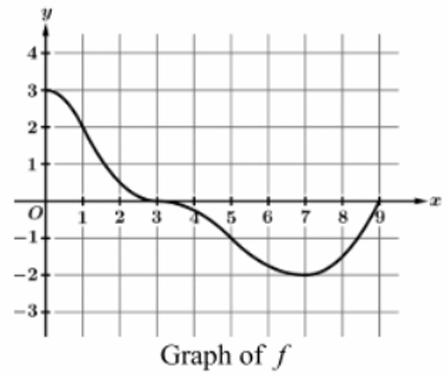
Step 1: Observe the direction of the curve on the interval \( 1 < x < 3 \). As \( x \) increases from 1 to 3, the value of \( y \) goes down. Therefore, the function \( f \) is decreasing. This eliminates options (A) and (B).
Step 2: Analyze the rate of change (concavity). The “rate” refers to the steepness or magnitude of the slope.
Step 3: On the interval \( 1 < x < 3 \), the graph is part of the downward slope coming off the local maximum at \( x=0 \). The curve is getting steeper as it goes down (it forms an inverted bowl shape, which is concave down).
Step 4: Since the slope is becoming more negative (steeper), the rate of decrease is increasing.
Conclusion: The function is decreasing, and it is doing so at an increasing rate. Thus, statement (C) is correct.
Question 2
(A)
| \(x\) | \(g(x)\) |
|---|---|
| 1 | 1 |
| 2 | 2 |
| 3 | 4 |
| 4 | 8 |
| 5 | 16 |
(B)
| \(x\) | \(g(x)\) |
|---|---|
| 1 | -20 |
| 2 | -10 |
| 3 | -5 |
| 4 | 5 |
| 5 | 10 |
(C)
| \(x\) | \(g(x)\) |
|---|---|
| 1 | 1 |
| 2 | 5 |
| 3 | 7 |
| 4 | 5 |
| 5 | 1 |
(D)
| \(x\) | \(g(x)\) |
|---|---|
| 1 | 7 |
| 2 | 3 |
| 3 | 1 |
| 4 | 3 |
| 5 | 7 |
▶️ Answer/Explanation
The correct option is (C).
For a function to be concave down, the slope (or rate of change) must be decreasing. In a table of values with equal \(x\)-steps, this means the first differences between consecutive \(g(x)\) values must get smaller as \(x\) increases.
Let’s calculate the first differences for each option:
Option (A): \(2-1=1\), \(4-2=2\), \(8-4=4\), \(16-8=8\). The rate is increasing (\(1, 2, 4, 8\)), so it is concave up.
Option (B): \(-10-(-20)=10\), \(-5-(-10)=5\), \(5-(-5)=10\). The rate fluctuates, so it is not consistently concave down.
Option (C): \(5-1=4\), \(7-5=2\), \(5-7=-2\), \(1-5=-4\). The rate is strictly decreasing (\(4, 2, -2, -4\)), which indicates the function is concave down.
Option (D): \(3-7=-4\), \(1-3=-2\), \(3-1=2\), \(7-3=4\). The rate is increasing (\(-4, -2, 2, 4\)), so it is concave up.
Question 3
▶️ Answer/Explanation
The correct option is (A).
• The problem states that the point \( (3, -2) \) is on the graph of \( g \), which means \( g(3) = -2 \).
• We substitute \( x = 3 \) into the given equation \( h(x) = 2g(x) + 3 \) to find the corresponding point on \( h \).
• This gives \( h(3) = 2(-2) + 3 = -4 + 3 = -1 \).
• Thus, the point \( (3, -1) \) lies on the graph of the function \( h \).
• For an inverse function \( h^{-1} \), the input and output values are swapped; so if \( (a, b) \) is on \( h \), then \( (b, a) \) is on \( h^{-1} \).
• Swapping the coordinates of \( (3, -1) \) gives the point \( (-1, 3) \).
• Therefore, the point \( (-1, 3) \) is on the graph of \( h^{-1} \).
Question 4
▶️ Answer/Explanation
The correct option is (B).
Step 1: Start with the given equation: \( \ln(3x) + \ln 2 = 4 \).
Step 2: Apply the product property of logarithms, \( \ln a + \ln b = \ln(ab) \), to combine the terms on the left side:
\( \ln(3x \cdot 2) = 4 \implies \ln(6x) = 4 \)
Step 3: Convert the logarithmic equation to its exponential form using the definition \( \ln y = k \iff y = e^k \):
\( 6x = e^4 \)
Step 4: Solve for \( x \) by dividing both sides by 6:
\( x = \frac{e^4}{6} \)
Question 5


▶️ Answer/Explanation
The correct option is (B).
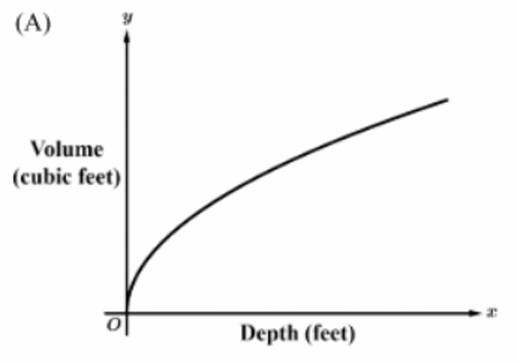
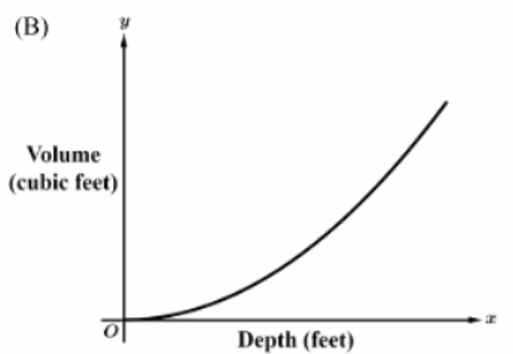
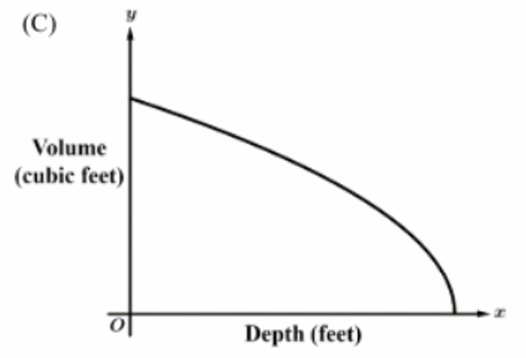
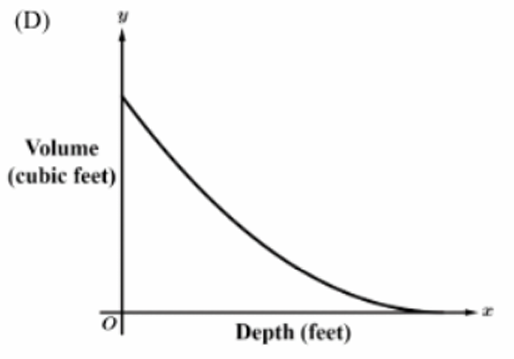
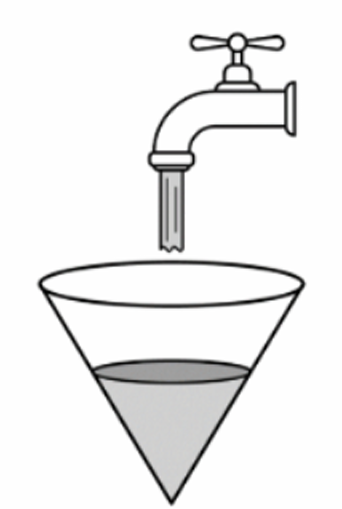
The volume \(V\) of a cone is defined by the formula \(V = \frac{1}{3}\pi r^2 h\).
Since the tank is conical, the radius \(r\) is directly proportional to the depth \(h\); we can write \(r = k \cdot h\).
Substituting \(r = kh\) into the volume formula gives \(V = \frac{1}{3}\pi (kh)^2 h = \frac{1}{3}\pi k^2 h^3\).
This simplifies to \(V = C \cdot h^3\), where \(C\) is a positive constant.
This equation indicates that Volume is a cubic function of Depth.
A cubic function \(y = x^3\) (for \(x > 0\)) starts at the origin and increases with an increasing slope (concave up).
Graphs (C) and (D) are incorrect because volume must increase as depth increases.
Graph (A) is concave down, whereas Graph (B) is concave up, matching the cubic relationship.
Question 6
▶️ Answer/Explanation
The correct option is (C).
1. According to the Binomial Theorem, \((a+b)^n = \sum_{k=0}^{n} \binom{n}{k} a^{n-k} b^k\).
2. Identify the components for substitution: \(a = x\), \(b = -4y\), and \(n = 5\).
3. The binomial coefficients for \(n=5\) (from Pascal’s triangle) are: \(1, 5, 10, 10, 5, 1\).
4. Substitute these into the formula: \(1(x)^5 + 5(x)^4(-4y) + 10(x)^3(-4y)^2 + 10(x)^2(-4y)^3 + 5(x)(-4y)^4 + 1(-4y)^5\).
5. Simplify the signs: odd powers of \((-4y)\) result in a negative sign, while even powers result in a positive sign.
6. The final expansion is: \(x^5 – 5x^4(4y) + 10x^3(4y)^2 – 10x^2(4y)^3 + 5x(4y)^4 – (4y)^5\).
Question 7
▶️ Answer/Explanation
To determine the intervals where \( k(x) \geq 0 \), we analyze the sign of the rational function.
1. Find the critical points where the numerator is zero or the denominator is zero. The numerator is zero at \( x = 3 \) and \( x = -2 \). The denominator is zero at \( x = 5 \).
2. Observe that the term \( -2(x-3)^2 \) is always less than or equal to zero because \( (x-3)^2 \geq 0 \) and multiplying by -2 makes it non-positive.
3. For the entire function \( k(x) \) to be greater than or equal to zero (positive), the remaining part of the expression, \( \frac{x+2}{x-5} \), must be less than or equal to zero (negative), so that negative \(\times\) negative = positive.
4. Solve the inequality \( \frac{x+2}{x-5} \leq 0 \). This fraction is negative when the numerator and denominator have opposite signs, which occurs in the interval between the roots: \( -2 \leq x < 5 \).
5. Check the boundary points: At \( x = -2 \), \( k(x) = 0 \), which is valid. At \( x = 5 \), the function is undefined, so we exclude it (use a parenthesis).
6. We must also ensure \( x = 3 \) is included since \( k(3) = 0 \), satisfying \( k(x) \geq 0 \). Since 3 is already inside the interval \( [-2, 5) \), our interval is complete.
Therefore, the correct interval is \( [-2, 5) \).
Correct Option: (A)
Question 8
▶️ Answer/Explanation
The given function is an exponential function defined as \( j(x) = -5\left(\frac{1}{3}\right)^x \).
First, analyze the limit as \( x \to \infty \). Since the base \( \frac{1}{3} \) is between \( 0 \) and \( 1 \), \( \left(\frac{1}{3}\right)^x \) approaches \( 0 \) as \( x \) gets larger.
Therefore, \( j(x) \) approaches \( -5 \cdot 0 = 0 \), so \( \lim_{x \to \infty} j(x) = 0 \).
Next, analyze the limit as \( x \to -\infty \). A negative exponent flips the fraction, so \( \left(\frac{1}{3}\right)^{-\infty} \) acts like \( 3^{\infty} \), which approaches \( \infty \).
Multiplying this large positive value by \( -5 \) results in a large negative value, so \( \lim_{x \to -\infty} j(x) = -\infty \).
Comparing these results with the given options, the correct description corresponds to option (B).
Question 9
▶️ Answer/Explanation
Set the function equal to the target value: \( 2\sin \theta = -1 \).
Isolate the sine term by dividing both sides by 2: \( \sin \theta = -\frac{1}{2} \).
Identify the reference angle: \( \sin \frac{\pi}{6} = \frac{1}{2} \), so the reference angle is \( \frac{\pi}{6} \).
Since \( \sin \theta \) is negative, \( \theta \) must lie in Quadrant III or Quadrant IV.
For Quadrant III: \( \theta = \pi + \frac{\pi}{6} = \frac{7\pi}{6} \).
For Quadrant IV: \( \theta = 2\pi – \frac{\pi}{6} = \frac{11\pi}{6} \).
Therefore, the values are \( \frac{7\pi}{6} \) and \( \frac{11\pi}{6} \), which corresponds to option (D).
Question 10
▶️ Answer/Explanation
Start with the given expression: \(\ln\left(\frac{2e^4}{x^3}\right)\).
Apply the quotient property of logarithms, \(\ln(\frac{a}{b}) = \ln a – \ln b\), to separate the numerator and denominator: \(\ln(2e^4) – \ln(x^3)\).
Apply the product property, \(\ln(ab) = \ln a + \ln b\), to the first term: \(\ln 2 + \ln(e^4) – \ln(x^3)\).
Use the power property, \(\ln(a^k) = k \ln a\), to move the exponents to the front: \(\ln 2 + 4\ln e – 3\ln x\).
Recall that the natural logarithm of \(e\) is 1 (\(\ln e = 1\)), so substitute this value: \(\ln 2 + 4(1) – 3\ln x\).
Rearrange the terms to match the format of the options: \(4 + \ln 2 – 3\ln x\).
This corresponds to option (A).
Question 11
▶️ Answer/Explanation
The function is given by \(j(x) = 8 – 7\tan\left(\frac{x}{4}\right)\).
Vertical asymptotes for the tangent function, \(\tan(\theta)\), occur where the function is undefined, which is when the argument \(\theta = \frac{\pi}{2} + \pi k\) for any integer \(k\).
In this function, the argument of the tangent is \(\frac{x}{4}\).
Set the argument equal to the condition for vertical asymptotes: \(\frac{x}{4} = \frac{\pi}{2} + \pi k\).
Solve for \(x\) by multiplying both sides of the equation by \(4\).
\(x = 4\left(\frac{\pi}{2}\right) + 4(\pi k)\).
Simplifying the expression results in: \(x = 2\pi + 4\pi k\).
Therefore, the correct option is (C).
Question 12
▶️ Answer/Explanation
The end behavior of a polynomial function is determined by its leading term (the term with the highest degree).
The problem states that as \( x \to -\infty \), \( k(x) \to \infty \) (starts up) and as \( x \to \infty \), \( k(x) \to -\infty \) (ends down).
Since the ends point in opposite directions, the degree of the polynomial must be odd.
Since the function goes to \( -\infty \) as \( x \) approaches positive infinity (right side goes down), the leading coefficient must be negative.
Looking at the options, we analyze the leading terms:
(A) \( 4x^5 \): Odd degree, positive coefficient (Ends: Down/Up). Incorrect.
(B) \( 3x^4 \): Even degree, positive coefficient (Ends: Up/Up). Incorrect.
(C) \( -2x^3 \): Odd degree, negative coefficient (Ends: Up/Down). Correct.
(D) \( -5x^6 \): Even degree, negative coefficient (Ends: Down/Down). Incorrect.
Question 13
▶️ Answer/Explanation
We are analyzing the limit of \( f(x) \) as \( x \to 1 \) from the right (since \( x > 1 \)).
First, evaluate the numerator at \( x = 1 \): \( -2(1+3) = -2(4) = -8 \).
Next, consider the denominator \( (x-1) \). As \( x \) approaches 1 from the right, \( (x-1) \) is a very small positive number.
We are dividing a negative constant (\( -8 \)) by a positive number approaching zero (\( 0^+ \)).
The result will be a negative number with an infinitely large magnitude.
Mathematically, \( \lim_{x \to 1^+} \frac{-8}{x-1} = -\infty \).
Therefore, the output values decrease without bound.
Correct Option: (A)
Question 14
▶️ Answer/Explanation
The correct option is (D).
A hole at \(x = -3\) requires a common factor of \((x+3)\) in both the numerator and denominator, which eliminates options (A) and (C).
To find the limit, we cancel the \((x+3)\) terms and evaluate the remaining expression at \(x = -3\).
For option (B): \(\lim_{x \to -3} \frac{4(x-4)}{x-1} = \frac{4(-7)}{-4} = 7 \neq 4\).
For option (D): \(\lim_{x \to -3} \frac{x-5}{x+1} = \frac{-8}{-2} = 4\), which satisfies the condition.
Therefore, \(k(x) = \frac{(x+3)(x-5)}{(x+3)(x+1)}\) is the correct function.
Question 15

▶️ Answer/Explanation
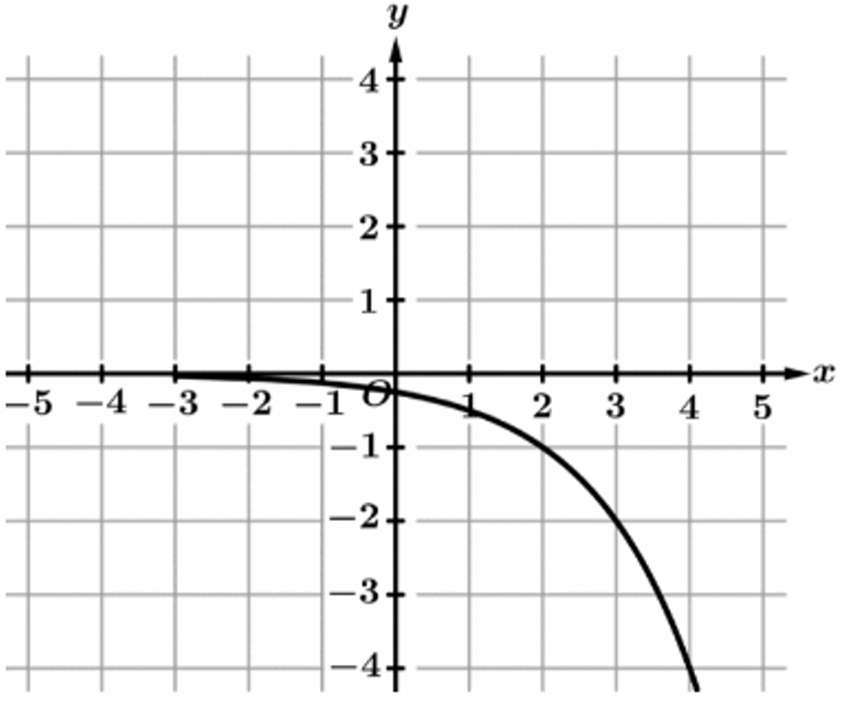
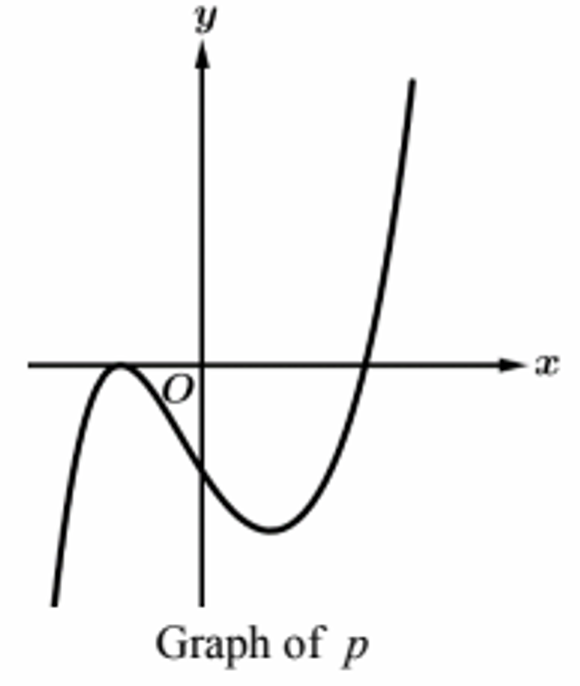
From the graph, the curve touches the \( x \)-axis at a negative value and turns around, indicating a real root with an even multiplicity of at least \( 2 \).
The curve also crosses the \( x \)-axis at a positive value, indicating a distinct real root with an odd multiplicity of at least \( 1 \).
Therefore, the visible behavior on the graph accounts for a minimum degree of \( 2 + 1 = 3 \).
The problem states that \( 2 – 3i \) is a zero of \( p \). Since the graph represents a polynomial with real coefficients, complex roots must occur in conjugate pairs.
This means the conjugate \( 2 + 3i \) is also a zero, contributing \( 2 \) distinct complex roots to the total degree.
Adding the minimum real roots and the complex roots together, the least possible degree is \( 3 + 2 = 5 \).
Correct Option: (D)
Question 16


▶️ Answer/Explanation
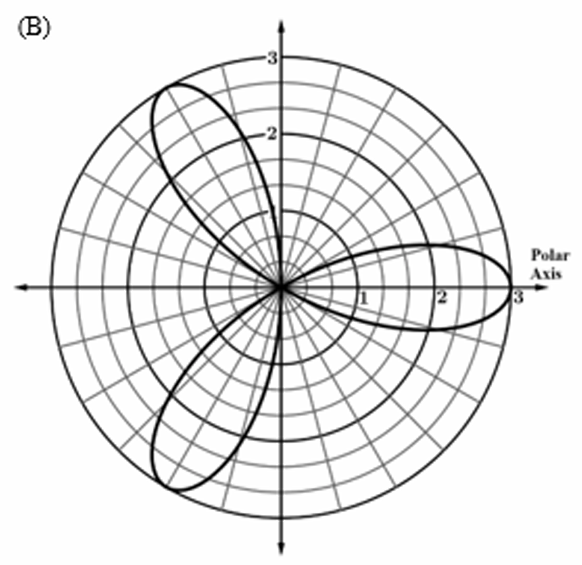
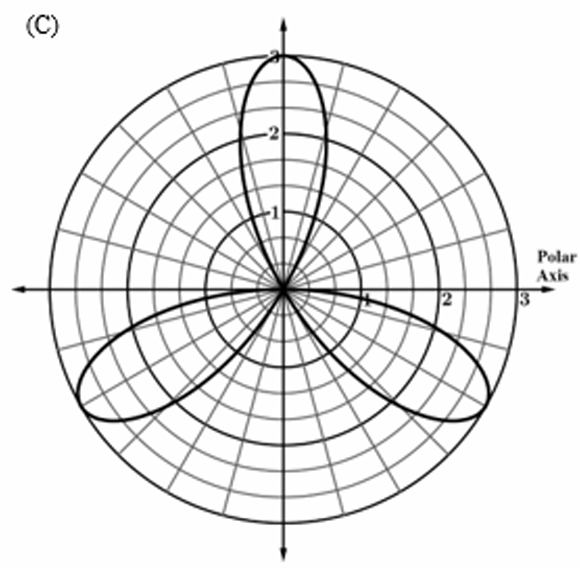
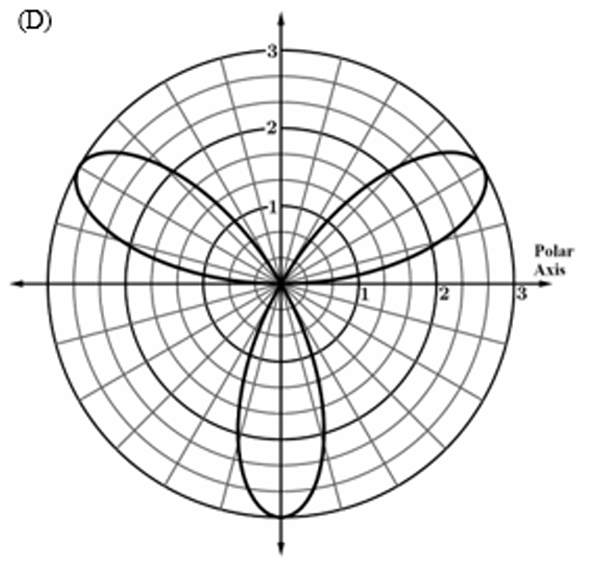
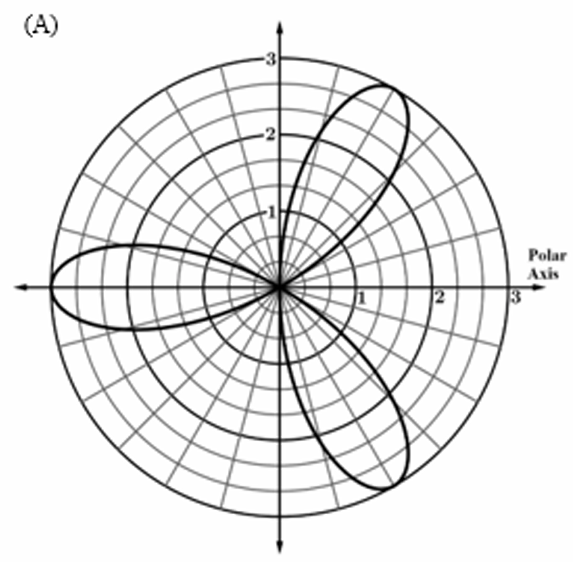
The function $r = -3 \sin(3\theta)$ represents a three-petaled rose because $n = 3$ is odd.
The maximum magnitude of $r$ is $|-3| = 3$, meaning the petals extend to a radius of $3$.
Since it is a sine function, the petals are not centered on the polar axis ($0^\circ$).
For $f(\theta)$ to reach its first extremum, $3\theta = \frac{\pi}{2}$ or $3\theta = \frac{3\pi}{2}$.
At $\theta = \frac{\pi}{6}$, $r = -3 \sin(\frac{\pi}{2}) = -3$, plotting a point at radius $3$ in the direction $\theta = \frac{7\pi}{6}$.
At $\theta = \frac{\pi}{2}$, $r = -3 \sin(\frac{3\pi}{2}) = 3$, plotting a petal tip directly on the positive y-axis.
Comparing this to the choices, Graph (C) is the only one with a petal tip at $(r, \theta) = (3, \frac{\pi}{2})$.
Therefore, the correct choice is (C).

Question 17

(B) $-14$
(C) $-3$
(D) $18$
▶️ Answer/Explanation
An odd function satisfies the property $f(-x) = -f(x)$.
To find $a$, we use the table entry $x = -2$ where $f(-2) = 10$.
Since $f(2) = -f(-2)$, it follows that $a = -10$.
To find $b$, we look for $f(b) = -7$ and notice $f(-8) = -7$.
Using the odd property $f(-x) = -f(x)$, we see $f(8) = -f(-8) = -(-7) = 7$.
From the table, $f(4) = -f(-4) = -7$, so $b$ must be $4$.
Therefore, $a + b = -10 + 4 = -6$.
The correct option is (A).
Question 18

(B) $4 \cos\left(2\left(x – \frac{\pi}{4}\right)\right) + 2$
(C) $-4 \sin\left(2\left(x – \frac{\pi}{2}\right)\right) + 2$
(D) $4 \cos\left(2\left(x – \frac{3\pi}{4}\right)\right) + 2$
▶️ Answer/Explanation
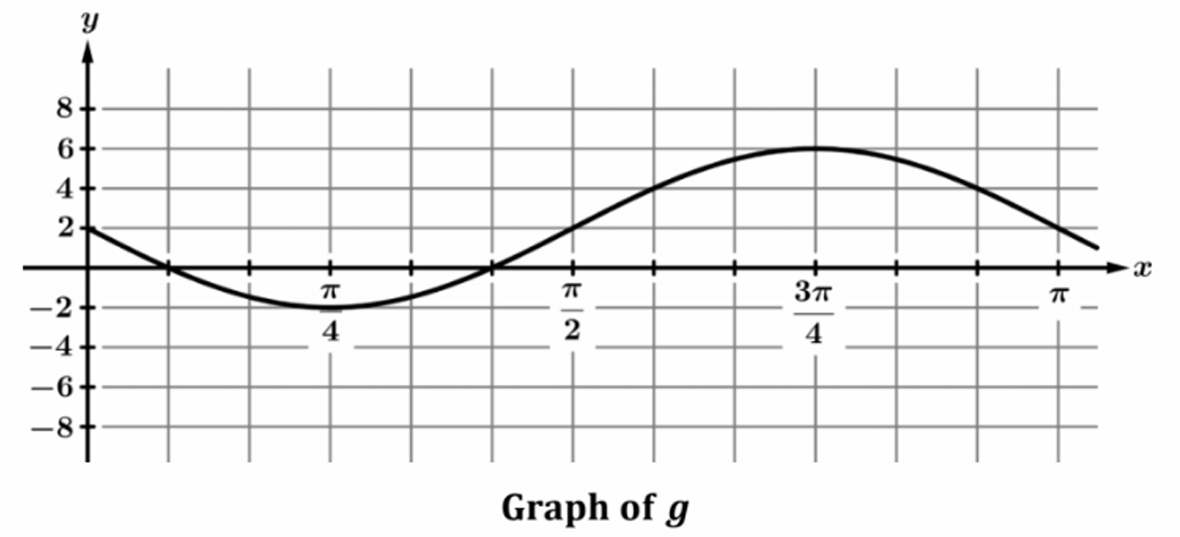
The midline of the graph is $y = 2$ and the amplitude is $4$, so the form is $g(x) = 4f(b(x-h)) + 2$.
The period is $\pi$ (from $x = -\frac{\pi}{4}$ to $x = \frac{3\pi}{4}$), so $b = \frac{2\pi}{\text{period}} = \frac{2\pi}{\pi} = 2$.
A maximum occurs at $x = \frac{3\pi}{4}$, which matches the peak of a standard cosine function shifted right.
Substituting into the cosine form $A \cos(b(x-h)) + k$, we get $4 \cos(2(x – \frac{3\pi}{4})) + 2$.
Checking point $(0, 2)$: $4 \cos(2(0 – \frac{3\pi}{4})) + 2 = 4 \cos(-\frac{3\pi}{2}) + 2 = 4(0) + 2 = 2$, which is correct.
Therefore, the expression in option (D) correctly represents the graph.
Question 19
▶️ Answer/Explanation
The given function is $j(x) = 3 \cdot 4^{(x+2)}$.
Apply the product rule of exponents: $a^{m+n} = a^m \cdot a^n$.
Rewrite the expression as $j(x) = 3 \cdot (4^x \cdot 4^2)$.
Calculate the constant value: $4^2 = 16$.
Substitute the value back: $j(x) = 3 \cdot 16 \cdot 4^x$.
Multiply the constants: $3 \cdot 16 = 48$.
The equivalent form is $j(x) = 48 \cdot 4^x$.
Therefore, the correct option is (B).
Question 20
(B) $y = -2x + 1$
(C) $y = -2x + 9$
(D) $y = 2x + 9$
▶️ Answer/Explanation
To find the slant asymptote, divide $f(x) = -2x^2 + 3x – 8$ by $g(x) = x + 3$.
Using synthetic division with the root $x = -3$:
The coefficients are $-2$, $3$, and $-8$.
Bring down $-2$, then multiply $-3 \times -2 = 6$.
Add $3 + 6 = 9$ to get the second coefficient of the quotient.
The resulting quotient is $-2x + 9$.
As $x \to \infty$, the remainder term $\frac{-35}{x+3}$ approaches $0$.
Thus, the equation of the slant asymptote is $y = -2x + 9$.
The correct option is (C).
Question 21

(B) $\cos \theta = -\frac{3}{4}$
(C) $\cos \theta = \frac{3}{5}$
(D) $\cos \theta = \frac{4}{5}$
▶️ Answer/Explanation
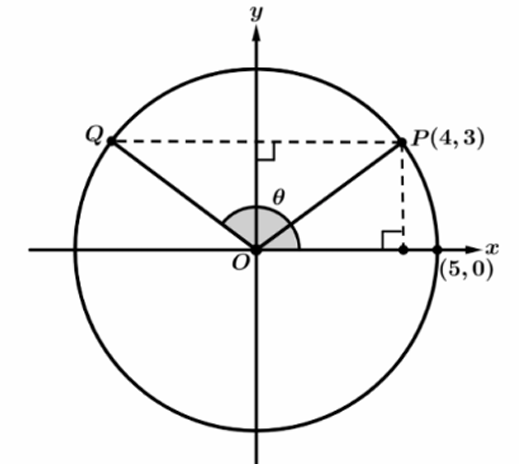
Point $P$ has coordinates $(4, 3)$, representing a horizontal distance of $4$ and a vertical distance of $3$.
Point $Q$ is the reflection of point $P$ across the $y$-axis, as shown by the dashed horizontal line.
The $x$-coordinate of $Q$ is the negative of the $x$-coordinate of $P$, so $Q = (-4, 3)$.
For any point $(x, y)$ on a circle of radius $r$, the cosine of the angle is defined as $\cos \theta = \frac{x}{r}$.
Given the radius $r = 5$ and the $x$-coordinate of $Q$ is $-4$.
Substituting these values gives $\cos \theta = \frac{-4}{5}$.
Therefore, the correct option is (A).

Question 22
▶️ Answer/Explanation
The given function is $p(x) = 4^{-2x}$.
Using the power of a power rule, $(a^m)^n = a^{m \cdot n}$, rewrite the expression as $(4^{-2})^x$.
Apply the negative exponent rule, $a^{-n} = \frac{1}{a^n}$, so $4^{-2} = \frac{1}{4^2}$.
Calculate the value of the base: $\frac{1}{4^2} = \frac{1}{16}$.
Substitute the base back into the function to get $p(x) = \left(\frac{1}{16}\right)^x$.
Comparing this result to the given options, we find it matches option (D).
Therefore, the equivalent form of the function is $p(x) = \left(\frac{1}{16}\right)^x$.
Question 23
▶️ Answer/Explanation
To find the value of $g\left(\frac{1}{9}\right)$, substitute $x = \frac{1}{9}$ into the function $g(x) = \log_{3} x$.
This gives the expression $g\left(\frac{1}{9}\right) = \log_{3} \left(\frac{1}{9}\right)$.
Rewrite the fraction as a power of $3$ using the rule $\frac{1}{a^n} = a^{-n}$.
Since $9 = 3^2$, it follows that $\frac{1}{9} = 3^{-2}$.
Substitute this back to get $\log_{3} (3^{-2})$.
Using the property $\log_{b} (b^y) = y$, the expression simplifies to $-2$.
Therefore, the correct value is $-2$, which corresponds to option (A).
Question 24
▶️ Answer/Explanation
Express the constant as a logarithm: $2 = \log_{7}(7^2) = \log_{7}(49)$.
Combine terms using the product rule: $\log_{7}(49(x-1)) = \log_{7}(4x+6)$.
Equate the arguments of the logarithms: $49x – 49 = 4x + 6$.
Solve the linear equation: $45x = 55$, which simplifies to $x = \frac{11}{9}$.
Check constraints: For $\log_{7}(x-1)$, we require $x – 1 > 0 \Rightarrow x > 1$.
Verify the solution: Since $\frac{11}{9} \approx 1.22$, which is $> 1$, the value is valid.
Final Answer: (C)
Question 25
(B) $\frac{1}{2}$
(C) $1$
(D) $2$
▶️ Answer/Explanation
Set the function $f(x) = 1$, which implies $\frac{g(x)}{h(x)} = 1$, or $g(x) = h(x)$.
Substitute the given expressions: $4^{x+1} = 2^{3x}$.
Rewrite the base $4$ as $2^2$: $(2^2)^{x+1} = 2^{3x}$.
Apply the power of a power rule: $2^{2(x+1)} = 2^{3x}$.
Equate the exponents since the bases are equal: $2(x+1) = 3x$.
Expand the left side: $2x + 2 = 3x$.
Subtract $2x$ from both sides to solve for $x$: $x = 2$.
The $x$-coordinate is $2$, which corresponds to option (D).
Question 26

(B) $f$ is best modeled by an exponential function, because the output values change proportionately as input values increase in equal-length intervals.
(C) $f$ is best modeled by a logarithmic function, because the input values change proportionately as output values increase in equal-length intervals.
(D) $f$ is best modeled by a logarithmic function, because the output values change proportionately as input values increase in equal-length intervals.
▶️ Answer/Explanation
The correct option is (C).
As the output values $f(x)$ increase by a constant addition of $2$ ($2, 4, 6, 8, 10$),
the corresponding input values $x$ change by a constant factor of $1/2$ ($80, 40, 20, 10, 5$).
This relationship defines a logarithmic function, where inputs change geometrically while outputs change arithmetically.
In an exponential function, the roles are reversed: inputs change arithmetically and outputs change geometrically.
Therefore, $f$ is logarithmic because input values change proportionately as output values increase in equal-length intervals.
The specific model for this data is $f(x) = \log_{1/\sqrt{2}}(x/80) + 2$.
Question 27
▶️ Answer/Explanation
The parent function $f(\theta) = \csc(\theta)$ has a range of $(-\infty, -1] \cup [1, \infty)$.
The horizontal compression by the factor in $4x$ affects the period, but does not change the range.
The vertical stretch by a factor of $2$ multiplies the output values of the cosecant function.
Multiplying the boundaries of the parent range by $2$ gives $2 \times 1 = 2$ and $2 \times -1 = -2$.
Therefore, the minimum positive value is $2$ and the maximum negative value is $-2$.
The resulting range of $h(x)$ is $(-\infty, -2] \cup [2, \infty)$.
This corresponds to option (B).
Question 28
(B) $x = \dfrac{-\ln 8}{2}$
(C) $x = -\ln 4$
(D) $x = \dfrac{3 – \ln 11}{2}$
▶️ Answer/Explanation
Set the function equal to $11$: $3 + 2e^{-x} = 11$.
Subtract $3$ from both sides to isolate the exponential term: $2e^{-x} = 8$.
Divide both sides by $2$ to simplify: $e^{-x} = 4$.
Take the natural logarithm ($\ln$) of both sides: $-x = \ln 4$.
Multiply by $-1$ to solve for $x$: $x = -\ln 4$.
Match the result with the given options: **Correct Option (C)**.
Question 76

▶️ Answer/Explanation
The average rate of change is the slope of the secant line connecting two points: $m = \frac{h(x_2) – h(x_1)}{x_2 – x_1}$.
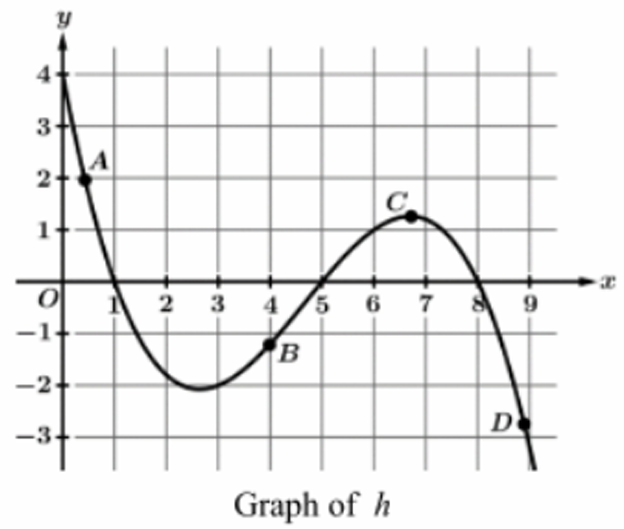
Between $A(0.5, 2)$ and $C(6.8, 1.3)$, the slope is slightly negative.
Between $B(4, -1.2)$ and $C(6.8, 1.3)$, the slope is positive as the function increases.
Between $B(4, -1.2)$ and $D(8.5, -2.8)$, the slope is $\frac{-2.8 – (-1.2)}{8.5 – 4} = \frac{-1.6}{4.5} \approx -0.35$.
Between $C(6.8, 1.3)$ and $D(8.5, -2.8)$, the slope is $\frac{-2.8 – 1.3}{8.5 – 6.8} = \frac{-4.1}{1.7} \approx -2.41$.
The value $-2.41$ is the most negative, representing the least average rate of change.
Therefore, the average rate of change is least between points $C$ and $D$.
Question 77
▶️ Answer/Explanation
The average rate of change on $[a, b]$ is given by the formula $\frac{g(b) – g(a)}{b – a}$.
Identify the interval boundaries: $a = -2$ and $b = 4$.
Calculate $g(-2)$ using the first piece: $g(-2) = 1 – (-2)^2 = 1 – 4 = -3$.
Calculate $g(4)$ using the second piece: $g(4) = 3 + 2(4) = 3 + 8 = 11$.
Substitute values into the formula: $\text{Rate} = \frac{11 – (-3)}{4 – (-2)}$.
Simplify the expression: $\text{Rate} = \frac{14}{6} = \frac{7}{3}$.
The correct option is (D).
Question 78
(B) $0.172$
(C) $0.540$
(D) $1.002$
▶️ Answer/Explanation
Find $L(x)$: Slope $m = \frac{6-2}{1-0} = 4$, so $L(x) = 4x + 2$.
Find $E(x)$: Form $y = ab^x$. At $x=0$, $a=2$; at $x=1$, $2b=6 \implies b=3$. So $E(x) = 2(3^x)$.
Define $f(x) = 4x + 2 – 2(3^x)$.
To find the maximum, set $f'(x) = 4 – 2(3^x)\ln(3) = 0$.
Solve for $x$: $3^x = \frac{2}{\ln(3)} \implies x = \frac{\ln(2/\ln(3))}{\ln(3)} \approx 0.544$.
Calculate $f(0.544) = 4(0.544) + 2 – 2(3^{0.544}) \approx 4.176 – 4.004 = 0.172$.
The correct option is (B).
Question 79
▶️ Answer/Explanation
The discount follows a geometric sequence where the first term $a_1 = 1.5\%$ and the common ratio $r = 2$.
Exceeding the purchase price means the discount percentage must be greater than $100\%$.
Week $1$: $1.5\%$
Week $2$: $3\%$
Week $3$: $6\%$
Week $4$: $12\%$
Week $5$: $24\%$
Week $6$: $48\%$
Week $7$: $96\%$
Week $8$: $192\%$, which is the first week to exceed $100\%$.
Thus, the correct option is (C).
Question 80
(B) $g(x) = 5f\left(\frac{x}{3}\right) + 7$
(C) $g(x) = 5f\left(\frac{x}{3}\right) – 7$
(D) $g(x) = 5f(3x) – 7$
▶️ Answer/Explanation
The correct answer is (C).
A horizontal dilation by a factor of $3$ replaces $x$ with $\frac{x}{3}$, giving $f\left(\frac{x}{3}\right)$.
A vertical dilation by a factor of $5$ multiplies the entire function by $5$, giving $5f\left(\frac{x}{3}\right)$.
A vertical translation by $-7$ units subtracts $7$ from the function, giving $5f\left(\frac{x}{3}\right) – 7$.
Combining these steps in the specified order results in the equation $g(x) = 5f\left(\frac{x}{3}\right) – 7$.
Question 81


▶️ Answer/Explanation
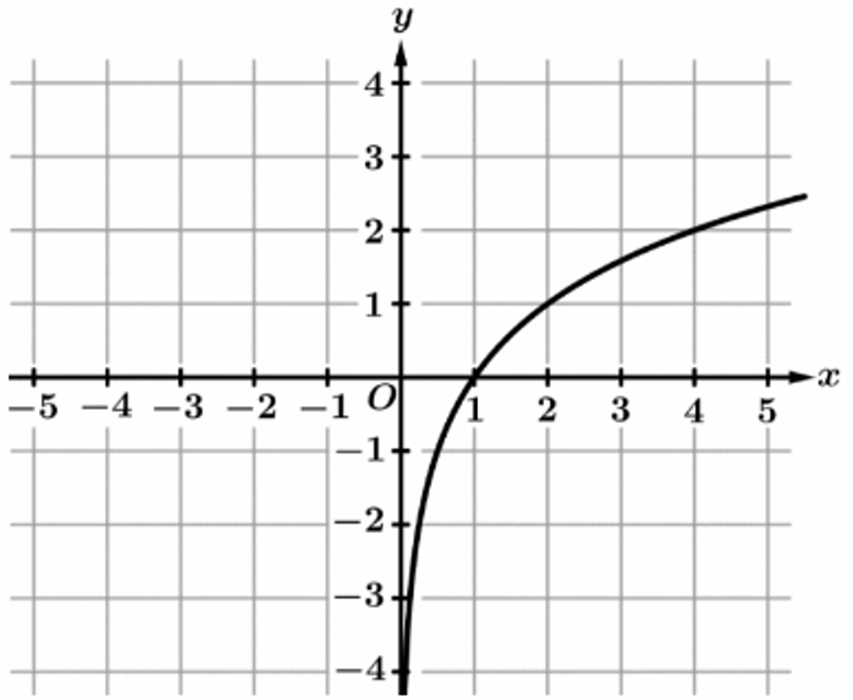
The correct graph is (B).
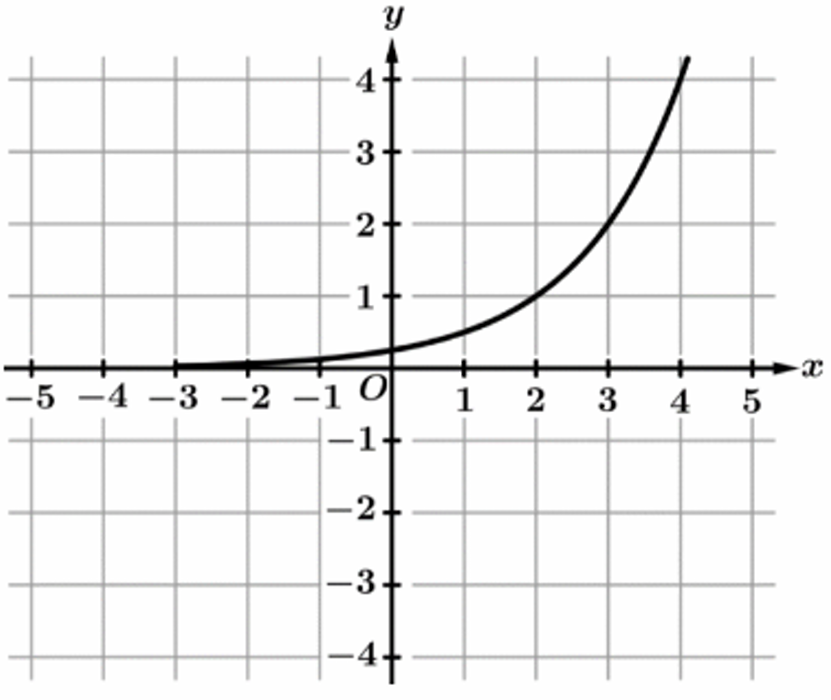
As $x \to \infty$, the output $h(x) \to \infty$, which is shown by the graph rising on the right.
As $x \to 0^+$, the output $h(x) \to -\infty$, indicating a vertical asymptote at $x = 0$.
Graph (A) represents an exponential growth function where $h(x) \to 0$ as $x \to -\infty$.
Graph (C) shows $h(x)$ decreasing as $x$ increases, contradicting the first condition.
Graph (D) shows $h(x) \to -\infty$ as $x \to \infty$, which also contradicts the prompt.
Only graph (B), typical of a logarithmic function $\log_b(x)$ where $b > 1$, fits both criteria.
Question 82
(B) One
(C) Two
(D) Infinitely many
▶️ Answer/Explanation
Using the identity $\sin(\theta + \frac{\pi}{2}) = \cos\theta$, we set $f(\theta) = g(\theta)$ as $\sin\theta = \cos\theta$.
Dividing by $\cos\theta$ (where $\cos\theta \neq 0$), we get $\tan\theta = 1$.
In the interval $[0, 2\pi]$, the tangent function equals $1$ at two specific points.
The first solution occurs in Quadrant I at $\theta = \frac{\pi}{4}$.
The second solution occurs in Quadrant III at $\theta = \frac{5\pi}{4}$.
Therefore, there are exactly two solutions within the given interval.
The correct option is (C).
Question 83
(B) $52.057^\circ\text{F}$
(C) $52.650^\circ\text{F}$
(D) $82.211^\circ\text{F}$
▶️ Answer/Explanation
Set up the initial equation: $41.7 = 63.6 + 21.9 \sin\left(\frac{2\pi}{365}(10 – c)\right)$.
Isolate the sine term: $\sin\left(\frac{2\pi}{365}(10 – c)\right) = \frac{41.7 – 63.6}{21.9} = -1$.
Find the argument: $\frac{2\pi}{365}(10 – c) = \arcsin(-1) = -\frac{\pi}{2}$.
Solve for the constant $c$: $10 – c = -\frac{365}{4}$, which gives $c = 101.25$.
Substitute $t = 59$ and $c$ into the model: $f(59) = 63.6 + 21.9 \sin\left(\frac{2\pi}{365}(59 – 101.25)\right)$.
Calculate the value: $f(59) = 63.6 + 21.9 \sin(-0.7275 \text{ radians}) \approx 52.057$.
The predicted average temperature is approximately $52.057^\circ\text{F}$.
Therefore, the correct option is (B).
Question 84
(B) $3.894$ and $13.728$ only
(C) $5.911$ and $11.590$
(D) $3.894$, $8.627$, and $13.728$
▶️ Answer/Explanation
The function $R(d)$ represents the rate of change of $M(d)$, so $M'(d) = R(d)$.
Points of inflection for $M(d)$ occur where its second derivative $M”(d)$ changes sign.
Since $M”(d) = R'(d)$, we must find where $R(d)$ has relative extrema (slopes of zero and sign changes).
Differentiate $R(d)$ to get $R'(d) = \frac{1}{200}(-4d^3 + 105d^2 – 822d + 1845)$.
Set $R'(d) = 0$ and solve for $d$ using a graphing calculator or numerical methods.
The roots of $R'(d)$ are approximately $d \approx 3.894$, $d \approx 8.627$, and $d \approx 13.728$.
At each of these values, $R'(d)$ (the second derivative of $M$) changes sign.
Therefore, $M(d)$ has points of inflection at $d = 3.894, 8.627, \text{ and } 13.728$.
Correct Option: (D)
Question 85
▶️ Answer/Explanation
Question 86

▶️ Answer/Explanation
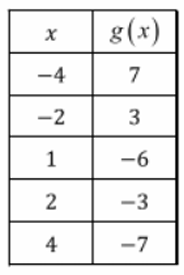
Compare the values at opposite inputs: \( g(4) = -7 \) and \( g(-4) = 7 \).
Similarly, check \( g(2) = -3 \) and \( g(-2) = 3 \).
In both cases, \( g(-x) = -g(x) \), which is the definition of an odd function.
Since \( g \) is an odd function, the relationship \( g(-1) = -g(1) \) must hold true.
From the table, we identify that \( g(1) = -6 \).
Substituting this value, we find \( g(-1) = -(-6) = 6 \).
Therefore, \( g \) is an odd function and \( g(-1) = 6 \), which matches option (B).
Question 87

▶️ Answer/Explanation
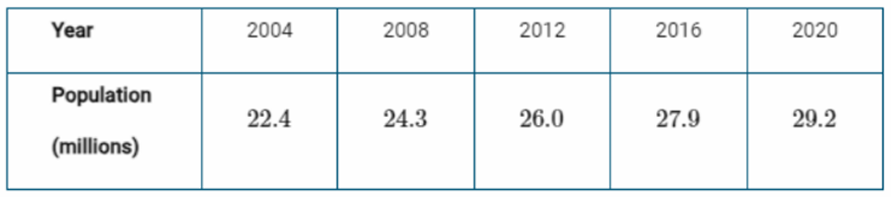
The correct option is (B) 2030.
1. Define variables and list data: Let \( x \) be the years since 2000 (so \( x=4 \) is 2004) and \( y \) be the population. The points are \((4, 22.4), (8, 24.3), (12, 26.0), (16, 27.9), (20, 29.2)\).
2. Linearize for regression: To fit \( y = a \cdot b^x \), we take the natural log: \( \ln(y) = \ln(a) + x \ln(b) \). We perform linear regression on the \( (x, \ln y) \) pairs.
3. Calculate regression parameters: Using statistical tools or a calculator, the regression yields approximately \( \ln(a) \approx 3.0516 \) and \( \ln(b) \approx 0.0167 \), giving \( a \approx 21.15 \) and \( b \approx 1.0168 \).
4. Establish the model: The exponential function is approximately \( f(x) = 21.15 \cdot (1.0168)^x \).
5. Set target population: We need to find \( x \) when \( f(x) = 35 \). So, \( 35 = 21.15 \cdot (1.0168)^x \).
6. Solve for x: Divide by 21.15 to get \( 1.6548 \approx (1.0168)^x \). Take the natural log: \( \ln(1.6548) = x \cdot \ln(1.0168) \), which gives \( 0.5037 \approx 0.0167x \). Thus, \( x \approx 30.1 \).
7. Convert to year: Since \( x \) is the number of years after 2000, the year is \( 2000 + 30 = 2030 \).
Question 1

▶️ Answer/Explanation
(A)(i) Find \( h(3) \)
The function is defined as \( h(x) = g(f(x)) \).
First, we find the value of the inner function, \( f(3) \).
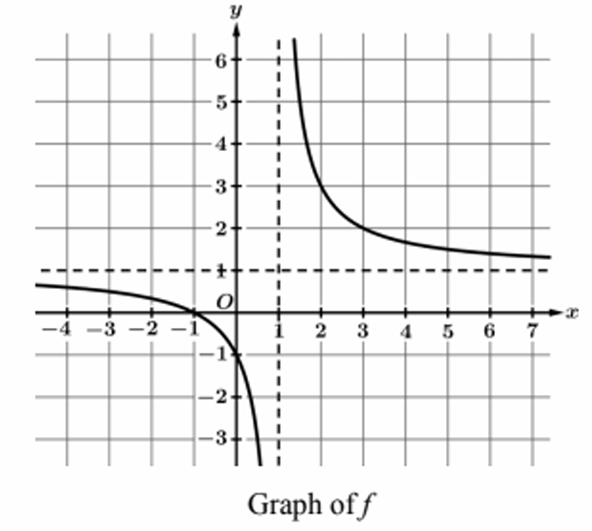
According to the problem text and graph, the point \( (3, 2) \) lies on the graph of \( f \). Therefore, \( f(3) = 2 \).
Now, substitute this value into the outer function \( g(x) \):
\( h(3) = g(2) \)
Using the definition \( g(x) = 2 + 3\ln x \):
\( g(2) = 2 + 3\ln(2) \)
Using a calculator to approximate \( \ln(2) \approx 0.693 \):
\( g(2) = 2 + 3(0.6931…) \approx 2 + 2.079 = 4.079 \)
Answer: \( h(3) \approx 4.079 \)
(A)(ii) Find real zeros of \( f \)
A real zero of a function occurs where the graph intersects the x-axis (where \( f(x) = 0 \)).
Looking at the provided graph, the curve intersects the x-axis at \( x = -1 \).
The problem text confirms the point \( (-1, 0) \) is on the graph.
There are no other intersections with the x-axis shown.
Answer: \( x = -1 \)
(B)(i) Find \( x \) for \( g(x) = e \)
Set up the equation:
\( 2 + 3\ln x = e \)
Subtract 2 from both sides:
\( 3\ln x = e – 2 \)
Divide by 3:
\( \ln x = \frac{e – 2}{3} \)
Convert from logarithmic to exponential form to solve for \( x \):
\( x = e^{\left(\frac{e – 2}{3}\right)} \)
Approximating the value (using \( e \approx 2.718 \)):
\( x \approx e^{0.2394} \)
Answer: \( x \approx 1.271 \)
(B)(ii) End behavior of \( g \)
We need to evaluate the limit as \( x \to \infty \) for \( g(x) = 2 + 3\ln x \).
As \( x \) increases without bound (\( x \to \infty \)), the natural logarithm function \( \ln x \) also increases without bound (\( \ln x \to \infty \)).
Multiplying by 3 and adding 2 does not change the unbounded nature.
Answer: \( \lim_{x \to \infty} g(x) = \infty \)
(C)(i) Is \( f \) invertible?
Answer: Yes, \( f \) is invertible.
(C)(ii) Reason
A function is invertible if and only if it is one-to-one. This can be verified visually using the Horizontal Line Test.
Looking at the graph of \( f(x) \):
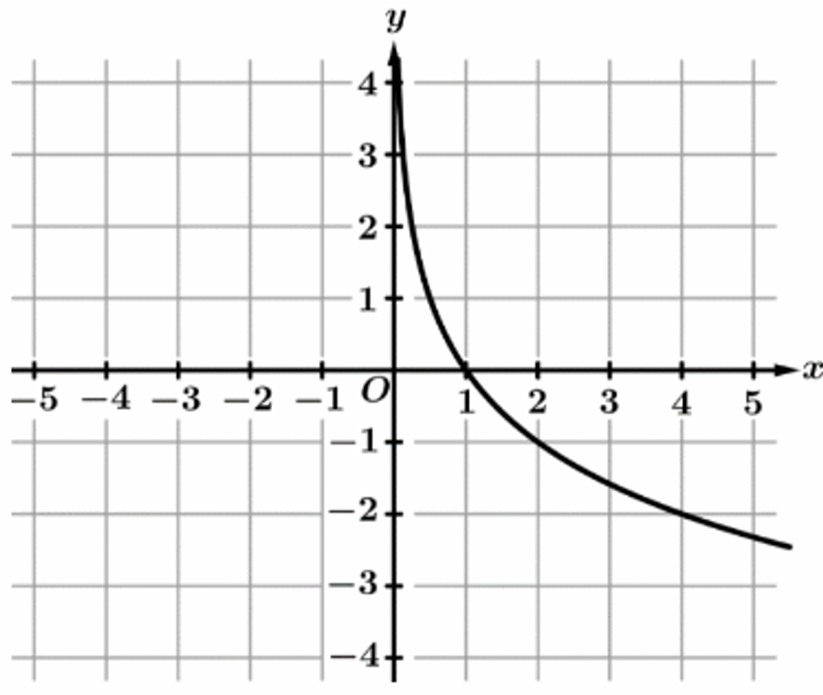
1. The function is strictly decreasing on both branches of its domain (\( x < 1 \) and \( x > 1 \)).
2. The range of the left branch appears to be \( (-\infty, 1) \) and the range of the right branch appears to be \( (1, \infty) \).
Because the y-values do not repeat (no horizontal line intersects the graph more than once), the function is one-to-one.
Therefore, \( f \) has an inverse.
Question 2
(A) (i) Use the given data to write two equations that can be used to find the values for constants \(a\) and \(b\) in the expression for \(R(t)\).
(ii) Find the values for \(a\) and \(b\) as decimal approximations.
(B) (i) Use the given data to find the average rate of change in the number of students that have heard the rumor, in students per hour, from \(t=2\) to \(t=6\) hours. Express your answer as a decimal approximation. Show the computations that lead to your answer.
(ii) Interpret the meaning of your answer from (i) in the context of the problem.
(iii) Consider the values that result from using the average rate of change found in (i) to estimate the number of students that have heard the rumor for times \(t=p\) hours, where \(0 < p < 6\). Are these estimates less than or greater than the number of students predicted by the model \(R\) for times \(t=p\) hours? Explain your reasoning using characteristics of the average rate of change and characteristics of the model \(R\).
▶️ Answer/Explanation
Part (A)
(i) Writing the equations:
We are given the following data points:
• At \(t=2\), \(R(2) = 15\).
• At \(t=6\), \(R(6) = 67\).
For \(t=2\), since \(0 \le 2 < 6\), we use the first part of the piecewise function: \(R(t) = 7(a)^{t/2}\).
$$15 = 7(a)^{2/2} \quad \Rightarrow \quad 15 = 7a^1$$
Equation 1: \(15 = 7a\)
For \(t=6\), since \(t \ge 6\), we use the second part of the piecewise function: \(R(t) = -213.29 + b \ln t\).
Equation 2: \(67 = -213.29 + b \ln(6)\)
(ii) Finding the values for \(a\) and \(b\):
From Equation 1:
$$a = \frac{15}{7} \approx 2.1428$$
From Equation 2:
$$67 + 213.29 = b \ln(6)$$
$$280.29 = b \ln(6)$$
$$b = \frac{280.29}{\ln(6)} \approx \frac{280.29}{1.79176} \approx 156.4328$$
Answer: \(a \approx 2.143\), \(b \approx 156.433\)
Part (B)
(i) Average Rate of Change:
The formula for the average rate of change from \(t=2\) to \(t=6\) is:
$$\text{Avg Rate} = \frac{R(6) – R(2)}{6 – 2}$$
Substituting the given values (\(R(6)=67\) and \(R(2)=15\)):
$$\text{Avg Rate} = \frac{67 – 15}{4} = \frac{52}{4} = 13$$
Answer: 13 students per hour.
(ii) Interpretation:
On average, the number of students who have heard the rumor increases by 13 students per hour between the 2nd hour and the 6th hour.
(iii) Estimates vs. Model Prediction:
Answer: The estimates are greater than the number of students predicted by the model.
Reasoning:
• On the interval \(0 < t < 6\), the function \(R(t) = 7(a)^{t/2}\) is an exponential growth function with a base greater than 1.
• Exponential growth functions are concave up (the rate of change is increasing).
• The average rate of change corresponds to the slope of the secant line connecting the points at \(t=2\) and \(t=6\).
• For a concave up curve, the secant line lies above the curve on the interval between the two points. Therefore, linear estimates based on the average rate (secant line) will be greater than the actual function values.
Part (C)
The range values (outputs) of \(R(t)\) represent the number of students. In the context of the problem, this range must be limited in two ways:
1. Population Cap: The number of students who heard the rumor cannot exceed the total student population of the school.
2. Discrete Values: You cannot have a fraction of a student, so strictly speaking, the context implies the range should consist of whole numbers (non-negative integers).
Question 3


- a. (h) is positive and increasing.
- b. (h) is positive and decreasing.
- c. (h) is negative and increasing.
- d. (h) is negative and decreasing.
▶️ Answer/Explanation
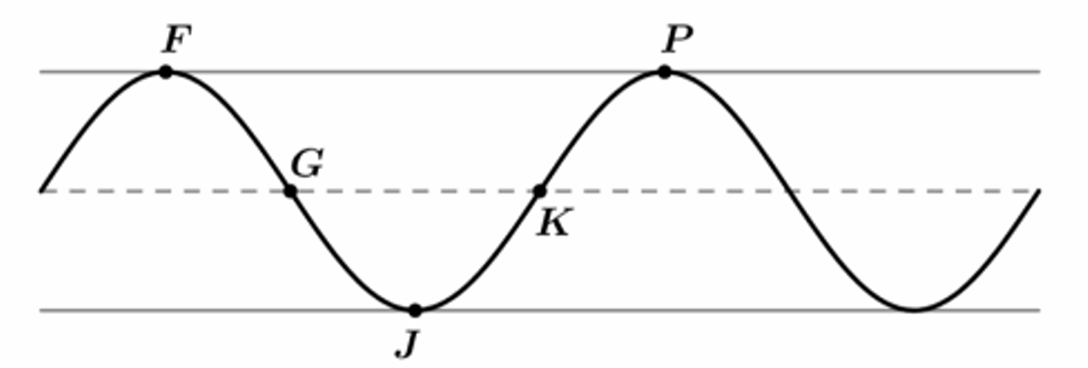
(A) Coordinates for the points (F, G, J, K), and (P)
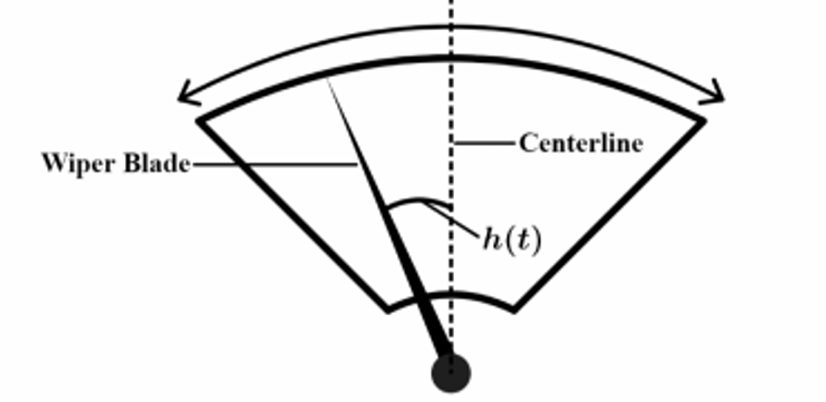
First, we analyze the motion to establish the timeline:
- At (t = 0), the blade is farthest left, so (h(0) = -0.75). This is a minimum value.
- At (t = 1), the blade is farthest right, so (h(1) = 0.75). This is a maximum value.
- At (t = 2), the blade is farthest left again, so (h(2) = -0.75). This is the next minimum.
The graph shows a sinusoidal wave. Let’s map the points based on this cycle:
- Point (F): This is the first maximum peak shown. Since the motion starts at a minimum at (t=0), the first maximum occurs at (t=1).
Coordinate: (F(1, 0.75)) - Point (G): This point is on the midline (where (h(t)=0)) as the graph goes downwards from a maximum to a minimum. This occurs exactly halfway between the maximum at (t=1) and the minimum at (t=2).
(t = \frac{1+2}{2} = 1.5).
Coordinate: (G(1.5, 0)) - Point (J): This is the minimum trough. We know the minimum occurs at (t=2).
Coordinate: (J(2, -0.75)) - Point (K): This point is on the midline as the graph goes upwards from a minimum to the next maximum. This occurs halfway between the minimum at (t=2) and the next maximum at (t=3).
(t = \frac{2+3}{2} = 2.5).
Coordinate: (K(2.5, 0)) - Point (P): This is the next maximum peak. The period is (2) seconds (from (t=1) to (t=3)).
Coordinate: (P(3, 0.75))
(B) Finding constants (a, b, c), and (d)
We are fitting the function (h(t) = a\sin(b(t+c)) + d).
- Amplitude ((a)): Half the distance between max and min.
(a = \frac{0.75 – (-0.75)}{2} = 0.75). - Vertical Shift ((d)): The average of max and min.
(d = \frac{0.75 + (-0.75)}{2} = 0). - Period ((T)) and Frequency ((b)): The wiper completes a full cycle (left-right-left) in (2) seconds.
(T = 2).
The formula for period is (T = \frac{2\pi}{b}).
(2 = \frac{2\pi}{b} \Rightarrow b = \pi). - Phase Shift ((c)):
We know the function starts at a minimum at (t=0). A standard positive sine wave starts at 0 and goes up. A sine wave shifted to match this graph must cross the midline going upwards at (t=0.5) (halfway between min at (0) and max at (1)).
So, we need the argument of the sine function, (b(t+c)), to be (0) when (t=0.5).
(\pi(0.5 + c) = 0 \Rightarrow c = -0.5).
Alternatively, using (c=1.5) is also valid, but (-0.5) is the simplest magnitude.
Values:
(a = 0.75)
(b = \pi)
(c = -0.5)
(d = 0)
(C) Analysis of interval ((t_1, t_2))
From part (A), (t_1) (point (G)) is (1.5) and (t_2) (point (J)) is (2). The interval is ((1.5, 2)).
(i) Which statement is true?
Looking at the graph between point (G) and point (J):
The graph is below the midline, meaning the values of (h) are negative.
The graph is moving downwards towards the minimum, meaning (h) is decreasing.
Answer: d. (h) is negative and decreasing.
(ii) Rate of change of (h)
The “rate of change of (h)” refers to the derivative, (h'(t)) (the slope of the tangent line).
On the interval ((1.5, 2)), the graph is concave up (it is shaped like a cup).
Mathematically:
– At (G) ((t=1.5)), the slope is at its steepest negative value.
– At (J) ((t=2)), the slope is zero (horizontal tangent at the minimum).
– As the slope goes from a negative number (e.g., (-2)) to (0), the value of the slope is increasing.
Answer: The rate of change of (h) is increasing on the interval ((t_1, t_2)).
Question 4
Directions:
- Unless otherwise specified, the domain of a function \( f \) is assumed to be the set of all real numbers \( x \) for which \( f(x) \) is a real number. Angle measures for trigonometric functions are assumed to be in radians.
- Solutions to equations must be real numbers. Determine the exact value of any expression that can be obtained without a calculator.
- Unless otherwise specified, combine terms using algebraic methods and rules for exponents and logarithms where applicable.
- For each part of the question, show the work that leads to your answers.
(A) The functions \( g \) and \( h \) are given by
\( g(x) = 3^{(2x)} \cdot 3^{(x+4)} \)
\( h(x) = 2\tan^2 x – 1 \)
(ii) Solve \( h(x) = 5 \) for values of \( x \) in the interval \( [0, 2\pi) \).
(B) The functions \( j \) and \( k \) are given by
\( j(x) = 2\log_{10}(x+3) – \log_{10} x – \log_{10} 3 \)
\( k(x) = \frac{(\tan^2 x)(\cot x)}{\csc x} \)
(ii) Rewrite \( k(x) \) as a fraction involving \( \sec x \) and no other trigonometric functions.
(C) The function \( m \) is given by
\( m(x) = \frac{2^{(5x+3)}}{\left(2^{(x-2)}\right)^3} \)
▶️ Answer/Explanation
(A)(i) Solve \( g(x) = 27 \)
First, simplify the expression for \( g(x) \) using the property of exponents \( a^m \cdot a^n = a^{m+n} \).
\( g(x) = 3^{2x} \cdot 3^{x+4} = 3^{(2x + x + 4)} = 3^{(3x+4)} \)
Set \( g(x) \) equal to 27 and rewrite 27 as a base of 3:
\( 3^{(3x+4)} = 27 \)
\( 3^{(3x+4)} = 3^3 \)
Since the bases are equal, the exponents must be equal:
\( 3x + 4 = 3 \)
\( 3x = 3 – 4 \)
\( 3x = -1 \)
\( x = -\frac{1}{3} \)
(A)(ii) Solve \( h(x) = 5 \) on \( [0, 2\pi) \)
Set the expression for \( h(x) \) equal to 5:
\( 2\tan^2 x – 1 = 5 \)
Add 1 to both sides:
\( 2\tan^2 x = 6 \)
Divide by 2:
\( \tan^2 x = 3 \)
Take the square root of both sides:
\( \tan x = \pm\sqrt{3} \)
The reference angle for \( \tan \theta = \sqrt{3} \) is \( \frac{\pi}{3} \).
Since we have \( \pm\sqrt{3} \), we must consider solutions in all four quadrants within the interval \( [0, 2\pi) \):
Quadrant I: \( x = \frac{\pi}{3} \)
Quadrant II: \( x = \pi – \frac{\pi}{3} = \frac{2\pi}{3} \)
Quadrant III: \( x = \pi + \frac{\pi}{3} = \frac{4\pi}{3} \)
Quadrant IV: \( x = 2\pi – \frac{\pi}{3} = \frac{5\pi}{3} \)
Solution set: \( x = \frac{\pi}{3}, \frac{2\pi}{3}, \frac{4\pi}{3}, \frac{5\pi}{3} \)
(B)(i) Rewrite \( j(x) \) as a single logarithm
Given: \( j(x) = 2\log_{10}(x+3) – \log_{10} x – \log_{10} 3 \)
Use the power rule \( n\log a = \log(a^n) \):
\( = \log_{10}((x+3)^2) – \log_{10} x – \log_{10} 3 \)
Factor out the negative sign for the last two terms to group them:
\( = \log_{10}((x+3)^2) – (\log_{10} x + \log_{10} 3) \)
Use the product rule \( \log a + \log b = \log(ab) \):
\( = \log_{10}((x+3)^2) – \log_{10}(3x) \)
Use the quotient rule \( \log a – \log b = \log(\frac{a}{b}) \):
\( = \log_{10}\left(\frac{(x+3)^2}{3x}\right) \)
(B)(ii) Rewrite \( k(x) \) involving \( \sec x \)
Given: \( k(x) = \frac{(\tan^2 x)(\cot x)}{\csc x} \)
First, simplify the numerator using \( \tan x \cdot \cot x = 1 \):
\( (\tan^2 x)(\cot x) = \tan x \cdot (\tan x \cdot \cot x) = \tan x \cdot 1 = \tan x \)
Now substitute back into the expression:
\( k(x) = \frac{\tan x}{\csc x} \)
Convert to sine and cosine:
\( = \frac{\frac{\sin x}{\cos x}}{\frac{1}{\sin x}} \)
\( = \frac{\sin x}{\cos x} \cdot \frac{\sin x}{1} = \frac{\sin^2 x}{\cos x} \)
We need the expression in terms of \( \sec x \). Use the identity \( \sin^2 x = 1 – \cos^2 x \):
\( = \frac{1 – \cos^2 x}{\cos x} \)
Substitute \( \cos x = \frac{1}{\sec x} \):
\( = \frac{1 – \left(\frac{1}{\sec x}\right)^2}{\frac{1}{\sec x}} \)
\( = \frac{1 – \frac{1}{\sec^2 x}}{\frac{1}{\sec x}} \)
Find a common denominator for the numerator:
\( = \frac{\frac{\sec^2 x – 1}{\sec^2 x}}{\frac{1}{\sec x}} \)
Multiply by the reciprocal of the denominator:
\( = \frac{\sec^2 x – 1}{\sec^2 x} \cdot \frac{\sec x}{1} \)
\( = \frac{\sec^2 x – 1}{\sec x} \)
(C) Find input values for \( m(x) = \frac{1}{16} \)
First, simplify the expression for \( m(x) \):
\( m(x) = \frac{2^{(5x+3)}}{\left(2^{(x-2)}\right)^3} \)
Simplify the denominator using the power rule \( (a^m)^n = a^{m \cdot n} \):
\( \left(2^{(x-2)}\right)^3 = 2^{3(x-2)} = 2^{3x-6} \)
Now apply the quotient rule \( \frac{a^m}{a^n} = a^{m-n} \):
\( m(x) = \frac{2^{5x+3}}{2^{3x-6}} = 2^{(5x+3) – (3x-6)} \)
\( = 2^{5x + 3 – 3x + 6} \)
\( = 2^{2x + 9} \)
Set \( m(x) = \frac{1}{16} \) and rewrite \( \frac{1}{16} \) as a power of 2:
\( \frac{1}{16} = \frac{1}{2^4} = 2^{-4} \)
Equate the simplified \( m(x) \) to \( 2^{-4} \):
\( 2^{2x + 9} = 2^{-4} \)
Equate the exponents:
\( 2x + 9 = -4 \)
\( 2x = -13 \)
\( x = -\frac{13}{2} \) or \( -6.5 \)