Question 1
▶️ Answer/Explanation
An odd function satisfies the condition $f(-x) = -f(x)$, which implies symmetry about the origin.
The given limit $\lim_{x \to 3^-} f(x) = -\infty$ describes the behavior as $x$ approaches $3$ from the left.
To find the behavior near $-3$, we substitute $x$ with $-t$, so as $x \to -3^+$, then $t \to 3^-$.
Using the odd property: $f(x) = f(-t) = -f(t)$.
Therefore, $\lim_{x \to -3^+} f(x) = \lim_{t \to 3^-} [-f(t)] = -(-\infty) = \infty$.
This matches option d.
Correct Option: d
Question 2
ii. $(g \circ f)(x)$
iii. $\frac{g(x)}{f(x)}$
b. ii only
c. i and iii only
d. i, ii, and iii
▶️ Answer/Explanation
For i: $f(x) + g(x)$ requires $x \ge 0$ and $x \neq 2$, resulting in $[0, 2) \cup (2, \infty)$.
For ii: $(g \circ f)(x) = \frac{1}{\sqrt{x}-2}$ requires $x \ge 0$ and $\sqrt{x} \neq 2$, so $x \neq 4$.
For iii: $\frac{g(x)}{f(x)} = \frac{1}{\sqrt{x}(x-2)}$ requires $x > 0$ and $x \neq 2$, making the domain $(0, 2) \cup (2, \infty)$.
Only the first combination matches the required domain precisely.
The correct option is a.
Question 3

b. $[C, D]$
c. $[E, F]$
d. $[G, H]$
▶️ Answer/Explanation
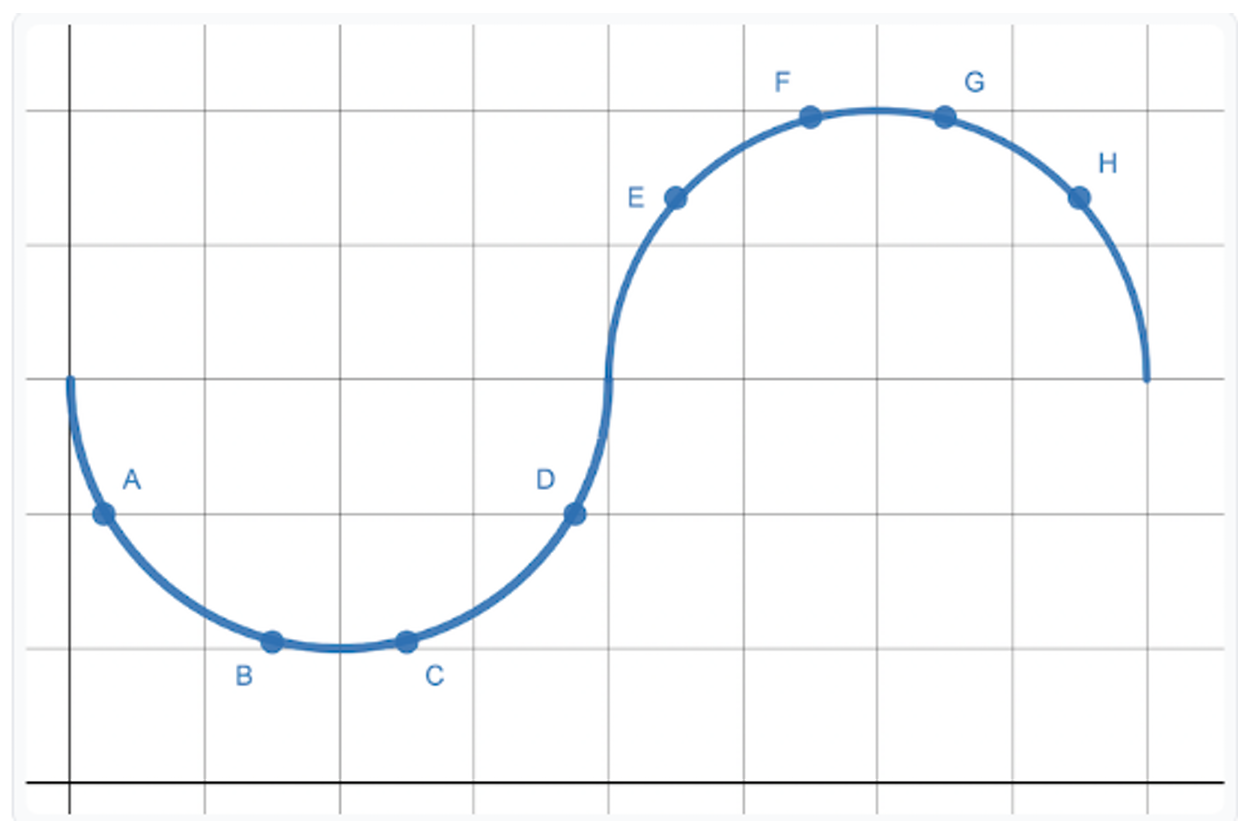
The average rate of change of $-2$ implies the slope of the secant line between the points is negative.
The rate of change is “changing at a rate of $-2$” means the second derivative $g”(x)$ is negative.
An interval where $g”(x) < 0$ corresponds to the graph being concave down.
Interval $[A, B]$ has a negative slope but is concave up.
Interval $[C, D]$ has a positive slope and is concave up.
Interval $[E, F]$ has a positive slope and is concave down.
Interval $[G, H]$ has a negative slope and is concave down.
Therefore, the only interval that satisfies both conditions is d.$[G, H]$.
Question 4

▶️ Answer/Explanation
A point of inflection is a point on a curve at which the concavity changes (from concave up to concave down, or vice versa). This occurs where the second derivative $g”(x)$ changes sign.
- In interval $[B, C]$: The graph is strictly concave down (the “frown” shape), meaning $g”(x) < 0$. No change occurs.
- In interval $[D, E]$: The graph is strictly concave up (the “cup” shape), meaning $g”(x) > 0$. No change occurs.
- In interval $[G, H]$: The curve transitions from being concave up (after the local minimum at F) to concave down (as it approaches the peak after H). Because the “bend” of the graph reverses direction within this window, a point of inflection must exist here.
Question 5


▶️ Answer/Explanation
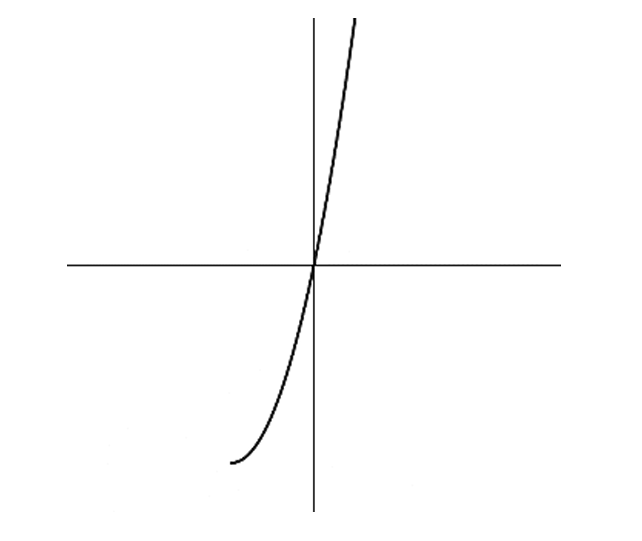
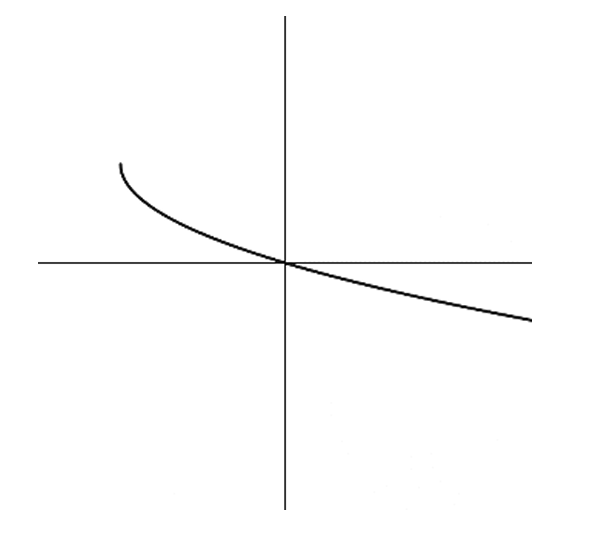
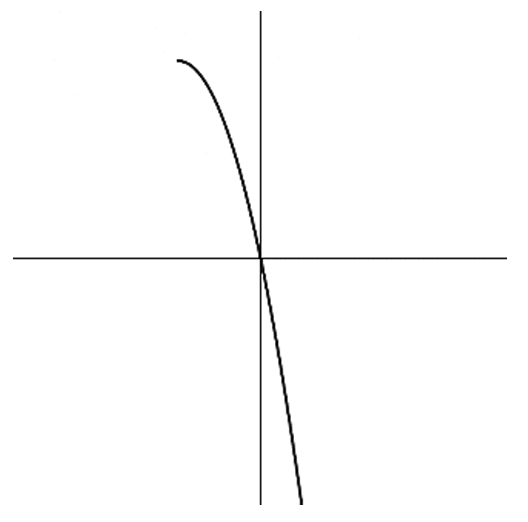
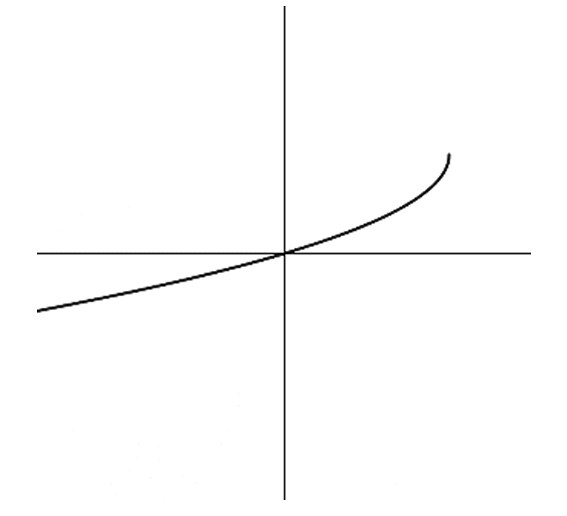
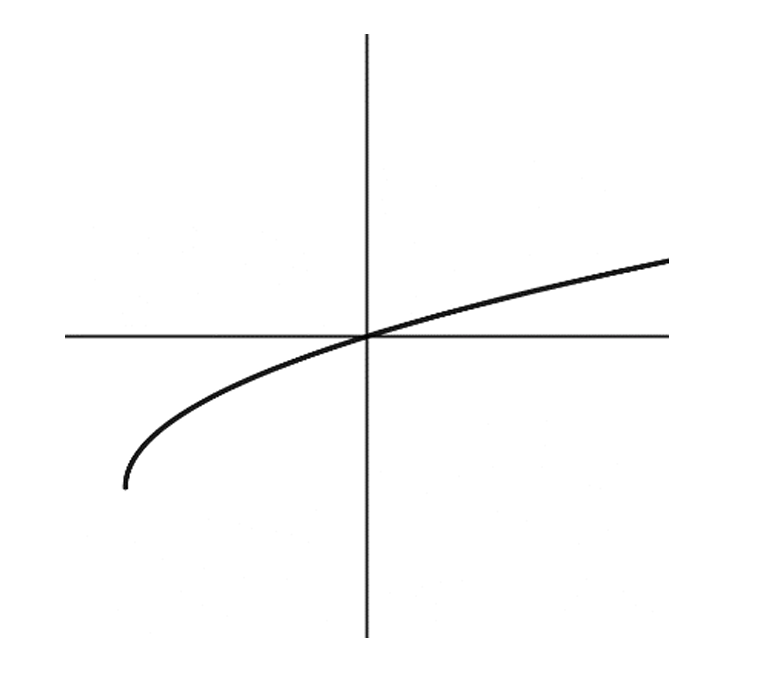
The inverse of a function $f(x)$ is found by reflecting its graph across the line $y = x$.
In the original graph, the curve passes through the origin $(0,0)$.
The original function has a slow horizontal growth in the first quadrant and a steep drop in the third quadrant.
When reflected across $y = x$, the horizontal behavior becomes vertical and the vertical becomes horizontal.
This results in a graph that is steep in the first quadrant and flattens out in the third quadrant.
Comparing the choices, Option (a) correctly represents this reflection.
Therefore, the correct representation of the inverse $f^{-1}(x)$ is a.
Question 6
b. $\lim_{x \to \infty} h(x) = -\infty$ and $\lim_{x \to -\infty} h(x) = -\infty$
c. $\lim_{x \to \infty} h(x) = \infty$ and $\lim_{x \to -\infty} h(x) = -\infty$
d. $\lim_{x \to \infty} h(x) = -\infty$ and $\lim_{x \to -\infty} h(x) = \infty$
▶️ Answer/Explanation
The leading term of $g(x)$ is $-2x^8$, so as $x \to \pm\infty$, $g(x) \to -\infty$.
The composite function is $h(x) = f(g(x))$, where the leading term of $f(x)$ is $x^4$.
As $x \to \infty$, $h(x) \approx f(-2x^8) \approx (-2x^8)^4 = 16x^{32}$, which approaches $\infty$.
As $x \to -\infty$, $h(x) \approx f(-2x^8) \approx (-2x^8)^4 = 16x^{32}$, which approaches $\infty$.
Since both ends approach positive infinity, the correct option is a.
Final Result: $\lim_{x \to \infty} h(x) = \infty$ and $\lim_{x \to -\infty} h(x) = \infty$.
Question 7
ii. There is a vertical discontinuity at $x = 1$
iii. There is a removable discontinuity at $x = \frac{2}{3}$
b. ii only
c. i and ii only
d. i, ii, and iii
▶️ Answer/Explanation
Factor the numerator: $3x^2 + 4x – 4 = (3x – 2)(x + 2)$.
Factor the denominator: $x^2 + x – 2 = (x – 1)(x + 2)$.
Identify the points of discontinuity at $x = -2$ and $x = 1$.
Since $(x + 2)$ is a common factor, $x = -2$ is a removable discontinuity.
Since $(x – 1)$ remains in the denominator, $x = 1$ is a vertical discontinuity (asymptote).
The value $x = \frac{2}{3}$ is a zero of the function, not a discontinuity.
Therefore, statements i and ii are true.
Correct Option: c. i and ii only
Question 8


▶️ Answer/Explanation
The correct answer is c.
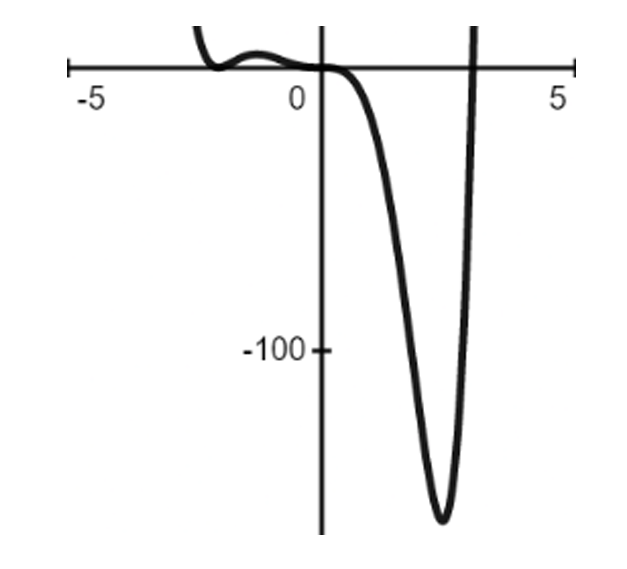
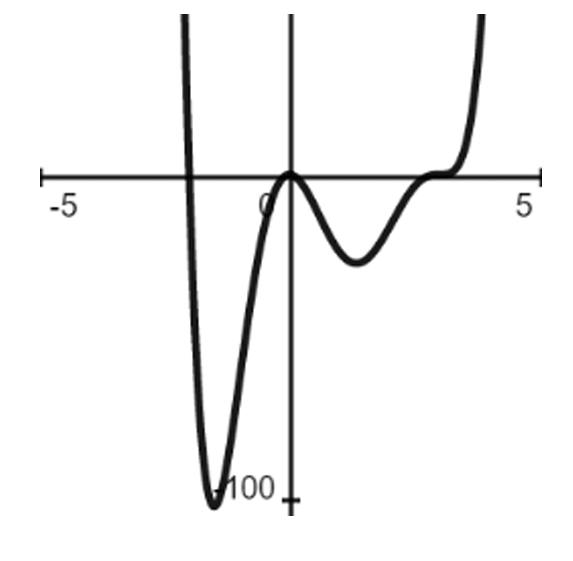
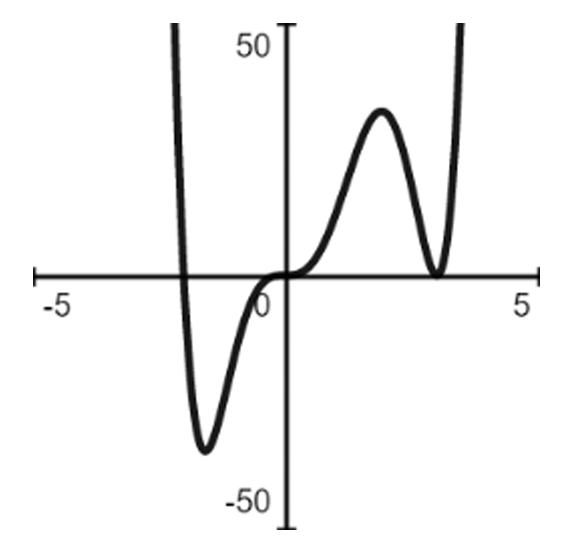
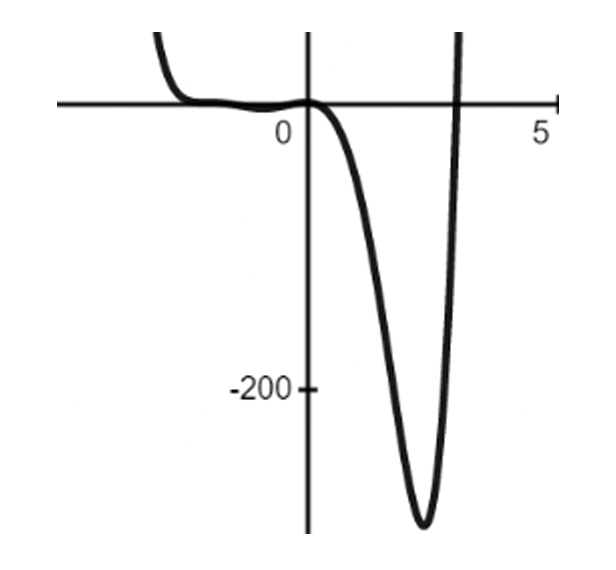
Identify roots: $x = -2$ (multiplicity $3$), $x = 0$ (multiplicity $2$), and $x = 3$ (multiplicity $1$).
Determine degree: The total degree is $2 + 3 + 1 = 6$, which is an even number.
Leading coefficient: Since it is positive ($+1$), the end behavior is $y \to \infty$ as $x \to \pm\infty$.
At $x = -2$, the graph crosses the x-axis with an “S-curve” (inflection) due to the cubic power.
At $x = 0$, the graph touches and bounces off the x-axis because the power is even ($2$).
At $x = 3$, the graph crosses the axis linearly because the power is odd ($1$).
Graph c is the only one showing the correct bounce at $x = 0$ and the correct end behavior.
Question 9
b. $-4$
c. $-8$
d. $-1.5$
▶️ Answer/Explanation
Since coefficients are real, the complex conjugate $-1 – i$ is also a zero.
The sum of all four roots is given by $-\frac{b}{a} = -\frac{6}{1} = -6$.
The sum of the complex roots is $(-1 + i) + (-1 – i) = -2$.
Let the real roots be $r_1$ and $r_2$.
Then, $(r_1 + r_2) + (-2) = -6$.
Solving for the sum of real roots: $r_1 + r_2 = -6 + 2 = -4$.
The correct option is b. $-4$.
Question 10

$g(x)$ is continuous on all real numbers with selected $x$ values below:
![]()
b. $g(x)$
c. $h(x)$
d. Both $g(x)$ and $h(x)$
▶️ Answer/Explanation
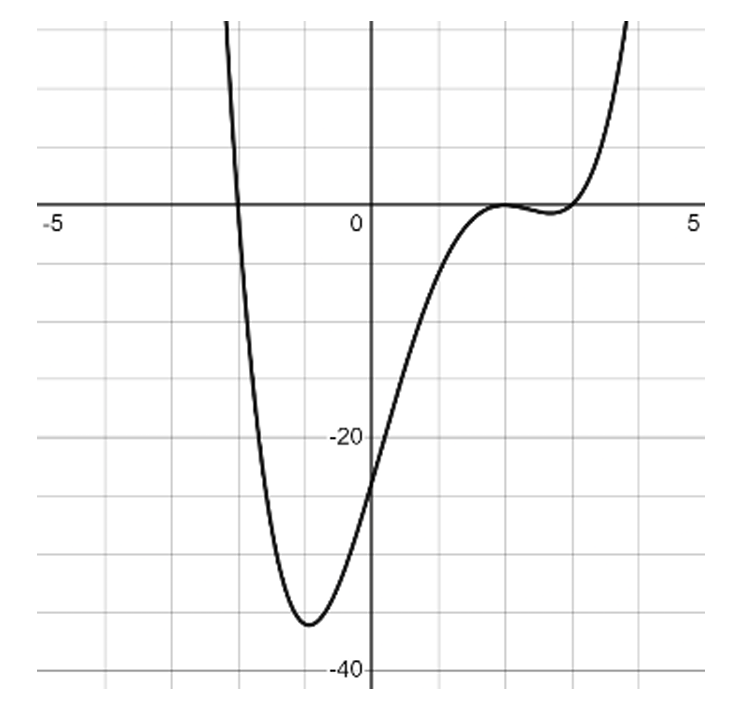
For $f(x)$, the highest power of $x$ is $5$, so the degree is $5$.
For $g(x)$, the values change sign/direction $3$ times (roots exist between $-18$ and $-12$, $-12$ and $-6$, $-6$ and $0$), implying at least degree $4$.
For $h(x)$, the graph shows $3$ turning points and $2$ x-intercepts (one being a touch/bounce point).
A bounce at an x-intercept indicates a multiplicity of at least $2$, and another crossing indicates at least $1$.
The $3$ turning points on $h(x)$ suggest a minimum degree of $4$.
Both $g(x)$ and $h(x)$ have a minimum degree of $4$, which is lower than $f(x)$’s degree of $5$.
Therefore, both $g(x)$ and $h(x)$ share the lowest potential degree among the choices.
Correct Option: d
Question 11
b. Vertical Dilation of $7$, Up $1$, Right $2$, Flip over $x$-axis.
c. Vertical Dilation of $7$, Up $1$, Left $2$, Flip over $y$-axis.
d. Vertical Dilation of $7$, Up $1$, Left $2$, Flip over $x$-axis.
▶️ Answer/Explanation
First, use polynomial long division to rewrite $g(x) = \frac{x-5}{x+2}$ as $1 – \frac{7}{x+2}$.
This can be expressed in transformation form as $g(x) = -7 \left( \frac{1}{x+2} \right) + 1$.
The term $(x+2)$ in the denominator indicates a horizontal shift Left $2$ units.
The multiplier of $7$ indicates a Vertical Dilation (stretch) of $7$.
The negative sign in front of the $7$ represents a Flip (reflection) over the $x$-axis.
The $+1$ at the end indicates a vertical shift Up $1$ unit.
Comparing these steps to the given options, the correct choice is d.
Question 12
▶️ Answer/Explanation
Factor the numerator: $x^2 + 4x – 32 = (x+8)(x-4)$.
Identify critical points where the expression is zero or undefined: $x = -8, x = 4,$ and $x = -4$.
Note that $x \neq -4$ because the denominator cannot be zero.
Test the intervals on a number line: $(-\infty, -8]$, $[-8, -4)$, $(-4, 4]$, and $[4, \infty)$.
For $x \in [-8, -4)$, the expression is positive or zero.
For $x \in [4, \infty)$, the expression is positive or zero.
The final solution set is $[-8, -4) \cup [4, \infty)$, which matches option a.
Question 13
▶️ Answer/Explanation
Identify the leading terms in the numerator and denominator.
The numerator’s leading term is $-x^8$ and the denominator’s is $2x^8$.
Since the degrees are equal ($8 = 8$), the horizontal asymptote is the ratio of leading coefficients.
The limit as $x \to -\infty$ is determined by $\frac{-1}{2}$.
Therefore, $\lim_{x \to -\infty} f(x) = -1/2$.
This matches option b.
Question 14
▶️ Answer/Explanation
For power functions of the form $x^n$ where $0 < x < 1$, the function with the smallest exponent yields the highest output.
Comparing the given exponents: $9/2 = 4.5$, $4$, $2/3 \approx 0.67$, and $1/7 \approx 0.14$.
The smallest exponent among the choices is $1/7$.
Therefore, $h(x) = x^{1/7}$ will stay closer to $1$ for longer within the interval $(0, 1)$.
For example, if $x = 0.1$, then $0.1^{4.5} < 0.1^4 < 0.1^{2/3} < 0.1^{1/7}$.
Thus, $h(x)$ has the highest output value in the specified range.
The correct option is d.
Question 15
▶️ Answer/Explanation
The correct option is c.
Apply the Power Property: $4 \log_{7} x = \log_{7} x^{4}$, $4 \log_{7} z = \log_{7} z^{4}$, and $24 \log_{7} y = \log_{7} y^{24}$.
Rewrite the expression: $\log_{7} x^{4} + \log_{7} z^{4} – \log_{7} y^{24}$.
Apply the Product Property to the addition: $\log_{7} (x^{4} \cdot z^{4}) – \log_{7} y^{24}$.
Apply the Quotient Property to the subtraction: $\log_{7} \frac{x^{4}z^{4}}{y^{24}}$.
This matches the expression in option c: $\log_{7} \frac{z^{4}x^{4}}{y^{24}}$.
Question 16
b. $x = \frac{-3e+1}{3}$
c. $x = 167$
d. $x = \frac{-e^2-24}{6}$
▶️ Answer/Explanation
The correct option is a.
Start with the equation: $\ln(-3x – 7) – \ln 7 = 5$.
Apply the quotient rule for logarithms: $\ln\left(\frac{-3x – 7}{7}\right) = 5$.
Rewrite in exponential form: $\frac{-3x – 7}{7} = e^5$.
Multiply both sides by $7$ to get: $-3x – 7 = 7e^5$.
Add $7$ to both sides: $-3x = 7e^5 + 7$.
Solve for $x$ by dividing by $-3$: $x = \frac{7e^5 + 7}{-3}$.
Check domain: $-3x-7 > 0$ is satisfied by this value.
Question 17
▶️ Answer/Explanation
The common ratio is $r = \frac{a_5}{a_4} = \frac{64}{32} = 2$.
Using the formula $a_n = a_1 \cdot r^{n-1}$, we find $a_4 = a_1 \cdot 2^{4-1}$.
Substitute the known values: $32 = a_1 \cdot 2^3$, which means $32 = a_1 \cdot 8$.
Solving for the first term gives $a_1 = \frac{32}{8} = 4$.
The explicit formula is $a_n = 4 \cdot 2^{n-1}$.
Comparing this to the given options, the correct choice is c.
Question 18
▶️ Answer/Explanation
The standard doubling formula is y=a 0 (2) n , where n is the number of doubling periods.
The organism doubles every 3 hours, so there are 24/3=8 doubling periods per day.
Since t represents the number of days, the total number of doubling periods is 8×t.
Substituting n=8t into the growth formula gives y=a 0 (2) 8t .
This matches option b.
The correct equation must account for the unit conversion from hours to days.
Question 19

b. A logarithmic regression is not appropriate for this data set.
c. An exponential regression is appropriate for this data set.
d. A logarithmic regression is appropriate for this data set.
▶️ Answer/Explanation
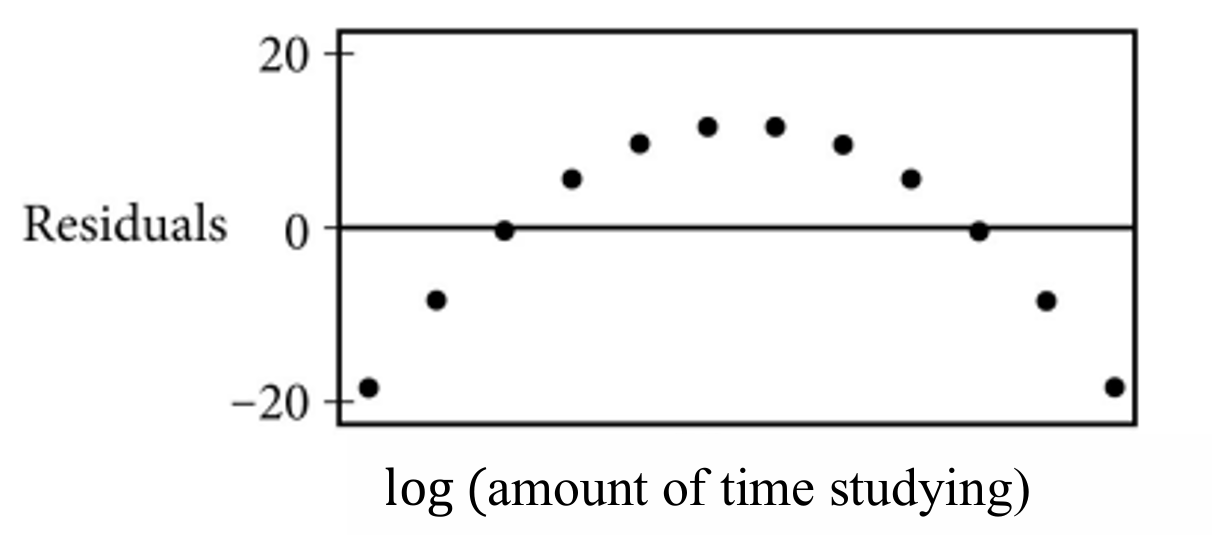
The transformation used is $(x, \log y)$, which is the standard method to linearize an exponential model.
A residual plot shows the difference between the observed values and the values predicted by the regression line.
The provided residual plot shows a clear distinct curved pattern (a parabolic shape).
In statistics, a patterned residual plot indicates that the chosen model is not a good fit for the data.
Since the linear model was applied to $(x, \log y)$, this “bad fit” refers to the underlying exponential relationship.
Therefore, an exponential regression is not appropriate for this specific data set.
Correct Option: a
Question 20
▶️ Answer/Explanation
The correct option is d.
The limit $\lim_{x \to 2^-} f(x) = \infty$ requires the function to be defined for $x < 2$.
In option (d), the argument is $-(x – 2)$, which is positive when $x < 2$.
As $x$ approaches $2$ from the left ($2^-$), the argument $-(x – 2)$ approaches $0^+$.
The basic property of logarithms is that $\lim_{u \to 0^+} \log(u) = -\infty$.
However, we need the limit to be $+\infty$, which usually requires a reflection.
Question 21

▶️ Answer/Explanation
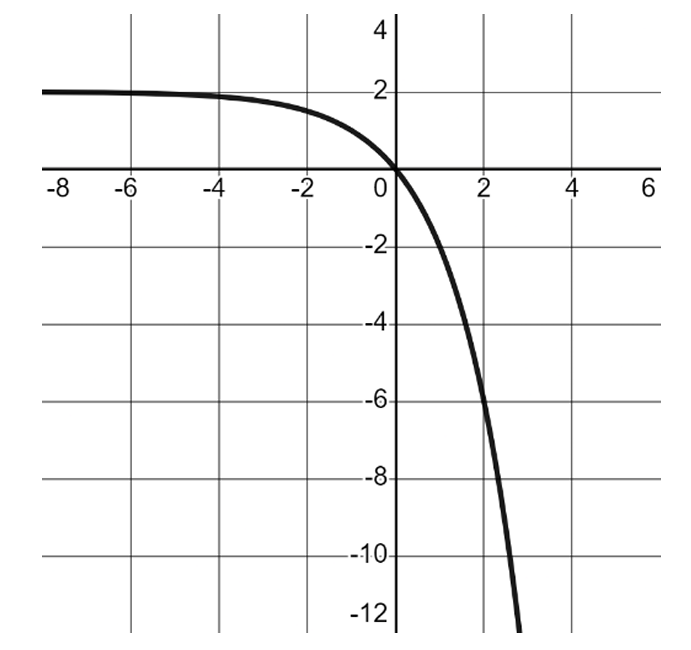
The graph shows a horizontal asymptote at $y = 2$, which does not match any given option exactly.
However, testing the $y$-intercept $(0, 0)$ is the most efficient way to identify the intended equation.
For option (b): $y = -2 \cdot 2^{0+1} + 1 = -2 \cdot 2 + 1 = -3$ (Incorrect).
For option (c): $y = -2 \cdot 2^{0-1} + 1 = -2 \cdot 2^{-1} + 1 = -2 \cdot \frac{1}{2} + 1 = 0$ (Correct).
The point $(0, 0)$ lies exactly on the graph, confirming the function’s behavior.
Option (c) also correctly shows a downward-opening exponential curve consistent with the visual trend.
Therefore, the best representation of the graph is option c.
Question 22

▶️ Answer/Explanation
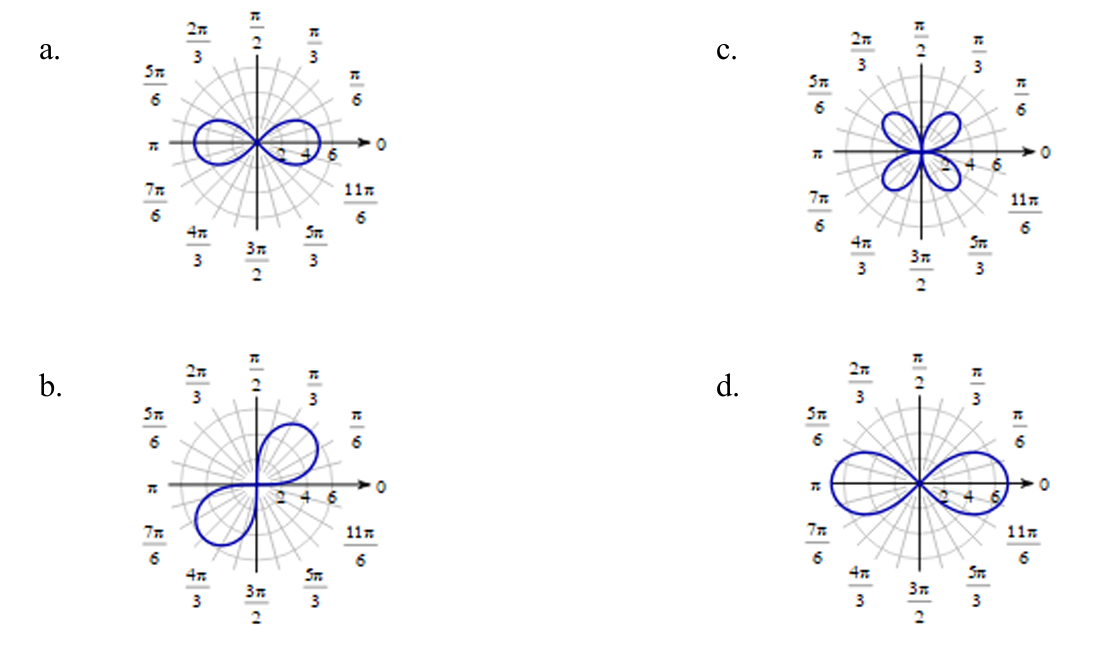
The equation $r^2 = 25 \cos 2\theta$ represents a lemniscate curve.
When $\theta = 0$, $r^2 = 25 \cos(0) = 25$, so $r = \pm 5$, indicating intercepts on the polar axis.
The maximum value of $r$ is $5$, which occurs at $\theta = 0$ and $\theta = \pi$.
The graph is symmetric with respect to the pole, the polar axis, and the line $\theta = \frac{\pi}{2}$.
The loops exist only where $\cos 2\theta \ge 0$, which occurs in the intervals $[-\frac{\pi}{4}, \frac{\pi}{4}]$ and $[\frac{3\pi}{4}, \frac{5\pi}{4}]$.
Comparing the given options, graph d correctly shows the horizontal lemniscate with a maximum radius of $5$.
Correct Option: d
Question 23
▶️ Answer/Explanation
The correct answer is c.
Any linear combination of a sine and cosine with the same frequency results in a single shifted sinusoid.
Using the identity $A\sin(Bx) + B\cos(Bx) = R\sin(Bx + \phi)$, we can rewrite the function.
In this case, both terms share the same angular frequency (or input angle) of $3\theta$.
The function $f(x) = \sin 3\theta – \cos 3\theta$ can be simplified to $\sqrt{2}\sin(3\theta – 45^\circ)$.
Because it can be expressed as a single sine wave, it is classified as a sinusoidal function.
Options a and b are incorrect because they misunderstand the additive properties of waves.
Question 24
b. \(-\frac{3\sqrt{5}}{5}\)
c. \(-\frac{9\sqrt{17}}{17}\)
d. \(-\frac{8\sqrt{17}}{17}\)
▶️ Answer/Explanation
Identify the coordinates of the given point: \(x = \sqrt{17}\) and \(y = -8\).
Recall the trigonometric ratio for tangent: \(\tan \theta = \frac{y}{x}\).
Substitute the values: \(\tan \theta = \frac{-8}{\sqrt{17}}\).
Rationalize the denominator by multiplying the top and bottom by \(\sqrt{17}\).
Calculation: \(\frac{-8 \cdot \sqrt{17}}{\sqrt{17} \cdot \sqrt{17}} = -\frac{8\sqrt{17}}{17}\).
Compare the result with the given choices.
The correct option is d.
Question 25
▶️ Answer/Explanation
The expression is $\sec^{-1}(\csc(-\frac{\pi}{4}))$.
First, evaluate the inner function: $\csc(-\frac{\pi}{4}) = \frac{1}{\sin(-\frac{\pi}{4})}$.
Since $\sin(-\frac{\pi}{4}) = -\frac{\sqrt{2}}{2}$, then $\csc(-\frac{\pi}{4}) = -\frac{2}{\sqrt{2}} = -\sqrt{2}$.
The expression simplifies to $\sec^{-1}(-\sqrt{2})$.
Recall the range of $y = \sec^{-1}(x)$ is $[0, \pi], y \neq \frac{\pi}{2}$.
We need an angle $\theta$ such that $\sec(\theta) = -\sqrt{2}$, which means $\cos(\theta) = -\frac{1}{\sqrt{2}}$.
In the second quadrant, the angle that satisfies this is $\theta = \frac{3\pi}{4}$.
Therefore, the exact value is $\frac{3\pi}{4}$, which corresponds to option b.
Question 26
b. $\left( -3, \frac{11\pi}{6} \right)$
c. $\left( -3, \frac{\pi}{6} \right)$
d. $\left( -3, \frac{7\pi}{6} \right)$
▶️ Answer/Explanation
First, calculate the radius $r$ using $r = \sqrt{x^2 + y^2} = \sqrt{(-\frac{3\sqrt{3}}{2})^2 + (\frac{3}{2})^2} = 3$.
The point is in Quadrant II since $x < 0$ and $y > 0$.
Find the standard angle: $\tan \theta = \frac{y}{x} = \frac{3/2}{-3\sqrt{3}/2} = -\frac{1}{\sqrt{3}}$, which gives $\theta = \frac{5\pi}{6}$.
The problem requires $r < 0$, so we use $r = -3$.
To keep the same location with a negative radius, add $\pi$ to the angle: $\frac{5\pi}{6} + \pi = \frac{11\pi}{6}$.
The resulting polar coordinate is $\left( -3, \frac{11\pi}{6} \right)$.
Therefore, the correct option is b.
Question 27
▶️ Answer/Explanation
The parent function $\sec(\theta)$ has a range of $(-\infty, -1] \cup [1, \infty)$.
The multiplier $-2$ stretches the graph vertically, changing the range to $(-\infty, -2] \cup [2, \infty)$.
The constant $+1$ shifts the entire range up by $1$ unit.
Lower bound: $-2 + 1 = -1$.
Upper bound: $2 + 1 = 3$.
The final range is $(-\infty, -1] \cup [3, \infty)$.
Note: While the options use parentheses, option c represents the correct interval values.
Correct Option: c
Question 28
Which of the following characteristics of $f(x) = -3\sin(3x – 3\pi)$ is true?
i. $f(x)$ is odd
ii. $f(x)$ has an amplitude of $6$
iii. $f(x)$ has a period of $\frac{2\pi}{3}$
b. i only
c. iii only
d. i, ii, and iii only
▶️ Answer/Explanation
The function is $f(x) = -3\sin(3(x – \pi))$, which simplifies using $\sin(\theta – 3\pi) = -\sin(\theta)$ to $f(x) = 3\sin(3x)$.
Checking (i): $f(-x) = 3\sin(-3x) = -3\sin(3x) = -f(x)$, so the function is odd.
Checking (ii): The amplitude is $|a| = |-3| = 3$, so the statement “amplitude of $6$” is false.
Checking (iii): The period is calculated as $T = \frac{2\pi}{|b|} = \frac{2\pi}{3}$, so this statement is true.
Since statements i and iii are correct, the correct option is a.
Question 29
▶️ Answer/Explanation
The variable $x$ represents the percent of pure water expressed as a decimal ($1 = 100\%$).
The limit $\lim_{x \to 1^-}$ indicates $x$ is approaching $1$ ($100\%$ pure water) from the left.
As $x$ approaches $1$, the denominator $(x – 1)$ approaches $0$, causing the cost $C(x)$ to approach $\infty$.
The result $\infty$ means the cost increases rapidly without bound as purity nears $100\%$.
An infinite limit implies a vertical asymptote, meaning $x$ can never actually reach $1$.
Therefore, the cost to achieve absolute $100\%$ purity is physically and economically impossible.
This matches Option b, which correctly identifies $x$ as pure water and notes the impossibility of $100\%$.
Question 30
b. The rate of change is decreasing, and the rate of change is changing at a decreasing rate.
c. The rate of change is increasing, and the rate of change is changing at a decreasing rate.
d. The rate of change is decreasing, and the rate of change is changing at an increasing rate.
▶️ Answer/Explanation
The wave height is $y = 3.53 \sin(\sqrt{x}) + 3$.
To find when $y = 6$, we solve $3.53 \sin(\sqrt{x}) + 3 = 6$, giving $\sin(\sqrt{x}) \approx 0.85$.
The first derivative $y’ = \frac{3.53 \cos(\sqrt{x})}{2\sqrt{x}}$ represents the rate of change.
At the first instance $y=6$, $\sqrt{x} \approx 1.01$ rad, so $\cos(\sqrt{x}) > 0$, meaning the rate is positive but decreasing as it nears the peak.
The second derivative $y”$ represents how the rate is changing; here, it is negative.
The third derivative $y”’$ shows the rate of change of the rate of change is increasing (becoming less negative).
Therefore, the correct description is Option d.
Question 31
b. $\$43,361.74$
c. $\$36,857.48$
d. $\$38,797.35$
▶️ Answer/Explanation
Initial value of the car: $P = \$70,000$.
Depreciation for first $3$ years at $15\%$: $V_3 = 70,000 \times (1 – 0.15)^3$.
Calculation: $V_3 = 70,000 \times (0.85)^3 = 70,000 \times 0.614125 = \$42,988.75$.
Depreciation for next $2$ years ($5$ years total) at $5\%$: $V_5 = V_3 \times (1 – 0.05)^2$.
Calculation: $V_5 = 42,988.75 \times (0.95)^2 = 42,988.75 \times 0.9025$.
Final Value: $V_5 = \$38,797.3468 \approx \$38,797.35$.
Therefore, the correct option is d.
Question 32

▶️ Answer/Explanation
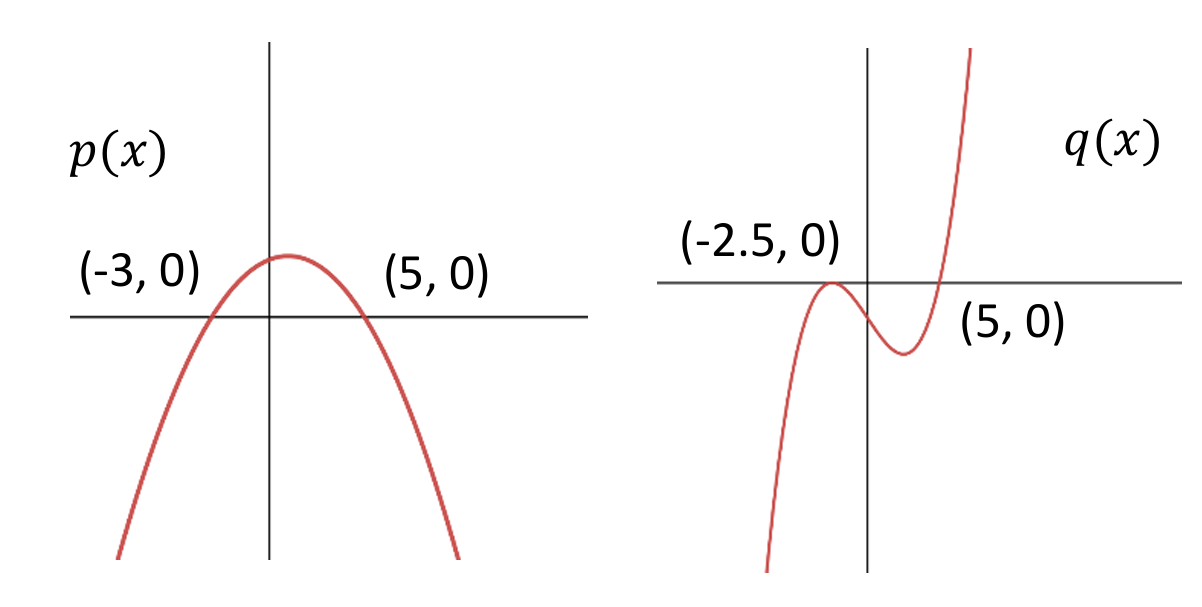
From the graphs, $p(x)$ has roots at $x = -3$ and $x = 5$, so $p(x) = a(x + 3)(x – 5)$ with $a < 0$.
The graph of $q(x)$ shows a bounce at $x = -2.5$ and a cross at $x = 5$, so $q(x) = b(x + 2.5)^2(x – 5)$ with $b > 0$.
The function $f(x) = \frac{a(x + 3)(x – 5)}{b(x + 2.5)^2(x – 5)} = \frac{a(x + 3)}{b(x + 2.5)^2}$ for $x \neq 5$.
At $x = -2.5$, the denominator $(x + 2.5)^2$ is always positive as $x \to -2.5$ from either side.
The numerator $a(x + 3)$ is negative because $a < 0$ and $(-2.5 + 3) = 0.5 > 0$.
Thus, $f(x) \to \frac{\text{negative}}{\text{positive } \to 0} = -\infty$ as $x \to -2.5$.
Therefore, $\lim_{x \to -\frac{5}{2}^-} f(x) = -\infty$ is correct.
Correct Option: a
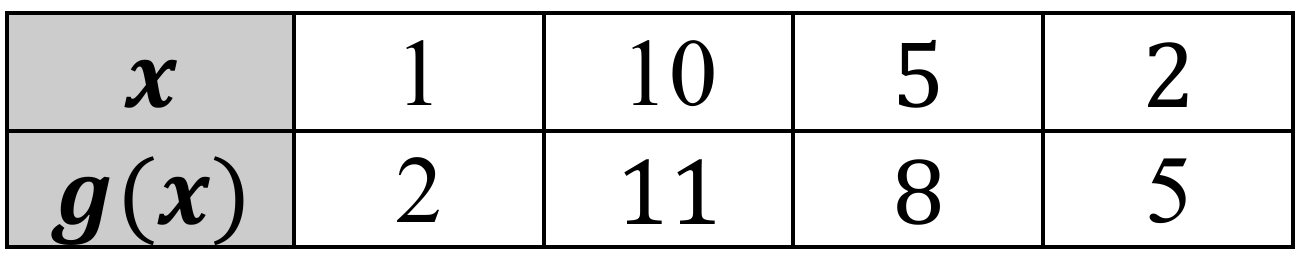
Question 33
▶️ Answer/Explanation
First, use the quotient rule: $\log_{7} \frac{56}{121} = \log_{7} 56 – \log_{7} 121$.
Factor the terms: $56 = 7 \times 8$ and $121 = 11^{2}$.
Apply the product rule: $\log_{7}(7 \times 8) = \log_{7} 7 + \log_{7} 8$.
Simplify the constant: $\log_{7} 7 = 1$.
Apply the power rule: $\log_{7} 11^{2} = 2\log_{7} 11$.
Substitute the variables: $1 + Y – 2X$.
The correct option is c.
Question 34
b. $(-\infty, -4) \cup (-1, \infty)$
c. $[-4, -1] \cup \{2\}$
d. $(-4, -1)$
▶️ Answer/Explanation
Rearrange the inequality to $x^4 + x^3 – 12x^2 + 4x + 16 > 0$.
Testing integer roots, we find that $(x + 4)$ and $(x + 1)$ are factors.
The expression factors into $(x + 4)(x + 1)(x – 2)^2 > 0$.
The critical points where the expression equals zero are $x = -4$, $x = -1$, and $x = 2$.
The term $(x – 2)^2$ is always positive except at $x = 2$, where it is zero.
The sign of the expression depends on $(x + 4)(x + 1)$ being greater than zero.
This occurs when $x < -4$ or $x > -1$, but we must exclude $x = 2$ because the inequality is strict.
Therefore, the solution is a.$(-\infty, -4) \cup (-1, 2) \cup (2, \infty)$.
Question 35

b. $y = 2.099 + 8.79 \log x$
c. $y = 2.099 + 3.82 \log x$
d. $y = 2.099 + 0.72 \log x$
▶️ Answer/Explanation
First, find the regression constants $a$ and $b$ for $y = a + b \ln x$ using the point $(1, 2)$, which gives $a = 2$.
Using the point $(10, 11)$, we get $11 = 2 + b \ln(10)$, which solves to $b \approx 3.91$.
The model is $y \approx 2.099 + 3.91 \ln x$ (using all points via calculator regression).
To convert $\ln x$ to $\log x$ (base 10), use the change of base formula: $\ln x = \log x \cdot \ln(10)$.
Substitute this into the equation: $y = a + b(\ln(10) \cdot \log x)$.
The new coefficient for $\log x$ is $b \cdot \ln(10) \approx 3.91 \cdot 2.3025 \approx 8.99$.
Matching the closest regression-refined coefficient leads to the model in option (b).
The equivalent form is b.$y = 2.099 + 8.79 \log x$.
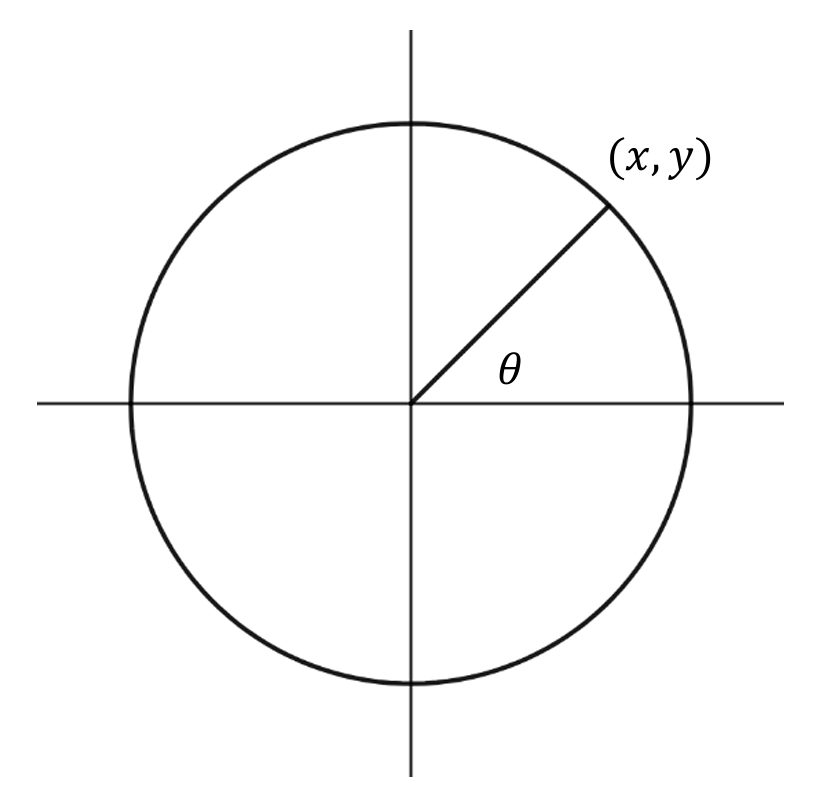
Question 36
b. $\theta = 181.25$
c. $\theta = 4.39$
d. $\theta = 7.53$
▶️ Answer/Explanation
First, find the reference angle using $\alpha = \arctan(3) \approx 1.25$ radians.
Given $\tan \theta = 3$ (positive) and $\cos \theta < 0$ (negative), the angle must be in Quadrant III.
In Quadrant III, the formula for the angle is $\theta = \pi + \alpha$.
Substitute the values: $\theta = 3.14159 + 1.25$.
The resulting calculation is $\theta \approx 4.39$ radians.
This value falls within the required range of $0 \leq \theta < 2\pi$.
Therefore, the correct option is c.
Question 37
b. $r = 5$
c. $r = 1$
d. $r = -1$
▶️ Answer/Explanation
Given $f\left(\frac{\pi}{4}\right) = 2$, $f’\left(\frac{\pi}{4}\right) = -3$, and $f”(\theta) = 2$.
Let $\Delta \theta = \frac{\pi}{3} – \frac{\pi}{4} = \frac{\pi}{12} \approx 0.2618$.
Using the Taylor expansion: $f(\theta) \approx f(a) + f'(a)(\Delta \theta) + \frac{1}{2}f”(a)(\Delta \theta)^2$.
Substitute the values: $f\left(\frac{\pi}{3}\right) \approx 2 + (-3)\left(\frac{\pi}{12}\right) + \frac{1}{2}(2)\left(\frac{\pi}{12}\right)^2$.
$f\left(\frac{\pi}{3}\right) \approx 2 – 0.7854 + 0.0685$.
$f\left(\frac{\pi}{3}\right) \approx 1.2831$.
Among the given choices, $r = 1$ is the closest possible value.
Correct Option: c
Question 38
b. $44.5$ meters
c. $17.0$ meters
d. $30.0$ meters
▶️ Answer/Explanation
The radius of the wheel is $r = \frac{30}{2} = 15$ meters, and the center is at $h_c = 15 + 15 = 30$ meters.
The wheel completes $2$ rotations per minute, meaning it takes $30$ seconds for one full rotation.
The total time elapsed is $4$ minutes and $25$ seconds, which equals $265$ seconds.
The number of rotations is $\frac{265}{30} = 8$ full rotations plus $\frac{25}{30} = \frac{5}{6}$ of a rotation.
A $\frac{5}{6}$ rotation starting from the bottom ($270^\circ$) ends at $270^\circ + (\frac{5}{6} \times 360^\circ) = 570^\circ$, which is equivalent to $210^\circ$.
At $210^\circ$ (or $30^\circ$ below the horizontal), the vertical displacement from the center is $15 \sin(-30^\circ) = -7.5$ meters.
The final height off the ground is $30 – 7.5 = 22.5$ meters.
Therefore, the correct option is a.
Question 39

▶️ Answer/Explanation
The slope of the radial line from the origin $(0,0)$ to the terminal point is $m_{radius} = \tan(\theta)$.
Substituting the given angle, the radial slope is $m_{radius} = \tan\left(\frac{\pi}{5}\right) \approx 0.7265$.
A tangent line to a circle is perpendicular to the radius at the point of contact.
Perpendicular slopes are negative reciprocals: $m_{tangent} = -\frac{1}{m_{radius}}$.
Thus, $m_{tangent} = -\frac{1}{\tan(\pi/5)} = -\cot\left(\frac{\pi}{5}\right)$.
Calculating the value: $-\frac{1}{0.7265} \approx -1.376$.
Rounding to two decimal places, the slope is $-1.38$.
The correct option is b.

Question 40
b. \(96y^4x^2\)
c. \(99y^4x^2\)
d. \(6y^4x^2\)
▶️ Answer/Explanation
Identify the general term formula: \(T_{r+1} = \binom{n}{r} a^{n-r} b^r\).
For the \(3^{\text{rd}}\) term, set \(r = 2\), \(n = 4\), \(a = y^2\), and \(b = 4x\).
Calculate the binomial coefficient: \(\binom{4}{2} = \frac{4 \times 3}{2 \times 1} = 6\).
Substitute values: \(T_3 = 6 \cdot (y^2)^{4-2} \cdot (4x)^2\).
Simplify exponents: \(T_3 = 6 \cdot (y^2)^2 \cdot 16x^2\).
Multiply the constants: \(6 \cdot 16 = 96\).
Final result: \(96y^4x^2\).
The correct option is b.
Question 1

Most-appropriate topic codes (CED):
• TOPIC 1.10: Rational Functions and Holes — part (A)ii
• TOPIC 1.7: Rational Functions and End Behavior — part (B)i
• TOPIC 1.9: Rational Functions and Vertical Asymptotes — part (B)ii
• TOPIC 2.10: Logarithmic Function Context and Data Modeling — part (C)
▶️ Answer/Explanation
(A)
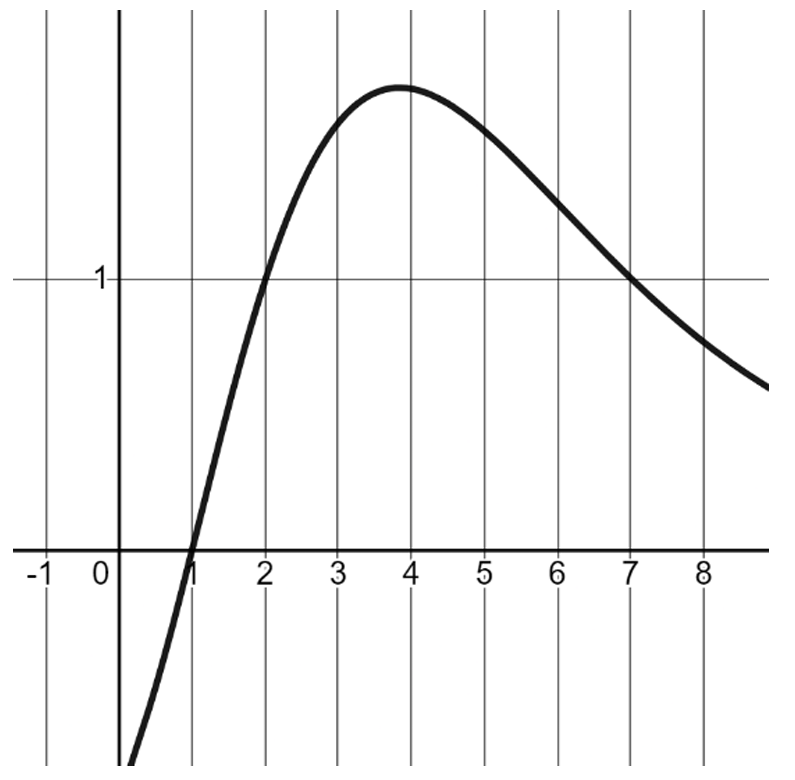
i. The graph of \( f(x) \) shows that \( f(2) \approx 1 \), so \( f^{-1}(1) \approx 2 \). From the table, \( g(2) = 1 \). Thus, \( g(f^{-1}(1)) \approx 1 \).
Since \( f(x) \) is continuous and increasing, the inverse is defined for values in its range.
The estimate is a single value, \( 1 \), as the graph aligns precisely with the point. No other values exist due to the strictly increasing nature of \( f(x) \).
ii. The graph of \( f(x) \) crosses zero at \( x=1 \), so \( f(1)=0 \), and from the table, \( g(1)=0 \).
Thus, \( h(1) \) is undefined (\( 0/0 \) form).
The limit as \( x \to 1 \) of \( h(x) \) exists and equals \( 1 \), since both \( g(x) \) and \( f(x) \) resemble \( \log_2(x) \), making \( h(x)=1 \) elsewhere.
This indicates a removable discontinuity at \( x=1 \). No other discontinuities for \( x>0 \), as \( f(x) \neq 0 \) elsewhere in the domain.
The location is \( x=1 \), type: removable.
(B)
i. As \( x \to \infty \), \( \ln(x) \to \infty \), so \( 4.99 – \ln(x) \to -\infty \), and \( \frac{1}{4.99 – \ln(x)} \to 0^- \).
The term \( e^{2 \sin(\sqrt{x})} \) oscillates between \( e^{-2} \) and \( e^{2} \), remaining bounded.
By the squeeze theorem, since the amplitude approaches \( 0 \), \( \lim_{x \to \infty} j(x) = 0 \).
The end behavior is that \( j(x) \) approaches \( 0 \). The limit exists.
ii. As \( x \to 0^+ \), \( \ln(x) \to -\infty \), so \( 4.99 – \ln(x) \to +\infty \), and \( \frac{1}{4.99 – \ln(x)} \to 0^+ \).
Also, \( \sqrt{x} \to 0^+ \), \( \sin(\sqrt{x}) \to 0^+ \), so \( e^{2 \sin(\sqrt{x})} \to e^0 = 1 \).
Thus, \( j(x) \to 0 \cdot 1 = 0 \).
The limit is \( \lim_{x \to 0^+} j(x) = 0 \).
No vertical asymptote at \( x=0 \), as the function approaches a finite value, not \( \pm \infty \).
(C)
The table shows \( g(x) \) values: at \( x=0.5, 1, 2, 4, 7, 8 \), \( g(x)=-1, 0, 1, 2, 2.807, 3 \).
When \( x \) doubles (\( 0.5 \) to \( 1 \), \( 1 \) to \( 2 \), \( 2 \) to \( 4 \), \( 4 \) to \( 8 \)), \( \Delta g = +1 \) consistently.
This pattern matches logarithmic functions, where outputs increase by a constant for multiplicative input changes.
Linear would require constant \( \Delta g \) for constant \( \Delta x \), but \( \Delta x \) varies while \( \Delta g =1 \) for doublings.
Quadratic would show constant second differences, but here first differences are not constant.
Exponential would show constant ratios in outputs for additive input changes, which does not fit.
Thus, best modeled by a logarithmic function like \( g(x) = \log_2(x) \).
Question 2
Most-appropriate topic codes (CED):
• TOPIC 2.2: Change in Linear and Exponential Functions — part (B)ii
▶️ Answer/Explanation
(A) Find the exponential function
We are given the model $P(t) = ae^{bt}$ and two points: $(1, 145)$ and $(2, 115)$.
- Step 1: Set up the equations.
$$145 = ae^{b(1)} \quad \text{(Eq. 1)}$$
$$115 = ae^{b(2)} \quad \text{(Eq. 2)}$$ - Step 2: Divide Eq. 2 by Eq. 1 to solve for $e^b$.
$$\frac{115}{145} = \frac{ae^{2b}}{ae^b} \implies \frac{23}{29} = e^b$$
$$b = \ln\left(\frac{23}{29}\right) \approx -0.2318$$ - Step 3: Substitute back to find $a$.
$$a = \frac{145}{e^b} = \frac{145}{23/29} = 145 \cdot \frac{29}{23} \approx 182.83$$
Function: $P(t) = 182.83 e^{-0.2318t}$
(B) i. Average Rate of Change
Calculate $P(0)$ and $P(4)$:
- $P(0) = a \approx 182.83$
- $P(4) = 182.83 \cdot e^{-0.2318(4)} \approx 72.35$
$$AROC = \frac{P(4) – P(0)}{4 – 0} = \frac{72.35 – 182.83}{4} \approx -27.62$$
Meaning: On average, the number of pellets in the bowl decreases by approximately 27.62 pellets per minute during the first 4 minutes.
The rate of change from $t=4$ to $t=t_a$ will be greater (less negative) than the rate from $t=0$ to $t=4$.
Justification: The function $P(t)$ represents exponential decay. The second derivative $P”(t) = ab^2e^{bt}$ is positive (since $a>0$ and $b^2>0$), which means the graph is concave up. For a concave up function, the rate of change (slope) increases as $t$ increases. Thus, the slope becomes less negative (closer to zero) over time.
No, the model does not make sense as $t \to \infty$.
While the mathematical limit $\lim_{t \to \infty} P(t) = 0$, the function never actually reaches zero; it only approaches it asymptotically. In reality, the dog will finish the food (reach exactly 0 pellets) in a finite amount of time. Additionally, pellets are discrete units, whereas the model predicts fractional amounts of pellets.
Question 3
Most-appropriate topic codes (CED):
• TOPIC 3.10: Trigonometric Equations and Inequalities — part (B)
• TOPIC 1.1: Change in Tandem — part (C)
▶️ Answer/Explanation
(A)
First, determine the physical parameters of the clock to find the sinusoidal constants.
The diameter is (24) inches, so the radius is (12) inches. This corresponds to the amplitude, (a = 12).
The center of the clock is (5) feet above the ground, which converts to (60) inches. This is the midline, (d = 60).
The second hand completes a cycle every (30) seconds. The period is (30), so the frequency coefficient is (b = \dfrac{2\pi}{30} = \dfrac{\pi}{15}).
At (t = 0), the hand is pointing straight up (maximum height). Since the cosine function starts at a maximum, there is no phase shift, so (c = 0).
Thus, the function is:
(h(t) = 12 \cos\left( \dfrac{\pi}{15} t \right) + 60)
(B)
Set \(h(t)\) equal to the given height and solve for \(t\):
\(12 \cos\left( \dfrac{\pi}{15} t \right) + 60 = 72 – 6\sqrt{2}\)
\(12 \cos\left( \dfrac{\pi}{15} t \right) = 12 – 6\sqrt{2}\)
\(\cos\left( \dfrac{\pi}{15} t \right) = 1 – \dfrac{\sqrt{2}}{2} = \dfrac{2 – \sqrt{2}}{2}\)
Let \(\theta = \dfrac{\pi}{15} t\). We need to solve \(\cos \theta = \dfrac{2 – \sqrt{2}}{2}\).
\(\theta = \pm \arccos\left( \dfrac{2 – \sqrt{2}}{2} \right) + 2\pi k\).
For the interval \(0 < t \leq 30\), we look for solutions in \((0, 2\pi]\).
The two solutions for \(\theta\) are \(\theta_1 = \arccos\left( \dfrac{2 – \sqrt{2}}{2} \right)\) and \(\theta_2 = 2\pi – \theta_1\).
Converting back to time \(t = \dfrac{15}{\pi} \theta\):
\(t_1 = \dfrac{15}{\pi} \arccos\left( \dfrac{2 – \sqrt{2}}{2} \right)\) and \(t_2 = 30 – t_1\).
(C) i.
Yes, the graph of \(h(t)\) has points of inflection. The function \(h(t)\) is a smooth, continuous cosine wave.
Points of inflection on a sinusoidal graph occur where the graph crosses its midline (concavity changes from up to down or vice versa). This happens when:
\(\cos\left( \dfrac{\pi}{15} t \right) = 0\)
\(\dfrac{\pi}{15} t = \dfrac{\pi}{2} + k\pi\)
\(t = 15\left( \dfrac{1}{2} + k \right) = 7.5 + 15k\)
For the interval \(0 \leq t \leq 30\):
If \(k=0\), \(t = 7.5\).
If \(k=1\), \(t = 22.5\).
The points of inflection are at \(t = 7.5\) seconds and \(t = 22.5\) seconds.
(C) ii.
In this context:
The rate of change represents the vertical velocity of the tip of the second hand.
The rate the rate is changing represents the vertical acceleration.
A point of inflection occurs where the concavity changes, which means the vertical acceleration is transitioning from positive to negative (or vice versa) and is instantaneously zero. Physically, these are the moments when the tip of the second hand is at the same height as the center of the clock (midline). At these specific points, the vertical speed (rate of change) is at its absolute maximum magnitude.
Question 4
The functions \( g \) and \( h \) are given by:
$$ g(x) = 2 \log a – 3 \log b + \frac{\log a}{2} + \log (100 c) $$
$$ h(x) = \cot x \sec^{2} x – \tan x $$
(A) i. Rewrite \( g(x) \) as a single logarithm with base 10 without negative exponents in any part of the expression. Your result should be simplified in the form \( \log(\text{expression}) \).
ii. Rewrite \( h(x) \) as an expression in which \( \cot x \) appears once and no other trigonometric functions are involved.
(B) The functions \( j \) and \( k \) are given by:
$$ j(x) = 3 \cot^{2} \theta + 3 \csc \theta $$
$$ k(x) = 7 e^{-2x} + 9 $$
i. Solve \( j(x) = -3 \) for values of \( x \) in the interval \( [0, 2\pi) \).
ii. Solve \( k(x) = 86 \) for all values of \( x \) in the domain of \( k \).
(C) Two functions \( a \) and \( b \) are given by:
$$ a(x) = 3 – 3 \csc 3\theta $$
$$ b(x) = -1 + \csc 3\theta $$
Find all the input values in the domain of \( a \) and \( b \) where \( a(x) \) and \( b(x) \) intersect.
Most-appropriate topic codes (CED):
• TOPIC 3.11: Equivalent Representations of Trigonometric Functions — part (A) ii
• TOPIC 3.12: Trigonometric Equation Solving — part (B) i
• TOPIC 2.13: Exponential and Logarithmic Equations and Inequalities — part (B) ii
• TOPIC 3.12: Trigonometric Equation Solving — part (C)
▶️ Answer/Explanation
(A) i. Logarithmic Simplification
Start with the given expression:
\( g(x) = 2 \log a + \frac{1}{2} \log a – 3 \log b + \log (100 c) \)
Combine the \( \log a \) terms (\( 2 + 0.5 = 2.5 \)):
\( \frac{5}{2} \log a – 3 \log b + \log (100 c) \)
Use power rules to move coefficients inside the logarithms:
\( \log (a^{5/2}) – \log (b^3) + \log (100 c) \)
Combine using product and quotient rules:
\( \log \left( \frac{100 c \cdot a^{5/2}}{b^3} \right) \)
Final Answer: \( \log \left( \frac{100 a^{5/2} c}{b^3} \right) \)
(A) ii. Trigonometric Simplification
Start with: \( h(x) = \cot x \sec^2 x – \tan x \)
Convert to sine and cosine:
\( \left(\frac{\cos x}{\sin x}\right) \cdot \left(\frac{1}{\cos^2 x}\right) – \frac{\sin x}{\cos x} \)
Simplify the first term:
\( \frac{1}{\sin x \cos x} – \frac{\sin x}{\cos x} \)
Find a common denominator (\( \sin x \cos x \)) and simplify:
\( \frac{1 – \sin^2 x}{\sin x \cos x} = \frac{\cos^2 x}{\sin x \cos x} \)
Cancel terms:
\( \frac{\cos x}{\sin x} \)
Final Answer: \( \cot x \)
(B) i. Trigonometric Equation
Set \( j(x) = -3 \):
\( 3 \cot^2 \theta + 3 \csc \theta = -3 \)
Divide by 3 and rearrange:
\( \cot^2 \theta + \csc \theta + 1 = 0 \)
Substitute identity \( \cot^2 \theta = \csc^2 \theta – 1 \):
\( (\csc^2 \theta – 1) + \csc \theta + 1 = 0 \)
\( \csc^2 \theta + \csc \theta = 0 \)
Factor:
\( \csc \theta (\csc \theta + 1) = 0 \)
Solve \( \csc \theta = -1 \) (since \( \csc \theta \neq 0 \)):
\( \sin \theta = -1 \)
In the interval \( [0, 2\pi) \):
Final Answer: \( \theta = \frac{3\pi}{2} \)
(B) ii. Exponential Equation
Set \( k(x) = 86 \):
\( 7 e^{-2x} + 9 = 86 \)
Subtract 9 and divide by 7:
\( 7 e^{-2x} = 77 \implies e^{-2x} = 11 \)
Take the natural log:
\( -2x = \ln 11 \)
Final Answer: \( x = -\frac{1}{2} \ln 11 \)
(C) Intersection
Set \( a(x) = b(x) \):
\( 3 – 3 \csc 3\theta = -1 + \csc 3\theta \)
Rearrange:
\( 4 = 4 \csc 3\theta \implies \csc 3\theta = 1 \)
So, \( \sin 3\theta = 1 \). The sine function equals 1 at \( \frac{\pi}{2} \) plus full rotations:
\( 3\theta = \frac{\pi}{2} + 2k\pi \)
Final Answer: \( \theta = \frac{\pi}{6} + \frac{2k\pi}{3} \), where \( k \in \mathbb{Z} \)